
Cisco Catalyst Center 3.1.x Upgrade
Upgrade to Catalyst Center 3.1.x
Catalyst Center 3.1.5 and later use an architecture that provides
- improved network automation and monitoring
- optimized resource utilization, and
- increased security.
To upgrade Catalyst Center, you'll need to:
- Ensure that the requirements and tasks described in Upgrade requirements have been completed.
- Complete the appropriate upgrade scenario.
Refer to this article for a description of how to complete these steps.
Upgrade requirements
Before you start the upgrade, ensure that the requirements and tasks described in these sections have been completed:
- General
- Supported Catalyst Center versions
- Back up and restore
- Cisco IMC
- Hardware
- Required upgrade wizard information
Also review the information provided in these sections:
General
- Confirm that no critical operations (such as backups or upgrades) are currently running.
- Ensure that NTP is configured on your system.
- For three-node HA clusters, confirm that each cluster node is healthy and HA is active.
- Install the Catalyst Center 3.1.x upgrade package.
Supported Catalyst Center versions
Ensure that one of these Catalyst Center versions is installed on the appliance you'll be upgrading from:
- 2.3.7.7.70047
- 2.3.7.7-70047-CSCwn89323.SMU
- 2.3.7.9.70301
- 2.3.7.9.70301.10
- 2.3.7.10.70209
- 2.3.7.10.70209.10
- 2.3.7.11.70047
If not, upgrade to version 2.3.7.10.70209.10. Complete the steps described in the Cisco Catalyst Center Upgrade Guide.
Back up and restore
- Confirm that Catalyst Center backups are configured correctly for automation.
-
Configure NFS for Assurance backups, if you want to preserve historical Assurance data after the upgrade.
In the Cisco Catalyst Center Administrator Guide, complete the steps described in the topic relevant to your deployment:
- Example of NFS server configuration—Ubuntu
- Example of NFS server configuration—Red Hat
 Note
Note- For Catalyst Center 3.1.6-75524.200 SMU and later, you can use either NFS or remote sync (rsync)/SSH for automation data backups.
- Catalyst Center also supports Windows-based NFS servers, as well an NFS provided by a storage vendor (such as NetApp or Isilon).
Cisco IMC
- Verify the Cisco IMC settings for your deployment.
- To determine your appliance's part number, view the Product Name field in Cisco IMC's Summary page.
-
Although Cisco IMC firmware versions 4.1 and later are supported, we recommend that you install these versions:
- Cisco IMC Version 4.3(2.260020) for appliance model DN2-HW-APL, DN2-HW-APL-L, DN2-HW-APL-XL
- Cisco IMC Version 4.3(6.260054) for appliance model DN3-HW-APL, DN3-HW-APL-L, DN3-HW-APL-XL
- Confirm that the Cisco IMC interface is properly configured for your appliances and is accessible.
- Review and resolve any critical hardware alerts detected by Cisco IMC.
Hardware
-
Ensure you are upgrading a second or third-generation Catalyst Center appliance.
Note
The Catalyst Center 3.1.x upgrade does not support first-generation Catalyst Center appliances. In the Cisco Catalyst Center Data Migration article, see the migration procedure for Scenario 14.
Required upgrade wizard information
Have this information ready before starting the Catalyst Center 3.1.x upgrade wizard:
- Catalyst Center admin superuser login credentials, as only users configured with the SUPER-ADMIN-ROLE can perform the upgrade
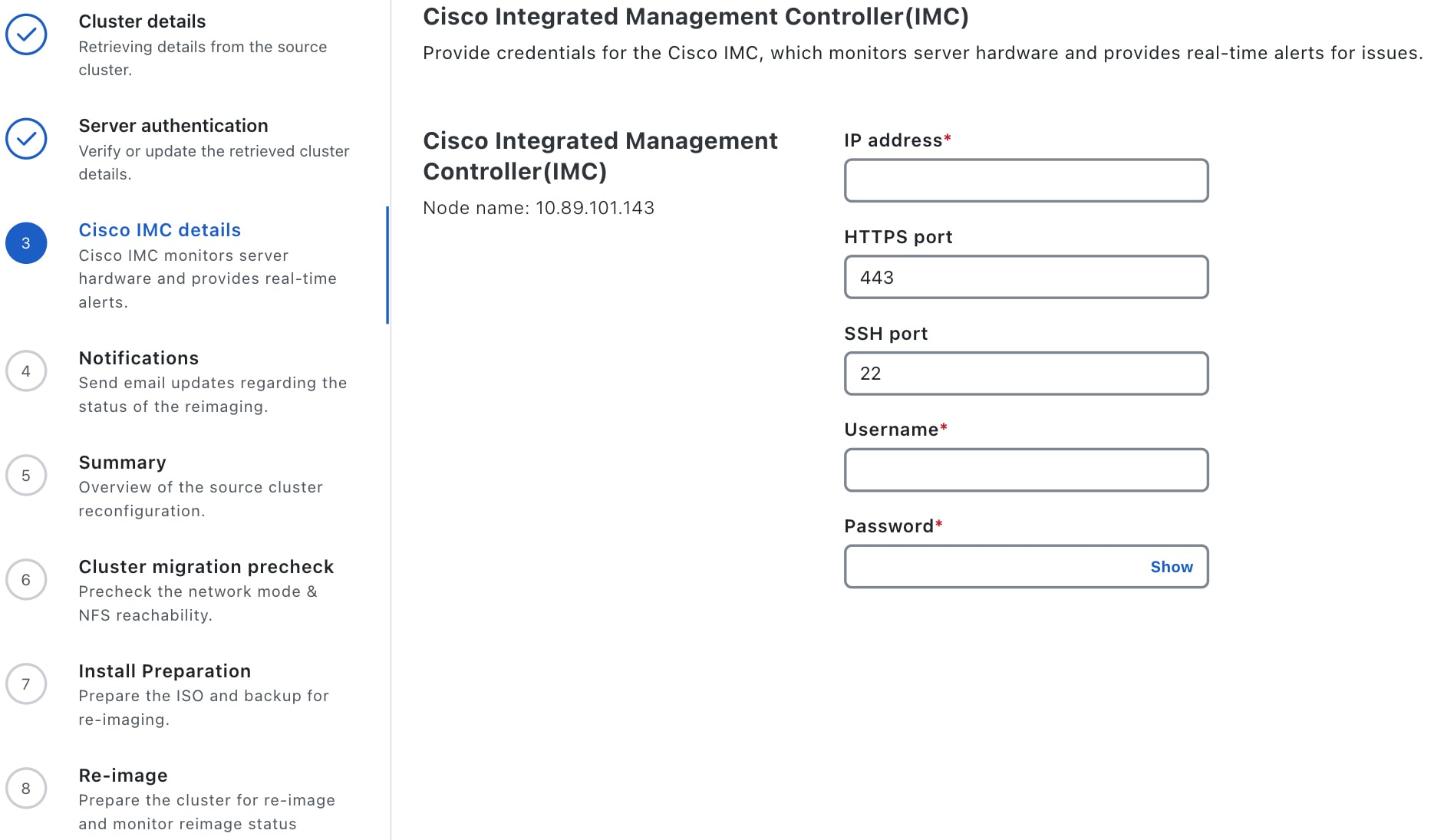
- Cisco IMC login credentials
Upgrade considerations
- Do not create backups or perform other maintenance tasks after starting the upgrade.
- CLI-based tuning changes, such as disabling older ciphers and TLS versions, are not captured or carried forward.
- Complete the Catalyst Center upgrade in one sitting to prevent losing configuration changes that are not captured in a backup.
Unsupported Catalyst Center appliances and features
- DN1 (first-generation) Catalyst Center appliances
- IPv6
- Clusters enabled with intercluster (ICL) IPsec
Install the Catalyst Center 3.1.x upgrade package
To upgrade to the new Catalyst Center architecture, first install the Catalyst Center 3.1.x upgrade package.
Step 1 | From the main menu, choose to open the Software Management page. |
Step 2 | Confirm that the Release Upgrade Wizard-X is available heading is displayed at the top of page. |
Step 3 | Click Download now. |
Step 4 | After the download prechecks complete successfully, click Download. You can click the More details link to open a slide-in pane that indicates the progress of the applications that are being downloaded. |
Step 5 | Click Install now. |
Step 6 | After the installation prechecks complete successfully, click Install. You can click the More details link to open a slide-in pane that indicates the progress of the applications that are being installed. After installation of the Catalyst Center 3.1.x upgrade package finishes, the upgrade wizard should start automatically. |
Verify Cisco IMC settings
Step 1 | Log in to Cisco IMC. The Summary page opens. | ||||||||||||||||||||||||
Step 2 | Confirm that the part number for your Catalyst Center appliance (listed in the Product Name field) matches one of part numbers listed in the Prerequisites topic's Hardware table. | ||||||||||||||||||||||||
Step 3 | Confirm that a supported Cisco IMC version is installed:
| ||||||||||||||||||||||||
Step 4 | Confirm that your appliance's virtual drives are named correctly:
| ||||||||||||||||||||||||
Upgrade scenarios
Review and complete the upgrade scenario that applies to your deployment.
Scenario 1: Upgrade a single or three-node Catalyst Center cluster
In this scenario, you are upgrading a single or three-node deployment to Catalyst Center 3.1.x. To upgrade to this new architecture and migrate your existing network data, complete this procedure.
NoteThe upgrade procedure is essentially the same for both single-node and three-node Catalyst Center clusters. The differences are minor and described where necessary.
Before you begin
- Review the upgrade requirements and confirm that they have been met.
- Install the Catalyst Center 3.1.x upgrade package.
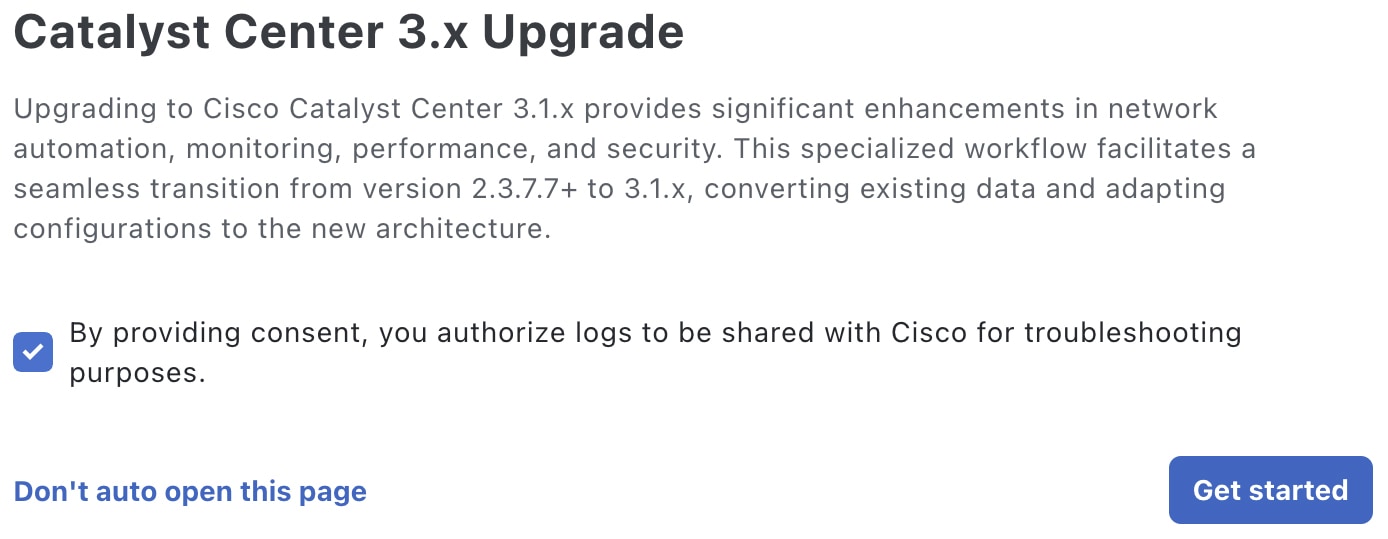
Step 1 | The Catalyst Center 3.1.x Upgrade window should open automatically after you install the upgrade package.
| ||||||||||||||
Step 2 | You are prompted to ensure that these requirements are in place:
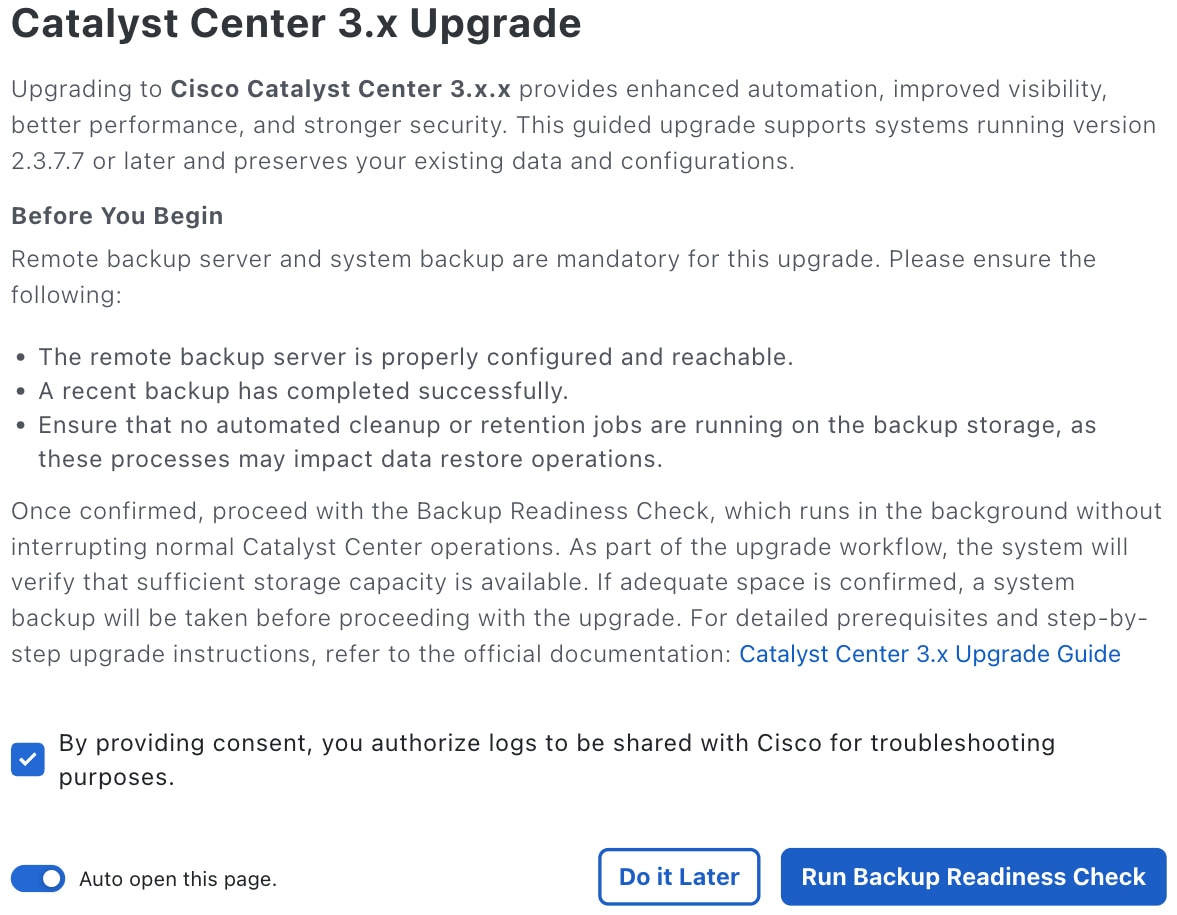 Select Run Backup Readiness Check. During the upgrade, a new backup is created automatically. The backup readiness check determines whether the local disk has sufficient space to create a full backup (the All Data option, which includes Automation and Assurance data) by verifying these conditions:
If all these conditions are true, you will see this: 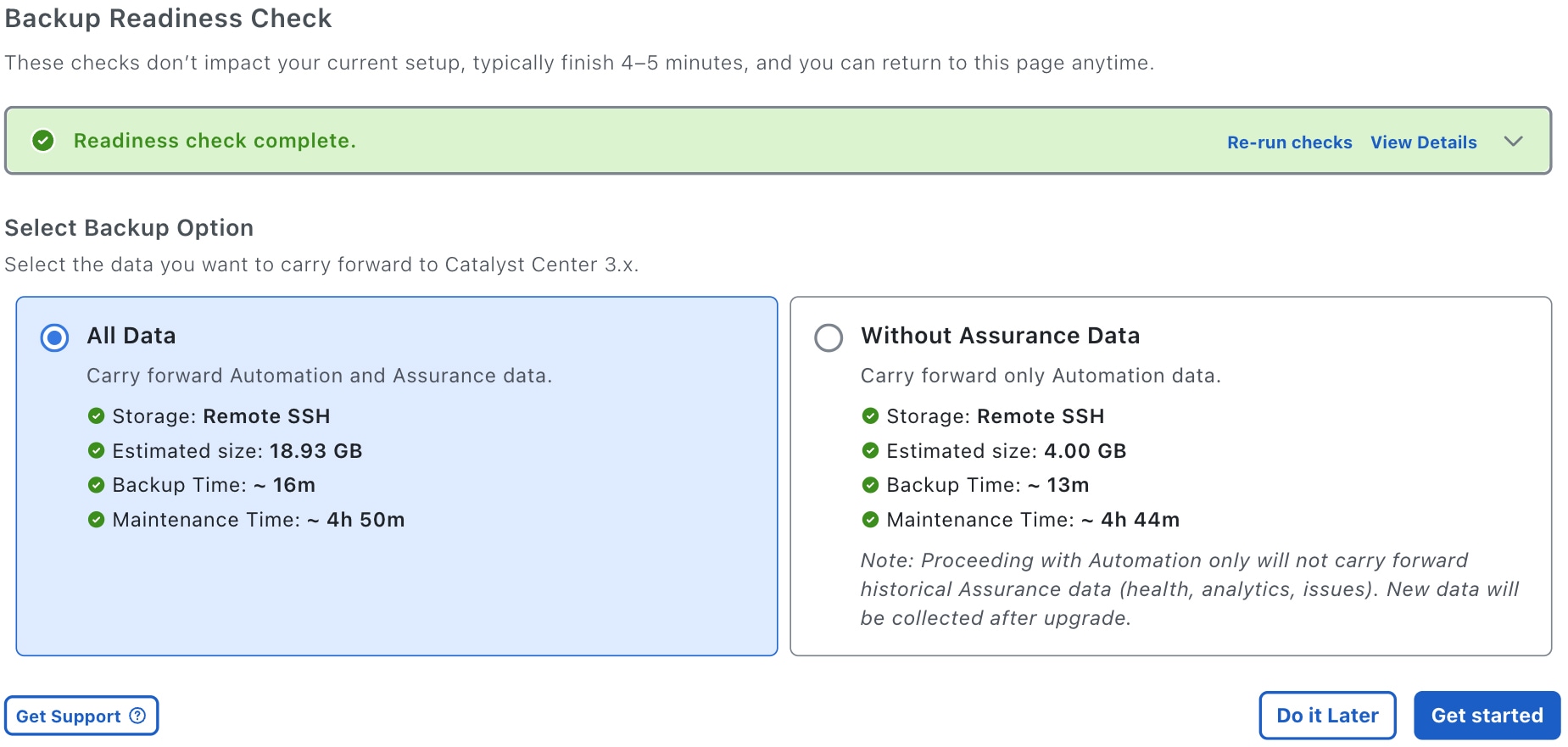 Note NoteA remote SSH server is mandatory for the upgrade, even when the backup is created on the local disk. During the upgrade, Catalyst Center archives the backup data to the remote SSH server, ensuring that an external copy is retained outside the appliance. If the local disk cannot accommodate the full backup, the backup readiness check also verifies whether the NFS server is configured and can accommodate the backup, including the appropriate permissions and performance validations. If the NFS checks pass, you will see this (note that storage is set to Remote SSH + NFS): 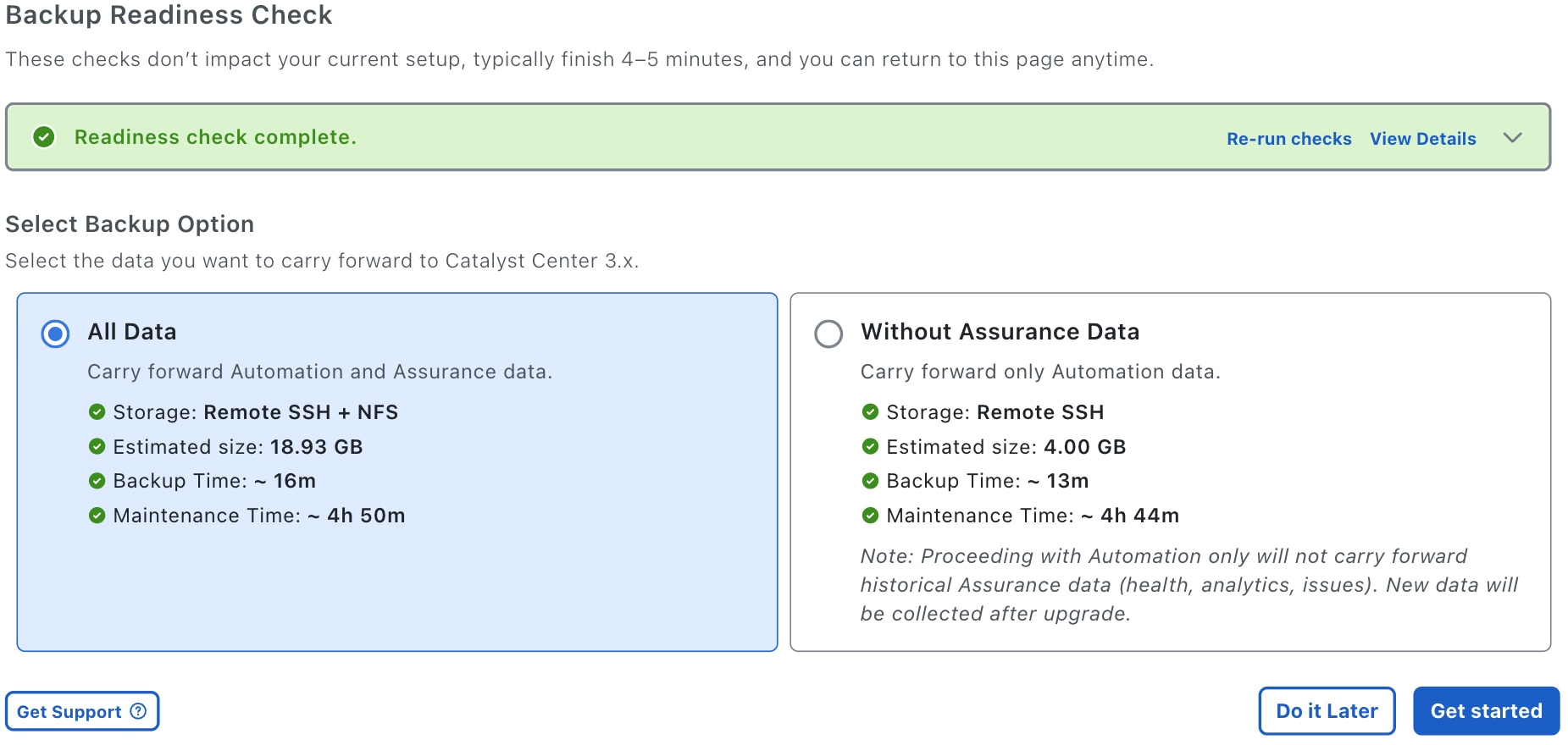 If critical NFS checks fail, you will not be able to proceed with the All Data option. Until the NFS issues are resolved, only the Without Assurance Data option is available. You will see this: 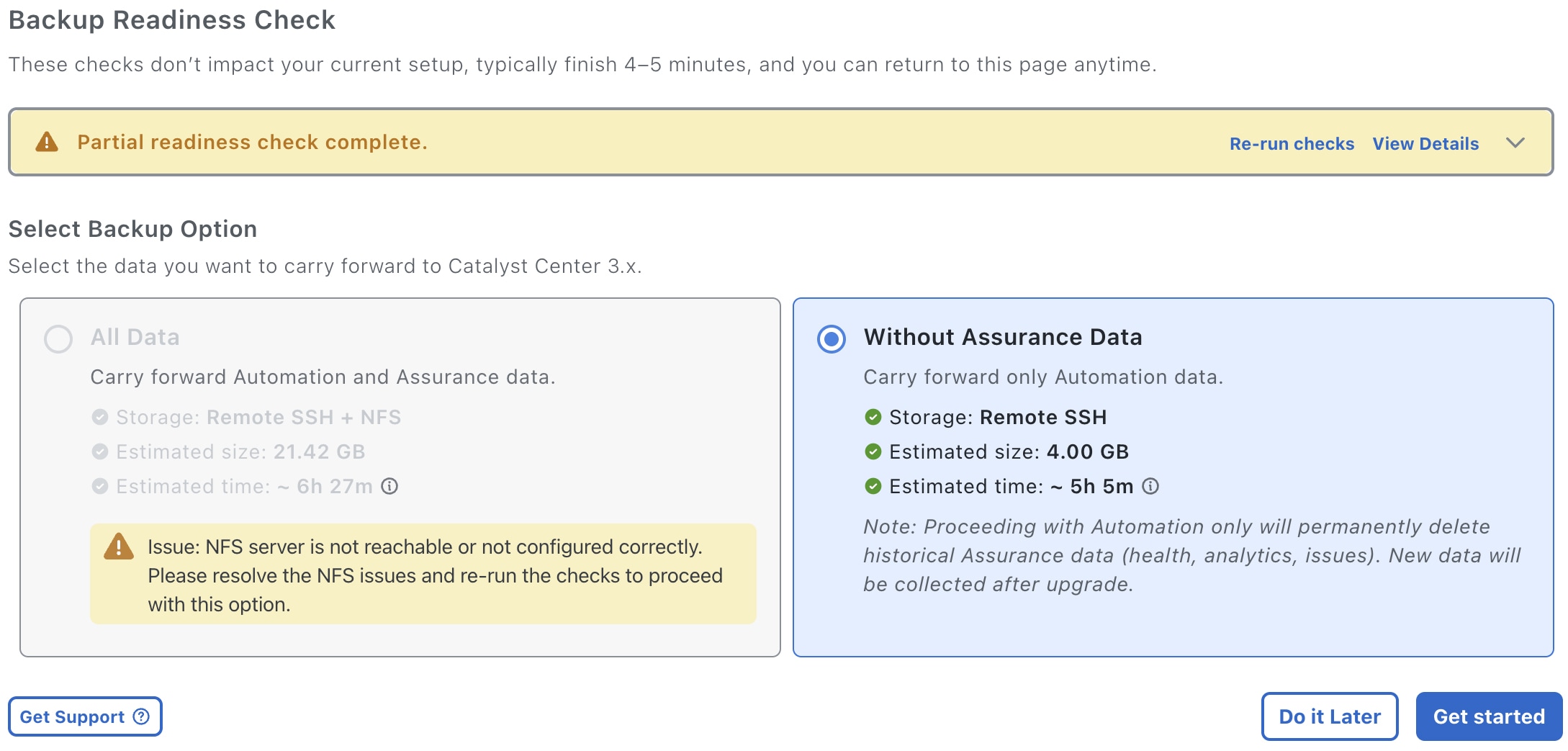 | ||||||||||||||
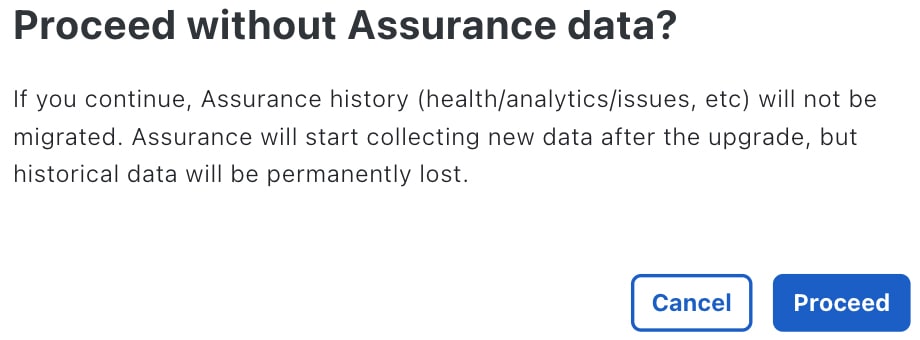
Step 3 | Select the backup option you want to use:
| ||||||||||||||
Step 4 | After the check completes, select Get started. | ||||||||||||||
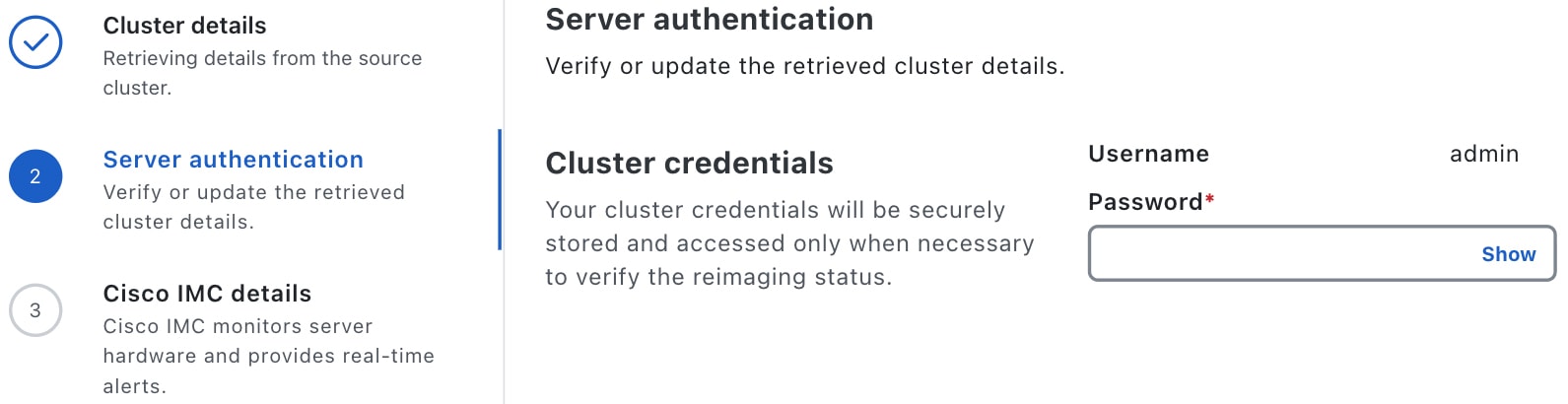
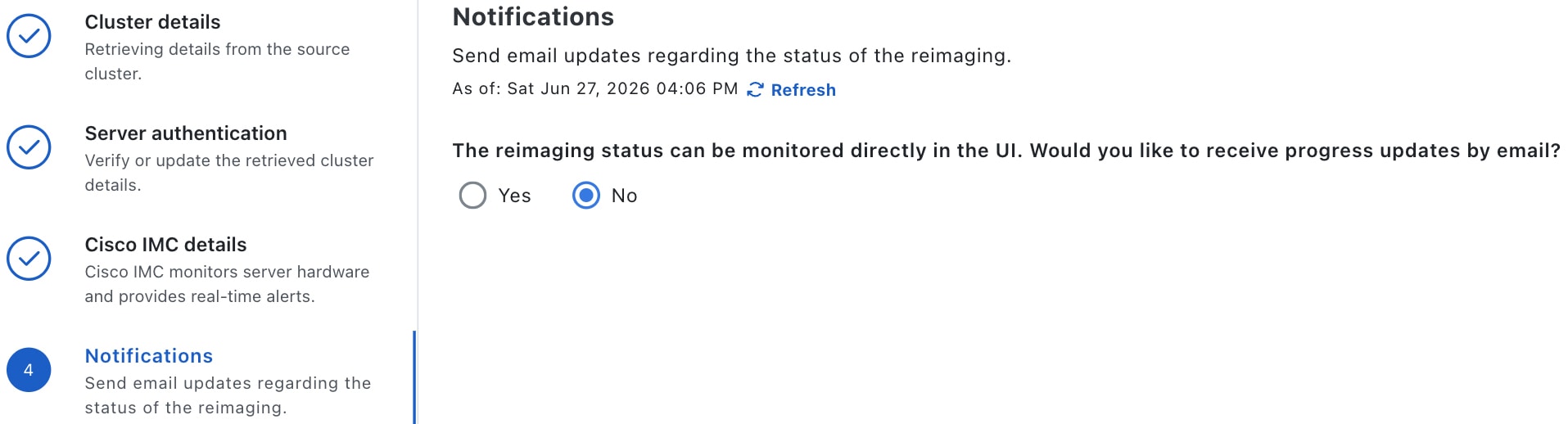
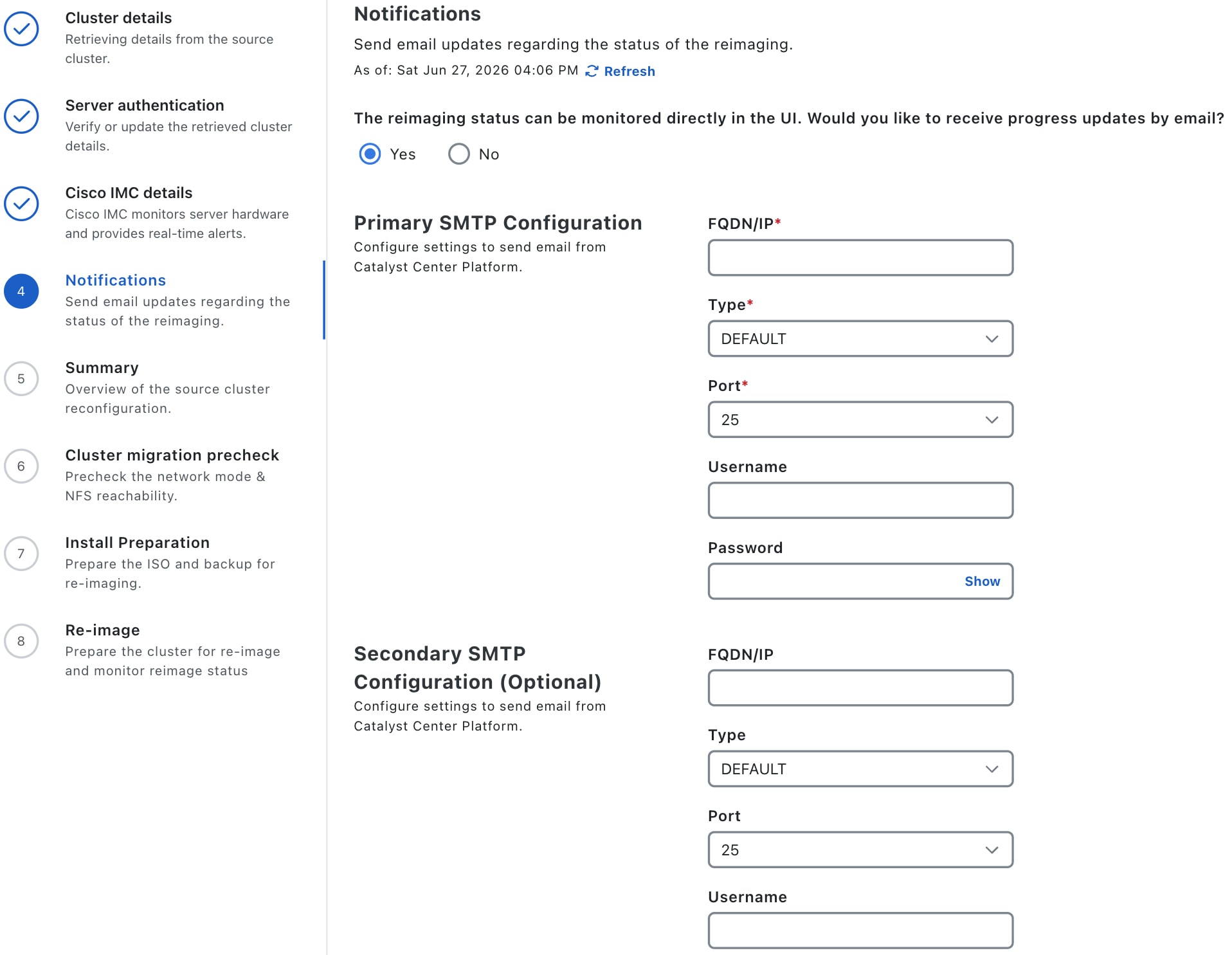
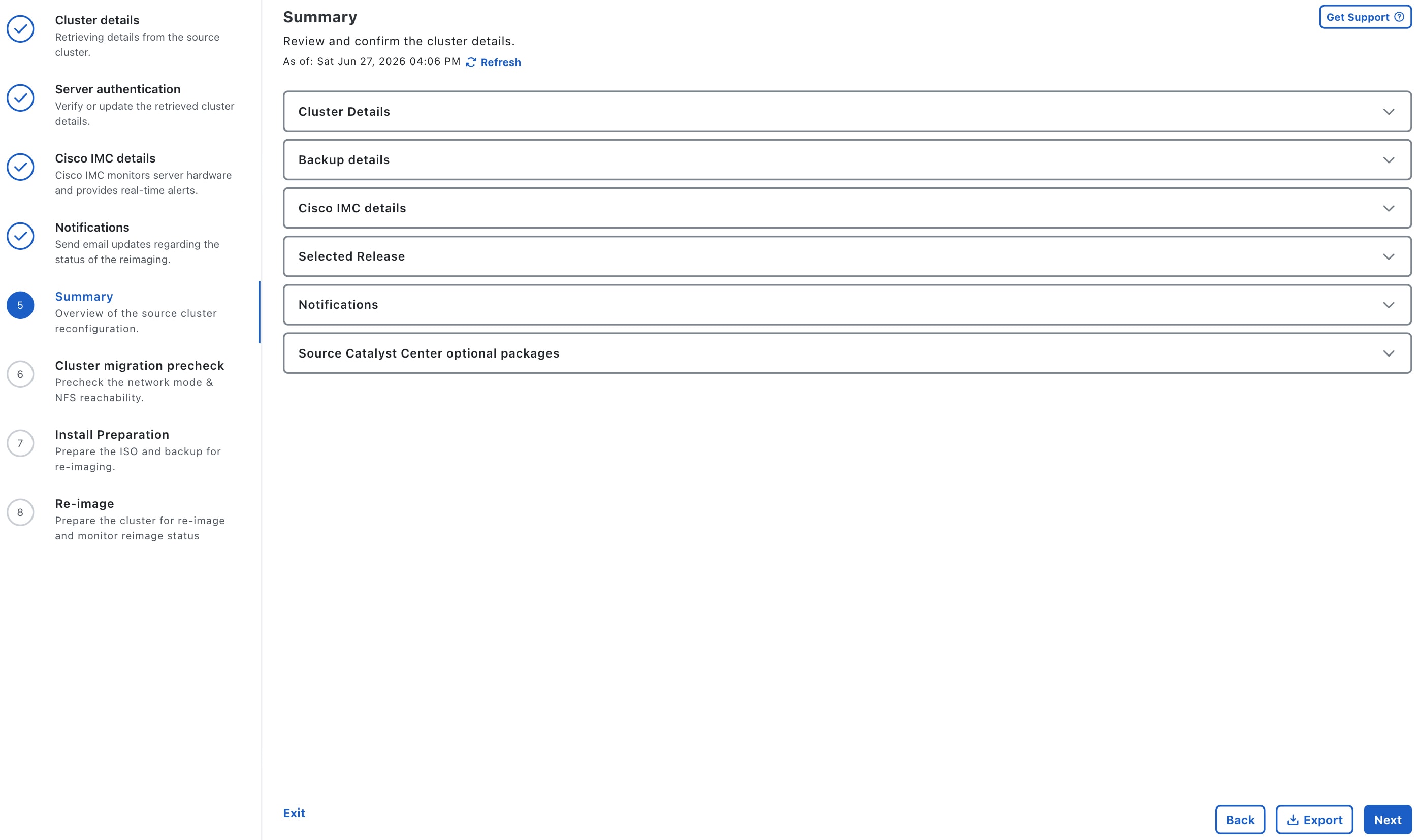
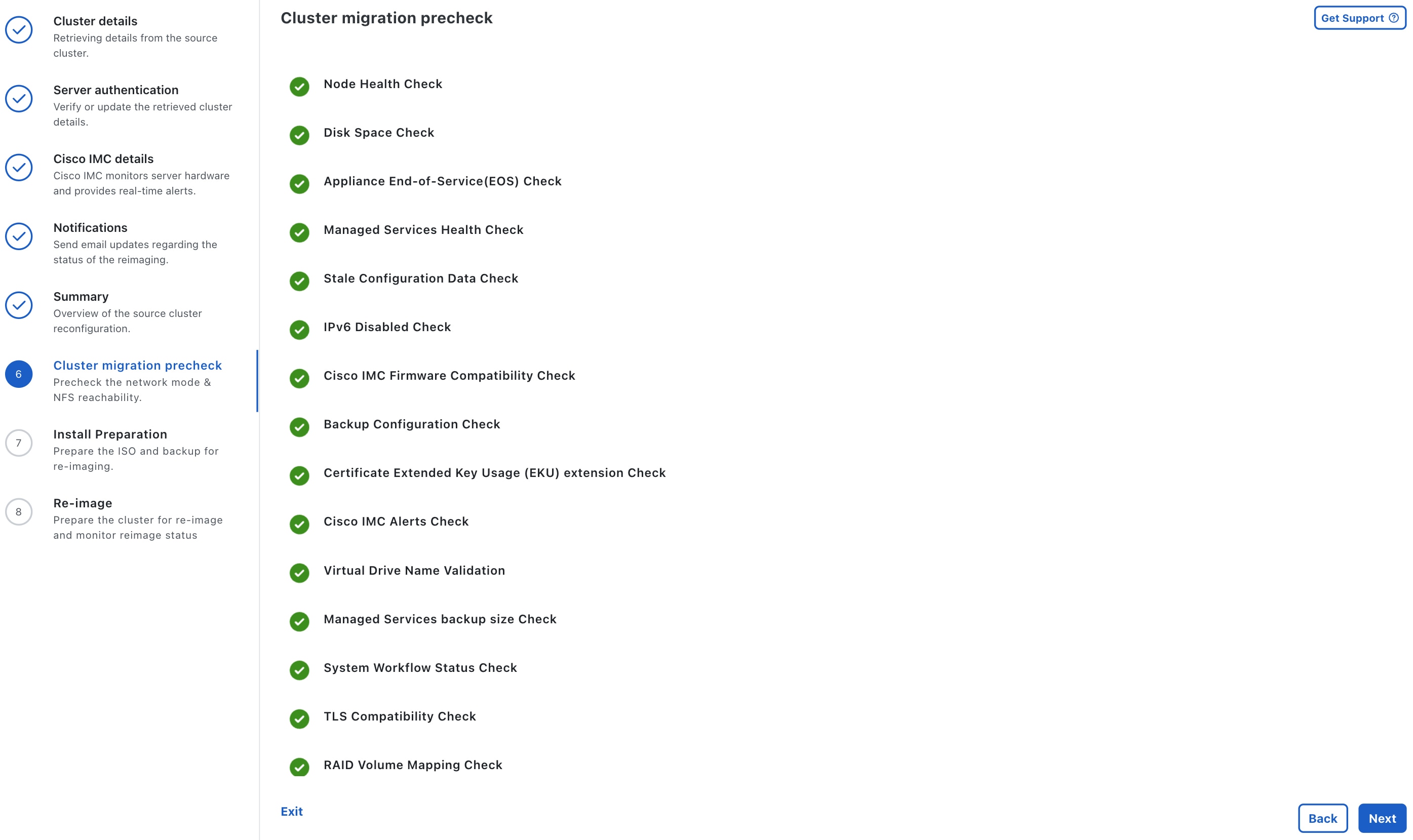
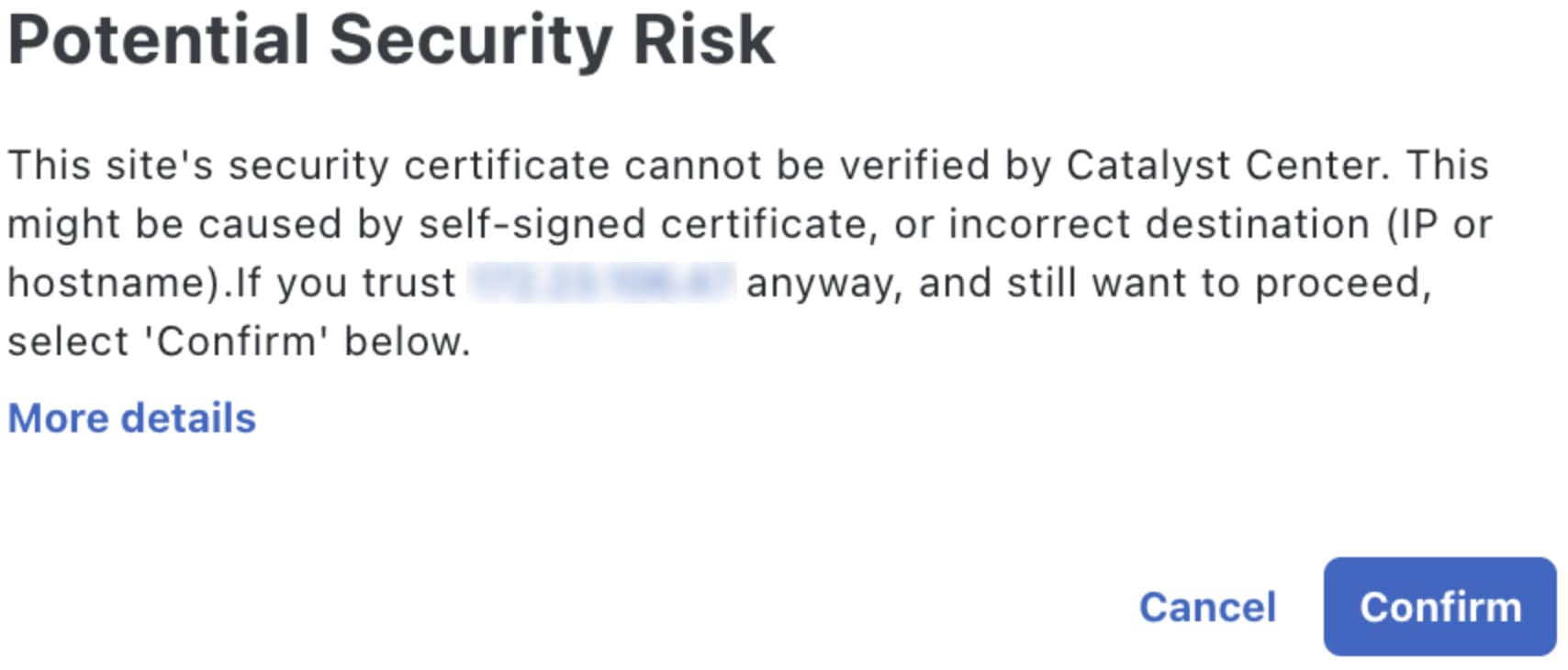
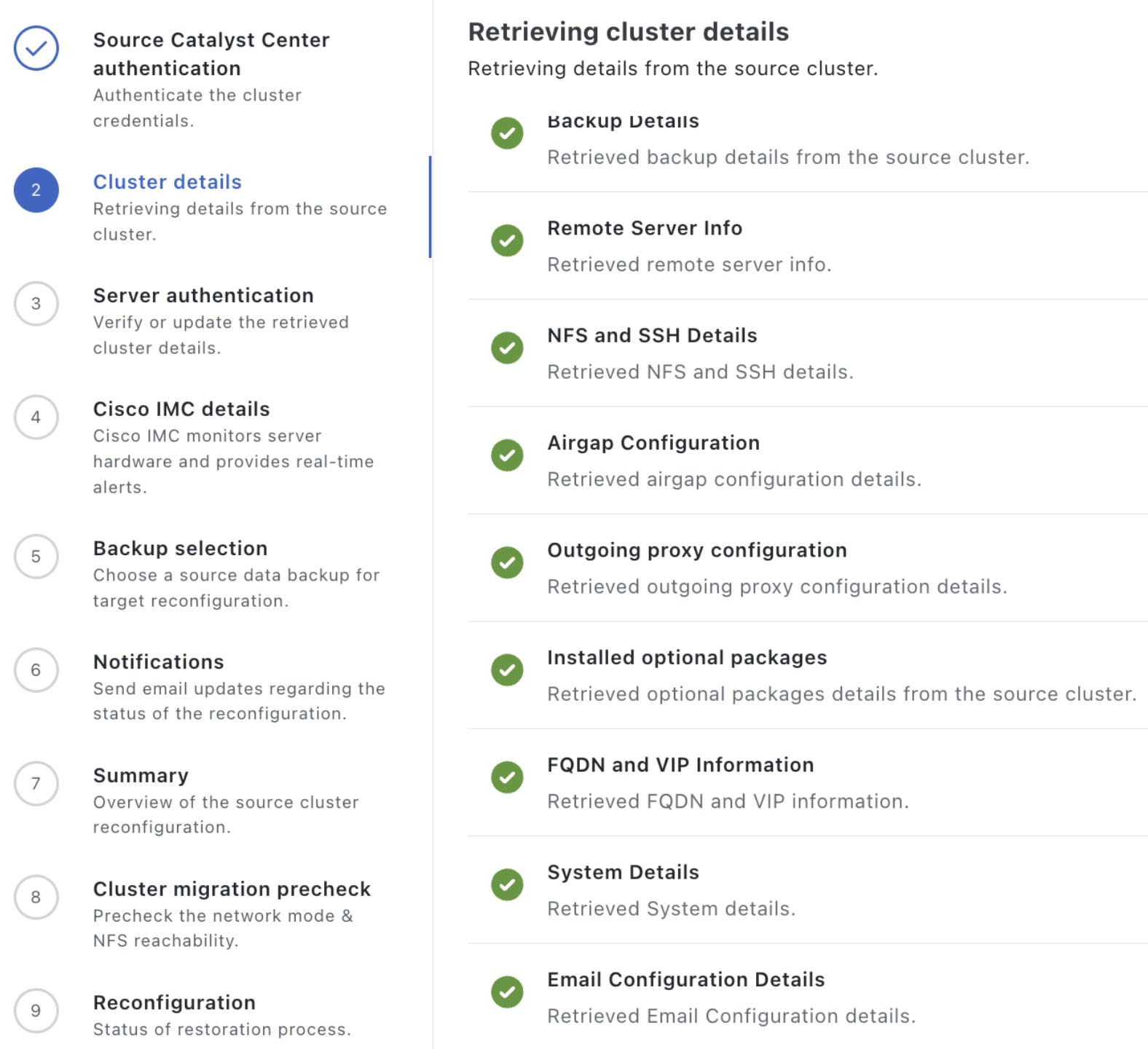
Step 5 | Complete the Catalyst Center 3.1x upgrade wizard. The wizard begins by retrieving information from your source Catalyst Center cluster, such as its configured backup server and FQDN. 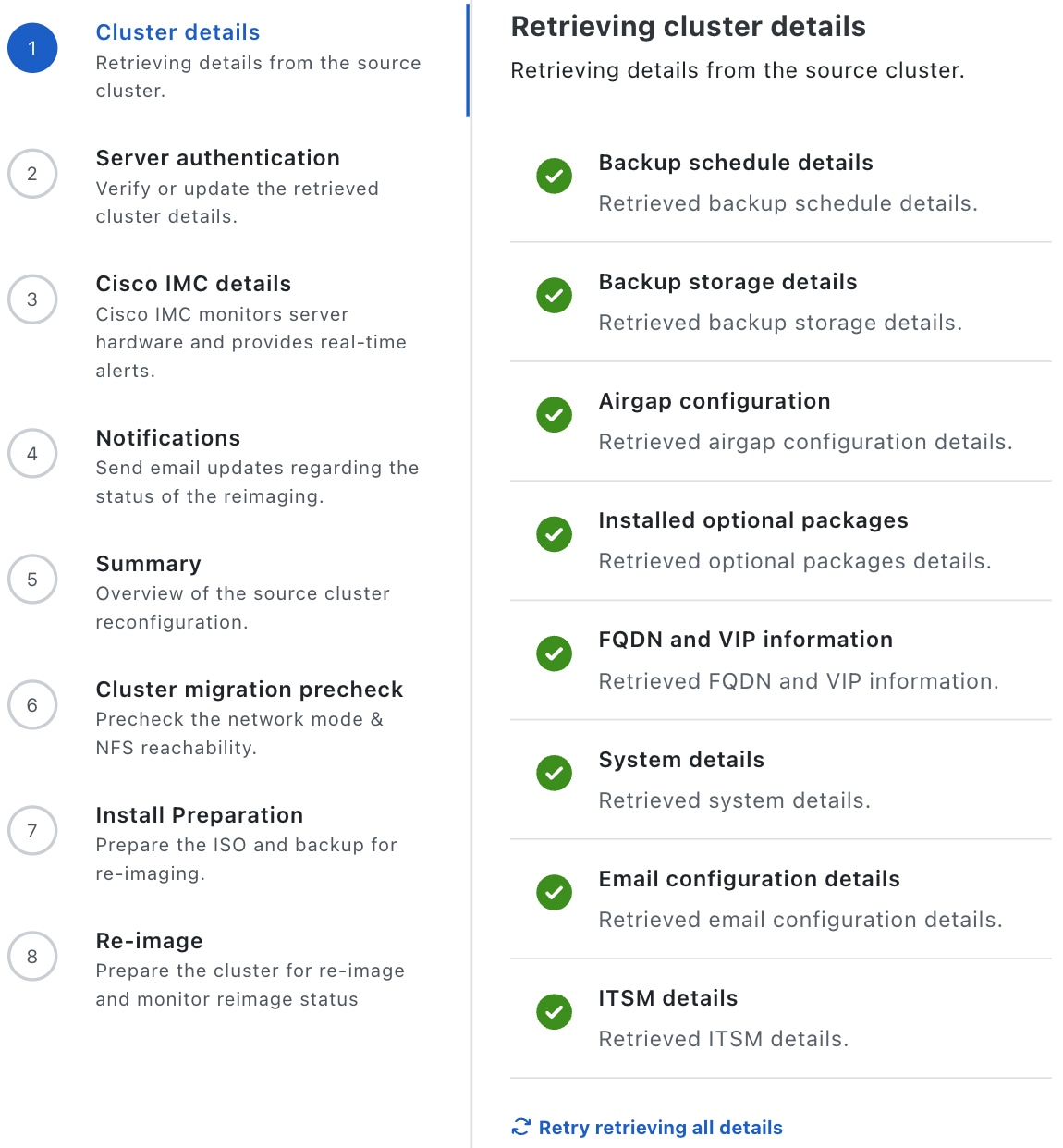 Note NoteIn any of the wizard's pages:
| ||||||||||||||
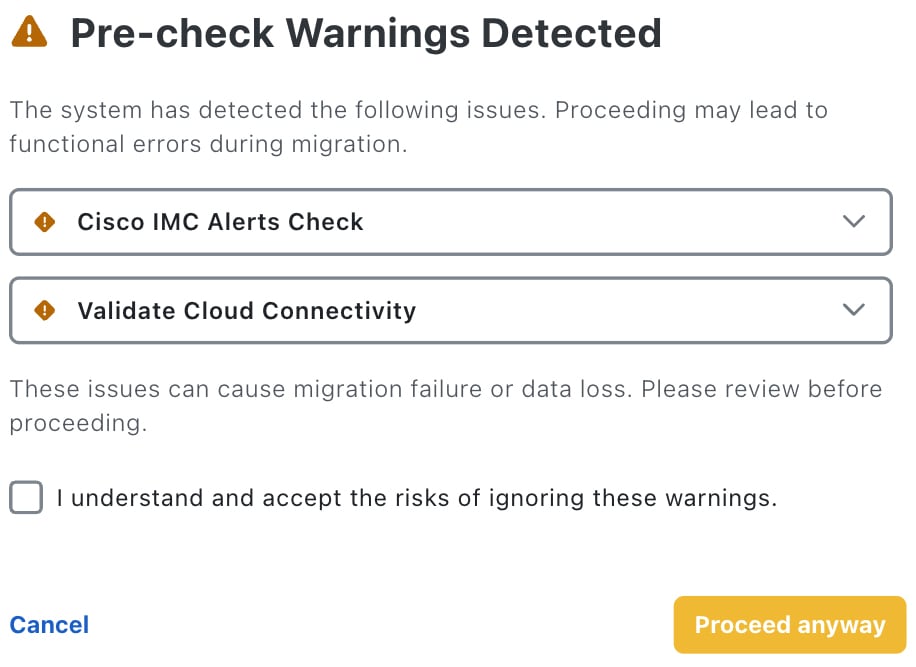
Step 6 | Take one of these actions:
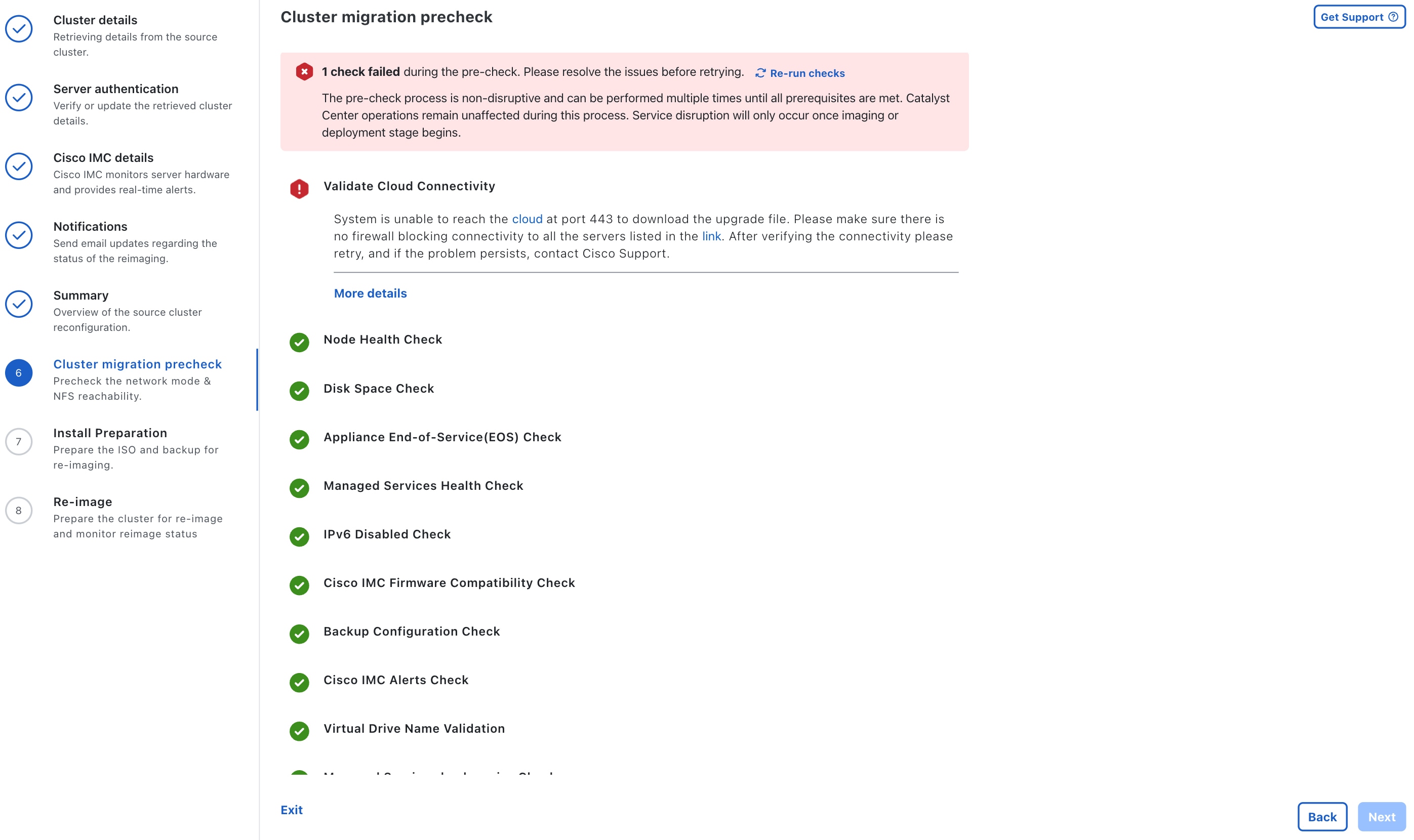 | ||||||||||||||
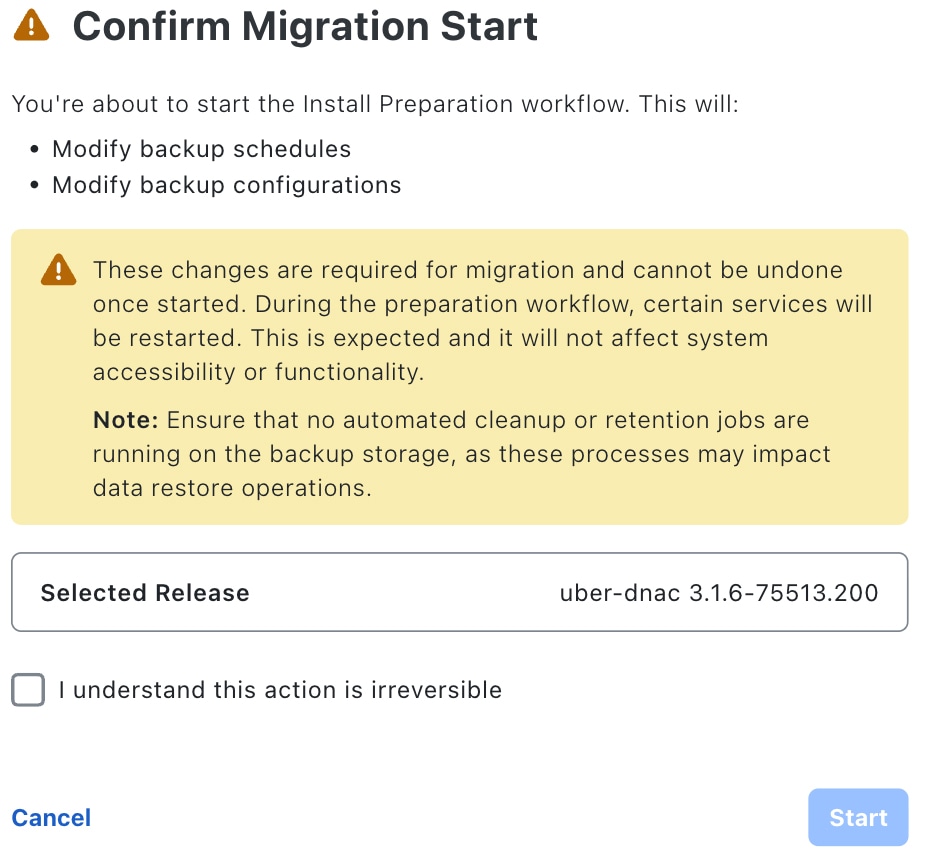
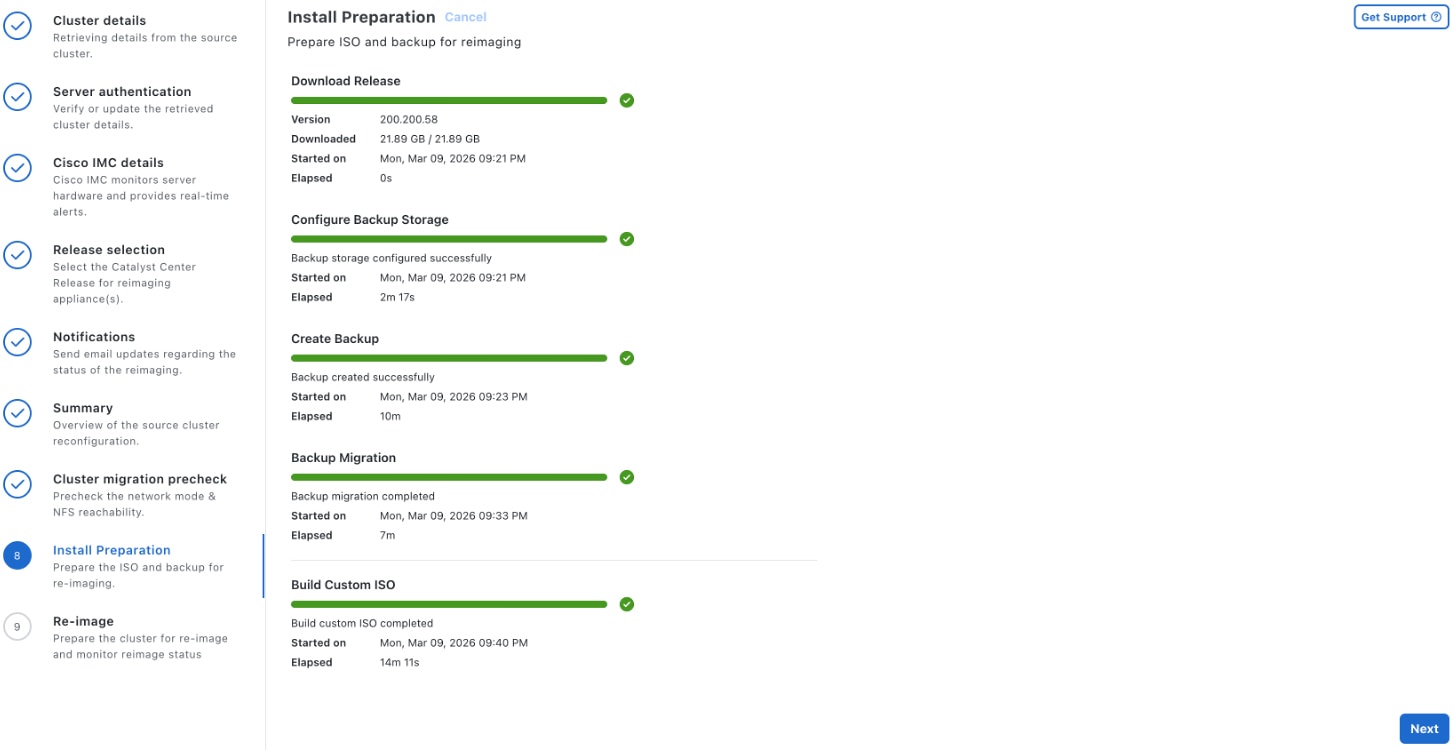
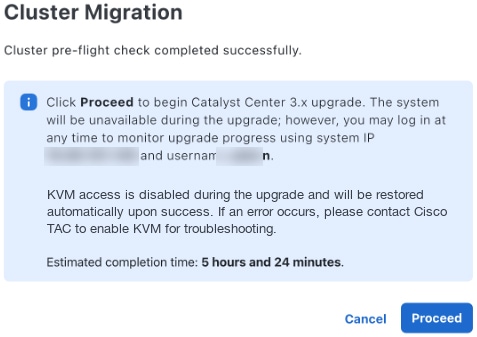
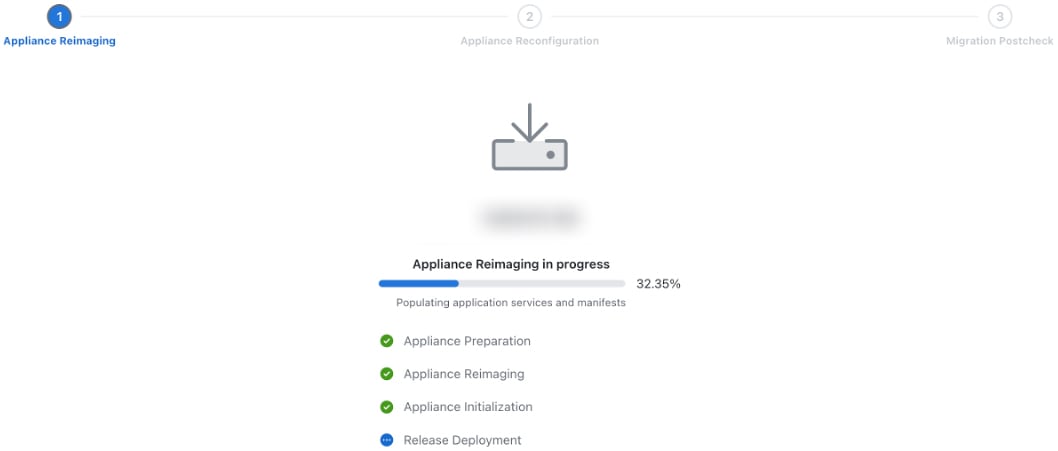
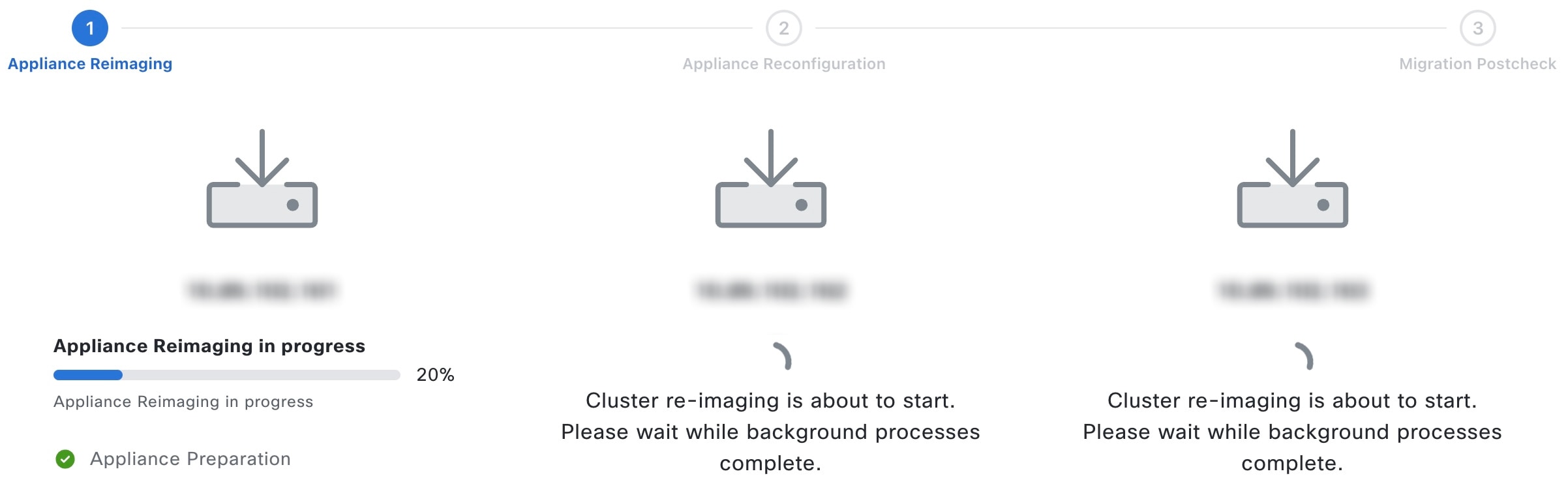
Step 7 | Start the Catalyst Center 3.1.x upgrade.
| ||||||||||||||
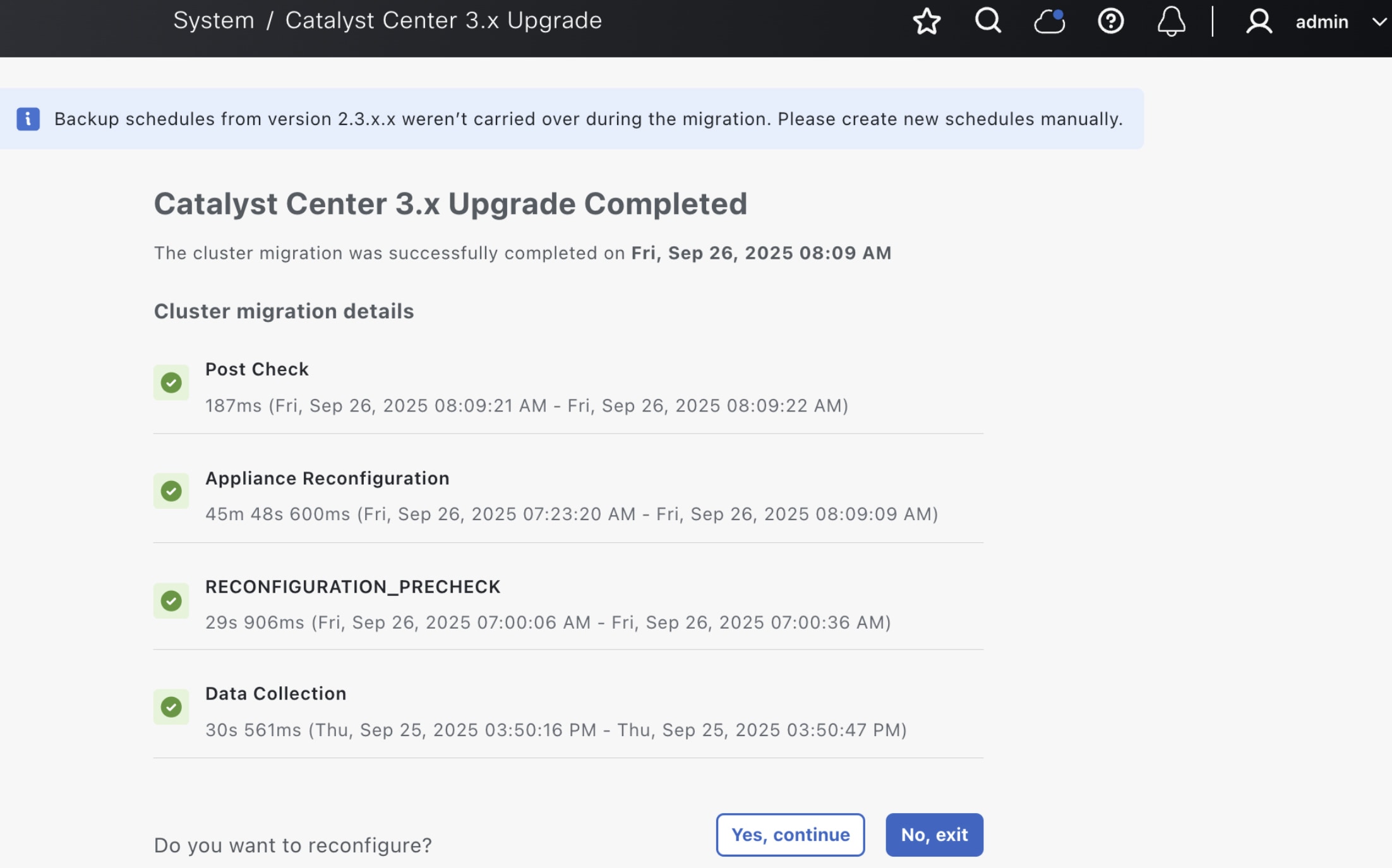
Step 8 | After the upgrade completes, you will see an upgrade summary. Select Home to open the Catalyst Center home page. 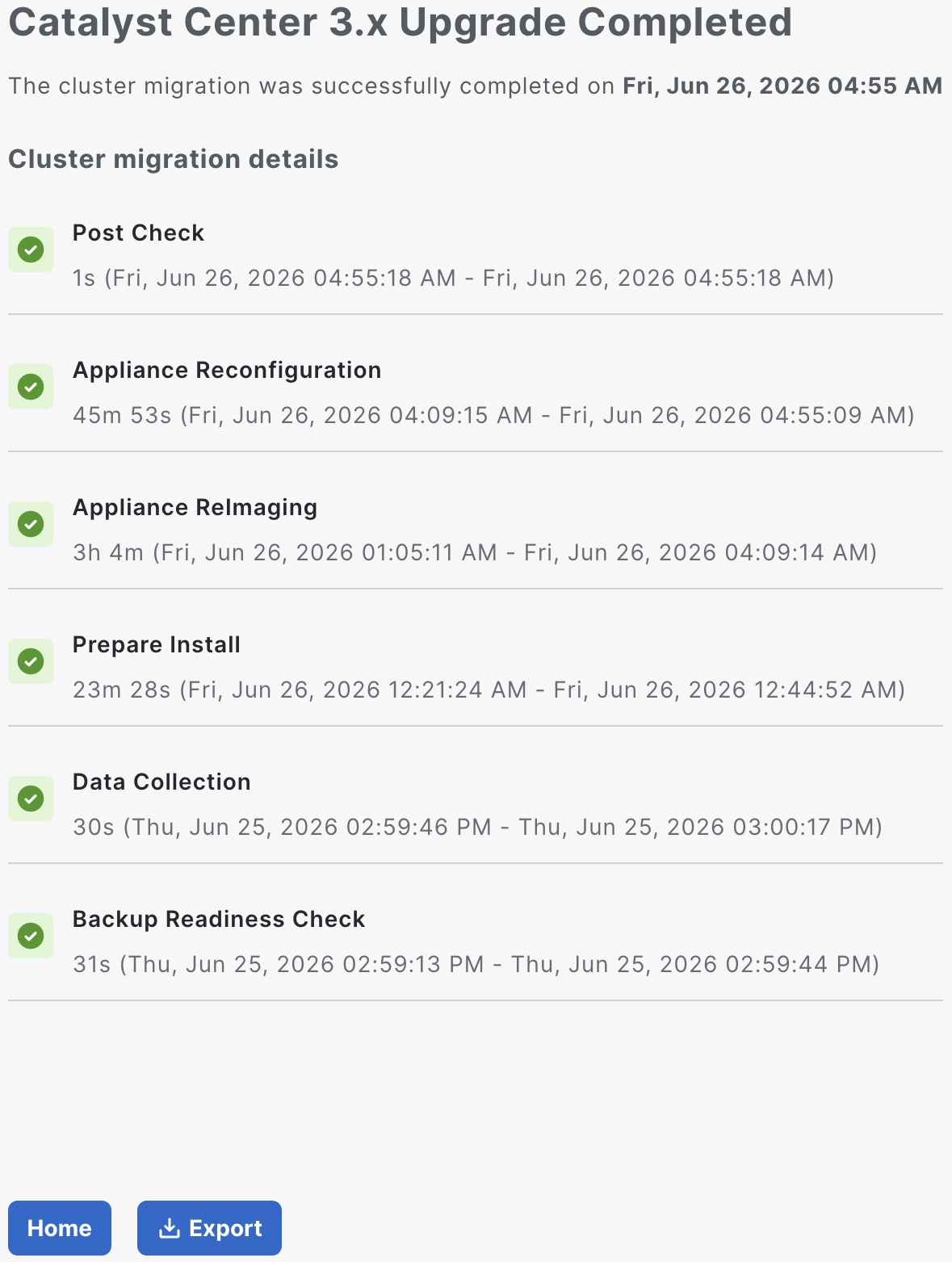 | ||||||||||||||
Step 9 | Clean up older backups. Backups created in earlier versions of Catalyst Center are no longer compatible and may not appear in the Backup & Restore page. Note that the backup data itself is still present in the configured backup storage locations, including the NFS directory and/or the remote SSH directory. To avoid unnecessary storage usage, we recommend cleaning up these older backups manually.
|
Scenario 2: Upgrade an air-gapped deployment to Catalyst Center 3.1.x
In this scenario, you are upgrading an air-gapped deployment to Catalyst Center 3.1.x.
Step 1 | Raise a request with the Cisco TAC. A representative gives you access and instructions for downloading the binary image for your Catalyst Center version from a Cisco file server. The air gap binary image includes the Catalyst Center 3.1.x upgrade package and ISO image for the 3.1.x version you're upgrading to. For example, if you are upgrading from Catalyst Center 2.3.7.10, you would download CatC-SW-23710-316.200rev7-Upgrade-AIRGAP.bin from the Software Download page. Catalyst Center supports these airgap deployment types:
Unlike Catalyst Center 2.3.7.x, the 3.1.x platform only supports Network Airgap mode. As a result:
| ||||||||||||||
Step 2 | Obtain the allowed IP ranges. During the upgrade, you are prompted to provide a list of allowed IP ranges (in CIDR format). After your deployment is upgraded, only these IP ranges are permitted and reachable. This requirement applies to both Network Airgap and Standard Airgap deployments. NoteThis is especially important for Standard Airgap deployments. In Catalyst Center 2.3.7.x, Standard Airgap mode allowed outbound network traffic to public IP ranges (only the catalog server was offline). After the upgrade to 3.1.x, Catalyst Center operates in Network Airgap mode, which restricts outbound traffic. Therefore, if Standard Airgap mode was set for your deployment in 2.3.7.x, you must provide all allowed public IP ranges so that they remain accessible after the upgrade. To determine the list of allowed IP ranges:
| ||||||||||||||
Step 3 | Deploy the air gap binary image by entering the maglev catalog airgap install binary-image-filename command. binary-image-filename is the binary image specific to your Catalyst Center version. The Catalyst Center 3.1.x upgrade package and ISO image for the 3.1.x version you're upgrading to are installed. | ||||||||||||||
Step 4 | The upgrade process is different from the standard airgap upgrade. Read the section "Upgrade your single or three-node Catalyst Center cluster" to ensure you understand each step in the upgrade process. During the upgrade, you are prompted to provide the list of allowed IP ranges (in CIDR format) in the Server authentication page. 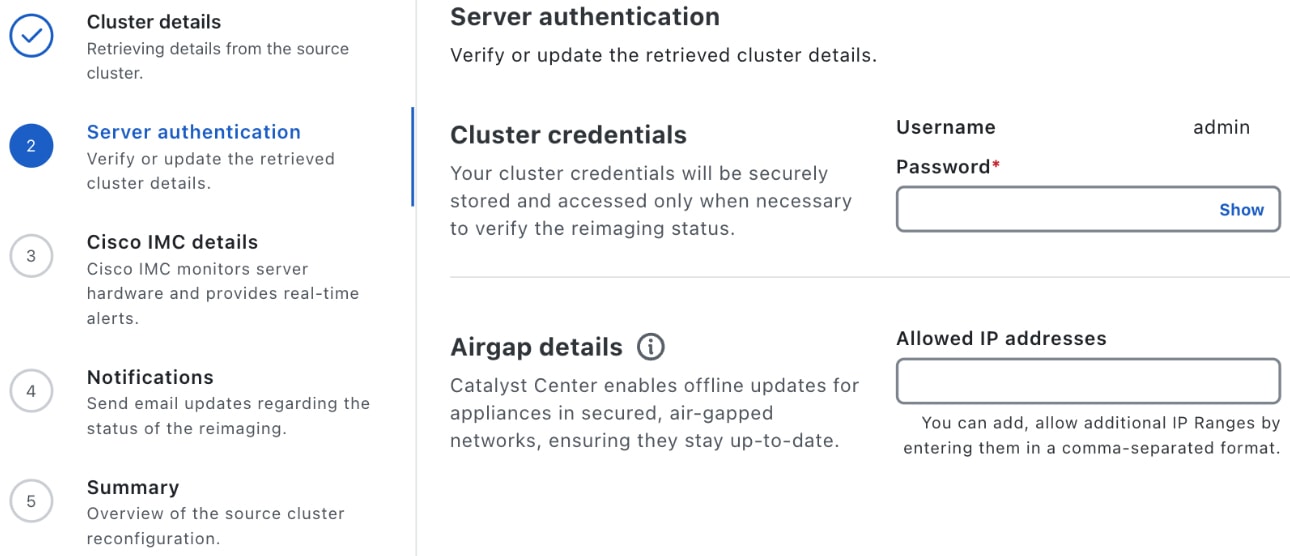 |
Scenario 3: Upgrade a disaster recovery deployment to Catalyst Center 3.1.x
In this scenario, you are upgrading your disaster recovery deployment to Catalyst Center 3.1.x.
Before you begin
- Verify the Cisco IMC settings for your appliances.
- Install the Catalyst Center 3.1.x upgrade package on both your disaster recovery system's main and recovery sites.
When reenabling your disaster recovery system after the upgrade, ensure that you set the correct Catalyst Center cluster as the main site. Otherwise, you will lose all data.
Note- Ensure that your disaster recovery system's main site is the current active site. This requirement is critical for a successful upgrade.
- Ensure that you have your disaster recovery configuration information available, such as VIPs and BGP routers. You’ll need this information to form a disaster recovery system after the 3.1.x upgrade.
On the recovery site after the upgrade:
- Log in to the recovery site as the admin superuser using the default credentials admin/P@ssword9.
- Only DR certificate will be restored.
After you install the upgrade package, you should see this: 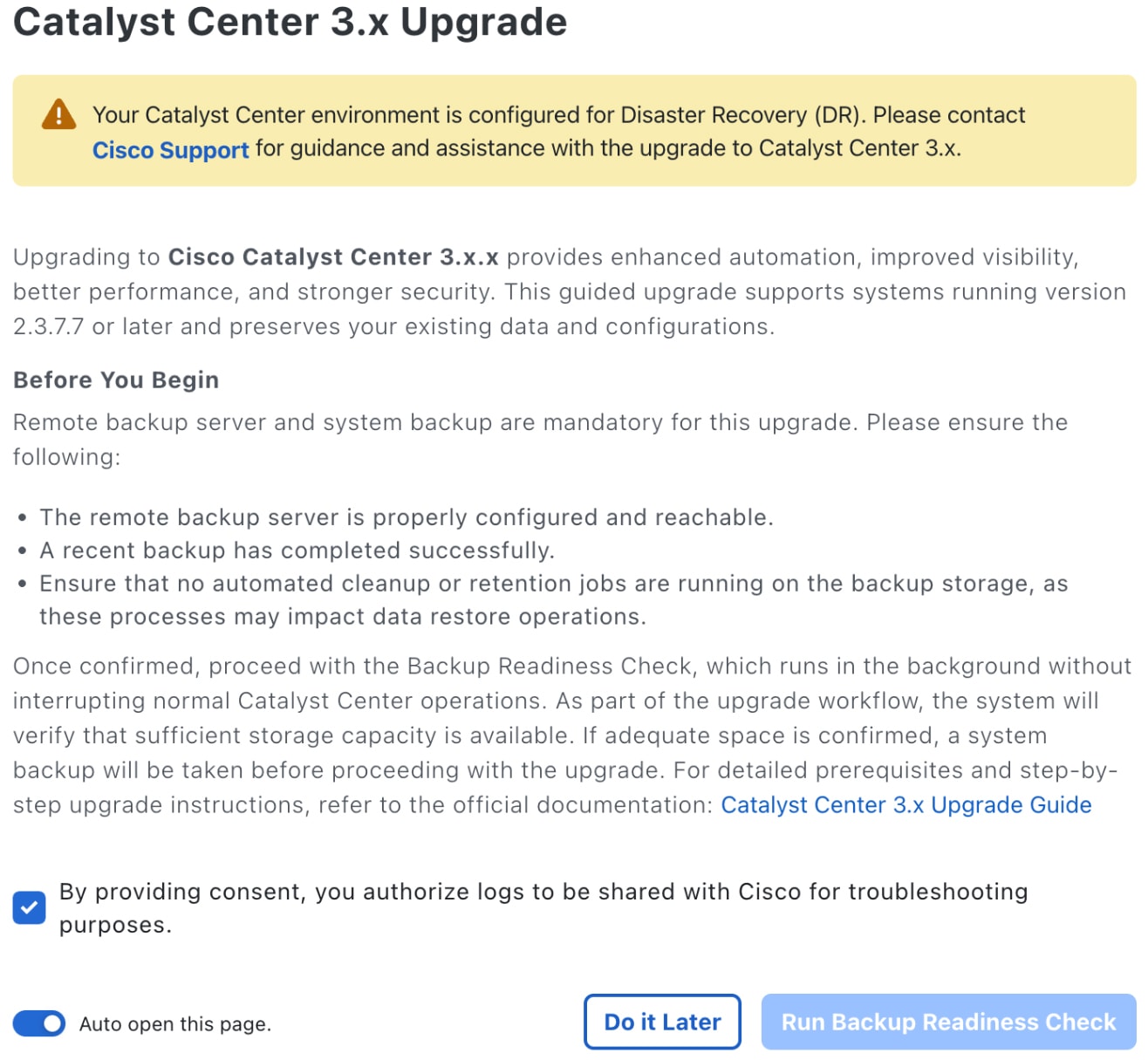 Contact the Cisco TAC so they can enable the upgrade of your disaster recovery deployment. |
Scenario 4: Restore Catalyst Center 3.1.3 data
In this scenario, you are migrating your Catalyst Center 3.1.3 data to an appliance that has Catalyst Center 3.1.5 or later installed.
Step 1 | Confirm that you have enough space to store your backups after upgrading to Catalyst Center 3.1.5 or later. In the Cisco Catalyst Center Administrator Guide, see the "Backup storage requirements" topic. |
Step 2 | Back up your Catalyst Center 3.1.3 deployment. In the Cisco Catalyst Center Administrator Guide, complete the steps described in the "Create a backup" topic. |
Step 3 | Install Catalyst Center 3.1.5 or later on your appliance. |
Step 4 | Add the NFS server using the same location that was configured for Catalyst Center 3.1.3. In the Cisco Catalyst Center Administrator Guide, complete the steps described in the "Add the NFS server" topic. |
Step 5 | Restore the backup you created in Step 2. In the Cisco Catalyst Center Administrator Guide, complete the steps described in the "Restore data from backups" topic. |
Scenario 5: Migrate data from one Catalyst Center appliance to another
Complete these steps to migrate data from an appliance (running Catalyst Center 2.3.7.x) to another Catalyst Center appliance (running Catalyst Center version 3.1.x).
Note- If you are using the same IP addressing scheme on your Catalyst Center 3.1.3 appliance, shut down the Catalyst Center 2.3.7.x appliance before you start up the Catalyst Center 3.1.3 appliance to prevent IP conflicts.
- Ensure that you have a DN2 or DN3 appliance running Catalyst Center 3.1.3with the same packages that are installed on your current 2.3.7.x appliance.
- You can migrate data to an appliance with either the same or bigger profile. For example, you can migrate data from a medium appliance to another medium appliance or a large appliance.
- Don't migrate data to an appliance with a smaller profile. For example, don't migrate data from an extra large appliance to a large appliance.
Step 1 | Ensure that Catalyst Center 2.3.7.x (version 2.3.7.7 or later) is installed on your appliance. |
Step 2 | Back up your appliance's Assurance (optional) and automation data. In the Cisco Catalyst Center Administrator Guide, complete the steps described in these topics:
|
Step 3 | From the Cisco software download site, download the relevant CatC_2.3.7.x-VA_MigrationScript_v3.tar.gz (which includes the CatC-2.3.7.x-VA_MigrationScript_v3.sh script) to your NFS server. |
Step 4 | Extract the .tar file and then copy CatC-2.3.7.x-VA_MigrationScript_v3.sh to your NFS server. |
Step 5 | Grant execute permission to the script by entering the chmod +x CatC-2.3.7.x-VA_MigrationScript_v3.sh command. (Replace 2.3.7.x with your specific version.) |
Step 6 | After the backup completes successfully, open an SSH console on your NFS server and enter these commands:
|
Step 7 | Start the script by entering the ./CatC-2.3.7.x-VA_MigrationScript_v3.sh command. (Replace 2.3.7.x with your specific version.) The script does two things:
|
Step 8 | After the script runs successfully, enter this command: unset REMOTE_SERVER_PASSWORD |
Step 9 | Configure the NFS server that the Catalyst Center 3.1.3 appliance will use:
|
Step 10 | Restore the backup file that you created in Step 2. In the Cisco Catalyst Center Administrator Guide, complete the steps described in the "Restore data from backups" topic. Enter the same encryption passphrase that you entered when completing Step 2. After the restore operation completes, the automation and Assurance data from the physical appliance (first, second, or third-generation) migrate to the virtual appliance. |
Scenario 6: Upgrade from a physical appliance to a virtual appliance
In this scenario, you are migrating your existing network data from a physical Catalyst Center appliance to a virtual appliance running Catalyst Center 3.1.5 or later on ESXi.
Note- Catalyst Center only supports the migration of data from a single-node medium appliance to a Catalyst Center on ESXi virtual appliance.
- The Catalyst Center on ESXi virtual appliance must have a different IP address than its source physical appliance.
Before you begin
- Configure a virtual appliance running Catalyst Center 3.1.5 or later on ESXi. See the Cisco Catalyst Center 3.1.x on ESXi Deployment Guide.
- Ensure that a backup server is configured for automation data, and that an NFS server is configured for Assurance data. NFS is mandatory for the migration of backup files from physical Catalyst Center appliances.
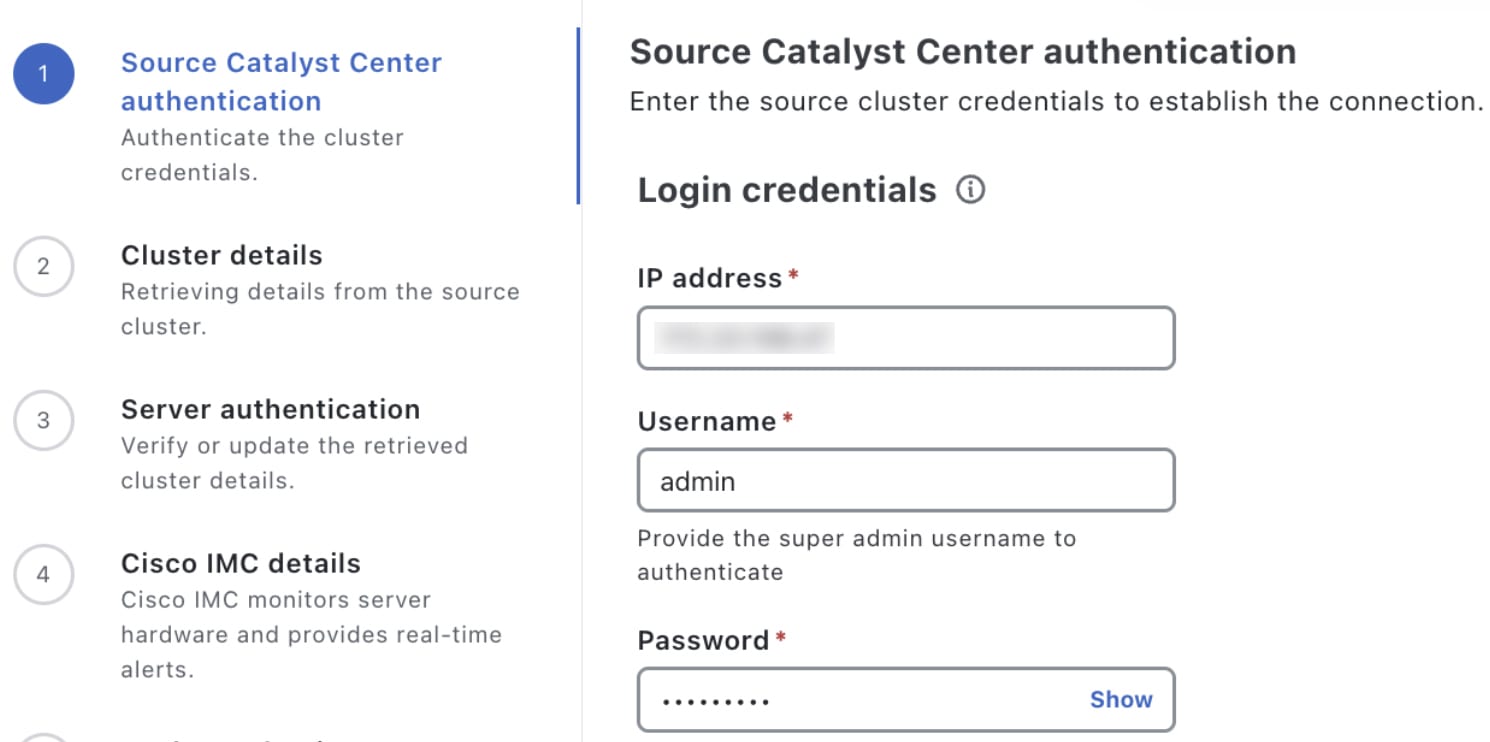
Step 1 | Start the Catalyst Center 3.1.x upgrade wizard:
| ||||||||||||||
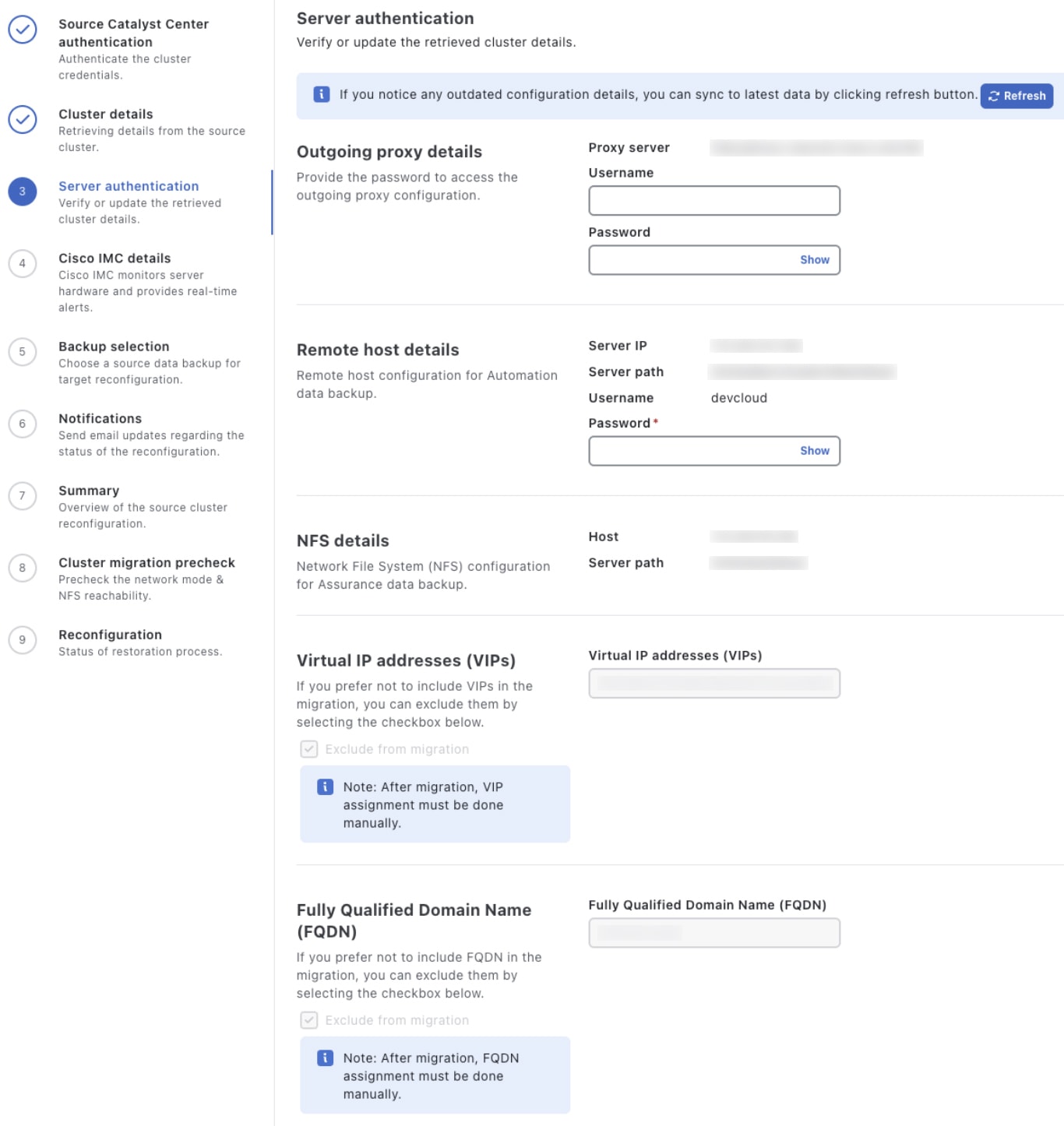
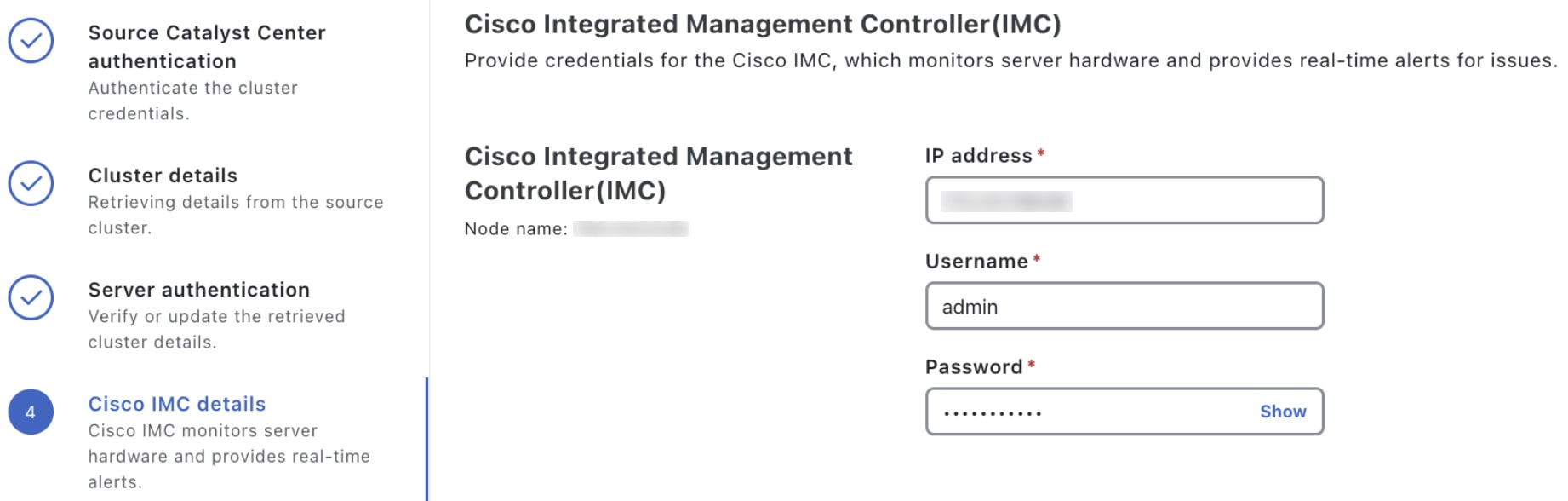
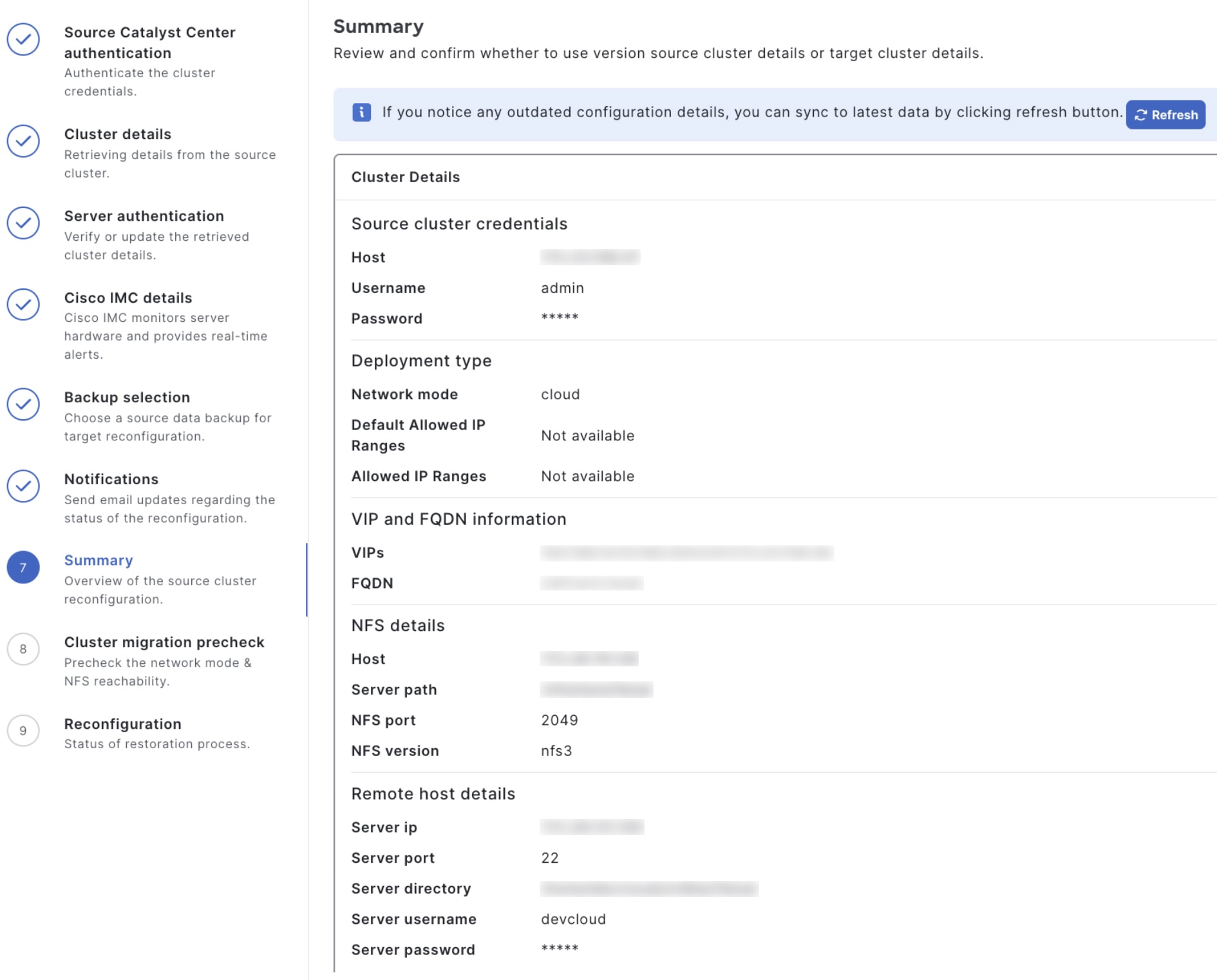
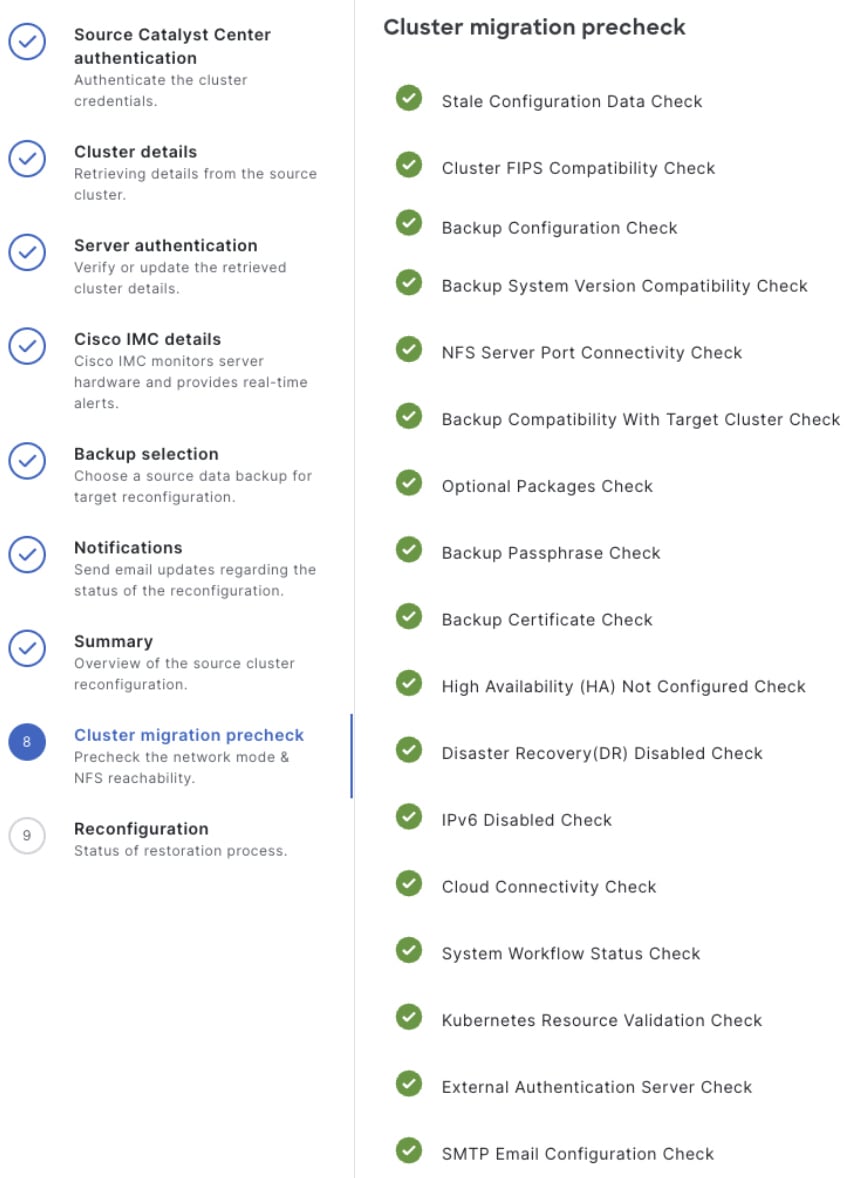
Step 2 | Complete the Catalyst Center 3.1.x upgrade wizard:
| ||||||||||||||
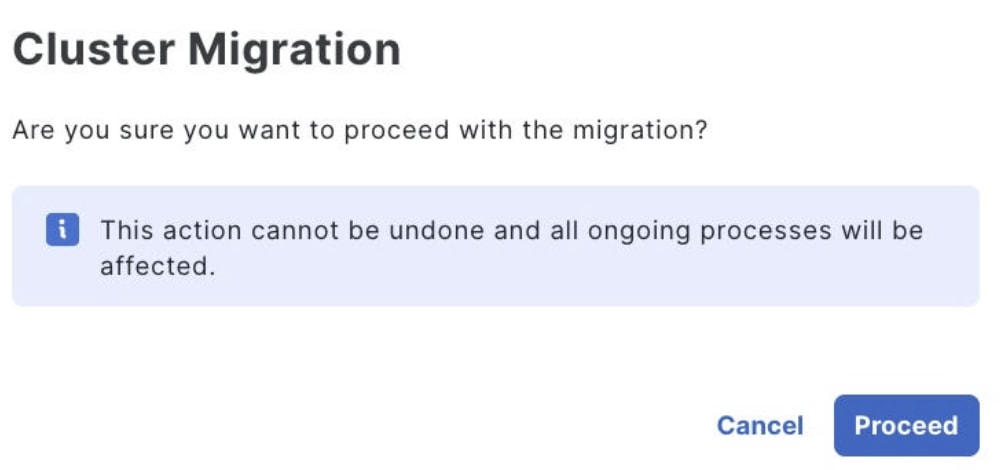
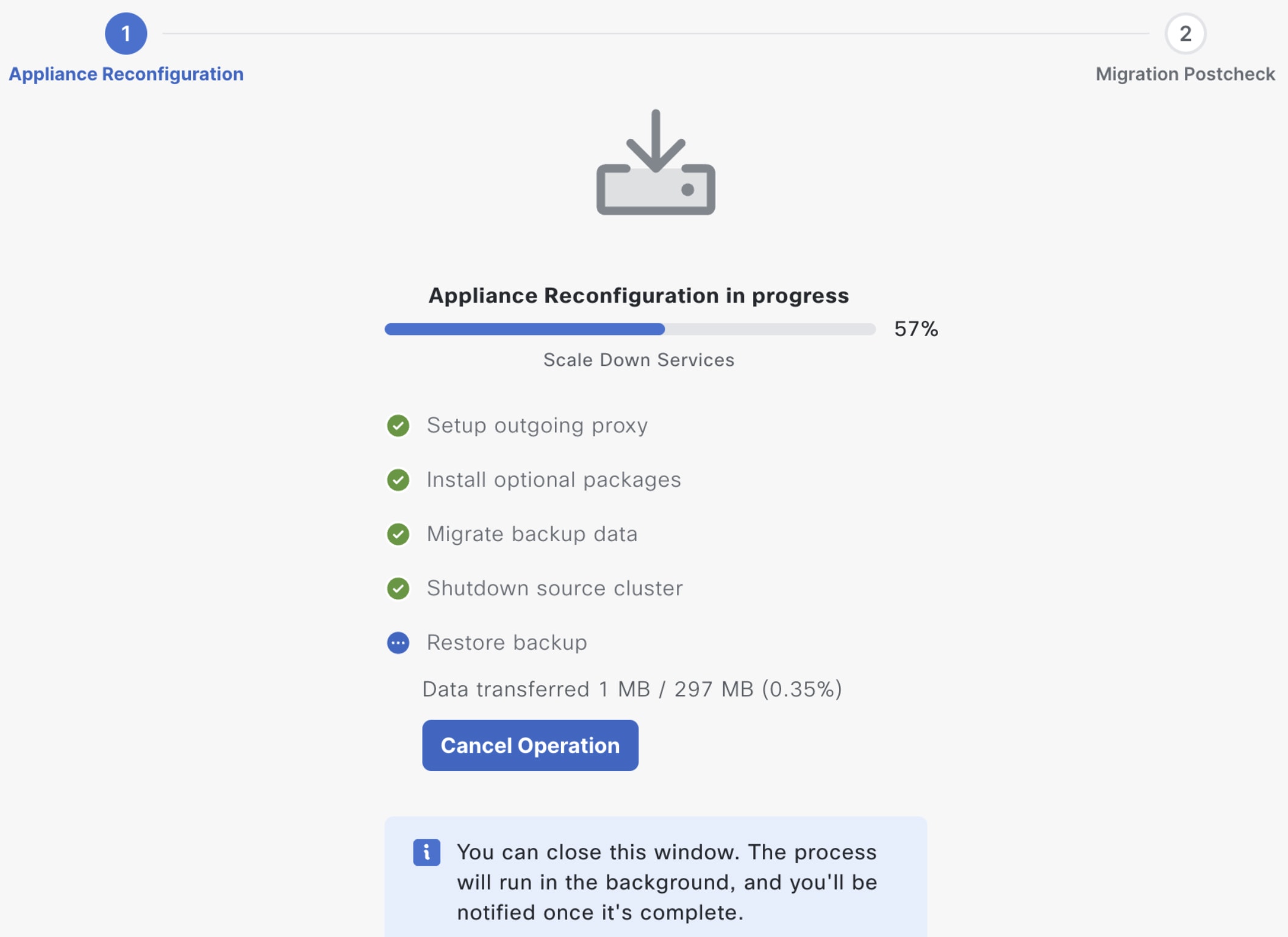
Step 3 | Start the Catalyst Center 3.1.x upgrade.
|
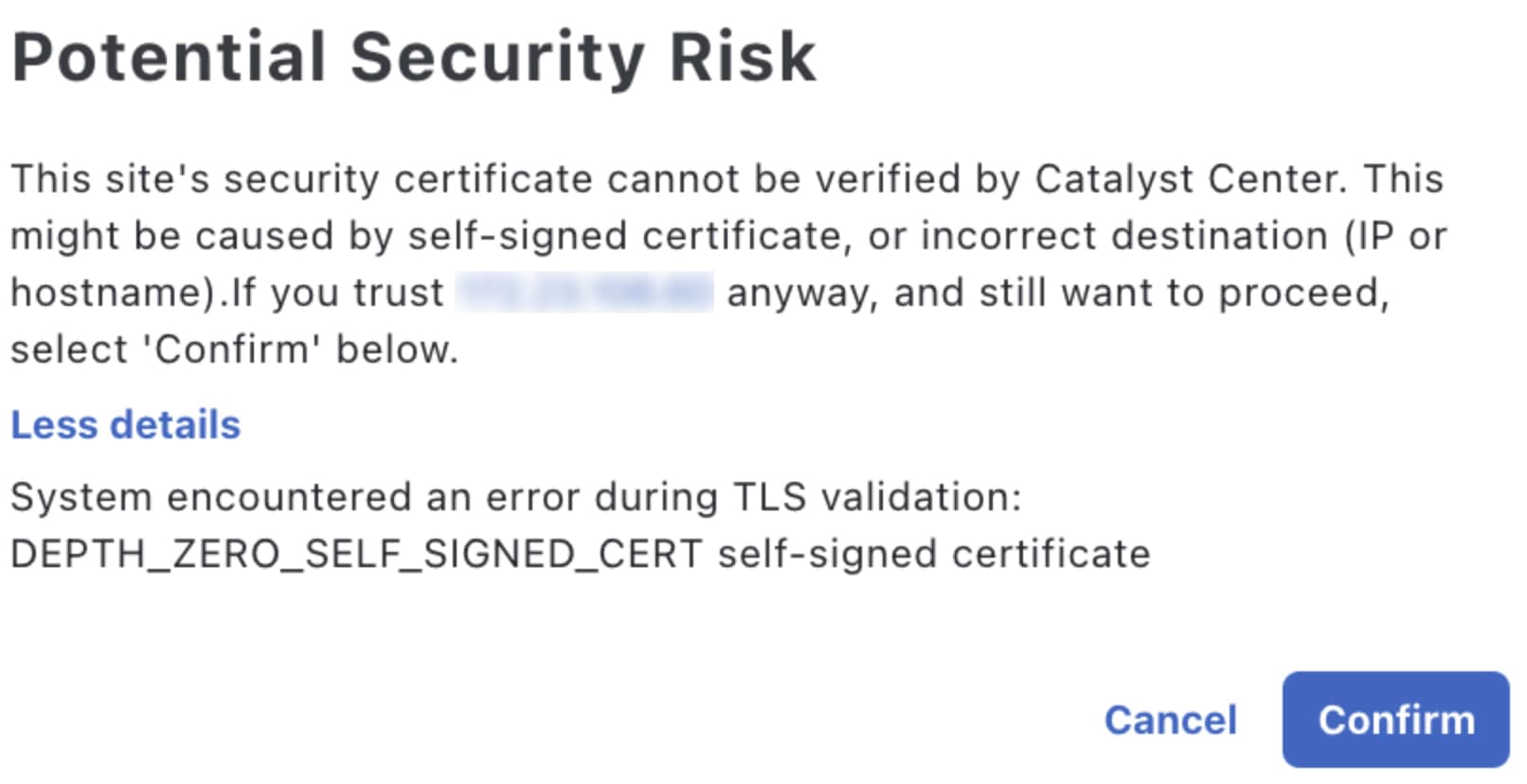
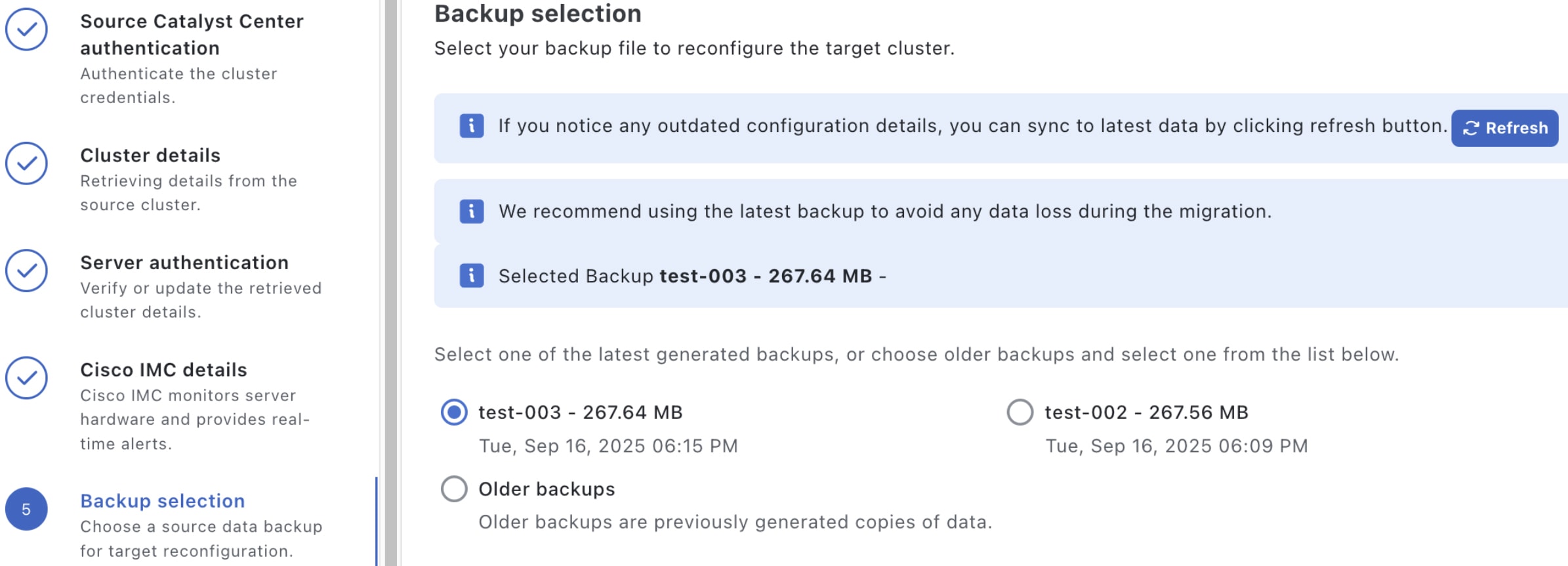
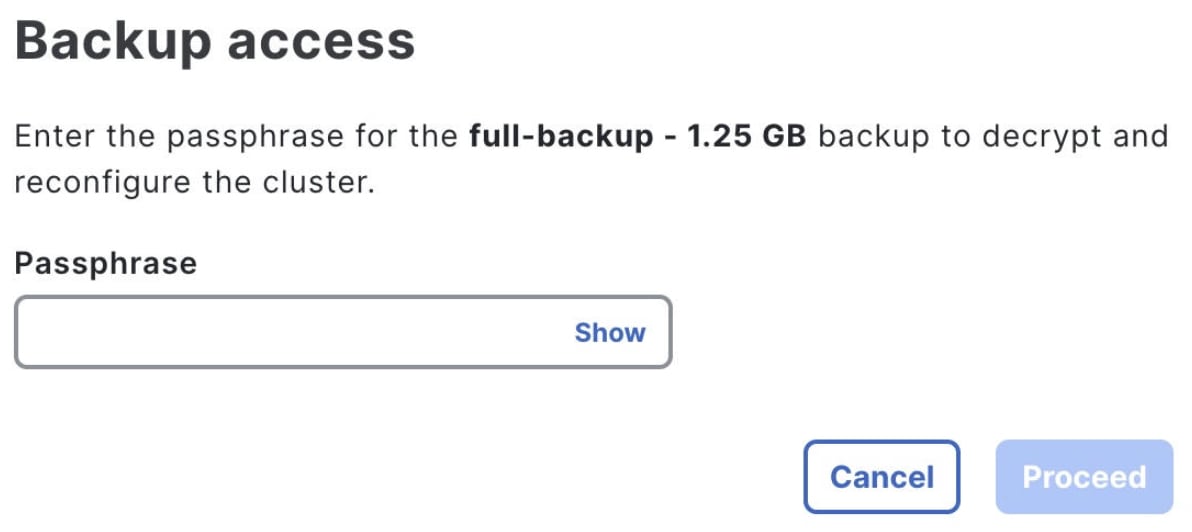
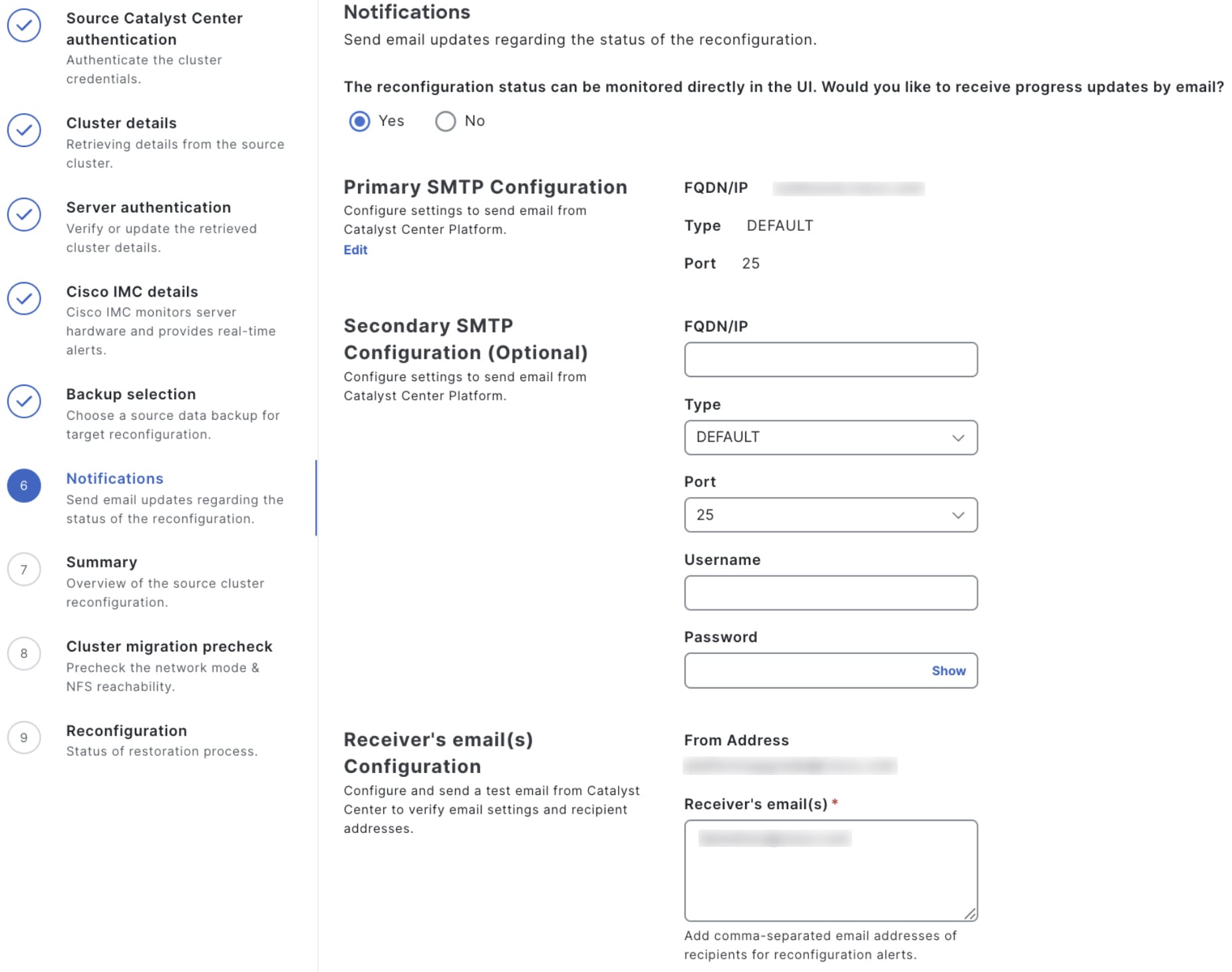
Scenario 7: Upgrade Catalyst Center on ESXi
In this scenario, you are upgrading your Catalyst Center 2.3.7.x on ESXi deployment to Catalyst Center on ESXi version 3.1.5 or later.
Step 1 | Back up your Catalyst Center 2.3.7.x on ESXi deployment. In the Cisco Catalyst Center Administrator Guide, complete the steps described in the "Back up data now" topic. | ||||||
Step 2 | Shut down Catalyst Center 2.3.7.x on ESXi. | ||||||
Step 3 | Configure a new Catalyst Center on ESXi virtual appliance (version 3.1.5 or later) with the same network settings as your previous virtual appliance. | ||||||
Step 4 | Configure the physical disk or NFS server that will be used for backup and restore operations.
| ||||||
Step 5 | Restore the backup you created in Step 1. In the Cisco Catalyst Center Administrator Guide, complete the steps described in the "Restore data from backups" topic. |
Scenario 8: Upgrade Catalyst Center on AWS
In this scenario, you are upgrading your Catalyst Center 2.3.7.x on AWS deployment to Catalyst Center on AWS version 3.1.5 or later.
Before you begin
- Ensure that a backup server is configured for automation data, and that an NFS server is configured for Assurance data. NFS is mandatory for the migration of backup files from physical Catalyst Center appliances.
- If you are using the same IP addressing scheme on your Catalyst Center 3.1.x appliance, shut down the Catalyst Center 2.3.7.x appliance before you start up the Catalyst Center 3.1.x appliance to prevent IP conflicts.
Step 1 | Ensure that Catalyst Center 2.3.7.x (version 2.3.7.7 or later) is installed on your Catalyst Center on AWS deployment. |
Step 2 | Back up your appliance's Assurance (optional) and automation data. In the Cisco Catalyst Center Administrator Guide, complete the steps described in these topics:
|
Step 3 | From the Cisco software download site, download the relevant CatC_2.3.7.x-VA_MigrationScript_v3.tar.gz (which includes the CatC-2.3.7.x-VA_MigrationScript_v3.sh script) to your NFS server. |
Step 4 | Extract the .tar file and then copy CatC-2.3.7.x-VA_MigrationScript_v3.sh to your NFS server. |
Step 5 | Grant execute permission to the script by entering the chmod +x CatC-2.3.7.x-VA_MigrationScript_v3.sh command. (Replace 2.3.7.x with your specific version.) |
Step 6 | After the backup completes successfully, open an SSH console on your NFS server and enter these commands:
|
Step 7 | Start the script by entering the ./CatC-2.3.7.x-VA_MigrationScript_v3.sh command. (Replace 2.3.7.x with your specific version.) The script does two things:
NoteAfter starting the script, you may see an error indicating that some items are missing. Install these items, and then restart the script. |
Step 8 | From the list of available backups, select the backup you want to migrate. |
Step 9 | After the script runs successfully, enter this command: unset REMOTE_SERVER_PASSWORD |
Step 10 | Configure the NFS server that the Catalyst Center3.1.x appliance will use:
|
Step 11 | Restore the backup file that you created in Step 2. In the Cisco Catalyst Center Administrator Guide, complete the steps described in the "Restore data from backups" topic. Enter the same encryption passphrase that you entered when completing Step 2. After the restore operation completes, verify that your system is functioning properly. Also confirm that all services are running in the System 360 page (). |
Scenario 9: Upgrade Catalyst Center on Azure
In this scenario, you are upgrading Catalyst Center 2.3.7.x to Catalyst Center on Azure version 3.1.5 or later.
Before you begin
- Ensure that a backup server is configured for automation data, and that an NFS server is configured for Assurance data. NFS is mandatory for the migration of backup files from physical Catalyst Center appliances.
- If you are using the same IP addressing scheme on your Catalyst Center 3.1.x appliance, shut down the Catalyst Center 2.3.7.x appliance before you start up the Catalyst Center 3.1.x appliance to prevent IP conflicts.
Step 1 | Ensure that Catalyst Center 3.1.x (version 3.1.5 or later) is installed on your Catalyst Center on Azure deployment. |
Step 2 | Back up your appliance's Assurance (optional) and automation data. In the Cisco Catalyst Center Administrator Guide, complete the steps described in these topics:
|
Step 3 | From the Cisco software download site, download the relevant CatC_2.3.7.x-VA_MigrationScript_v3.tar.gz (which includes the CatC-2.3.7.x-VA_MigrationScript_v3.sh script) to your NFS server. |
Step 4 | Extract the .tar file and then copy CatC-2.3.7.x-VA_MigrationScript_v3.sh to your NFS server. |
Step 5 | Grant execute permission to the script by entering the chmod +x CatC-2.3.7.x-VA_MigrationScript_v3.sh command. (Replace 2.3.7.x with your specific version.) |
Step 6 | After the backup completes successfully, open an SSH console on your NFS server and enter these commands:
|
Step 7 | Start the script by entering the ./CatC-2.3.7.x-VA_MigrationScript_v3.sh command. (Replace 2.3.7.x with your specific version.) The script does two things:
After starting the script, you may see an error indicating that some items are missing. Install these items, and then restart the script. |
Step 8 | After the script runs successfully, enter this command: unset REMOTE_SERVER_PASSWORD |
Step 9 | Configure the NFS server that the Catalyst Center 3.1.x appliance will use:
|
Step 10 | Restore the backup file that you created in Step 2. In the Cisco Catalyst Center Administrator Guide, complete the steps described in the "Restore data from backups" topic. Enter the same encryption passphrase that you entered when completing Step 2. After the restore operation completes, verify that your system is functioning properly. Also confirm that all services are running in the System 360 page (). |
Troubleshoot upgrade issues
Unsupported Catalyst Center appliances and features
First-generation (DN1) appliances
Issue: The 3.1.x platform upgrade does not support first-generation (DN1) Catalyst Center appliances.
Appliance End-of-Service(EOS) CheckRe-imaging is not supported for End-Of-Service(EOS) hardware (i.e DN1): Unsupported appliance detected at node(s):192.192.192.235 (DN1-HW-APL).

Resolution: Complete the steps described in Scenario 5: Migrate data from one Catalyst Center appliance to another.
IPSEC-enabled HA clusters
Issue: The 3.1.x platform upgrade does not support High Availability (HA) clusters with IPSEC enabled.
IPSec Status CheckPlatform migration is not supported for clusters with HA (High Availability) IPSec enabled.
To proceed please use the script-based migration method mentioned in the document. If you need help
or have questions, please contact Cisco Support for assistance.
Resolution: Complete the steps described in Scenario 5: Migrate data from one Catalyst Center appliance to another.
IPv6-enabled appliance
Issue: You are unable to upgrade a Catalyst Center appliance that has IPv6 enabled.
IPv6 Disabled Check IPv6 is enabled on the appliance, which is not supported.
Resolution: Complete the steps described in Scenario 5: Migrate data from one Catalyst Center appliance to another.
Backup readiness issues
Remote backup server is not configured
Issue: The remote host for automation backups has not been configured.
There is an error while trying to get the backup remote server settings.
Remote host settings are missing under backup configuration. Backups cannot be listed
without remote host settings. Please reenter the Remote Server configuration using this
link and retry. If problem persists, please contact Cisco Support.
Resolution: Contact Cisco Support for assistance.
- From the main menu, choose .
- Select Configure.
- Enter the information for the remote host you will use to store backups. In the Cisco Catalyst Center Administrator Guide, Release 2.3.7.x, refer to the “Backup Server Requirements” and “Configure Backup Servers” topics.
Insufficient disk space on backup server
Issue: The amount of automation data you need to back up is larger than what can fit in a local backup.
There is an error while trying to get the backup remote server settings. Remote host
settings are missing under backup configuration. Backups cannot be listed without remote host
settings. Please reenter the Remote Server configuration using this link and retry. If problem
persists, please contact Cisco Support.
Resolution: Contact the Cisco TAC for assistance.
Appliance/Cisco IMC issues
Invalid CIMC Credentials
Issue: You see an invalid credentials error.
Node validation failed: node 196.196.13.11 with CIMC IP 172.23.106.61 due to invalid credentials specified.
Please confirm that the CIMC details are correct and try again.
Resolution: Confirm that you have entered the correct Cisco IMC credentials.
Invalid CIMC IP address
Issue: The Cisco IMC IP address you specified does not match the IP address of the Catalyst Center appliance you are upgrading to the 3.1.x platform.
Node validation failed: node 192.168.16.10 with CIMC IP 10.10.0.10 due to invalid
credentials specified. Please confirm that the CIMC details are correct and try again.
Resolution: Verify that the Cisco IMC IP address you provided is correct and reachable.
Non-admin role CIMC user
Issue: You specified a non-admin Cisco IMC user.
Node validation failed: node 192.168.16.10 with CIMC IP 10.10.0.10 due to
The provided user is assigned the 'user' role. Catalyst Center 3.x Upgrade requires admin privileges.
Please use a CIMC user with the 'admin' or 'administrator' role and try again.
Resolution: Specify a Cisco IMC user configured with the admin role. This is a requirement for the 3.1.x platform upgrade.
User role CIMC user
Issue: You specified a read only role Cisco IMC user.
Node validation failed: node 196.196.13.11 with CIMC IP 172.23.106.60 due to
The provided user is assigned the 'readonly' role. Catalyst Center 3.x Upgrade requires admin
privileges. Please use a CIMC user with the 'admin' or 'administrator' role and try again.Issue: Communication issue between Catalyst Center appliance and CIMC interface.
Node validation failed: node 196.196.13.11 with CIMC IP 172.23.106.47 due to communication
with the specified CIMC failed on ports 443/22. Please verify that the CIMC details, network
connectivity, and firewall rules are correct, then try again.
If you cannot reach Cisco IMC, check these items:
- Confirm that you configured the correct Cisco IMC address for your Catalyst Center appliance.
-
If IP filtering is enabled, either disable it or add an IP address that Catalyst Center can reach in the allowed list:
- Log in to Cisco IMC.
- Select .
- Uncheck Enable IP Filtering.
-
If SSH is disabled, enable it as it is required:
- Select .
- Check SSH Enabled.
-
Ensure that the LDAP server is reachable.
If multiple LDAP servers are configured:
- Log in to Cisco IMC.
- Select .
- Set a timeout value of 20 seconds. For example, if two LDAP servers are configured and one or both of these servers are unavailable, the login will fall back to local Cisco IMC users within 60 seconds.
Unresponsive CIMC
Issue: If you see these errors, the CIMC most likely is unresponsive or in unhealthy state.
Cisco IMC Host IP: Empty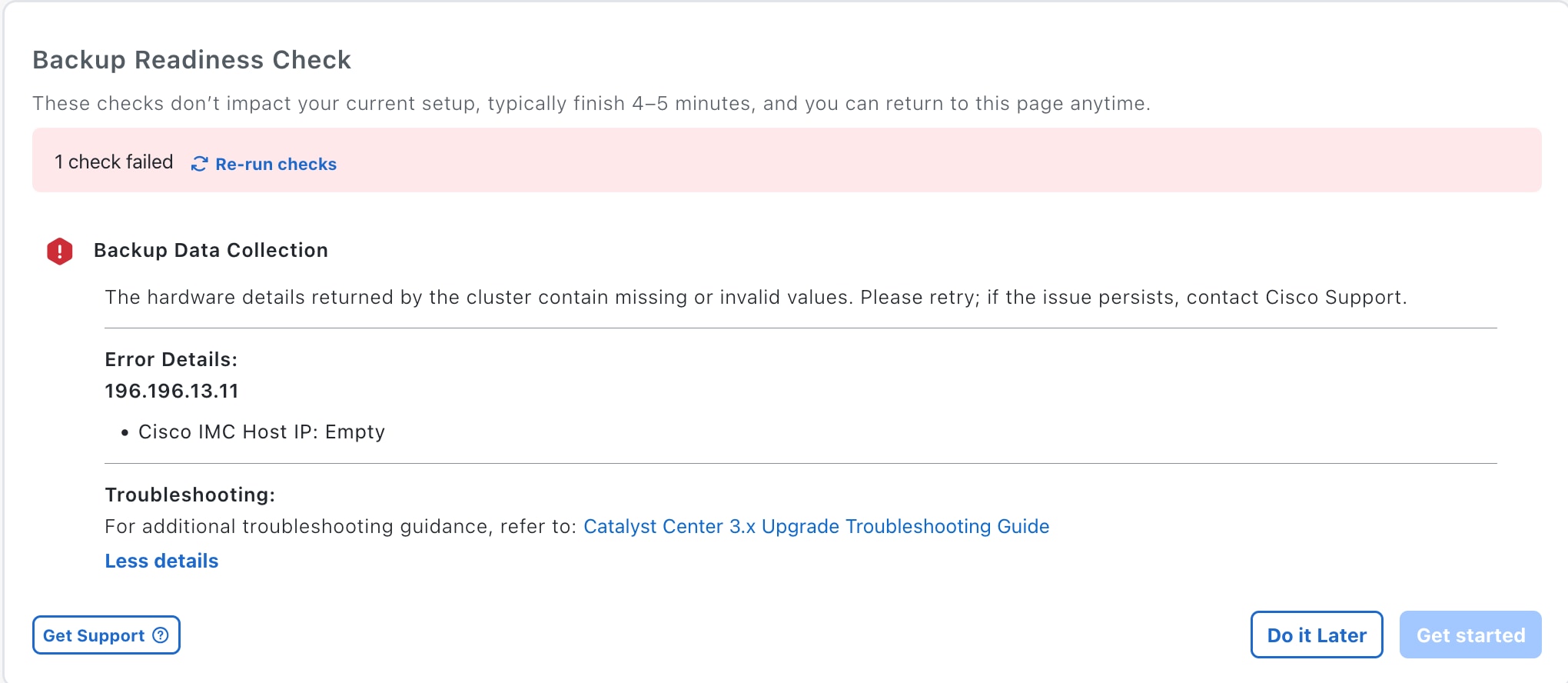
Appliance Preparation “error while making NDP disk primary: Request timed out”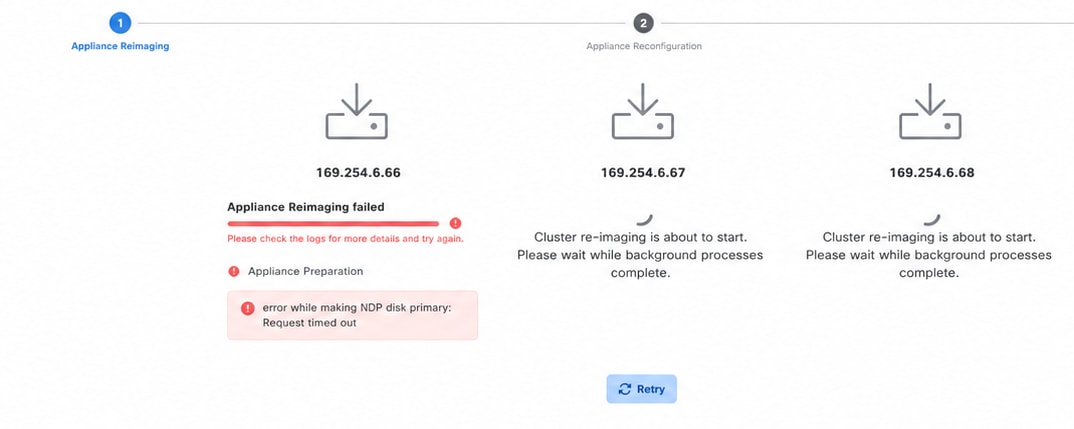
Resolution: Restart CIMC by clicking CIMC Reboot in the top right section of the CIMC graphical user interface. Click Retry after CIMC restarts.
Configured interface is physically disconnected
Issue: If you see this message, it indicates that Catalyst Center's cluster interface is not connected. All configured interfaces must be in the UP state and physically connected for the 3.x platform upgrade to proceed.
Network Interface Status Check Failed: The following issues were identified on
node 172.16.176.11:enp94sOf1(cluster): The interface is not connected Please ensure the
network cable is properly plugged in and verify the interface configuration. Retry, and
if the issue persists, contact Cisco Support.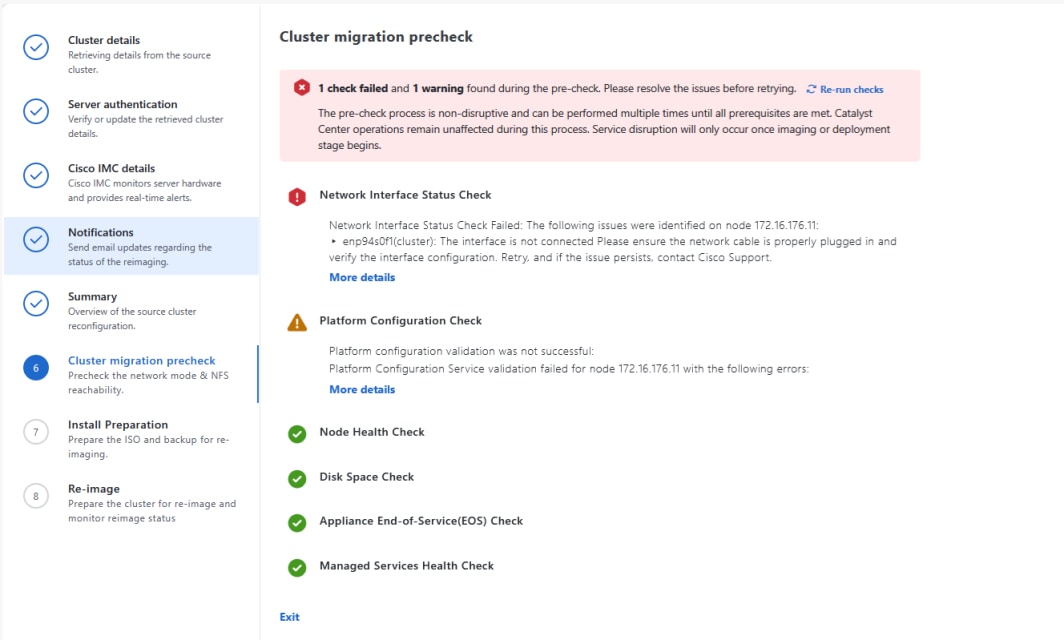
Resolution: Check or replace the physical connector or cable for the reported interface.
General issues
Email Notifications
Issue: An SMTP connection failure occurred after sending a test notification email.
Error while sending test email: The SMTP connection failed due to a mismatch between
the server certificate and its IP address or hostname. Please verify SMTP Server configuration
and check IP 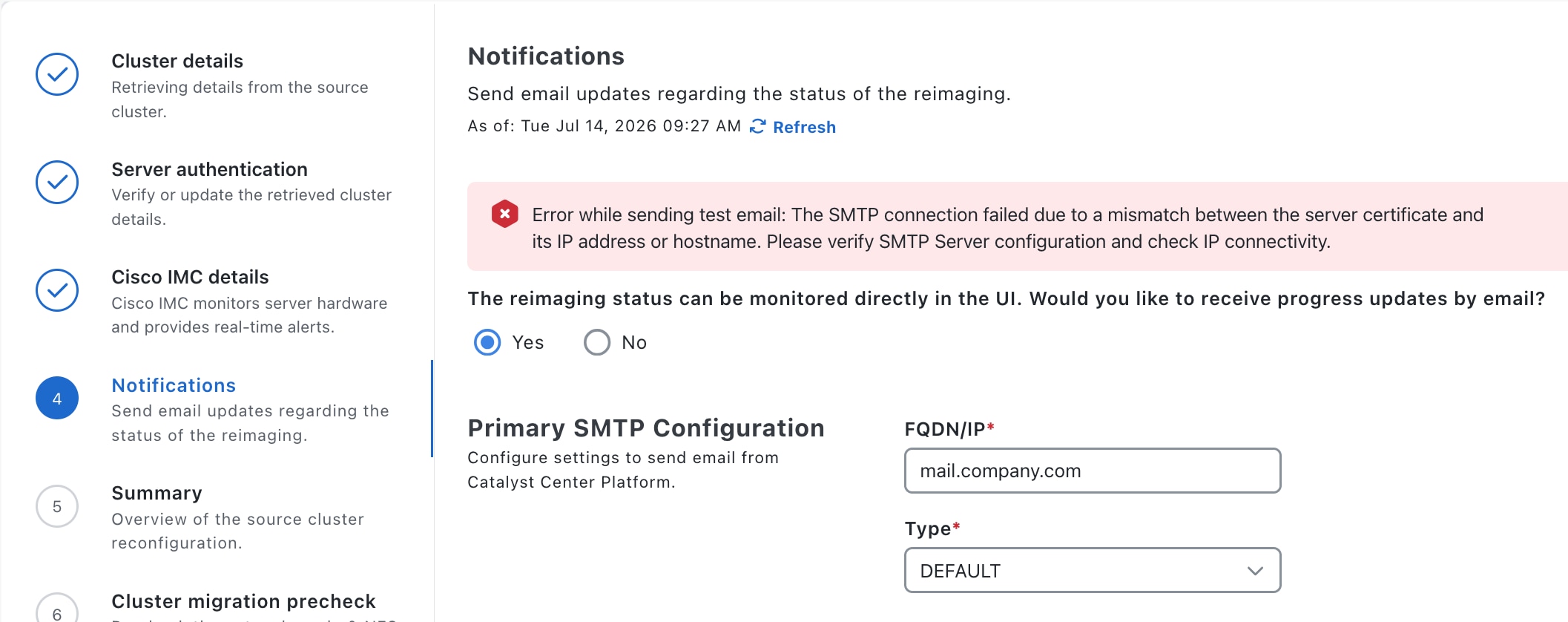
Resolution: In the 3.1.x platform upgrade wizard’s Notifications page, confirm that you entered the correct SMTP settings.
Fallback options
This topic describes the options that are available if you completed the Catalyst Center 3.1.x upgrade and find yourself in one of these situations:
- You need to delay your deployment's upgrade to Catalyst Center 3.1.x.
- You experienced a catastrophic failure that requires a reimage of your Catalyst Center appliance.
Option 1 (recommended): Proceed with the Catalyst Center 3.1.x upgrade
To continue using the new platform, complete these steps:
- Install Catalyst Center or later.
- Restore the transformed backup file. Specify the NFS directory location in its NFS backup configuration.
Option 2: Revert back to Catalyst Center 2.3.7.x
To revert back to Catalyst Center 2.3.7.x, which runs on the previous platform, you'll need to complete these tasks:
- Reimage your appliance, installing the Catalyst Center 2.3.7.x version that was installed previously.
- Revert your backup file to the same Catalyst Center 2.3.7.x version.
For assistance, contact the Cisco TAC.