Audio video bridging
Audio and video bridging (AVB) is an IEEE 802.1BA standard that
-
enables high-quality audio and video streaming over Ethernet for both consumer and professional applications,
-
allows endpoints and network equipment to operate together for interoperable deployments, and
-
replaces traditional analog single-purpose point to point one way, simplifying cabling and network management.
AVB deployment requirements and limitations
AVB deployments have specific requirements and limitations:
-
AVB is supported on SKUs running Network Advantage license.
-
AVB is supported on a total of 16 ports (12 downlinks and 4 uplinks) and on an STP enabled network.
-
Currently, AVB operates only with MSTP and RSTP.
-
AVB is supported only when the MTU is set to 1500. AVB is not supported when the MTU is configured higher than 1500 or in SD-Access deployments.
-
All switches between the talkers and listeners must be AVB aware for the MSRP streams to be established.
-
MVRP is an optional protocol, but it is recommended because it automatically manages the VLANs across all AVB nodes.
-
The switch supports a maximum of 256 streams; the exact number is limited by a bandwidth reservation of 75 percent on each port.
-
AVB Class-A and Class-B reservations occur on a first-come, first-served basis. If a Class-B reservation occurs when bandwidth is limited, and a Class-A request comes later, the Class-A reservation is rejected.
-
The PTPv1 clock must be in forward mode if it is in use.
AVB is not supported for these configurations:
-
On 2.5-gigabit (multi-gigabit) ports.
-
On ports where copper SFP is used.
-
Not supported with interface speed of 10 or 100 Mbps.
-
On stacked systems.
-
On Port-Channel interfaces.
-
Does not interoperate with redundancy protocols such as REP, PRP, and others.
Audio video bridging supported platforms
AVB is supported on the Network Advantage license.
|
PID ID |
Product ID |
No. of ports * Speed |
Downlinks |
AVB support |
|---|---|---|---|---|
|
1 |
IE-9310-26S2C |
1G SFP/ 4 ports/ 25 - 28 |
1G SFP/ 22 ports / 1 - 22 |
Yes. First 12 downlink ports and 4 uplink ports. |
|
1G Combo/ 2 ports / 23 -24 |
||||
|
2 |
IE-9320-26S2C |
1G SFP/4 X 1Gig SFP (Ports 25-28) |
1G SFP/ 20 ports / 1 - 20 |
No AVB Support. |
|
1G SFP/ 2 ports / 21- 22 |
||||
|
1G Combo/ 2 ports / 23-24 |
||||
|
3 |
IE-9320-22S2C4X |
10G SFP+/ 4 X 10 Gig SFP/ 25 - 28 |
1G SFP/ 22 ports / 1 - 22 |
No AVB Support. |
|
1G Combo/ 2 ports / 23 -24 |
||||
|
4 |
IE-9320-24T4X |
10G SFP+/ 4 ports/ 25 - 28 |
1G Copper/24 port/1-24 |
Yes. First 12 downlink ports and 4 uplink ports. |
|
5 |
IE-9320-24P4X |
10G SFP+/ 4 ports/ 25 - 28 |
1G Copper/24 port/1-24 |
Yes. First 12 downlink ports and 4 uplink ports. |
|
6 |
IE-9320-16P8U4X |
10G SFP+/ 4 ports/ 25 - 28 |
1G Copper/16 port/1-16 |
Yes. First 12 downlink ports and 4 uplink ports. |
|
2.5G Copper/8 port/17-24 |
No support on multi-gigabit ports. |
|||
|
7 |
IE-9320-24P4S |
1G SFP/ 4 ports/ 25 - 28 |
1G Copper/24 port/1-24 |
Yes. First 12 downlink ports and 4 uplink ports. |
Audio video bridging benefits
Audio video bridging benefits are advantages of a mechanism that enables Ethernet based audio-video transmission with
-
guaranteed maximum latency
-
time synchronized operations
-
bandwidth guaranteed transmission, and
-
professional-grade quality.
Components of audio video bridging network
An Audio Video Bridging (AVB) network is a communication system that
-
operates only in domains where every device is AVB capable
-
comprises AVB talkers, AVB listeners, AVB switches, and the grandmaster clock source, and
-
provides deterministic streaming of audio and video data using IEEE 802.1 AVB standards.
AVB network component types
The AVB network consists of four primary component types:
-
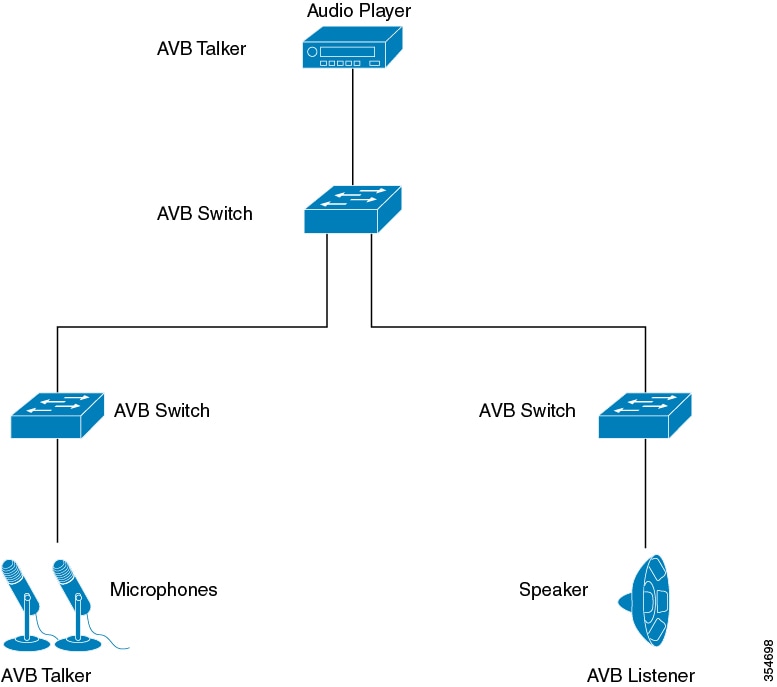
AVB Talker: An AVB end station that is the source or producer of a stream. Examples include microphones and video cameras.
-
AVB Listener: An AVB end station that is the destination or consumer of a stream. Examples include speakers and video screens.
-
AVB Switch: An Ethernet switch that complies with IEEE 802.1 AVB standards (IE-9300).
-
AVB stream: A data stream associated with a stream reservation compliant with the Stream Reservation Protocol (SRP).

Note
In some instances, the word bridge is used. In this context, it refers to a switch.
The IEEE 802.1BA specification requires that an AVB talker must be grandmaster capable. In a typical deployment a network node can also be the grandmaster, provided it can either source or derive timing from a grandmaster capable device and provide the timing to the AVB network using IEEE 802.1AS.
AVB network configurations
This figure shows a simple illustration of AVB network with different components.
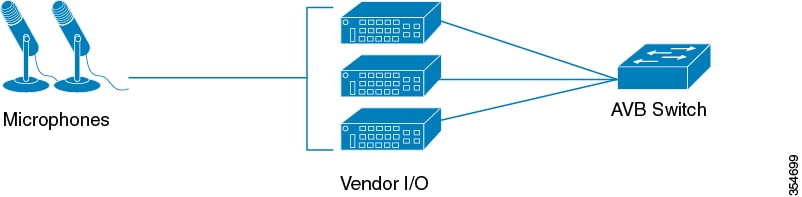
In many instances, the audio or video end points (Microphone, speaker, and so on) are analog devices. AVB end-point vendors introduce Digital Signal Processors (DSP) and I/O devices that provide extensive audio or video processing and aggregate the end-points into an AVB Ethernet interface, as illustrated in the figure.
 Feedback