550X Product Family
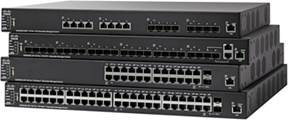
The Cisco® 550X Series are the next-generation stackable managed Ethernet switches that provide the advanced capabilities and superior performance you need to support a more demanding network environment at an affordable price. These switches incorporate fan and power hardware redundancy, increasing overall network availability. The SG550X and SF550X models provide 24 or 48 ports of Gigabit Ethernet and Fast Ethernet connectivity with 10 Gigabit uplinks. The SG550XG models provide 16, 24, or 48 ports of 10 Gigabit Ethernet with both copper and fiber connection options, providing a solid foundation for your current business applications, as well as those you are planning for the future. At the same time, these switches are easy to deploy and manage, without a large IT staff.
Compare Models In This Family Compare All 550X Series Models
-
Design
Install and Upgrade
Configure
Maintain and Operate
Troubleshoot and Alerts
-
Smartport Best Practices for Sx250, Sx350, SG350X, and Sx550X Series Switches
-
Troubleshoot Smartports on your Sx250, Sx350, SG350X, or Sx550X Series Switch
-
Configuring Switch as a Unicast Simple Network Time Protocol SNTP Client via CLI
-
Configuring VRRP Virtual Routers on a SG550XG Switch through the CLI
-
SG350XG, Sx550X: The Switch Does Not Recognize a USB Flash Drive
-
SG350X, Sx550X: Unable to Change XG Port Settings on a Switch
-
Design
Cisco Tech Talk: EOS and EOL Announcements for Beginners | Understand Product Lifecycle & Support
In this Cisco Tech Talk, we break down the basics of End of Sale (EOS) and End of Life (EOL) announcements for beginners. Learn how to interpret these important product lifecycle milestones and how they impact your network planning, upgrades, and support decisions.
Cisco Tech Talk: Switch MGig Overview
Cisco’s new 350 and 550 series switches deliver blazing-fast connectivity while providing PoE power using existing cable. They are an easy-to-deploy, budget-friendly solution that allows you to increase your network speed and bandwidth—while providing as much as five times the performance.
Cisco Tech Talk: Tracking Cisco Business EOS/EOL Announcements Easily
In this Cisco Tech Talk, learn how to access and interpret Cisco’s End of Sale (EOS) and End of Life (EOL) announcements for business-class products.
Cisco Tech Talk: What Is Layer 3 Switching on SG350 and SG550 Series Switches
Simply put, Layer 3 switches are super-fast routers that do Layer 3 forwarding in hardware, such as switches. Learn about Layer 3 Switching on SG350 and SG550 Series switches here. For additional support visit http://cs.co/9005EFHM1
Cisco Tech Talk: What is Switch Stacking
Some network switches have the ability to be connected to other switches and operate together as a single unit. These configurations are called stacks, and they are useful for quickly increasing the capacity of your network. Learn how to here. For additional information visit http://cs.co/9006E0xiM
Configuration
Cisco Tech Talk: Configure Bandwidth on SG550XG Managed Switch
Learn how to configure bandwidth options on the SG550XG Managed Switch. For more, visit http://cs.co/nr0308c.
Cisco Tech Talk: Configuring Auto-Voice VLAN on SG350 and SG550 Series Switches
AutoVoice VLAN is responsible for maintaining voice VLAN, but it depends on Auto SmartPort to maintain the voice VLAN port memberships.Learn about how to configure AutoVoice VLAN on SG350 or 550 series switches here.
Cisco Tech Talk: Configuring Basic and Advanced QoS
This video walks you through configuring basic and advanced QoS features on Cisco small business switches. For more support help, visit http://cs.co/nr0920g.
Cisco Tech Talk: Configuring DHCP Pools in Multi-LAN Environments
This video provides assistance in configuring DHCP pools in multi-LAN environments. For more support help, visit http://cs.co/nr0920c.
Cisco Tech Talk: Configuring Generic VLAN Registration Protocol (GVRP) on Cisco RV345
GVRP (Generic VLAN Registration Protocol) is a protocol that facilitates control of virtual local area networks (VLANs) within a larger network. GVRP conforms to the IEEE 802.1Q specification. Learn how to configure GVRP on SMB series Switches.
Cisco Tech Talk: Configuring LLDP on Cisco SMB Switches
This video helps you understand and configure the Link Layer Discovery Protocol (LLDP) on Cisco small business switches. For more support help, visit http://cs.co/nr0920e.
Cisco Tech Talk: Configuring Policy-Based Routing on Cisco SMB Switch
Learn how to configure Policy-Based Routing on Cisco SMB Switch. Policy-based Routing (PBR) provides a means for routing selected packets to a next hop address based on packet fields, using ACLs for classification. PBR lessens reliance on routes derived from routing protocols.
Cisco Tech Talk: Configuring Secure Shell User Authentication Settings on Cisco SMB Switches
Learn how to configure Secure Shell user-authentication settings on a Cisco small business switch. For more support help, visit http://cs.co/nr0920d.
Cisco Tech Talk: Configuring Spanning Tree Protocol (STP) Settings
Learn how to configure the Spanning Tree Protocol on Cisco switches. For more support help, visit http://cs.co/nr0920b.
Cisco Tech Talk: Configuring Switch Port Analyzers (SPAN and RSPAN) on Cisco Switch
Learn how to configure SPAN and RSPAN on SG350 and SG550 Switches. SPAN (and RSPAN) which is sometimes called port mirroring or port monitoring, selects network traffic for analysis by a network analyzer. The network analyzer can be a Cisco SwitchProbe device or other Remote Monitoring (RMON) probes.
Cisco Tech Talk: How to Use MAC Authentication on Cisco Small Business Switches
MAC Authentication allows you to filter which users can connect to your network. In this video you will learn about 802.1x MAC authentication and how to configure your SMB Switch to support it. For additional support, please visit the Cisco Small Business Support Community: http://cs.co/9008Ern9Q.
Cisco Tech Talk: How to use Static and Dynamic IP Addresses on Cisco Small Business Switches
Learn how to configure Static and Dynamic addresses on a Cisco Switch. For additional support information, visit the Cisco Small Business Support Community: http://cs.co/9003DADul.
Cisco Tech Talk: Managing Dropped Packet and Packet Loss on Cisco SG500 Series Switches
Learn how to configure SG500 Series Switches to view and manage packet loss. For more support information, visit the Cisco Small Business Support Community: http://cs.co/9005D253c.
Cisco Tech Talk: Multicast Forwarding on Cisco SMB Switch
Multicast forwarding enables one-to-many information dissemination. Multicast applications are useful for dissemination of information to multiple clients, where clients do not require reception of the entire content.
How to Configure QoS Advanced Setup on Cisco SG350 and SG550 Switches | Tutorial
In this video, we walk you through how to configure QoS (Quality of Service) advanced settings on Cisco SG350 and SG550 switches. Learn how to prioritize network traffic, improve application performance, and optimize your network’s bandwidth utilization.
How to Configure Stacking with Link Aggregation Group (LAG) on Cisco SG550x Switches
In this video, we demonstrate how to configure stacking with Link Aggregation Group (LAG) on Cisco SG550x switches. Learn how LAG can increase bandwidth and provide redundancy by combining multiple network links into a single logical connection.
How to Manage VLANs on SG550 and SG350 Switches | Configuration Best Practices
In this video, we walk you through the process of managing VLANs on Cisco SG550 and SG350 switches. Learn how to configure, assign, and troubleshoot VLANs to ensure efficient network segmentation and improved traffic management.
How to Set Up and Monitor Spanning Tree on Cisco SG550X Switch | Guide
In this video, we guide you through the process of setting up and monitoring Spanning Tree Protocol (STP) on the Cisco SG550X switch. Learn how to configure STP to prevent network loops, ensure optimal path selection, and enhance network reliability.
Maintain & Operate
Cisco Tech Talk: How to Use 802.1x EAP Statistics
Learn how to use 802.1x Extensible Authentication Protocol statistics to manage authentication on Cisco Small Business switches. For more, visit http://cs.co/nr0308b.
 Feedback