Cisco Rugged Enterprise Networking At a Glance
Available Languages
Bias-Free Language
The documentation set for this product strives to use bias-free language. For the purposes of this documentation set, bias-free is defined as language that does not imply discrimination based on age, disability, gender, racial identity, ethnic identity, sexual orientation, socioeconomic status, and intersectionality. Exceptions may be present in the documentation due to language that is hardcoded in the user interfaces of the product software, language used based on RFP documentation, or language that is used by a referenced third-party product. Learn more about how Cisco is using Inclusive Language.
Delivering seamless, secure connectivity throughout a modern campus—whether it’s a corporate office, medical center, university, shopping mall, or airport—requires extending the network well beyond just the enterprise’s office buildings. The reality of today's smart campus – which includes parking structures, building management, outdoor workspaces, and sprawling perimeter areas – demands that the network infrastructure be rugged, reliable, and secure.
Traditionally, such networks have been unmanaged islands. This creates multiple headaches: they are difficult to troubleshoot, lack assured performance, and, most dangerously, act as uncontrolled security blind spots that can introduce threats when connecting back to the core enterprise network.
A unified network between a campus and its surrounding rugged spaces is the best way to secure and manage the entire enterprise because it replaces the complexity and vulnerability of disparate systems with centralized control, consistent security policy enforcement, and streamlined operations.
● Parking lots: Improve user experience and safety with sensors for wayfinding and displays for occupancy information, surveillance cameras and gate access control, secure kiosks for payment, and chargers for electric vehicles.
● Outdoor workspaces: Provide secure Wi-Fi connections in outdoor workspaces and help your staff stay connected wherever they might choose to work.
● Across campus: Enable communication between buildings, cameras installed at campus perimeter, and temporary ad hoc locations with high-speed wireless without having to lay expensive fiber.
● Building management systems: Gain real-time control over essential systems including HVAC, generators, elevators, and pumps, even when they are housed in hot, dusty utility locations. Integrate cameras and badge-controlled doors for comprehensive physical safety.
● Remote and mobile assets: Transform remote and mobile assets from isolated units into integrated, intelligent components of your overall operation, driving down costs and maximizing productivity.
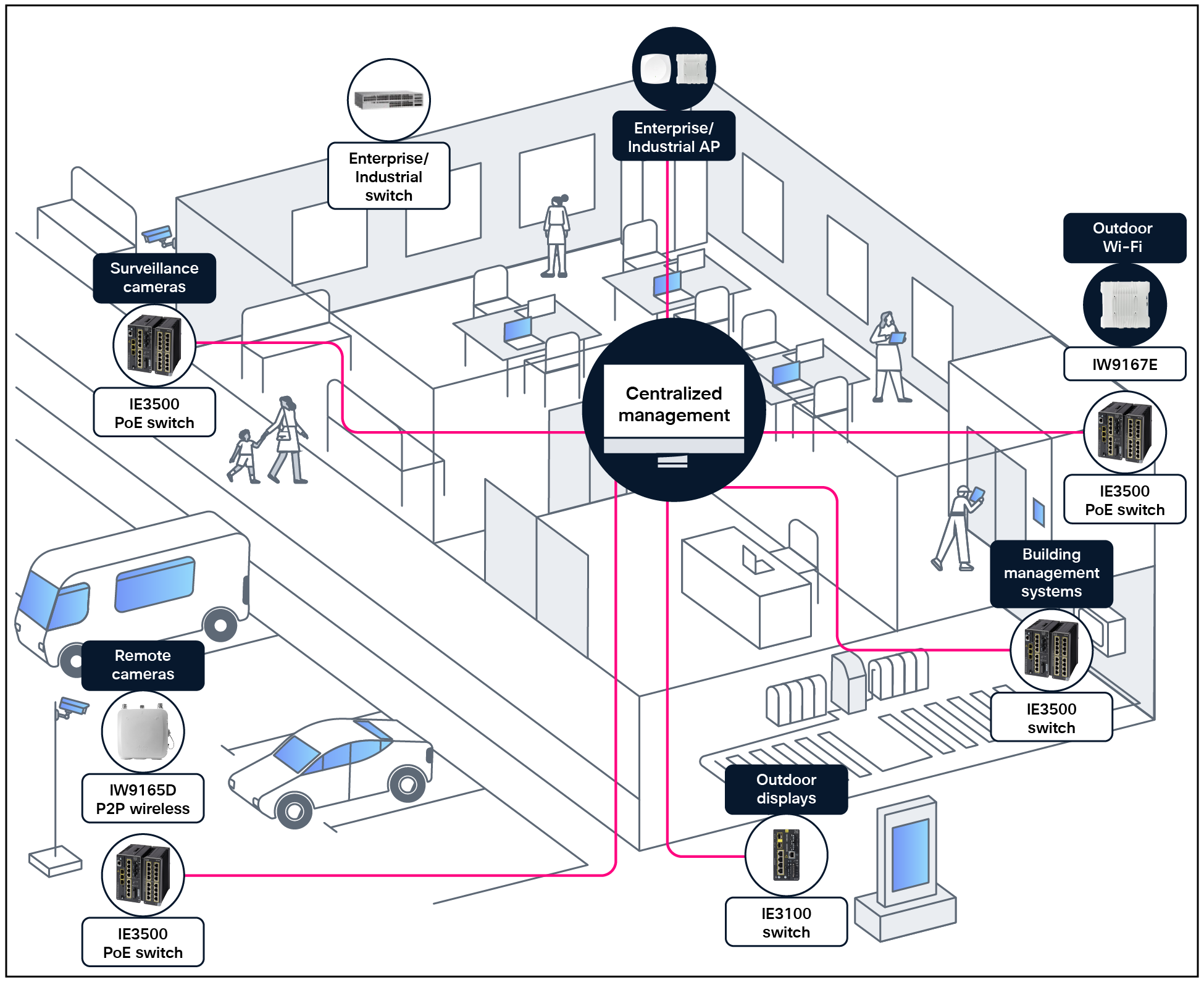
Cisco's solution for rugged enterprise networking provides an infrastructure that extends the enterprise network, with its management and security policies, beyond the campus to the outdoors and rugged spaces. The campus network is supplemented by ruggedized equipment that is purpose-built to operate reliably and securely in uncarpeted and non-climate-controlled environments. Our solution is an integrated architecture and includes the following:
● Cisco® rugged switches: A comprehensive portfolio of purpose-built ruggedized switches that are resistant to an extended range of temperature, dust, and vibration. These switches run the same Cisco IOS® XE operating system as Cisco’s enterprise switches and are managed by the same trusted Cisco Catalyst™ Center. Cisco industrial switches also offer up to 90W of Power over Ethernet (PoE) power per port, reducing complexity, improving flexibility of deployment, and making power consumption easier to monitor and manage.
● Cisco rugged wireless clients and access points: A unified offering that combines Wi-Fi 6/6E and Cisco Ultra-Reliable Wireless Backhaul (URWB) technologies. While Wi-Fi provides connectivity to laptops, phones, sensors, and other devices, URWB provides low-latency, highly reliable, long-range, and high-bandwidth connections and is an excellent alternative to wired connectivity for various locations around the campus.
● Cisco rugged routers: Secure, reliable, and flexible connectivity for remote and mobile assets in harsh environments, offering multiple WAN options like 5G and LTE, while enabling centralized management with Catalyst Center or Catalyst SD-WAN Manager and advanced cybersecurity.
● Cisco Catalyst Center: A centralized console that simplifies and automates network operations across all networking environments. Using Catalyst Center, IT teams can see, monitor, and manage devices, whether they are on the main corporate campus, in a remote branch office, or at an outdoor site, eliminating the complexity of switching between different management systems for different network domains. Catalyst Center also provides deep visibility into PoE usage enabling proactive optimization of deployment and power consumption.
● Meraki dashboard: By providing a single pane of glass for both enterprise and ruggedized networking equipment, the Meraki dashboard simplifies deployment, configuration, and troubleshooting, eliminating the complexities and security risks associated with disparate, unmanaged network silos. This ensures consistent security and operational visibility across the entire organization, from the corporate headquarters to harsh, uncarpeted environments.
● Cisco SD-WAN Manager: Uniform management for both enterprise and ruggedized routers by enabling centralized, scalable, and secure control across diverse network environments.
● Universal applicability: Extend core security and management practices to the challenging operational areas of any campus, whether it is a corporate headquarters, hospital, university, retail establishment, or airport.
● Operational efficiency: Reduce complexity and leverage existing IT skills with centralized management that assures performance for reliable and predictable experience while reducing downtime.
● Enhanced security: Eliminate security gaps and blind spots with consistent policy enforcement and zero-trust access control with authentication and segmentation.
● Business agility: Drive smart campus initiatives and digitization with rapid and scalable deployments. Improve user experience with secure connectivity and seamless mobility.
● Power optimization: Optimize energy usage and save costs with deep, actionable insights into your network's energy footprint. Proactively monitor and troubleshoot PoE issues and distribution across switches.
IT teams, it’s time to extend your expertise beyond the office and into uncarpeted spaces. By leveraging your existing skills and familiar tools, you can unify the entire organizational network. Instead of allowing facility managers or external contractors to deploy basic, unmanaged networking equipment – creating fragmented, unsecured silos – you can take charge. This approach not only provides consistent management and visibility but also closes critical security gaps, protecting your entire organization from breaches that can originate from these unmanaged silos.
To explore further and for a free no-obligation one-on-one consultation with one of our experts, please contact us and we will reach out to you to schedule a session.