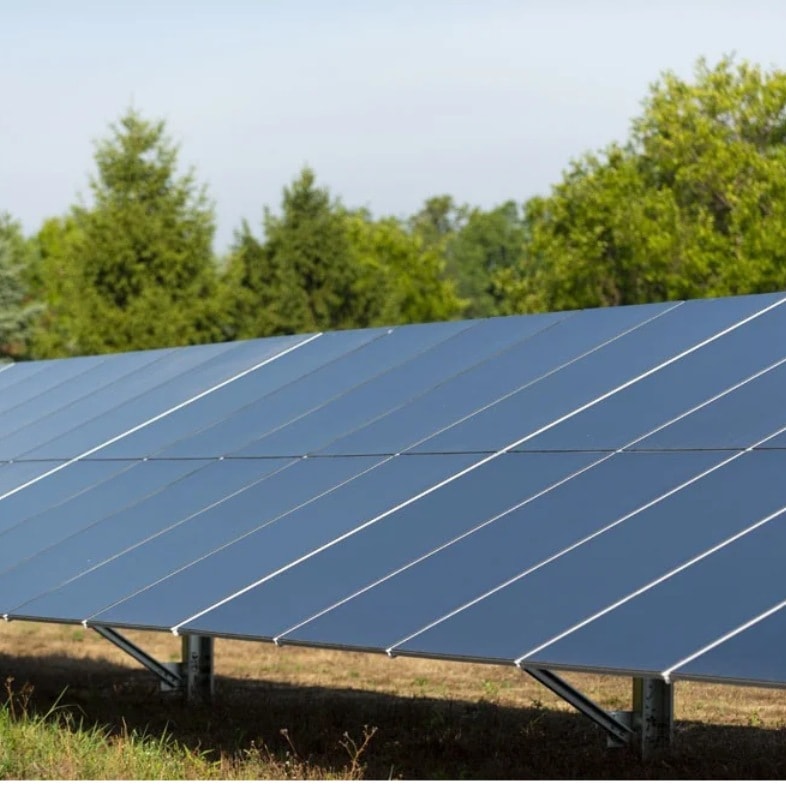
First Solar manufactures thin-film solar panels. The company operates six high-volume manufacturing facilities and is building a seventh in South Carolina.
Scaling high-yield production with modernized industrial networks

First Solar modernized its IT and manufacturing infrastructure to support data-intensive quality control systems and rapid factory expansion.
About First Solar

Challenge
As First Solar expanded its manufacturing operations, data-intensive machine vision systems strained legacy infrastructure. They needed high-performance networks and servers to guarantee continuous production uptime, and a blueprint to sustain rapid growth:
- Needed high-performance industrial networks and servers to process machine-vision data in real time and support quality control.
- Needed uninterrupted wireless coverage for workers and equipment across complex factory floors.
- Wanted to converge IT and OT onto a highly resilient, high-availability foundation to guarantee continuous operations.
- Wanted a replicable network blueprint to automate deployments at new facilities and accelerate expansion.

Solution
First Solar uses Cisco industrial networking, servers, and network automation to standardize production infrastructure. Catalyst Center and AI-enabled wireless help its team operate at scale and repeat deployments. Key capabilities include:
- Cisco Industrial Ethernet Switches offer high-performance and secure connectivity, purpose-built for modern manufacturing operations.
- Cisco Unified Computing System (UCS) bring the reliable compute power required to support critical manufacturing systems.
- Cisco AI-assisted radio resource management helps one person manage approximately 4,000 access points.
- Cisco Catalyst Center automates deployment of a standardized network blueprint at new factories.
Outcomes
Five-nines availability
Reported five-nines availability across IT services supports around-the-clock manufacturing.
Wireless at scale
One person manages approximately 4,000 access points using AI-assisted radio resource management.
Faster factory deployments
Automation reduced standard-image deployment from a team of network engineers to one or two people.
Maximized yield and uptime
High-performance industrial networking enabled machine vision at scale to maximize product quality and reduce downtime.
The business challenge: Scaling yield in a rapidly growing market
First Solar is expanding aggressively within a highly competitive and growing global clean-energy market. To meet the escalating demand for renewable energy components, the company is rapidly deploying new high-volume manufacturing facilities while concurrently driving initiatives to improve production yield within its existing plants. In thin-film solar panel manufacturing, maximizing yield and minimizing scrap are critical business metrics.
To detect product defects earlier in the production process, First Solar has started making heavy use of advanced machine-vision systems. These high-resolution operational technology (OT) systems are deployed along the manufacturing line to identify broken glass or microscopic cracks in solar panels as they emerge from production. When a system detects an anomaly, it immediately routes the panel for inspection, allowing the company to intercept quality issues before they become costly downstream problems.
However, integrating these modern manufacturing technologies introduced infrastructure challenges. AI-driven machine-vision systems are highly data-intensive, requiring high network throughput, low-latency transmission, and substantial compute capacity to process imagery in real time. This put increased pressure on the company’s legacy network and server infrastructure. Unplanned outages and network bottlenecks began to threaten the 24/7 production schedules. First Solar realized that to maintain its growth trajectory and fully utilize its defect-detection systems, it required a highly resilient, high-performance industrial network and server architecture capable of converging IT and OT environments.
The solution: High-performance industrial networking
First Solar turned to Cisco to establish a standardized, high-performance infrastructure foundation. The company required an environment where the network operates not merely as a back-office utility, but as a robust, business-critical production platform capable of supporting the immense data loads of modern manufacturing.
By standardizing its IT and factory networks on Cisco, First Solar solved its performance and reliability constraints. Deploying Cisco Industrial Ethernet switches offered the performance required to support the heavy video throughput of machine-vision cameras and the low-latency transmission needed to operate industrial controls reliably. These ruggedized switches are purpose-built to withstand the environmental realities of a manufacturing floor while delivering the bandwidth necessary for continuous video data processing.
Coupled with Cisco servers configured with high GPU and compute capacity, First Solar’s infrastructure can now process defect-detection algorithms locally and in real time. The transition to this modernized architecture completely transformed the operational stability of the facilities. By replacing fragmented legacy systems with a cohesive Cisco foundation, First Solar reduced the unplanned outages that previously disrupted manufacturing. The company now reports achieving 99.999% uptime across its IT services. In a high-volume manufacturing environment, this level of reliability limits theoretical annual downtime to roughly five minutes, directly protecting productive capacity and ensuring continuous factory output.
AI-simplified wireless for widespread connectivity
In addition to the wired industrial network, First Solar required robust wireless coverage across its massive manufacturing facilities to keep workers and tools connected. Factory floors are notoriously hostile radio frequency (RF) environments, characterized by metal structures, moving machinery, and significant interference, making reliable Wi-Fi coverage difficult to sustain through manual configuration.
To solve this, First Solar deployed Cisco Wi-Fi access points equipped with AI-assisted radio resource management (RRM). This technology continuously monitors the RF environment across the factory floor, using artificial intelligence and machine learning to automatically adjust channel assignments and power levels in response to interference or congestion.
The implementation of AI-assisted RRM provided reliable wireless coverage everywhere in the facility. Just as importantly, it drastically reduced the operational overhead required to manage the wireless estate. Cisco’s AI capabilities allow First Solar to manage an environment of approximately 4,000 access points with just one dedicated IT resource. This operational efficiency means the organization was able to free up skilled engineers to focus on higher-value resiliency and security planning rather than troubleshooting wireless connectivity issues.
A repeatable blueprint for factory expansion
Because deploying new factories is a core component of First Solar’s growth strategy, the company needed a way to bring new facilities online rapidly and consistently. In the past, deploying network infrastructure for a new plant required a large team of network engineers manually configuring hardware, which was time-consuming and introduced the risk of configuration errors and operational inconsistencies.
To accelerate its expansion, First Solar implemented Cisco Catalyst Center to automate network deployment and management. Catalyst Center serves as a centralized management plane, allowing the IT team to design a standardized network blueprint that dictates exactly how the factory network should be configured, segmented, and secured.
As First Solar builds its seventh high-volume manufacturing facility, this automation layer is proving invaluable. Instead of treating the new factory as a custom deployment, the IT team uses Catalyst Center to easily replicate their established network blueprint and deploy standard configuration images across the new hardware. This zero-touch provisioning and centralized automation reduce the effort required to deploy the network at a new factory from a full team of engineers down to just one or two people. Standardization also creates a highly predictable day-two operations environment, as all facilities operate on a familiar architecture with centralized management and consistent security policies.
Enabling the next generation of manufacturing
By establishing a standardized Cisco infrastructure, First Solar has successfully navigated the complexities of scaling clean-energy manufacturing. The combination of high-performance industrial switches and compute power ensures the machine-vision systems can operate flawlessly, supporting earlier defect detection. Simultaneously, AI-assisted wireless management and Catalyst Center automation have provided the IT organization with a highly scalable, repeatable operating model.
As First Solar continues to expand its manufacturing footprint and evaluate tools like Cisco Cyber Vision to deepen operational visibility and security across the factory floor, its underlying network is no longer a constraint. It is a resilient, automated platform designed to achieve 99.999% availability, ensuring the business can maintain its rapid growth trajectory and prepare for a more connected, data-driven future in manufacturing.
Testimonials

More for you
Next steps
Explore Cisco manufacturing
Explore Cisco solutions for connected factories, OT security, and scalable operations.
Learn about Catalyst Center
See how Catalyst Center automates network deployment and centralizes management as operations scale.