Cyber Vision New UI

Cyber Vision New UI

A Cyber Vision New UI is an asset-based user interface that

  • organizes information around assets, which is a clearer representation of physical equipment, instead of discrete components or device entries,

  • aggregates multiple network identities (including interfaces, IP addresses, and MAC addresses) that belong to the same physical equipment, and

  • prioritizes the most relevant information, such as asset name, type, and version, to help users stay focused and reduce clutter.

Table 1. Feature History Table

Feature

Release Information

Feature Description

New UI

Release 5.3.x

Cisco Cyber Vision Center offers New UI that comprises simplified, structured views of assets, vulnerabilities, and alerts. The New UI includes a new method for automatically grouping assets using AI-based clustering. Click Go to Cyber Vision New UI in the top banner of your Center to get started.

Key differences between Classic UI and New UI

The Classic UI focuses on technical entities such as components and devices. Users need to manually define presets, such as baselines or monitoring sets. They often manage separate entries for each network identity, which results in complexity and confusion.

The Cyber Vision New UI connects the physical industrial environment and its digital representation. It visually groups all elements associated with a single physical equipment. Examples include production line equipment or customer installations.

Table 2. Contrast table

Feature

Classic UI

New UI

Entity focus

Components, devices

Assets—representation of physical equipment

Information grouping

Each network identity shown as a separate item

Multiple identities grouped by asset

User effort

Requires manual preset definitions

Provides automatic aggregation to improve clarity

Information display

Shows all details, often overwhelming

Displays only the most relevant attributes of each asset.

Assets

An asset is a network entity that

  • serves as a core physical component within an industrial network, such as a programmable logic controller (PLC), a switch, a controller, or a server,

  • may represent one or more modules with distinct identifiers, which may include serial number, reference, or type, even when MAC and IP addresses overlap; and

  • is defined, categorized, and managed according to established rules in Cisco Cyber Vision to ensure effective asset inventory and operations.

Modular assets: If an asset is modular, such as a chassis with multiple modules, its summary shows details including slot, model name, type, firmware version, and serial number. Each module, such as a CPU, communication module, or I/O module, appears as a separate block in the chassis view.

Table 3. Feature History Table

Feature

Release Information

Feature Description

Search bar

Release 5.3.x

New UI contains a search bar in the global top banner. You can search for an asset by name, IP address, or MAC address.

Asset list CSV enhancements

Release 5.3.x

The CSV that you download from Cyber Vision Center includes a column that lists the sensors that have detected assets.

Asset interfaces

Assets use different network interfaces to communicate within the network. Interfaces may include MAC addresses, IP addresses, VLAN IDs, or combinations of these. The system collects interface properties from network traffic. It selects one interface as the primary interface for visualizations. If multiple interfaces exist, you can change which interface is primary. The asset list shows both the primary and additional interfaces for each asset.

Asset data management

The table presents the main functions available for managing asset data in the Assets page. It describes the specific capabilities and behavior of each function.

Function

Description

Delete assets

By default, the system deletes assets removed from the production line after 30 days.

You can manually delete assets detected due to misconfiguration. If sensors detect the assets again, the system may re-add them to the inventory.

Search for assets

Enter at least three characters from an asset’s name, IP address, or MAC address in the search bar to quickly locate details.

Export

Export all asset data to a CSV file. The export includes asset IDs so you can distinguish assets with the same name.

Filter asset data

Select Assets and use one of the these methods to manage the asset table:

  • Click Focus to sort the asset table by Default, Network, or Security.

  • Access the table settings menu to show or hide columns as needed.

Organization hierarchies

Organization hierarchies are structural models that

  • group assets, sensors, and data sources within Cisco Cyber Vision Center,

  • arrange those entities in a hierarchical tree of levels (nodes), and

  • enable granular organization, management, and access control across multiple subdivisions.

Hierarchy management

  • Each node in the hierarchy is a level.

  • The system defines the Global level and places it at the top of the hierarchy. You cannot delete this level.

  • You can add, edit, or delete levels. However, if a level contains child levels or assigned entities such as sensors or PCAPs, the system prevents deletion.

  • The system supports nesting up to five sub-levels; after this limit, no additional levels can be added.

  • You can add, edit, or delete levels in the hierarchy through Configuration > Organization Hierarchy.

Assign multiple PCAP files to an organization hierarchy

Before you begin

  • Confirm you have appropriate permissions to assign PCAP files.

  • Ensure the required PCAP files have already been uploaded.

Assign multiple packet capture (PCAP) files to an organization hierarchy to enable automated asset creation in Cisco Cyber Vision.

Use this task to organize and manage multiple PCAP files for asset management within an organization hierarchy.

Follow these steps to assign multiple PCAP files to the organization hierarchy:

Procedure


Step 1

From the main menu, choose Configuration > PCAPs.

Step 2

Select the PCAP files you want to assign to an organization hierarchy.

Step 3

Click Assign Selected to Organization Hierarchy.

Step 4

Choose the appropriate organization hierarchy.

Step 5

Click Assign.


The selected PCAP files are assigned to the chosen organization hierarchy, automatically initiating asset creation in Cisco Cyber Vision.

Each PCAP initiates asset creation in Cisco Cyber Vision.

Vulnerabilities

A vulnerability is a system weakness that

  • enables attackers to gain unauthorized access or perform malicious actions,

  • results from flaws in system design, implementation, or configuration, and

  • requires mitigation through security measures to prevent exploitation.

The system detects vulnerabilities when an asset or component matches a rule in the Knowledge Database. These rules come from CERTs, manufacturers, and partner manufacturers (for example, Schneider or Siemens). Vulnerabilities are identified by correlating Knowledge Database rules with normalized asset and component properties.

The Vulnerabilities page lists all identified vulnerabilities and their details.

Vulnerability scores

Vulnerability scores are indicative of the potential risk level and impact associated with specific vulnerabilities. Vulnerability scores include these scoring systems:

Cisco Security Risk Score (CSRS)

The Cisco Security Risk Score, which is powered by Cisco Vulnerability Management is represented on a scale from 0-100. It quantifies the risk of a vulnerability by looking beyond technical severity to understand how real-world attackers are leveraging the vulnerability in the wild—if at all. A variety of vulnerability and threat variables are considered when calculating this score, including predictive modeling to forecast the weaponization of vulnerabilities, the availability of recorded exploits or exploit kits, the presence of near real-time exploitation, and much more. Explore Cisco Vulnerability Management and the Cisco Security Risk Score at your own pace through a click-through product demo.

Common Vulnerability Scoring System (CVSS)

The Common Vulnerability Scoring System (CVSS) provides a way to capture the principal characteristics of a vulnerability and produce a numerical score reflecting its severity. The numerical score can then be translated into a qualitative representation (such as low, medium, high, and critical) to help organizations properly assess and prioritize their vulnerability management processes. For more information, see https://www.first.org/cvss/.

Vulnerabilities details

The Vulnerabilities page lists all identified vulnerabilities and their details.
Table 4. Vulnerability field descriptions

Field name

Description

Possible values/examples

CVE ID

CVE ID stands for Common Vulnerabilities and Exposures Identifier. It is a unique, standardized identifier assigned to publicly known cybersecurity vulnerabilities. This ID allows for consistent referencing of specific vulnerabilities across different security products and databases.

CVE-2023-20198

Name

This field provides a concise, descriptive title for the vulnerability.

Out-of-bounds Write Vulnerability in Rockwell ControlLogix Communication Modules

Cisco Security Risk Score (CSRS)

This is a proprietary risk assessment score developed by Cisco. It provides an evaluation of the vulnerability's severity and potential impact based on Cisco's internal analysis and threat intelligence. It's typically presented as a numerical score along with a severity level (e.g., High, Medium, Low).

  • 67-100: High vulnerability

  • 34-66: Medium severity vulnerability

  • 0-33: Low severity vulnerability

CVSS Score

It is the industry standard for assessing the severity of computer system security vulnerabilities. It provides a numerical score (0-10) and a qualitative severity rating (Low, Medium, High, Critical) based on various metrics like attack vector, complexity, impact on confidentiality, integrity, and availability. Security teams use CVSS scores to prioritize severe vulnerabilities and strengthen system security.

  • 9-10: Critical vulnerability

  • 7-8.9: High severity vulnerability

  • 4-6.9: Medium severity vulnerability

  • 0.1-3.9: Low severity vulnerability

MITRE ATT&CK® Tactics

Indicates whether the vulnerability can be associated with specific tactics from the MITRE ATT&CK® framework. Tactics represent the "why" of an attack (for example, gaining initial access, privilege escalation). A technique describes the specific actions or methods an attacker uses to achieve a tactic. Each tactic may be achieved through multiple techniques.

To view detailed information about the tactics and techniques associated with a specific vulnerability, click the CVE ID link and review the MITRE ATT&CK® section. The "3 Tactics matched" (for example) indicator suggests that the system has identified activities corresponding to three different MITRE ATT&CK tactics. Under each tactic, you can find one or more techniques used. For additional details, visit MITRE ATT&CK®.

Execution, Exfiltration, Persistence

Attack Vector

Describes the path or means by which an attacker can exploit the vulnerability. It indicates the context from which the vulnerability can be exploited (example, locally, over a network, physically).

Network, Adjacent Network, Local, Physical

Affected Assets

This number indicates how many of your monitored assets are currently identified as being vulnerable to this specific CVE. Clicking on the CVE ID provides a detailed list of these assets.

1 for CVE-2023-20198, 2 for CVE-2024-20437

Acknowledge or revert a vulnerability acknowledgement

Mark vulnerabilities as acknowledged, or undo acknowledgement as needed, to manage security alerts effectively.

Use this task when you need to acknowledge vulnerabilities affecting assets, or revert previous acknowledgements in the Cyber Vision Center.

Before you begin

Ensure you have access to the Assets or Vulnerabilities dashboards.

Procedure


Step 1

From the main menu, choose Assets.

Step 2

Select an asset.

Step 3

Select the Vulnerabilites tab.

Step 4

Select the relevant CVE ID to view vulnerability details.

Step 5

In the Add/Edit Comment field, enter a comment as needed.

Step 6

To acknowledge the vulnerability, select Acknowledge on this asset.

Step 7

To revert acknowledgement, select Revert Acknowledgement.


  • When you acknowledge a vulnerability, the system clears the alerts from the Alerts dashboard.

  • When you revert an acknowledgement, the alerts reappear in the Alerts dashboard.

Communication maps

A communication map is a network visualization tool that

  • visually displays communication patterns among industrial assets,

  • enables filtering and grouping of assets by protocol, network, or functional group, and

  • supports investigation by providing details such as observed protocols, data exchange volumes, and source/destination asset information.

This functionality enables operational technology (OT) and information technology (IT) teams to quickly visualize and understand the communication context of industrial assets. It provides a clear visual reference to abnormal communications and potential risks.

Table 5. Feature History Table

Feature

Release Information

Feature Description

Communication maps and their filter enhancements

Release 5.4.x

Easily spot communications between assets, including those outside your active view. Communication maps highlight assets outside your active view filter with dotted lines.

External communications visibility

Release 5.4.x

View all communications between a selected asset and external entities. You can identify unexpected external communications that may expose your organization to attacks.

Group by network functionality in communications

Release 5.4.x

The communication map displays all communications between network groups and simplifies network interaction analysis.

See functional group–centric views of the communication map

Release 5.3.x

The communications map displays the communication activity between the configured functional groups. The communication links between groups are not actionable.

Using asset vendor names and icons

Release 5.3.x

In the New UI, communication maps include vendor icons that make asset identification easier.

Communication map features

The communication map offers multiple features to view and analyze network communications and subnet details:

You can access the communication map from the Communications page in the main menu. The map provides these features:

  • Displays all communications between networks

  • Shows subnet details for each map node

Table 6. Communication map features

Feature

Feature

Time filter

  • Use the time filter to focus on communications during specific periods for trend or activity analysis.

  • The Last week filter is enabled by default.

Protocol filter

  • The protocol filter lists all protocols used.

  • By default, all protocols are visible. However, Traffic-heavy Protocols are deselected to improve clarity. You can select them manually to display their data.

Show unknown (L2 Network)

Displays subnets that contain only MAC addresses without IP addresses.

Allow node rearrangement

Lets you rearrange nodes on the map for clarity. Rearrangements are temporary and are not saved after you leave the view.

Asset communication map features

The asset communication map displays all communications between the asset you select and other individual assets.

Table 7. Features

Feature

Description

Search

Allows you to search for assets within the current map and view their communication details.

Time filter

  • Use the time filter to focus on communications during specific periods for trend or activity analysis.

  • The Last week filter is enabled by default.

Group communications

  • You can group assets by Network (subnet) or Functional Group to organize the map.

    Note


    Before organizing the communication map, accept functional groups and define network groups.

  • Group nodes show communications between assets from the same group. Individual links show details of communication between groups: observed protocols, data exchange volumes, and information about the asset source or destination.

  • If an asset communicates with another asset you did not include in the active view filter, the map displays the node and links for that asset as a dotted line.

  • Non-communicating groups appear in grid view on the map.

Communication type

Enables filtering of the communication map by external or internal communications.

Protocol filter

  • Lists all protocols used between assets.

  • All protocols appear by default, but Traffic-Heavy Protocols are deselected to improve clarity.

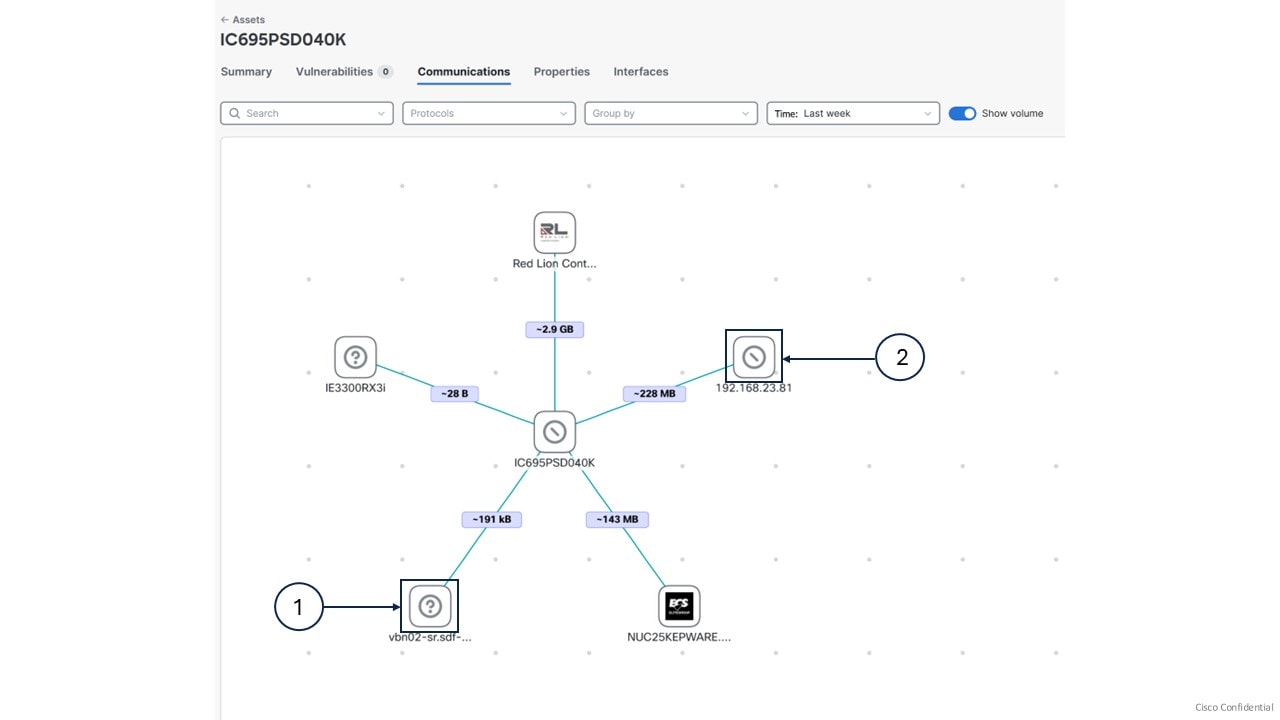
Assets identification

For each asset, the map shows the vendor icon and name. If this information is unavailable, you see the asset’s IP address or MAC address.

Figure 1. Icon descriptions

Icon

Description

(1)

This icon indicates that vendor information for the asset is unavailable.

(2)

This icon indicates that the vendor is known, but its icon is unavailable.

External communications in the New UI

Visualize external communications to identify unexpected paths that could expose your organization to attacks from external sources.

External communication appears in the New UI when:

  • The communication is to or from networks that are explicitly marked as External in the Classic UI.

  • If no external networks are defined (in the Classic UI under Admin > Network Organization), Any communication not assigned to an IT Internal or OT Internal network counts as external communication.

Display external communications for an asset

Display all external communications between your selected asset and external entities for monitoring or auditing.

Procedure

Step 1

From the main menu, select Asset.

Step 2

Click your asset that has external communications.

Step 3

Open the Communications tab.

Note


In the map view, external communications are grouped under the All external communications icon.

Step 4

To display the list of external communications with detailed information, choose one of these options:

  • Click the All external communications icon on the communications map.

  • Switch to the List view.


You see all external communications associated with your selected asset, including details about each connection.

Asset clustering

Asset clustering is a functional grouping that

  • organizes assets based on their real-world network communication patterns,

  • distinguishes between Operational Technology (OT) and Information Technology (IT) assets for grouping, and

  • is generated automatically through algorithmic analysis.

Asset clustering simplifies asset management by creating groups that reflect actual communication behaviors in a network. The system suggests groupings, identifies transferable assets, and maintains cluster stability until network patterns change.

Table 8. Feature History Table

Feature

Release Information

Feature Description

Receive property-based and communication-based group suggestions from asset clustering algorithm

Release 5.3.x

Asset clustering algorithms suggest property-based groups (assets that share the same definition, network, or other properties), in addition to communication-based groups (assets that primarily communicate with each other).

Asset movement

  • Asset clustering helps to identify assets that can move between functional groups, those that can move to an ungrouped list, and ones that can move from the ungrouped list into a group.

  • The algorithm recommends which assets to transfer and then provides an updated list of functional groups.

Asset clustering suggests two types of functional groups to help organize your assets:

  • Communication-based groups: Consist of OT assets that primarily communicate with each other rather than with the broader network. These groups serve as OT process function groups to align with automation stations.

  • Property-based groups: Consist of assets that share common definitions, network attributes, or other properties.

Cluster assets into functional groups

Organize related assets into functional groups for easier management and monitoring.

Use asset clustering to group assets based on function or communication patterns. You can access asset clustering from configuration pages including Functional Group, Sensor Applications, Assets, or from an individual asset's detail page.

Follow these steps to perform asset clustering:

Procedure


Step 1

From the main menu, choose Configuration > Functional Groups.

Step 2

Click Start asset clustering.

The system suggests functional groups in the list.

Step 3

Click the Functional Group name to review group details.

Step 4

Click Map to view asset communications within the group.

Note


The lightning symbol indicates the most significant asset in the group.

Step 5

Click Edit Name to change the Functional Group name.

Step 6

Click Accept to create the functional group.


The assets are clustered into a new functional group.

What to do next

  • Accept or discard the suggested functional groups before you run clustering again.

  • If you click Discard, the system ungroups the recommended assets and includes them in the next clustering run.

Asset clustering methods

You can perform asset clustering for individual assets, groups, or sensors using several available methods. This table summarizes each method and its description:

Method

Description

For the set of assets

Use asset clustering to analyze a specific set of assets. This method excludes unrelated functional groups from the results.

From the main menu, choose Assets. Check the checkboxes of the assets, click More actions, and select Run asset clustering.

For a functional group

Perform focused asset clustering for a specific functional group.

Click the functional group name from the Functional Group column on the Assets page, click More actions, and select Run asset clustering.

For a sensor

Cluster assets detected by a specific sensor application. This process improves data organization and analysis.

Select the sensor applications from Configuration > Sensor Applications and click Run asset clustering.

For an individual asset

Group similar assets by running the asset clustering function for a selected asset.

Click the asset name on the Assets page, click Functional group actions, and select Run asset clustering.

Functional group actions and descriptions

Understand the available actions you can perform on functional groups, as well as the effect of each action.

The table lists the functional group actions and their descriptions.

Action

Description

Lock functional group

When you lock the group, it stays out of asset clustering. While locked, no assets can be added or removed from the group during clustering operations.

From the Assets page, click the functional group name. Click More actions and select Lock Group.

Move asset from one functional group to another

You can manually adjust your functional group by moving assets between groups. The asset clustering process may not always be able to move assets automatically.

From the Assets page, check the checkboxes of the assets. Click More actions and select Add selected to group. Select the functional group from the list and click Add.

Delete the functional group

Permanently removes the specified group from the system. Assets in the deleted group are no longer associated with that group.

From the Assets page, click the functional group name and click Delete group.

Remove asset from functional group

Detaches an asset from its current functional group without moving it to another group.

Check the checkbox of the asset from the Assets page, click the More actions, and select Remove asset from group.

On the Assets page, select the checkbox for the asset. Click More actions and select Remove asset from group.


Note


To access the More actions field, accept or discard the suggested functional groups.


Alerts

Alerts are system-generated notifications that

  • indicate significant activity or irregularities detected within an industrial network,

  • categorize information based on type, associated data, and network components, and

  • provide warnings to help with security monitoring and response.

An alert is a notification that triggers when a user-defined rule’s condition is met. Cyber Vision sends alerts through Syslog when they are raised, cleared, or their status changes. For details about this configuration, see Enable or disable syslog notifications for an alert type.

You can acknowledge vulnerabilities on assets to clear corresponding alerts from the dashboard or revert acknowledgments to restore alerts.

Table 9. Feature History Table

Feature

Release Information

Feature Description

Network-based organization hierarchy alert configuration

Release 5.4.x

You can configure alerts at the organization hierarchy level with one additional entity type: Organization Hierarchy (Networks).

The system changes all existing alert rules with the entity type Organization Hierarchy to Organization Hierarchy (Sensors) automatically.

Mute or unmute alert instances for prohibited vendor alert type

Release 5.4.x

You can use the mute and unmute feature to control prohibited vendor alerts. Mark alert instances as reviewed and not urgent so they remain in the system but are not active. Select the duration to mute an alert instance; after that period, the alert becomes active again.

Active and cleared alerts

Release 5.3.x

The Alerts page displays two types of alerts:

  • Active

  • Cleared

Pause alert creations

Release 5.3.x

You can pause an alert type in the Configure > Alerts

Change vulnerability scoring system for alerts

Release 5.3.x

The Cisco Security Risk Score is the default scoring system applied to alert configurations. However, you can choose to update an alert configuration to apply the CVSS scoring system instead.

Alert for severe vulnerabilities in monitored entities

Release 5.3.x

Create and edit rules for the Severe vulnerabilities in monitored entities alert based on the Cisco Security Risk Score or the CVSS score.

Alert for prohibited vendors

Release 5.3.x

The Configure > Alerts page contains a default alert for prohibited vendors. The alert rule is based on an editable list of prohibited vendors.

Alert features and types

This section describes the alert stages, default types, default rules, and attributes used in the Cyber Vision center.

Alert stages

You can track alerts as they progress through different stages.

  • Active: This tab displays current unresolved alerts. Alerts remain active while the underlying problem exists.

  • Muted: When you mute alert instances related to the prohibited vendors alert type, those alerts appear in the muted tab.

  • Cleared: Once you resolve the issue, alerts appear in the Cleared tab. The system retains cleared alerts for up to 14 days and then purges them.

Default alert types and associated default rules

Severe vulnerabilities in monitored entities

  • The system monitors assets and raises alerts for high-severity vulnerabilities.

  • The default rule of this alert type is Default_OH_Global.

Prohibited vendors

  • The system triggers alerts for assets linked to prohibited vendors.

  • The default rule of this alert type is Prohibited_list.

Table 10. Alert details

Name

Description

Alert Type

Types include Severe vulnerabilities in monitored entities and Prohibited Vendors.

Trigger

Values vary by alert type, such as vulnerabilities or specific vendor names.

Instances

The number of assets impacted by the alert rule.

Severity

Severity levels are Critical, High, Medium, and Low.

Triggered By

The alert category causes the alert.

Last Detected

Displays the date and time when the alert was last triggered.

Alert type management and permitted alert rule actions

Configure alert types and permitted actions for each alert rule to manage alerts for monitored entities and prohibited vendors.

Alert type management options:

  • You can pause or resume each alert type from the configuration interface (Configuration > Alerts).

  • Pausing an alert type temporarily stops new alerts for its rules without affecting existing alerts.

  • Resuming re-enables new alert notifications for its rules.

Table 11. Permitted alert rule actions for each alert type

Alert Type

Permitted alert rule actions

Severe vulnerabilities in monitored entities

Create, edit, duplicate, or delete alert rules

Prohibited vendors

Edit alert rules only

Use these options to maintain security awareness and ensure appropriate rule management for each alert type in your organization.

Create alert rules

Add alert rules to monitor asset vulnerabilities and receive timely notifications in the Alerts dashboard.

Use alert rules in the Severe vulnerabilities in monitored entities alert type to track severe vulnerabilities in assets. If a vulnerability matches a rule, you see an alert on the dashboard.

Before you begin

  • You cannot create alert rules for the Prohibited Vendors alert type.

  • You see only the default alert rules before creating new ones.

Procedure


Step 1

From the main menu, choose Configuration > Alerts.

Step 2

Select the Severe vulnerabilities in monitored entities alert type.

Step 3

Click Create new rule.

Step 4

Add an Alert Rule Name, then select the Severity and Entity type.

Entity types:

  • Functional Groups: Triggers alerts for assets associated with functional groups.

  • Organization Hierarchy (Sensors): Triggers alerts for assets linked to sensors assigned to the selected organization hierarchy levels.

  • Organization Hierarchy (Networks): Triggers alerts for assets linked to networks assigned to the selected organization hierarchy levels.

Step 5

On the Entity selection page, select organization hierarchy levels or functional groups.

  • If selecting assets based on functional groups, check Include Ungrouped assets to include assets not in any functional group.

  • If selecting assets by organization hierarchy (Networks), check Assets seen in Unknown networks to include unidentified or unmapped assets.

  • If selecting assets by organization hierarchy (Sensors), check Assets seen by Unknown data sources to include unidentified or unmapped assets.

Note


The available Entity selection options depend on the Entity type you select in the Rule name and entity type step.

Step 6

In the Scoring system and threshold tab, select one scoring system:

  • For Cisco Security Risk Score, enter a threshold number between 34 and 100.

  • For CVSS, enter a threshold number between 7 and 10.

Note


Cisco Security Risk Score is the default, but you can select CVSS.

Step 7

Review your selections in the Summary and click Save.


The new alert rule appears on the Configuration > Alerts > Severe vulnerabilities in monitored entities page. You receive alerts when asset vulnerabilities match the new rule.

What to do next

  • Regularly review the Configuration > Alerts page to manage and update alert rules as needed.

  • To manage alert rules, navigate to Configuration > Alerts, select an alert type, and choose to edit, duplicate, or delete actions.

Mute prohibited vendor alert instances

Mute the relevant alert instances to prevent repeated reviews of known alerts for prohibited vendors.

Use the mute feature to mark specific asset alerts as reviewed and not urgent. Muted alert instances remain in the system. They are inactive until the mute period ends.

Procedure


Step 1

From the main menu, choose Alerts.

Step 2

On the Active tab, find the Prohibited vendors alert and click the relevant alert Instances count.

Step 3

Select the alert instances you want to mute.

Step 4

Click Mute.

Step 5

Select the mute duration.

  • You can select from three available durations: Forever, For 7 days, or For 30 days.

  • To specify a custom period, select Custom and enter a number of days from 1 to 180.

Note


After the selected duration (except Forever), alerts become active again.

Step 6

(Optional) Add a comment.

Step 7

Click Mute to confirm.


Muted alerts move from the Active tab to the Muted tab.

What to do next

  • If you need to unmute an alert instance, navigate to Alerts > Muted tab, click the relevant alert Instances count, select the alert instance, and click Unmute.

  • After you unmute, the instance drawer of the active alert shows when it was last muted.

Syslog notification details for various alert types

The system sends syslog notifications to the configured syslog server when an alert is raised, cleared, or its status changes. Notifications include information that helps you track and investigate events.

Common syslog message fields

  • CEF:0

  • vendor: cisco

  • product: Cyber Vision

  • version: 2.0

  • event_class_id: alert_raised or alert_cleared

  • event_name: alert type name

  • severity id: numeric value based on the severity of the alert rule

  • cat: alert category

  • SCVAuthorId (optional): User ID if a user manually acknowledged an alert; empty if the system cleared the alert

  • alertRuleId: Alert rule UUID

  • alertId: Alert UUID

  • msg: Value changes based on alert type and event_class_id

  • assetId

  • assetName

  • assetFunctionalGroupId: Empty when the asset is ungrouped

  • center-id: UUID of the center

  • sensorNames

Table 12. Additional fields for specific alert types

Alert type

Fields

Severe vulnerabilities in monitored entities

  • vulnNumber: For example, CVE-2023-10025

  • vulnName

  • vulnCVSSscore

  • vulnCSRSscore

Prohibited vendors

  • vendorName: Listed when the alert involves prohibited vendors

These syslog notification details enable effective monitoring and response to system alerts of various types.

Enable or disable syslog notifications for alert types

You can manage whether the Cyber Vision Center sends syslog notifications for alerts of specific alert types to your configured syslog server.

Follow these steps to enable or disable syslog notifications for an alert type:

Before you begin

  • Ensure you have administrator access to Cyber Vision Center.

  • Confirm that a syslog server is configured. See Configure syslog.

Procedure


Step 1

From the Cyber Vision New UI, choose Configuration > Alerts.

Step 2

Select an alert type.

Step 3

Enable or disable Syslog Notification.


When you enable syslog notifications in the Cyber Vision Center, you receive syslog messages on the configured syslog server whenever the system raises (or unmutes), clears, or mutes an alert.

Filters

A filter is a New UI feature that

  • narrows the information displayed on core Cyber Vision pages,

  • allows users to focus on specific assets, network segments, or alerts, and

  • leaves configuration actions unaffected.

Table 13. Feature History Table

Feature

Release Information

Feature Description

Filter Cyber Vision Center data by organization hierarchy

Release 5.3.x

All the data views in New UI can be filtered by organization hierarchy, sensors, or networks associated with an asset.

At the top of the left menu, in the Organization filter, choose the hierarchy level you want to focus on.

Global is the default choice and covers all assets.

Filter data in Cyber Vision Center by active view filter

Release 5.3.x

A product-level banner in the New UI allows you to filter data on every page except configuration pages.

If you have not applied any filters, No filter applied is displayed.

Click Edit to apply one or more filters from functional group, network or sensor, asset type, and vendor categories.

Filter views in Cyber Vision New UI

Narrow the information displayed in Cyber Vision New UI by applying filters to the Dashboard, Alerts, Assets, Vulnerabilities, and Communications pages.

Use filters to focus on specific assets, network segments, or alerts in Cyber Vision. This action does not affect Configuration pages.

Use these steps to filter data in Cyber Vision:

Procedure


Step 1

From the main menu, choose Organization.

Step 2

Select either Sensors or Networks.

Note


The Sensors tab is selected by default.

  • To select all sensors or networks at a hierarchy level, select that level.

  • To choose specific sensors or networks from a selected hierarchy level: open the organization drawer again, open Sensor selection or Network selection, select items, then click Apply.

    Note


    To select assets not linked to sensors or networks, choose Unknown.

  • Use the search box to find sensors or networks by name.

Step 3

To clear your selected sensors or networks and return to the complete organization hierarchy, open the Organization Hierarchy drawer again and click the Reset selection icon.

Step 4

To edit the sensor or network selection for the selected organization hierarchy only, open the Organization Hierarchy drawer again and click the Edit selection icon.

Step 5

To refine your filter, click Edit on the active view bar.

Step 6

Use the Select buttons to add filters as needed.

Step 7

Click Apply to update or Reset to clear the filters.


The views show only data that matches your filter criteria.

What to do next

Review the filtered data on Dashboard, Alerts, Assets, Vulnerabilities, or Communications pages.

Network definitions

A network definition is a configuration element in Cyber Vision that

  • specifies which networks (IP ranges and VLANs) should be monitored,

  • allows classification of internal IT and OT assets to improve asset inventory accuracy, and

  • enables exclusion or grouping of assets for focused security assessments.

Table 14. Feature History Table

Feature

Release Information

Feature Description

Assign a network to an organization hierarchy

Release 5.3.x

Assign a network to an organization hierarchy level.

Network definition details

  • Cyber Vision includes network definitions preconfigured with the default RFC1918 addresses: 10.0.0.0/8, 172.16.0.0/12, and 192.168.0.0/16.

  • By default, all assets detected through PCAP analysis or sensors are grouped into a single network. To improve asset accuracy and relevance, assign network definitions to one of three network types:

    • OT Internal ((for devices such as PLCs and HMIs))

    • IT Internal (for laptops and other IT assets)

    • External (for assets that are excluded from inventory)

  • Network administrators choose network types and validate IP ranges to avoid duplication.

  • In the Classic UI, you can create new network definitions. In the New UI, you can only view and assign existing definitions.

Assign a network to an organization hierarchy

Assign a specific network to a designated level within the organization hierarchy. This action aligns management access and policy controls with the organizational structure.

Perform this task when you need to organize network resources, apply hierarchical policies, or update the organizational assignment for the network.

Follow these steps to assign a network to an organization hierarchy:

Before you begin

You must have Network Definition permission with read/write access.

Procedure


Step 1

From the main menu, choose Configuration > Network Definition.

Step 2

Locate the network you want to assign and click Assign.

Step 3

Select the appropriate organization hierarchy level.

Step 4

Click Assign to complete the assignment.


The selected network is now associated with the specified level in the organization hierarchy.

Sensor applications

A sensor application is an embedded software component that

  • runs on Cisco networking devices or runs as a standalone system,

  • captures industrial network traffic and performs deep packet inspection to extract relevant information, and

  • securely transmits metadata to the center for storage and analytics.

Sensor applications use Cisco’s IOx platform (IOx is Cisco's software framework) to integrate into existing Cisco routers, switches, or purpose-built appliances.

Sensor health and processing states

You can view all installed sensors in the Configuration > Sensor Applications section of the Cyber Vision New UI. Use this section to understand each sensor’s network device, health status, and processing status.

Health status

The table describes each operational lifecycle step of the sensor and the impact on connectivity and management requirements.

Status

Description

New

The first status of the sensor after detection by the Center. The sensor is requesting an IP address from the DHCP server.

Request pending

The sensor has requested a security certificate from the Center and is awaiting enrollment authorization.

Authorized

The sensor has just been authorized by an administrator or product user and will soon transition to “Enrolled.”

Enrolled

The sensor has completed enrollment, possesses a certificate and private key, and is actively connected to the Center.

Disconnected

The sensor was previously enrolled but is not currently connected to the Center. This may occur due to device shutdown, network disruptions, or sensor issues.

Processing status

The table provides information about the communication state of the sensor and data flow with the Center.

Status

Description

Disconnected

The sensor is enrolled but not currently connected to the Center.

Not enrolled

The sensor is not yet enrolled; typically paired with the “New” or “Request Pending” health status.

Normally processing

The sensor is connected and actively sending data to the Center for analysis.

Waiting for data

The Center has processed all received data and is awaiting new data from the sensor.

Pending data

The sensor is attempting to send data, but the Center is busy processing other incoming data.

Assign sensors to the Organization Hierarchy

Assign one or more sensors to an Organization Hierarchy to enable asset creation within Cisco Cyber Vision.

Use this task to map sensors in your environment to a defined organization hierarchy. Assignment enables Cisco Cyber Vision to organize asset data and operational context based on organization hierarchy.

Follow these steps to assign sensors to the organization hierarchy:

Procedure


Step 1

From the main menu, choose Configuration > Sensor Applications.

Step 2

To assign a single sensor, locate the sensor and click Assign.

Step 3

To assign multiple sensors, select the checkboxes for each sensor and click Assign Selected to Organization Hierarchy.

Step 4

Select the organization hierarchy.

Step 5

Click Assign to confirm.


Your selected sensors are assigned to the organization hierarchy. Each assigned sensor is responsible for asset creation in Cisco Cyber Vision.

Use Cases

Filter PLCs by organization hierarchy

Organize and review your PLC assets based on the organization hierarchy.

Before you begin

  • Create your organization hierarchy.

  • Assign sensors, networks, and PCAP to your organization hierarchy.

Procedure


Step 1

From the main menu, choose Organization.

Step 2

Select Sensors or Networks.

Step 3

Select the organization level.

Step 4

Click Edit on the active view bar.

Step 5

Apply the Asset types filter for PLCs.

Step 6

Click Apply.


The list displays PLCs organized by the selected organization hierarchy level.

Acknowledge critical vulnerabilities

Acknowledge critical vulnerabilities with a CVSS score greater than 9.0 to declutter dashboards, and reduce alert noise.

Use this task when you need to focus on vulnerabilities of the highest severity for an asset by filtering and acknowledging them.

Before you begin

  • Ensure you have permission to view and acknowledge vulnerabilities.

Procedure


Step 1

From the main menu, choose Assets and click asset name.

Step 2

View the Vulnerabilities list for the selected asset.

Step 3

Click the filter icon of the table.

Step 4

Select Critical from the drop-down list in the CVSS Score column.

Step 5

Click Acknowledge.


When you acknowledge vulnerabilities, they no longer appear in dashboard counters and alerts. This simplifies ongoing risk management.

What to do next

Review acknowledged items periodically to ensure they remain appropriate.