-
Flexible NetFlow is not supported on the Layer 2 port-channel interface, but is supported on the Layer 2 port-channel member
ports.
-
Flexible NetFlow is supported on the Layer 3 port-channel interfaces and member ports but not on both at the same time for
the same traffic type and direction.
-
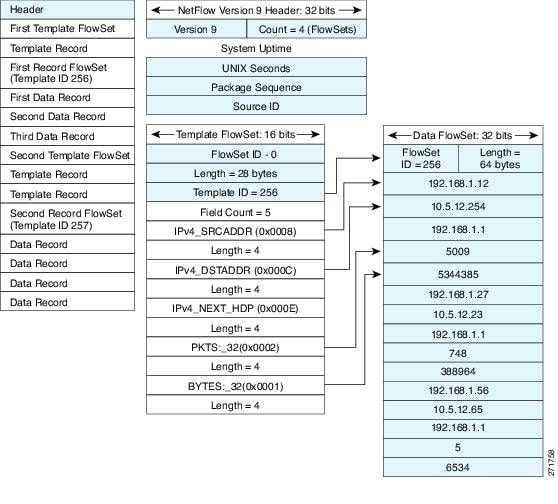
Flexible NetFlow Version 9 and Version 10 (IPFIX) export formats are supported. Flexible Netflow Version 5 Export Protocol is also supported. However, if you have not configured the export protocol, Version 9 export format is applied by default.
-
Flexible Netflow without AVC and other NBAR or AVC enabled features cannot be configured at the same time on the same interface.
Use AVC Flexible Netflow with these features.
For information on how to configure AVC Flexible Netflow, refer "Configuring Application Visibility and Control in a Wired
Network" section of the System Management Configuration guide.
-
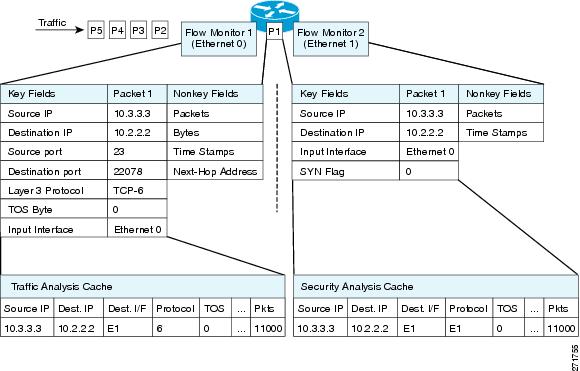
Layer 2, IPv4, and IPv6 traffic types are supported. A unique flow monitor for each traffic type can be applied for a given
interface and direction. Multiple flow monitors for the same traffic type cannot be applied to an interface in the same direction.
-
Layer 2, VLAN, Layer 3 and SVI interfaces are supported, but the device does not support tunnels.
-
The following NetFlow table sizes are supported:
|
Trim Level
|
Ingress NetFlow Table
|
Egress NetFlow Table
|
|
Network Essentials
|
32 K
|
32 K
|
|
Network Advantage
|
32 K
|
32 K
|
-
Depending on the switch type, a switch will have one or more forwarding ASICs, with multiple cores per ASIC. The capacities
listed in the above table are on a per-Core/per-ASIC basis.
-
The switch can support up to 3 ASICs. Each ASIC has two cores. Each core has 32k ingress and 32 egress entries.
-
The hardware NetFlow tables which exist on separate ASIC cores cannot be combined. Flows will be created in the table on the
core which processed that packet.
-
NetFlow hardware implementation supports four hardware samplers. You can select a sampler rate from 1 out of 2 to 1 out of
1024. Both — random and deterministic — sampling modes are supported.
-
NetFlow hardware uses hash tables internally. Hash collisions can occur in the hardware. Therefore, in spite of the internal
overflow Content Addressable Memory (CAM), the actual NetFlow table utilization could be about 80 percent.
-
Depending on the fields that are used for the flow, a single flow could take two consecutive entries. IPv6 and datalink flows
also take two entries. In these situations, the effective usage of NetFlow entries is half the table size, which is separate
from the above hash collision limitation.
-
The device supports up to 15 flow monitors.
-
Ingress flows are stored in the ingress table for the corresponding ASIC and core that received the packets for that flow.
Egress flows are stored in the egress table for the corresponding ASIC and core that sent packets for that flow.
-
The reported value for the bytes count field (called “bytes long”) is Layer-2-packet-size—18 bytes. For classic Ethernet traffic
(802.3), this will be accurate. For all other Ethernet types, this field will not be accurate. Use the "bytes layer2” field,
which always reports the accurate Layer 2 packet size. For information about supported Flexible NetFlow fields, see 'Supported
Flexible NetFlow Fields' topic.
-
Flexible NetFlow export is not supported on the Ethernet management port, GigabitEthernet 0/0.
-
When a flow record has only Source Group Tag (SGT) and Destination Group Tag (DGT) fields (or only either of the two) and
if both the values are not applicable, then a flow will still be created with zero values for SGT and DGT. The flow records
are expected to include source and destination IP addresses, along with SGT and DGT fields.
-
On non-Cisco TrustSec interfaces, an SGT value of zero implies that there is no command header. On Cisco TrustSec interfaces,
an SGT value of zero implies an unknown tag.
-
When a quality of service (QoS) marked packet is received on an interface which has NetFlow configured in the ingress direction,
the QoS value of the packet is captured by the NetFlow collector. However, when the packet is received on an interface which
has NetFlow configured in the egress direction and the QoS value has been rewritten on ingress by the switch, the new QoS
value of the packet is not captured by the collector.
-
For an IPv6 flow monitor, Source Group Tag (SGT) and Destination Group Tag (DGT) fields cannot co-exist with MAC address fields.
-
NetFlow records do not support MultiProtocol Label Switching-enabled (MPLS-enabled) interfaces.
-
Data capture based on MPLS label inside the MPLS network is not supported. Capture of IP header fields of an MPLS tagged packet
is not supported.
-
Egress flow monitors do not capture flows that are egressing out in EoMPLS mode or in L3VPN Per-Prefix mode.
-
Flow exporter exports the flow data only after the template data time out period ends. Configuration changes such as VPN ID
modification or VRF deletion will take effect after the time out period ends.
-
A flow monitor cannot be shared across Layer 3 physical interfaces and logical interfaces (such as, Layer 3 port-channel interface,
Layer 3 port-channel member, and switch virtual interface [SVI]), but a flow monitor can be shared across logical interfaces
or Layer 3 physical interfaces.
-
When Flexible NetFlow and Network Address Translation (NAT) are configured on an interface,
-
Flexible NetFlow will display and export the actual flow details; but not the translated flow details. Application-level gateway
(ALG) flow details are not part of the actual flow details that are exported.
-
If the ALG traffic gets translated through the CPU, Flexible NetFlow will display and export the translated flow details for
the ALG traffic.


 Feedback