The documentation set for this product strives to use bias-free language. For the purposes of this documentation set, bias-free is defined as language that does not imply discrimination based on age, disability, gender, racial identity, ethnic identity, sexual orientation, socioeconomic status, and intersectionality. Exceptions may be present in the documentation due to language that is hardcoded in the user interfaces of the product software, language used based on RFP documentation, or language that is used by a referenced third-party product. Learn more about how Cisco is using Inclusive Language.
Cisco Identity Based Networking Services (IBNS) provides a policy and identity-based framework in which edge devices can deliver
flexible and scalable services to subscribers. This module provides information about what Cisco IBNS is and its features
and benefits.
Cisco Identity Based Networking Services Overview
Cisco IBNS provides a policy and identity based framework in which edge devices can deliver flexible and scalable services
to subscribers. This module provides information about what Cisco IBNS is and its features and benefits.
Understanding Cisco Identity Based Networking Services
Cisco IBNS feature provides a policy and identity-based framework in which edge devices can deliver flexible and scalable
services to subscribers. Cisco IBNS provides an identity-based approach to access management and subscriber management. It
offers a consistent way to configure features across technologies, a command interface that allows easy deployment and customization
of features, and a robust policy control engine with the ability to apply policies defined locally or received from an external
server to enforce policy in the network.
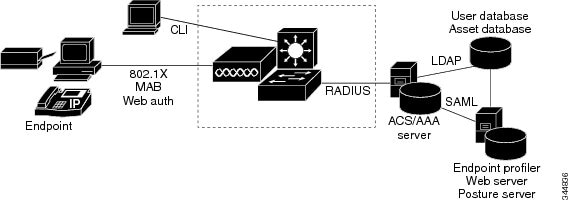
The figure below illustrates a typical deployment of Cisco IBNS in a physically distributed enterprise with a campus, branch
offices, and remote workers.
Figure 1. Sample Deployment of Cisco IBNS
By default, the access-session closed command is enabled in IBNS 1.0 and as a result, devices cannot perform any pre-authentication actions on the network when
using IBNS 1.0. By default, authentication is open in IBNS 2.0, and devices can perform pre-authentication actions on the
network. To close authentication on IBNS 2.0, configure the access-session closed command in interface-port configuration mode.
Features in Cisco Identity Based Networking Services
Cisco IBNS includes the following features:
Cisco common
classification policy language (C3PL)-based identity configuration
Concurrent
authentication methods on a single session, including IEEE 802.1x (dot1x), MAC
authentication bypass (MAB), and web authentication
Downloadable
identity service templates
Extended RADIUS
change of authorization (CoA) support for querying, reauthenticating, and
terminating a session, port shutdown and port bounce, and activating and
deactivating an identity service template.
Local
authentication using Lightweight Directory Access Protocol (LDAP)
Locally defined
identity control policies
Locally defined
identity service templates
Per-user
inactivity handling across methods
Web authentication support of common session ID
Web authentication support of IPv6
Benefits of Cisco Identity Based Networking Services
Identity-based solutions are essential for delivering access control for disparate groups such as employees, contractors,
and partners while maintaining low operating expenses. Cisco IBNS provides a consistent approach to operational management
through a policy and identity-based infrastructure leading to faster deployment of new features and easier management of switches.
Cisco IBNS provides the following benefits:
An identity-based framework for session management.
A robust policy control engine to apply policies defined locally or received from an external AAA server.
Faster deployment and customization of features across access technologies.
A simpler and consistent way to configure features across access methods, platforms, and application domains.
Web Authentication
Support for Common Session ID
Cisco IBNS allows a single session identifier to be used for web authentication sessions in addition to all 802.1X and MAB
authenticated sessions for a client. This session ID is used for all reporting purposes such as show commands, MIBs, and RADIUS
messages and allows users to distinguish messages for one session from messages for other sessions. This common session ID
is used consistently across all authentication methods and features applied to a session.
Web Authentication
Support of IPv6
Cisco IBNS introduces IPv6 support for web authentication. IPv6 is supported for web authentication only when Cisco IBNS is
explicitly configured. This means that you must permanently convert your configuration to the Cisco common classification
policy language (C3PL) display mode by specifically configuring a Cisco IBNS command such as the policy-map type control subscriber command.
IP Device
Tracking
IP device tracking can be configured using the Switch Integrated Security Features (SISF) policy. Use the tracking enable
command in device tracking configuration mode, to configure device tracking using SISF policy. Use the show device-tracking command to display the device tracking configuration.
The following is the sample configuration for device tracking.
Feature History for Cisco Identity Based Networking Services Overview
This table provides release and related information for the features explained in this module.
These features are available in all the releases subsequent to the one they were introduced in, unless noted otherwise.
Table 1. Feature History for Cisco Identity Based Networking Services Overview
Release
Feature Name
Feature Information
Cisco IOS XE Everest 16.5.1a
Web Authentication Support of Common Session ID
Allows a single session identifier to be used for all web authentication sessions in addition to 802.1X and MAB authenticated
sessions.
Use the Cisco Feature Navigator to find information about platform and software image support. To access Cisco Feature Navigator,
go to https://cfnng.cisco.com.
 Feedback