Mesh Policy Engine features released on Novenber 10, 2026.
This section lists new features for Mesh Policy Engine.
What's New in Security Cloud Control
Mesh Policy Engine features released on Novenber 10, 2026.
This section lists new features for Mesh Policy Engine.
The new version of Mesh Policy Engine integrates more closely with Cisco enforcers. You can organize policies in a hierarchy and use Common Objects and Audit Logs as you manage policy.
For more information, refer to Introduction to Mesh Policy Engine.
Policy hierarchy (parent and child policies) works with Mandatory and Defualt rules sections. With hierarchy:
The Mandatory sections are evaluated in order from parent to child.
The Default sections are evaluated in reverse order, from child to parent.
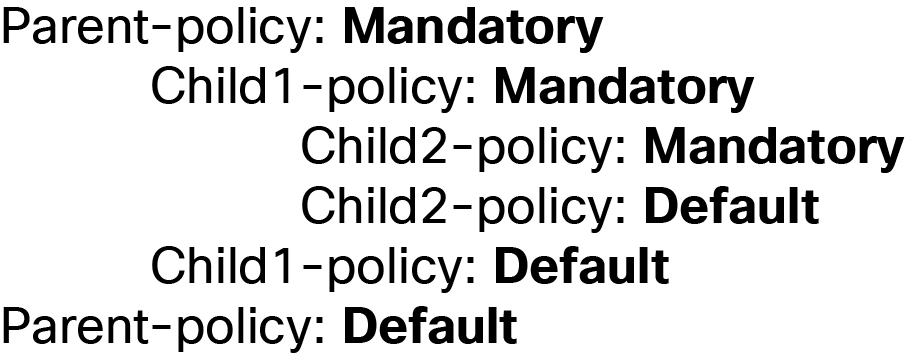
For Firewall Threat Defense and Secure Access, the mesh policy acts as the parent policy to the existing policy for each enforcer.
For more information, refer to Policy hierarchy.
You can now share policy with Secure Access. Secure Access supports rules from a network object to a network object and/or service object.
The mesh policy acts as the parent policy to the existing policy in Secure Access. Mesh policy is hierarchical: Mandatory sections are evaluated in order from parent to child, and Default sections are evaluated in reverse order, from child to parent. The mesh policy Mandatory rules are evaluated first, then the existing Secure Access rules, and finally the mesh policy Default rules.
Previously, Mesh Policy Engine compressed and optimized rules before sending them to enforcers. Now enforcers receive rules and objects that match what you authored.
For more information, refer to Deploy policy changes to enforcers.