Connection settings
Connection settings refer to a variety of features that manage connections through a device.
Connection setting types
Connection settings include these types:
-
Global timeouts for various protocols—All global timeouts have default values. Change them only if you experience premature connection loss.
-
Connection timeouts per traffic class—You can override the global timeouts for specific types of traffic using service policies. All traffic class timeouts have default values, so you do not have to set them.
-
Connection limits and TCP Intercept—By default, there are no limits on how many connections can go through (or to) the ASA. Use service policy rules to set limits on particular traffic classes. This protects servers from denial of service attacks Particularly, you can set limits on embryonic connections (those that have not finished the TCP handshake), which protects against SYN flooding attacks. When embryonic limits are exceeded, the TCP Intercept component activates to proxy connections and throttle attacks.
-
Dead connection detection (DCD)—Enable dead connection detection if you have persistent connections that are valid but often idle. These connections may get closed when they exceed idle timeout settings. Dead connection detection identifies idle but valid connections and keeps them alive by resetting their idle timers. Whenever idle times are exceeded, DCD probes both sides of the connection to see if both sides agree that the connection is valid.. The show service-policy command output includes counters to show the amount of activity from DCD. You can use the show conn detail command to get information about the initiator and responder and how often each has sent probes.
-
TCP sequence randomization—Each TCP connection has two initial sequence numbers (ISN): one generated by the client and one generated by the server. By default, the ASA randomizes the ISN of the TCP SYN passing in both the inbound and outbound directions. Randomization prevents an attacker from predicting the next ISN for a new connection and potentially hijacking the new session. However, TCP sequence randomization effectively breaks TCP SACK (Selective Acknowledgement), as the sequence numbers the client sees are different from what the server sees. You can disable randomization per traffic class if desired.
-
TCP normalization—The TCP Normalizer protects against abnormal packets. You can configure how some types of packet abnormalities are handled by traffic class.
-
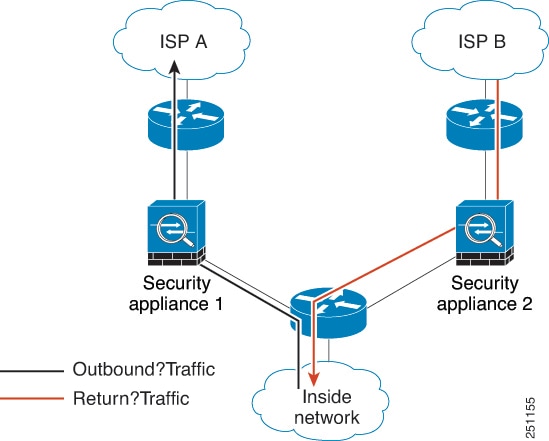
TCP state bypass—You can bypass TCP state checking if you use asymmetrical routing in your network.
-
SCTP state bypass—You can bypass Stream Control Transmission Protocol (SCTP) stateful inspection if you do not want SCTP protocol validation.
-
Flow offloading—You can identify select traffic to be offloaded to a super fast path, where the flows are switched in the NIC itself. Offloading can help you improve performance for data-intensive applications such as large file transfers.


 Feedback