Routed Optical Networking

Routed Optical Networking

Benefits of Routed Optical Networking

Routed Optical Networking

  • simplifies complex multilayer networks by collapsing network layers and minimizing the functional overlap

  • improves overall network efficiency by optimizing each layer of the network, and

  • integrates open data models and standard APIs, enriching powerful automation.

Routed Optical Networking offers improvements and simplification because it

  • uses modern optical and routing technologies to converge services over an IP infrastructure connected by a simplified DWDM layer

  • merges IP and private line services onto a single unified IP layer

  • simplifies end-to-end network architecture

  • utilizes a modern software stack that spans across network management and control planes

  • improves the capacity and cost efficiency of networks

  • has a smaller carbon footprint

  • offers unified capacity planning, unified EMS, unified path optimization, orchestration, and assurance

  • provides an automation ecosystem with open, programmable, and modular components, and

  • provides savings on Total Cost of Ownership (TCO) across CapEx and OpEx.

Components of Routed Optical Networking

Routed Optical Networking uses these components:

  • High-density Cisco routers

  • High-capacity ZR or ZR+ pluggable digital coherent optics

  • Simplified DWDM line systems

  • End-to-end multi-layer automation

Legacy architecture and Routed Optical Networking architecture

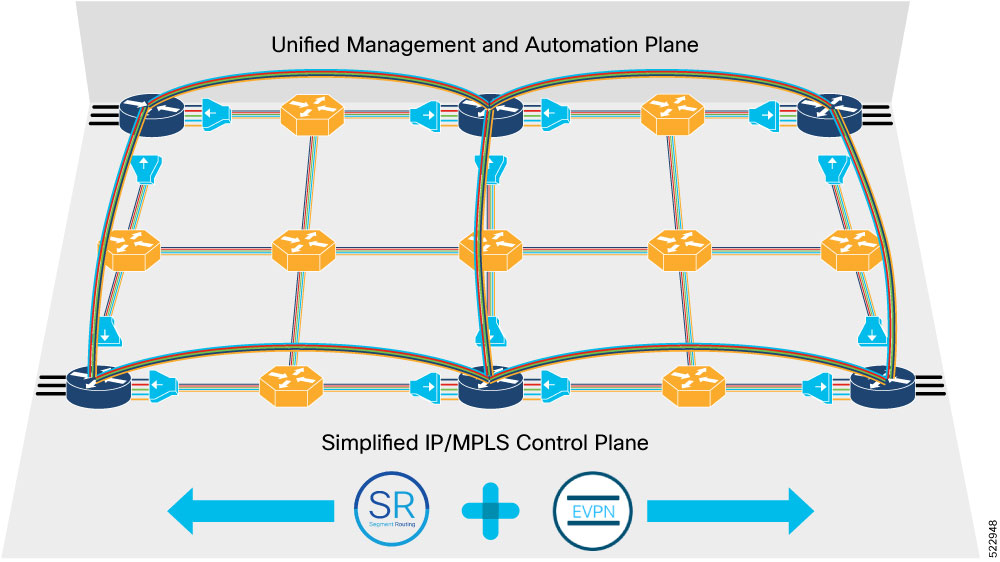
Routed Optical Networking architecture unifies the WDM, OTN, and packet transport layers into a single, easy-to-control layer.

Figure 1. Routed Optical Networking strategy
Routed Optical Networking strategy

Agile Services Networking transport architecture

The Agile Services Networking architecture simplifies the network by converging services on a unified, automated infrastructure, providing scalability and agility for new services in the AI era and beyond. See Agile Services Networking.

Routed Optical Networking as part of Cisco’s Agile Services Networking architecture brings network simplification to the physical network infrastructure, just as EVPN and Segment Routing simplify the service and traffic engineering network layers. Routed Optical Networking collapses complex technologies and network layers into a more cost efficient and easy to manage network infrastructure.

Routed Optical Networking achieves this architecture by leveraging high-density routers, high-capacity digital coherent pluggable optical modules, simplified optical elements, and advanced automation capabilities. Components of Routed Optical Network are also fully compliant ROADM-based networks and can interoperate seamlessly with a mix or traditional transponders and Routed Optical Networking pluggable DCO.

The converged architecture enables

  • unified planning and design

  • seamless multi-layer provisioning

  • unified multi-layer management

  • end-to-end multi-layer and multi-domain network visibility

  • end-to-end network optimization for IP and private line services, and

  • convergence of IP and private line services on a single converged packet network infrastructure with guaranteed SLAs.

Comparison of legacy multilayered and Routed Optical Networking architectures

This table compares legacy multilayered and Routed Optical Networking architectures.

Table 1. Comparison of legacy multilayered and Routed Optical Networking architectures
Layered architecture Routed Optical Networking architecture

Trades off port density and capacity on router line cards for coherent optical transmission

Higher port density and capacity on the router line cards using digital coherent pluggable optical modules

Proprietary components; noninteroperable

Standards-based approach; interoperable across vendors

Siloed approach; separate control and management planes

Common control and management planes for converged optical and IP layer

Manual service stitching necessary across network domains

Enables end-to-end closed-loop automation and manageability

Independent capacity planning on IP and optical layers, where additional capacity is dimensioned on each layer separately leading to CapEx inefficiencies.

Unified capacity planning on a converged network optimizing CapEx investments

Routed Optical Networking architecture

Multilayer architecture

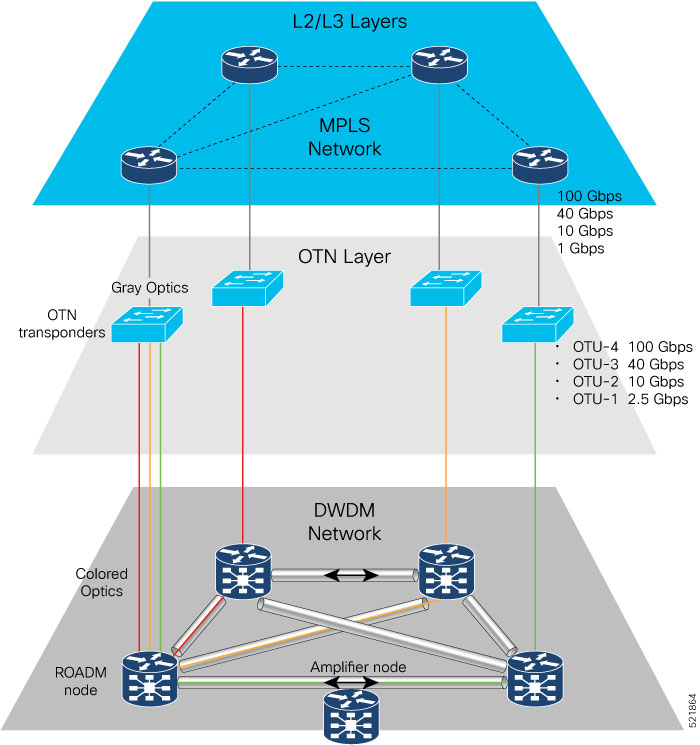
This diagram displays the current multilayer architecture.

Figure 2. Multilayer architecture
Multilayer architecture

Routed Optical Networking architecture

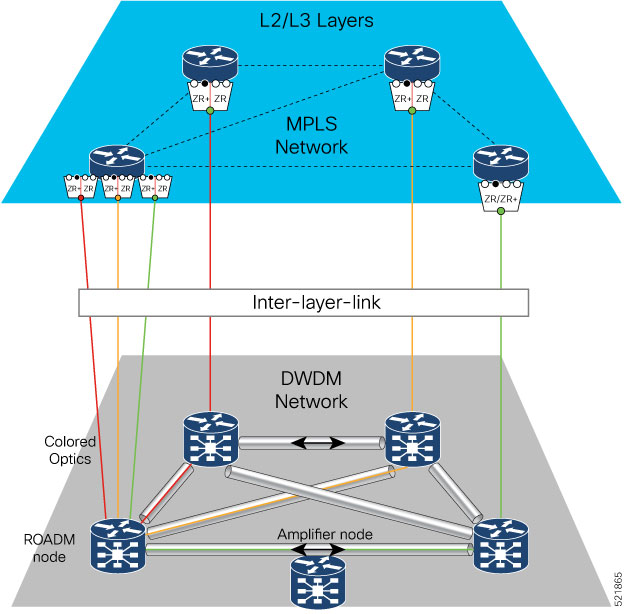
Routed Optical Networking is a transformative architecture that disrupts the existing multilayer network architecture. It converges all network services into a single layer.

The routers are connected through dark fiber or a DWDM network using standardized pluggable digital coherent optics, such as ZR and ZR+ transceivers. These transceivers reduce cabling, power consumption, and physical footprint compared to traditional external transponders.

With a single service layer based on IP, flexible management tools can leverage telemetry and model-driven programmability to streamline lifecycle operations. This simplified architecture integrates open data models and standard APIs, enabling a provider to focus on automation initiatives for a simpler topology.

This diagram displays the Routed Optical Networking architecture.

Figure 3. Routed Optical Networking architecture
Routed Optical Networking architecture

Benefits of Routed Optical Networking

Routed Optical Networking has these benefits.

  • Cost Savings: Routed Optical Networking reduces the network's total cost of ownership. Routed Optical networks make the most efficient use of high capacity routers and DWDM optical infrastructure. The routers' high-capacity switching allows networks to achieve denser interconnection and move traffic protection to the IP layer. Routed Optical Networking saves costs by converging service layers, simplifying the DWDM optical system, and using industry-standard ZR and ZR+ pluggable digital coherent optics. Elimination of multiple layers reduces power usage and hardware footprint. End-to-end multi-layer automation enables better utilization of network capacity.

  • Simplification: Using Agile Services Networking technologies like Segment Routing, EVPN. and Routed Optical Networking simplifies networks from the base infrastructure layer to the services layer. Using Circuit-Style Segment Routing and Private Line Emulation, Routed Optical Networking allows providers to converge services while maintaining or exceeding existing private line service SLAs. This convergence leads to simplified planning, design, activation, management, and troubleshooting.

  • Automation: Automation enhances resiliency, improves failure detection, and simplifies repair processes. Enhanced multi-layer visibility and root cause analysis allow network operators to quickly discover and remedy faults. Troubleshooting is enhanced with rich network telemetry at each layer.

  • Optimize Capacity: Routed Optical Networking uses the IP layer's capability to statistically multiplex network traffic at the packet level. Statistical multiplexing efficiently carries network traffic, adapting to instantaneous traffic demands and avoiding idle link capacity. Routed Optical Networking networks utilize fiber capacity to its fullest by intelligently utilizing capacity at the IP layer instead of wasting DWDM resources with unnecessary bypass circuits.

Routed Optical Networking deployment models

There is no one-size-fits-all solution for deploying a new architecture. The approach depends on the structure of the network and the goals of its owner. Therefore, it is critical to have a flexible control platform that supports a phased deployment and a smooth evolution.

Routed Optical Networking deployment

When a new IP and optical network is deployed, the hardware, together with its control architecture – including Crosswork Hierarchical Controller, Crosswork Network Controller, and Cisco Optical Network Controller, are installed from scratch. Install Crosswork Hierarchical Controller ahead of time to prepare for Routed Optical Networking deployment. This helps in planning the network using accurate data on existing services, network, and fiber assets. See Components of automation.

Third-party optical network Routed Optical Networking deployment

When routers with ZR and ZR+ optics are deployed over networks that use third-party optical devices, Crosswork Hierarchical Controller is integrated with Crosswork Network Controller and the existing DWDM optical controllers. Crosswork Hierarchical Controller creates IP links between the routers by configuring the optical path through the optical controllers and terminates those paths on the DWDM transceivers in the routers.

What's new in Routed Optical Networking 3.0

Feature

Release

Description

Automation Starter Solution

Crosswork Hierarchical Controller 8.0

Automation Starter Solution accelerates adoption of Routed Optical Networking by simplifying the installation and deployment of the overall Routed Optical Networking solution. It is a simplified automation stack that is used to manage ZR and ZR+ optics in Cisco routers. The primary difference between the starter and full solution is the absence of Crosswork Network Controller in the Starter solution.

Support for QDD-based Optical Line System

Cisco IOS XR Release 7.11.1

These routers support Cisco QSFP-DD Pluggable Open Line System Modules (QSFP-DD OLS):

  • NCS-57B1-6D24-SYS and NCS-57B1-5DSE-SYS routers

  • NCS-57C3-MOD and NCS-55A2-MOD routers (only through NC57-MPA-2D4H-S modular port adapter)

Support for 100G-ZR coherent transceivers

Cisco IOS XR Release 7.11.1

These routers support DP01QSDD-ZF1:

  • N540-24Q8L2DD-SYS

  • NCS-57B1-6D24H-S

  • NCS-57B1-5D24-SE

  • NCS-57D2-18DD-S

  • NC57-48Q2D-S

  • NC57-48Q2D-SE-S

  • NC57-MOD-S and NC57-MPA-2D4H-S on:

    • NCS-55A2

    • NC55-MOD

    • NC57-MOD

    • NCS-57C3

Support for 400G-ER coherent transceivers

Cisco IOS XR Release 7.11.1

These routers support DP04QSDD-ER1:

  • NC57-18DD-SE

Cisco Optical Site Manager

Cisco IOS XR Release 7.11.2

Cisco Optical Site Manager runs as an additional application on IOS-XR on the NCS 1010 and is packaged with NCS 1010 IOS-XR releases.

Cisco Optical Site Manager .

  • provides site-level management for an NCS 1010 network built using multiple disaggregated NCS 1010 devices

  • offers a single communication point for controllers such as Cisco Optical Network Controller, and

  • allows users to perform management and assurance tasks related to the site nodes such as viewing alarms, performance statistics, and performing OAM functions like OTDR and connectivity verification.

Cross Launch between Automation software suite applications

Cisco Optical Site Manager 7.11.2

Crosswork Hierarchical Controller 8.0

Cisco Crosswork Network Controller 6.0

Cisco Optical Network Controller 3.1

You can now setup SSO login for Cisco Optical Site Manager, Crosswork Hierarchical Controller, Cisco Crosswork Network Controller, and Cisco Optical Network Controller. After setting up SSO, you can cross-launch among these applications. For example, you can launch the node functional view in Cisco Optical Site Manager from the Link Assurance application in Crosswork Hierarchical Controller.