Span loss calculations
A span loss calculation is an optical network measurement that
-
determines the signal power loss between NCS 1020 and NCS 1010 (amplifer) nodes in an optical transmission network,
-
compares the power measurements at transmitter (Tx) and receiver (Rx) ports at the near and far ends of a fiber span, and
-
automatically raises the Span Loss Value Out Of Range alarm when the calculated loss does not fall within configured thresholds.
On a Raman span with Raman tuning enabled, span loss verification reports the following values:
-
Span loss with pumps off: This measurement is the difference in power values between the DFB-Tx/Rx of the remote node and the DFB-Rx/Tx of the local node. This measurement also includes a timestamp. When a Raman span is up, the span loss application latches on to the difference in power between DFB-Tx and DFB-Rx before Raman tuning turns the Raman pumps on.
-
Apparent span loss: This measurement is based on the power values of C band, L band and Optical Service Channel (OSC). For a Raman span, the span loss application uses this span loss value to raise the Span Loss Value Out Of Range alarm.
-
Estimated span loss: This value is based on Raman gain that is achieved by Raman tuning application. Estimated span loss value is based on Raman gain that is achieved when safety loop was closed and tuning was performed. Raman tuning application reports the Raman gain measurement. When you disable Raman tuning, the span loss application does not compute the Estimated span loss.
Estimated span loss = Apparent span loss + Raman gain
-
OSC span loss: This measurement is the difference in OSC power values between the Tx/Rx of the remote node and the Rx/Tx of the local node.
-
Signal span loss: This measurement is the difference in the received C band signal power values between the Tx/Rx of the remote node and the Rx/Tx of the local node.
The span loss application reports the span loss value for a span every 90 seconds. If span loss changes, for example when a change in fiber loss occurs, the span loss application typically takes 90 seconds to update the span loss.
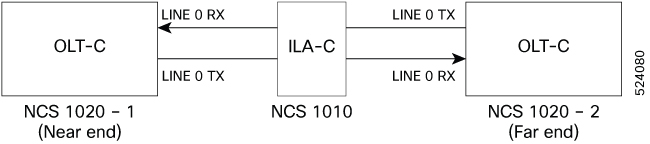
For example, in the previous figure, the Tx Span Loss on NCS 1020-1 is the difference in signal power between LINE 0 Tx on NCS 1020-1 and LINE 0 Rx on NCS 1010.
View span loss values
Use this procedure to display span loss measurements between NCS 1010 nodes. This process helps verify optical signal integrity and diagnose network issues
 Note |
Rx span loss values are not available on a network where one NCS 1010 node is upgraded to R25.3.1 while other nodes are on an earlier software version. |
Procedure
|
Use the show olc span-loss command to view the Tx span loss and Rx span loss. Example:The following sample shows the output of the show olc span-loss command on a Raman span with Raman tuning disabled. In this sample output, Raman tuning is disabled on both Ots0/0/0/0 and Ots0/0/0/2 on the near end node. The far end nodes have Raman tuning enabled. The following sample shows the output of the show olc span-loss command on a non-Raman span. |
Configure Span Loss Thresholds
Use this task to configure span loss thresholds.
Procedure
|
Step 1 |
Select the controller on which the span loss thresholds need to be configured after entering into the optical applications configuration mode. Example: |
||
|
Step 2 |
Configure the minimum and maximum span loss threshold values. Example:The system raises a SPAN-LOSS-OUT-OF-RANGE alarm if span loss is greater than the maximum threshold or less than the minimum threshold. The above example sets the minimum threshold to 10 dB and maximum threshold to 20 dB. The system raises a SPAN-LOSS-OUT-OF-RANGE alarm under following conditions:
The system does not trigger a SPAN-LOSS-OUT-OF-RANGE alarm when Raman span loss is measured with Raman tuning disabled. |
||
|
Step 3 |
Configure the minimum and maximum difference thresholds between OSC and signal span loss values. Example:The above example sets the minimum threshold deviation to 8 dB and maximum threshold deviation to 10 dB. The system raises a SIGNAL-OSC-SPAN-LOSS-DIFF-OUT-OF-RANGE alarm if the deviation between the received OSC span loss and the received signal span loss is greater than the maximum threshold or less than the minimum threshold. |
||
|
Step 4 |
Configure the bidirectional span loss mismatch threshold value for the span. Example:This example sets the bidirectional span loss mismatch threshold value to 40 dB. The range is 0.0 dB to 42.0 dB. The system raises a SIGNAL-BIDIR-SPAN-LOSS-MISMATCH alarm when the difference between Tx and Rx signal span loss is greater than the set tolerance value. For non-Raman spans, the difference is between Tx and Rx signal span loss. For Raman spans, it is between apparent Rx and Tx signal span loss.
|
||
|
Step 5 |
Commit the changes and exit all the configuration modes. Example: |
Baseline threshold
|
Feature Name |
Release Information |
Description |
|---|---|---|
|
Span Loss Baseline Deviation Monitoring |
Cisco IOS XR Release 26.1.1 |
You can now configure minimum and maximum deviation values to monitor the measured Rx signal span loss against the baselined value. The valid range is defined as baselined span loss − minimum deviation (lower limit) and baselined span loss + maximum deviation (upper limit). If the measured Rx span loss falls outside this calculated range, a SPAN-LOSS-BASELINE-DEVIATION-OUT-OF-RANGE alarm is raised. Commands added:
|
After network turn-up, ALC saves the Rx and Tx span loss values on all nodes as a baseline. These values are then compared with the user-configured minimum and maximum threshold values.
The system subtracts the configured min-baseline-deviation value from the baselined span loss to determine the lower threshold, and adds the max-baseline-deviation value to determine the upper threshold.
If the measured Rx signal span loss falls outside the configured range, the SPAN-LOSS-BASELINE-DEVIATION-OUT-OF-RANGE alarm is raised. The range is defined by:
-
Lower limit = baselined span loss − min-baseline-deviation
-
Upper limit = baselined span loss + max-baseline-deviation
For example, if the baselined span loss is 20 dB, the minimum deviation is 1 dB, and the maximum deviation is 3 dB:
-
Lower limit = 20 − 1 = 19 dB
-
Upper limit = 20 + 3 = 23 dB
The alarm is raised only if the measured span loss drops below 19 dB or exceeds 23 dB.
Threshold hysteresis
The hysteresis value for alarms is used to prevent frequent toggling when the threshold parameter fluctuates around the threshold value. The hysteresis value for the SPAN-LOSS-BASELINE-DEVIATION-OUT-OF-RANGE alarm is 0.5 dBm.
Configure baseline threshold
Use this task to configure the minimum and maximum threshold values for baseline span loss.
Procedure
|
Step 1 |
Use the optical-line-control command to select the controller on which the baseline threshold must be configured. Example: |
|
Step 2 |
Use the span-loss min-baseline-deviation command to configure the minimum and maximum baseline span loss threshold values. Example: |
|
Step 3 |
Commit the changes and exit all the configuration modes. Example: |
|
Step 4 |
Use the show running-config optical-line-control controller Ots command to verify the configured values. The entries in bold display the configured minimum and maximum threshold values for baseline span loss. Example: |
Baseline threshold values are configured on the nodes.
 Feedback