G.8032 Ethernet Ring Protection
G.8032 Ethernet ring protection is a protection switching feature that
-
implements protection switching mechanisms for Ethernet layer ring topologies
-
uses the G.8032 Ethernet ring protection (ERP) protocol version 1, defined in ITU-T G.8032, and
-
provides protection for Ethernet traffic in a ring topology with non-Cisco devices.
Ring protection links
Ring protection links are specialized Ethernet ring links that
-
ensure continuous network connectivity by protecting the ring from disruptions,
-
prohibit the formation of loops that can affect the network, and
-
provide redundancy, allowing the Ethernet ring to function even if some links fail.
Ethernet ring structure
An Ethernet ring consists of multiple Ethernet ring nodes. Each node connects to adjacent nodes using two independent ring links. A ring link is defined by the two adjacent nodes it connects and the port used for the ring link (also known as a ring port). There must be at least two Ethernet ring nodes for the ring topology to be valid.
ITU-T G.8032 Ethernet ring protection switching functionality
ITU-T G.8032 Ethernet ring protection switching functionality is a network protection mechanism that
-
provides loop avoidance,
-
uses learning, forwarding, and Filtering Database (FDB) mechanisms, and
-
ensures traffic flows continuously through all links except the Ring Protection Link (RPL).
RPL node types and functions
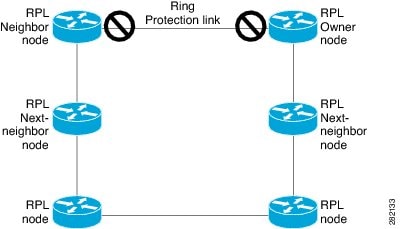
Loop avoidance in an Ethernet ring is achieved by ensuring traffic flows continuously through all links except the Ring Protection Link (RPL).
This is a list of RPL types (or RPL nodes) and their functions:
-
RPL owner: Responsible for blocking traffic over the RPL to prevent loops in the Ethernet traffic. There can be only one RPL owner in a ring.
-
RPL neighbor node: An Ethernet ring node adjacent to the RPL. It is responsible for blocking its end of the RPL under normal conditions. This node type is optional and prevents RPL usage when protected.
-
RPL next-neighbor node: Next-neighbor node is an Ethernet ring node adjacent to an RPL owner node or RPL neighbor node. It is mainly used for FDB flush optimization on the ring. This node is also optional.
The figure illustrates the G.8032 Ethernet ring topology.
R-APS control messages
R-APS control messages are ring coordination mechanisms that
-
coordinate switching the ring protection link (RPL) on and off between nodes on the ring
-
trigger when a failure occurs along the ring, sending R-APS Signal Failure (R-APS SF) messages in both directions from nodes adjacent to the failed link after they block the port facing the failed link, and
-
cause the RPL owner to unblock the RPL port upon receipt of this message.
Loop-free topology behavior
 Note |
A single link failure in the ring ensures a loop-free topology. |
CFM protocols and link failures
CFM protocols and link failures are network fault detection mechanisms that
-
use Connectivity Fault Management (CFM) and line status messages to detect ring link and node failures
-
enable Ring Automatic Protection Switching (R-APS) messages for recovery coordination when failed links are restored, and
-
support the Ethernet Ring Protection (ERP) protocol for both unidirectional failure and multiple link failure scenarios in a ring topology.
CFM protocol operation and performance
During the recovery phase, when the failed link is restored, the nodes adjacent to the restored link send Ring Automatic Protection Switching (R-APS) No Request (R-APS NR) messages. Upon obtaining this message, the ring protection link (RPL) owner blocks the RPL port and sends two messages: R-APS NR and R-APS RPL (R-APS NR, RB). These messages cause all other nodes, other than the RPL owner in the ring, to unblock all blocked ports.
Note |
The G.8032 Ethernet Ring Protection (ERP) protocol uses CFM Continuity Check Messages (CCMs) at an interval of 3.3 milliseconds (ms). At this interval (which is supported only on selected platforms), SONET-like switching time performance and loop-free traffic can be achieved. |
When you enable CFM, the G.8032 Ethernet Ring Protection feature ensures recovery times of less than 50 milliseconds. This is achieved by managing the forwarding state of each ring port, preventing loops, and maintaining connectivity in the event of a failure.
Note |
This feature can operate without CFM; however, performance of less than 50 milliseconds is not guaranteed without it. |
G.8032 ERP timers
G.8032 ERP timers are network management mechanisms that
-
prevent race conditions during network state changes
-
filter out intermittent faults and verify network stability, and
-
ensure proper sequencing of switching operations in Ethernet ring protection.
Timer types and configuration
The G.8032 protocol uses three main categories of timers:
-
Delay timers: Used by the Ring Protection Link (RPL) owner to verify that the network has stabilized before blocking the RPL. Note the following points about delay timers.
-
After a signal failure (SF) condition, a Wait-to-Restore (WTR) timer is used to verify that the SF is not intermittent.
-
The WTR timer can be configured by the operator. The default time interval is 5 minutes; the time interval ranges from 1 to 12 minutes.
-
After a force switch (FS) or a manual switch (MS) command is issued, a Wait-to-Block (WTB) timer is used to verify that no background condition exists.
Note
The WTB timer interval may be shorter than the WTR timer interval.
-
-
Guard timer: Used by all nodes when changing state; the guard timer blocks latent outdated messages from causing unnecessary state changes. The guard timer can be configured. The default time interval is 500 ms; the time interval ranges from 10 to 2000 ms.
-
Hold-off timers: Used by the underlying Ethernet layer to filter out intermittent link faults. The hold-off timer can be configured. The default time interval is 0 seconds; the time interval ranges from 0 to 10 seconds. Faults are reported to the ring protection mechanism only if this timer expires.
 Feedback