Troubleshoot EIGRP Convergence Time in Catalyst 8500 Dual-Link Failure Scenarios

Available Languages
Contents
Introduction
This document describes the analysis and processing of EIGRP Convergence Time in Catalyst 8500 Dual-Link Failure Scenarios.
Prerequisites
Requirements
Cisco recommends that you have knowledge of these topics:
- Enhanced Interior Gateway Routing Protocol (EIGRP) concepts and functionality
Components Used
The information in this document is based on these software and hardware versions:
- Cisco Catalyst C8500-12X Edge Platform in version 17.12.05a
- Cisco Catalyst C9500 switch in version 17.12.05a
The information in this document was created from the devices in a specific lab environment. All of the devices used in this document started with a cleared (default) configuration. If your network is live, ensure that you understand the potential impact of any command.
EIGRP Background
EIGRP (Enhanced Interior Gateway Routing Protocol) is an enhanced distance vector routing protocol of Cisco. It ensures loop-free routing calculation through DUAL (Diffusing Update Algorithm) and achieves fast convergence when alternative paths are available.
In the troubleshooting of EIGRP, the information needs to be distinguished:
| Table/Concept |
Function |
| Neighbor Table |
Records the neighbors that have established EIGRP adjacency relationships. |
| Topology Table |
Saves the candidate paths and DUAL status learned from neighbors. |
| Routing Table |
Stores the paths that are ultimately used for actual traffic forwarding. |
| Successor |
The current best path, installed in the routing table. |
| Feasible Successor (FS) |
Non-circular backup path that meets feasibility conditions; can be directly switched in case of failure of the primary path. |
Problem Background
Problem Description
The issue behavior: After administratively shutting down two EIGRP interfaces simultaneously, one of the routes associated with those interfaces could still be observed in the routing table for a short period. The expected is that all routes learned through the two failed interfaces would disappear immediately after both interfaces were shut down.
Topology
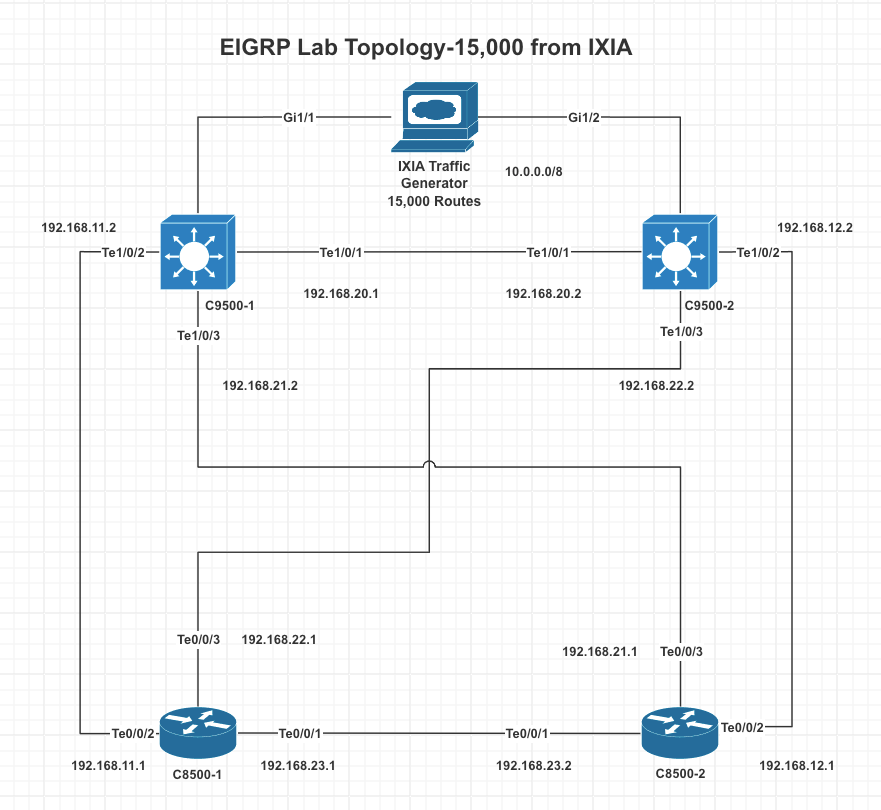
The IXIA traffic generator advertised 15,000 routes into the EIGRP domain to simulate a production-scale routing environment.
Conclusion
This behavior is expected and is caused by the EIGRP DUAL (Diffusing Update Algorithm). It is not a software defect.
When multiple interfaces fail almost simultaneously, DUAL attempts to install an alternate feasible path before initiating a full network-wide recomputation. As a result, the routing table can temporarily display a route through another available successor or feasible successor until the topology converges.
Test Procedure
The debugs were enabled on C8500-1 before shutting down two interfaces simultaneously.
debug eigrp fsm
debug eigrp neighbor
debug eigrp packets
debug ip routing
debug ip eigrp
The interfaces were then shut down simultaneously.
C8500-1(config)#interface range Te0/0/2, Te0/0/3
C8500-1(config-if-range)#shutdown
Expected DUAL Processing
The sequence of events observed during convergence is shown here.
Step 1 – Interfaces Go Down
Once the interfaces are administratively shut down:
- Interface state changes to DOWN.
- Connected routes are immediately removed.
- Neighbor adjacency is declared down.
- DUAL starts topology recalculation.
Example debug:
RT: interface Te0/0/2 removed from routing table
RT: interface Te0/0/3 removed from routing table
%DUAL-5-NBRCHANGE: EIGRP-IPv4 500: Neighbor 192.168.11.2 (TenGigabitEthernet0/0/2) is down: interface down
%DUAL-5-NBRCHANGE: EIGRP-IPv4 500: Neighbor 192.168.22.2 (TenGigabitEthernet0/0/3) is down: interface down
%LINK-5-CHANGED: Interface TenGigabitEthernet0/0/2, changed state to administratively down
%LINK-5-CHANGED: Interface TenGigabitEthernet0/0/3, changed state to administratively down
At this point the original successor becomes invalid.
C8500-1#show ip route eigrp
   10.0.0.0/24 is subnetted, 15000 subnets
D        10.0.0.0 [90/256768] via 198.168.23.2, 00:00:00, TenGigabitEthernet0/0/1
D        10.0.1.0 [90/256768] via 198.168.23.2, 00:00:01, TenGigabitEthernet0/0/1
D        10.0.2.0 [90/256512] via 192.168.22.2, 00:00:02, TenGigabitEthernet0/0/3                  <<<<<< not disappear directly
D        10.0.3.0 [90/256768] via 198.168.23.2, 00:00:01, TenGigabitEthernet0/0/1
D        10.0.4.0 [90/256512] via 192.168.22.2, 00:00:02, TenGigabitEthernet0/0/3                  <<<<<< not disappear directly
D        10.0.5.0 [90/256512] via 192.168.22.2, 00:00:02, TenGigabitEthernet0/0/3                  <<<<<< not disappear directly
D        10.0.6.0 [90/256768] via 198.168.23.2, 00:00:00, TenGigabitEthernet0/0/1
D        10.0.7.0 [90/256768] via 198.168.23.2, 00:00:00, TenGigabitEthernet0/0/1
D        10.0.8.0 [90/256768] via 198.168.23.2, 00:00:01, TenGigabitEthernet0/0/1
D        10.0.9.0 [90/256768] via 198.168.23.2, 00:00:00, TenGigabitEthernet0/0/1
D        10.0.10.0 [90/256512] via 192.168.22.2, 00:00:03, TenGigabitEthernet0/0/3                 <<<<<< not disappear directly
D        10.0.11.0 [90/256512] via 192.168.22.2, 00:00:03, TenGigabitEthernet0/0/3                 <<<<<< not disappear directly
D        10.0.12.0 [90/256512] via 192.168.22.2, 00:00:03, TenGigabitEthernet0/0/3
Step 2 – DUAL Searches for an Alternate Path
Before flooding queries throughout the network, DUAL checks its topology table for another valid successor.
Example topology information:
| Next Hop |
Status |
|---|---|
| 192.168.11.2 |
Original Successor (Failed) |
| 192.168.22.2 |
Best Alternate Path |
| 198.168.23.2 |
Feasible Successor |
The debug shows:
Find FS for destination
EIGRP-IPv4(500): 192.168.11.2 metric INF/INF (invalid)
EIGRP-IPv4(500): 192.168.22.2 metric 256512/256256
EIGRP-IPv4(500): 198.168.23.2 metric 256768/256512
DUAL therefore selects 192.168.22.2(metric = 256512)as the new successor.
Step 3 – Temporary Route Installation
The routing table is updated immediately.
RT: delete route to 10.0.0.0 via 192.168.11.2
RT: updating eigrp 10.0.0.0/8 via 192.168.22.2
...
RT: rib update return code: 19
EIGRP-IPv4: routing table not updated thru 192.168.23.2
Although another path through 192.168.23.2 already exists, it is not installed, because a better metric is still available.
Therefore, users can observe that the route still exists even though one of the failed interfaces has already been shut down.
This is the behavior that caused the network administrator concern.
Step 4 – Second Path Also Fails
The second interface subsequently goes down.
%DUAL-5-NBRCHANGE: Neighbor 192.168.22.2 is down
At this moment:
- Current successor disappears.
- No immediate valid successor remains.
- DUAL enters Active state.
RT: delete route to 10.0.0.0 via 192.168.22.2
RT: no routes to 10.0.0.0, delayed flush
Step 5 – DUAL Receives Reply
DUAL sends Queries and waits for Replies from remaining neighbors.
A remaining neighbor replies with an alternate path.
EIGRP: Received REPLY on Te0/0/1 from 192.168.23.2
...
RT: add 10.0.0.0/8 via 192.168.23.2, eigrp metric [90/256768]
The new successor is then installed.
Step 6 – Network Reconverges
Once convergence completes, EIGRP advertises the updated topology.
Send UPDATE
Advertise out Te0/0/1
All neighbors receive the new topology information.
The network returns to a stable state.
Convergence Timeline
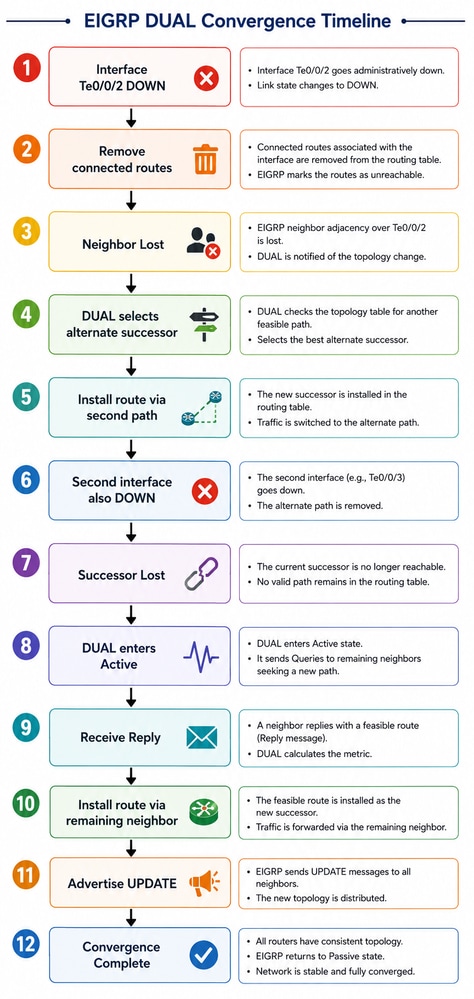
Why Does the Route Still Exist
The key reason is that DUAL does not immediately remove a destination if another valid successor or feasible successor is available.
Instead, DIGRP attempts to preserve forwarding continuity by switching traffic to another available path before initiating a complete topology recomputation.
Therefore, after the first interface failure:
- The original route disappears.
- A better alternate path is installed immediately.
- The destination remains present in the routing table.
Only after the second alternate path also becomes unavailable does DUAL begin another recomputation and install the final available path.
This behavior is fully consistent with the EIGRP design objective of fast convergence.
Key DUAL Concepts
| Term |
Description |
|---|---|
| Successor |
Current best loop-free route installed in the routing table. |
| Feasible Successor |
Backup loop-free route stored in the topology table. |
| Feasible Distance (FD) |
Lowest calculated metric to a destination. |
| Reported Distance (RD) |
Metric advertised by a neighbor. |
| Active State |
DUAL is searching for a new path. |
| Passive State |
Route is stable. |
| Reply Count |
Number of outstanding replies before convergence completes. |
| Metric = Infinity |
Indicates the route is no longer reachable. |
| RIB Return Code 19 |
The candidate route was not installed because a better route already exists in the RIB |
Final Conclusion
The observed behavior is expected EIGRP DUAL behavior rather than a routing anomaly.
When two interfaces are shut down in rapid succession:
- EIGRP immediately removes routes associated with the failed interface.
- DUAL installs the best available alternate successor.
- The destination remains visible in the routing table because an alternate path is available.
- If that alternate path also fails, DUAL performs another recomputation.
- After receiving Replies from remaining neighbors, a new successor is installed and convergence completes.
Therefore, the observation that one route remains in the routing table after simultaneously shutting down two interfaces is a normal result of the DUAL convergence process and does not indicate a software defect.
Related Information
- Understand and Use the Enhanced Interior Gateway Routing Protocol
- Troubleshoot EIGRP Common Issues
- Cisco Technical Support & Downloads
Revision History
| Revision | Publish Date | Comments |
|---|---|---|
1.0 |
31-Aug-2026
|
Initial Release |
 Feedback