
Introduction
Cisco IQ™ provides customers with enhancements and features designed to improve asset visibility, deliver smarter insights across their environments, and streamline case management. In addition, AI features such as the Cisco IQ Assistant optimize operational outcomes and the Cisco IQ user experience by providing contextual understanding that empowers users to make proactive, informed decisions and streamlines processes for customer engagement and success.
This document provides common customer questions about Customer Experience (CX) portfolio simplification, support tiers, and Cisco IQ.
Cisco IQ
Cisco IQ is a new suite of applications that deliver the outcomes defined in the Support and Professional Services offers through a digital experience for our customers, partners, and internal teams. Cisco IQ brings AI-powered services and insights to all parties in a new interactive and industry-forward setting. It provides new apps, and insights to customers where they need them, such as SaaS (available now), On-Premises (On-Prem) or APIs (available now).
Embedded in Cisco support and services offers, Cisco IQ is a single, unified, AI-powered interface that revolutionizes the entire customer journey—from planning and design to implementation, onboarding, ongoing optimization, and transformation. It brings the ultimate digital experience designed to accelerate the customers’ time to value, boost resiliency, and deliver unparalleled simplicity.
General
Q. What is Cisco IQ?
A. Cisco IQ is the customer-facing, AI-powered experience that connects the entire customer journey with Cisco Services. It brings together real-time insights, assessments, troubleshooting, learning, automation, and agent-driven guidance from Cisco Support and, in the future, Professional Services, helping customers plan, deploy, manage, secure, and optimize their environments. Cisco IQ adapts to each customer’s environment to deliver personalized, contextual recommendations across the lifecycle.
Cisco IQ is available in SaaS and will eventually deliver information to customers in several ways, such as through APIs, email, connections to IT Service Management (ITSM), Webex and others. Also, the installation modality of Cisco IQ Virtual Machine (VM) will be flexible. Customers can select from SaaS, On-Prem (tethered- coming soon or air-gapped) deployment modes. There is no additional charge for Cisco IQ; it is available through Cisco Support now and later, Cisco Professional Services offerings.
Q. How does Cisco IQ benefit customers?
A. Cisco IQ enables customers to:
-
Understand and plan their Cisco IT landscape: Access dynamic AI-driven insights to clearly view their infrastructure, prioritize upgrades, plan renewals, and benchmark against peers, reducing complexity and enabling agile action.
-
Prevent outages and disruptions: AI-powered assessments identify misconfigurations and vulnerabilities and provide prioritized, actionable recommendations to address issues before they escalate, minimizing effort and downtime.
-
Resolve incidents faster: AI-driven troubleshooting and conversational guidance help teams quickly identify root causes and solutions, streamlining case management and freeing up time for higher priorities.
-
Stay on top of transformation: Access expert reports, insights, and dashboards—all unified and AI-enhanced for easy query, analysis, and information synthesis.
Q. When is Cisco IQ going to be generally available to customers?
A. The Cisco IQ SaaS is now available, with On-Prem modalities coming soon.
Q. Which customers will have access to Cisco IQ?
A. Cisco IQ is the AI-powered digital experience for all CX customers with a valid Cisco Support contract. In the future, Professional Services customers—with or without an underlying Cisco Support contract—will get access to Cisco IQ as well. Based on the user’s entitlement for Support levels (Basic, Standard, Signature), they have access to specific apps and app features.
Q. What architectures does Cisco IQ support?
A. Refer to this page for the list of architectures that Cisco IQ supports.
Q. Will Cisco IQ replace architecture-specific dashboards (e.g., Nexus® switch dashboards or M7 server management dashboards)?
A. Cisco IQ will not replace architecture specific product dashboards. The vision is to show the same CX insights to customers where they are, whether in the product dashboards, in their own apps, or in the Cisco IQ experience.
Q. What are the key Cisco IQ modules?
A. Key modules include:
-
Assets: Dynamic asset inventory with AI insights for risk trends
-
Assessments: Intelligent security advisories, device hardening, configuration best practices
-
Support: Simplified case opening, summarization, intelligent case management
-
AI Assistant: Conversational interface for queries, analysis, and information synthesis
Q. What are the Cisco IQ deployment options?
A. Cisco IQ offers three flexible deployment modes to align with the customer’s operational, security, data sovereignty, and connectivity requirements:
-
SaaS: For customers prioritizing ease of use, rapid deployment, reduced capital expenditure, and those with a cloud-first strategy who are comfortable with secure data transfer to the cloud. This deployment will require a lightweight on-premises connector that will act as a secure bridge for services hosted in the cloud.
-
On-Prem Tethered: For organizations with strict data residency requirements. Hosted on-premises with a tethered connection to SaaS for updates, it combines the security and control of on-premises data storage with the convenience of automated updates and new feature delivery from the cloud.
-
On-Prem Air-Gapped: For customers in highly regulated sectors or industries with the most stringent compliance, data sovereignty, and security mandates. Hosted on-premises and air-gapped, it has no external connectivity and requires manual intervention for all updates.
Q. Is Cisco IQ a cloud-only application, and does it require onsite agents?
A. Cisco IQ will offer flexible deployment modes designed to accommodate diverse infrastructure needs. We just launched Cisco IQ SaaS. For the AI-powered insights, we recommend the Cisco IQ Link installation On-Prem to get device connectivity for the most optimal SaaS Insights and recommendations. Cisco IQ Virtual Appliance will also be available in the future in Tethered and Air-Gapped modes.
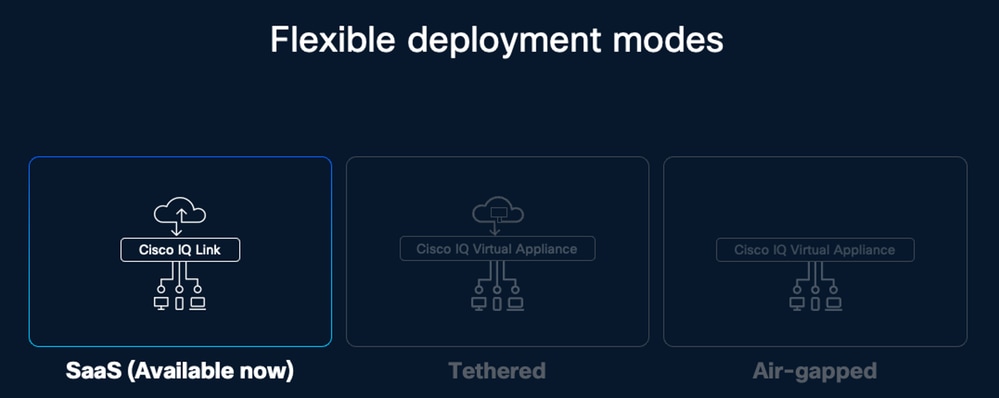 Cisco IQ Deployment Modes
Q. What is Cisco IQ Link?
A. Cisco IQ Link is the data collection software which is deployed on a virtual machine within the customer’s on-premises network to perform automated device discovery and telemetry collection. It can also connect to the On-Prem Catalyst Center.
Q. Has Cisco IQ Link replaced Cisco IQ Connector?
A. No, they are separate components but integrated. Cisco IQ Connector is the data collection tool—it collects telemetry and device data to enable Cisco IQ’s AI-powered insights and analytics—a component inside of Cisco IQ Link. Cisco IQ Link represents the VM that provides a secure communication channel between SaaS and On-Prem environment.
Q. What are the requirements before configuring and installing Cisco IQ Link?
A. Please refer to the Cisco IQ Link Getting Started Guide.
Q. Is there a cost associated with Cisco IQ deployment?
A. Cisco IQ is the digital experience for all CX customers who have a valid Cisco Support contract. There is no additional cost for Cisco IQ usage.
Q. How will a customer user interact with Cisco IQ?
A. Customers can create accounts and use Cisco IQ at https://iq.cisco.com.
Q. How will a net-new customer be able to access Cisco IQ?
A. Customers can create new accounts on-demand without Cisco intervention. Account creators automatically become Account Administrators, enabling immediate productivity. Account Administrators can then browse their eligible contracts and select which assets to add to their account.
Q. Who at the customer can create the Cisco IQ account and become the Account Administrator—can a front-line engineer with a Cisco Connection Online (CCO) profile do it, and how is administrator designation handled (especially for customers who have never used CX Cloud)?
A. Anyone at the customer with a CCO profile can create the Cisco IQ account; internal Cisco personnel cannot create the account on the customer’s behalf. The first person who creates the account becomes the administrator. Cisco does not have visibility into who the ‘right’ person should be at the customer—this is the same self-onboarding model CX Cloud has used successfully for years. Once created, administrators can use resource groups to limit which assets a viewer can see.
Q. Is the installation of a collector required to use Cisco IQ?
A. A collector is optional. Cisco IQ allows the customer to build an initial inventory using contract data alone. For advanced analytics and deployment data, the customer can choose between installing Cisco IQ Link or leveraging direct product telemetry. This ensures the customer can tailor the onboarding process to their specific requirements. For the AI-powered insights, we recommend Cisco IQ Link installation On-Prem to get device connectivity for the most optimal SaaS Insights and recommendations.
Q. What capabilities are there in Cisco IQ for each offer tier?
A. Refer to the image below for the Cisco IQ capabilities by offer tier.
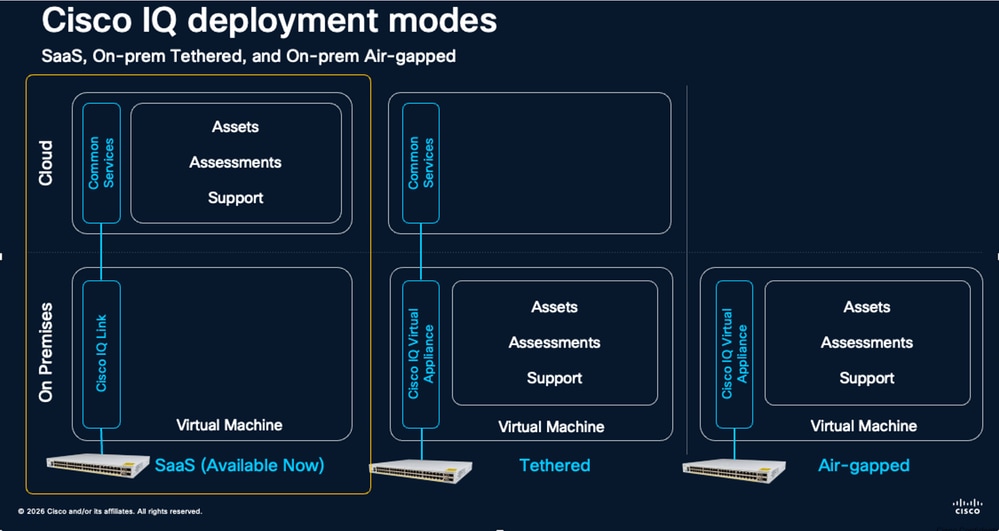 Cisco IQ Capabilities
Q. Is a mobile application planned for Cisco IQ?
A. The need for a mobile app will be evaluated in the future.
Q. Are there any service types that are not supported within Cisco IQ?
A. Cisco IQ currently supports assets that are hardware and software on contracts. Any SaaS products that are purely subscription-based will be supported in the future.
Q. Does Cisco IQ support data exports in multiple formats beyond Excel?
A. Yes. Cisco IQ utilizes a Generative AI interface to offer a wide range of export options. In addition to standard Microsoft Excel files, the user can export data to PDFs with graphical formats allowing for a more customized and integrated data experience.
Q. What is the customer onboarding process for Cisco IQ?
A. The onboarding process for Cisco IQ is streamlined and simple. Customers begin by defining their Cisco IQ account and then integrating their service contracts and preferred telemetry data sources. To support global data residency requirements, customers can choose from three regional data center options. To ensure a successful start, we provide guided digital onboarding and adoption journeys for a self-service experience. For those requiring additional assistance, expert support is available through the Cisco Technical Assistance Center (TAC).
Q. What Cisco IQ onboarding and optimization services are available for customers to manage vulnerabilities after data collection?
A. Cisco IQ does not require a separate onboarding or ‘cleanup’ service for vulnerability management. If many vulnerabilities surface after configuring Cisco IQ, those vulnerabilities have existed for the customer since the corresponding Field Notice or Product Security Incident Response Team (PSIRT) advisory was published—Cisco IQ simply surfaces them in one place and makes prioritization and remediation easier. For deeper, hands-on remediation work, customers can engage Professional Services.
Q. What contracts are allowed in Cisco IQ?
A. Please refer to the following requirements:
-
Users must be entitled to contract in their Cisco.com profile
-
Contracts should be for your company
-
Contracts should be a Cisco Support contract (not a partner contract)
For any contract-related changes, please open a case in the Customer Service Hub.
Q. Who can escalate a Cisco IQ case, and what escalation methods are available (TAC vs AI Assistant)?
A. Only the person who originally created the case can escalate it. To escalate, the customer can either call TAC or use the AI Assistant inside Cisco IQ—both options are available today.
Q. Do customers get access to the AI Assistant with Basic?
A. Basic tier customers can use the AI Assistant for self-service troubleshooting activities (i.e., pasting in error messages and getting feedback on the likely issue and next troubleshooting steps).
Q. Does Cisco IQ allow customers to query cases and perform basic self-service troubleshooting?
A. Yes. Cisco IQ provides the ability to query cases and perform basic self-service troubleshooting today.
Q. Which backend tools are integrated to deliver the self-service troubleshooting feature (query cases and basic troubleshooting)?
A. The Support module in Cisco IQ today has access to entitled Cases, Cisco.com documentation, TAC knowledge bases, TechZone, and Community Forums. Using these specific internal sources is critical to maintaining the accuracy and reliability of Cisco support and distinguishes it from generic public AI models.
Q. Does the Cisco AI assistant cover all Cisco products, or is it limited to specific products?
A. It covers all Cisco products. The Ask AI Troubleshooting module draws answers from Cisco.com product documentation and TAC knowledge bases; both TAC and the Cisco Support offer cover all Cisco products. Using TAC-specific internal resources is critical to maintaining accuracy and reliability and distinguishes it from public Large Language Models (LLMs).
Q. Are security hardening and configuration assessments based on LLMs or pattern matching, and what guardrails mitigate non-deterministic outputs?
A. They are deterministic, not LLM-based.
Q. Can Cisco IQ assessments be customized with customer-specific rules?
A. Custom compliance rules are on the roadmap but not yet available.
Q. Can the Security Hardening capability run a device assessment on demand from the User Interface (UI) to generate a summary?
A. No. Evaluations are performed during telemetry processing; there is no on-demand “run assessment from the UI” option today. Customers can view the AI Insights for filtered assets by expanding the window. Ad-hoc assessment runs are tentatively planned for 2HFY27.
Q. Where can I find the Analyze option in the Assets inventory table?
A. Navigate to the Assets module > Inventory menu item > Insights box above the asset table (Signature support tier required) > Expand > Analyze.
Q. Does Cisco IQ leverage the Mythos model to scan its own source code for vulnerabilities, and is it used in security assessment features?
A. Yes, Cisco IQ leverages this model to scan its own source code for vulnerabilities. Mythos-detected vulnerability assessments are under review; defects found through that process will be available in the priority defect assessment feature under development.
Q. With the AI Assistant prompt “show me my open cases,” will a user see all open TAC cases for the entire account or only those they created based on CCO ID?
A. All TAC Service Requests (SRs) and Return Merchandise Authorization (RMAs) under the account for the onboarded contracts are available in both the UI table view and to the AI Assistant. Additionally, there is a separate UI element where users can see their own TAC SRs and RMAs that they personally submitted.
Q. Why do TAC case details in Cisco IQ show only the cases a user is entitled to see based on their CCO profile?
A. Cisco IQ shows you only the cases you are entitled to see; that view is unique to each user and is determined by the contracts in your CCO profile.
Q. How can customers identify the Cisco IQ welcome email in their inbox, and how is the email triggered?
A. The welcome email’s sender is Cisco IQ CiscoIQ-team@path.cisco.com and the subject line of the email is “Welcome to Cisco IQ”. The screenshot of the email template follows as a reference.
The welcome email is triggered by one of two actions: either the Administrator adds a User to Cisco IQ and does not uncheck the send email box, or the Administrator chooses to send the email to an existing user from the existing user list. The email is not sent for users that are migrated from CX Cloud when a customer creates an account and chooses to migrate CX Cloud to Cisco IQ.
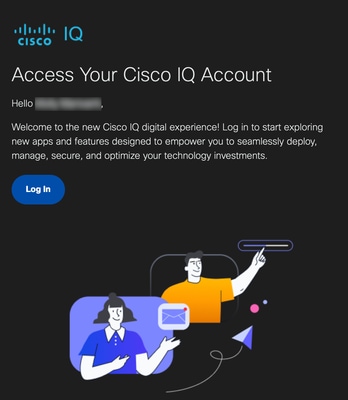 Cisco IQ Welcome Email
Q. Will Cisco IQ offer differentiated feature sets based on support tier?
A. Yes. Cisco IQ features are entitled based on the support tier of the customer’s assets. This means that access to specific apps and capabilities will scale according to the chosen level of support.
Q. How will Cisco IQ enable better collaboration between Cisco Support and Professional Services?
A. Cisco IQ will facilitate collaboration through:
-
Unified digital interface for both offers
-
Shared insights and analytics
-
Seamless transition of insights to expert-led action
-
Common view of customer environment and history
-
Integrated reporting and Key Performance Indicator (KPI) tracking
Q. Can customers segment access by contract number or business unit within Cisco IQ?
A. Yes. Customers can create multiple accounts with different contract numbers based on their business need.
Q. Is regional data residency (e.g., selectable data centers for sensitive data) planned for collector deployments?
A. Please refer to the Offer Disclosure for details.
Q. Can the customer assign a services partner to a “Customer” user role in Cisco IQ?
A. Though Cisco IQ allows customer to onboard any user with a valid Cisco ID (CCO ID), the customer should not add partner users to a “Customer” user role. Currently, Cisco IQ does not support partner-specific roles with the necessary data access controls.
We are actively developing dedicated partner roles, which are scheduled for release in FY27. Once implemented, these roles will provide the customer with the following capabilities:
-
Controlled onboarding: the customer will be able to approve, and onboard partner users associated with their Cisco Support resale contract into roles specifically designed for partners
-
Flexible access management: the customer can grant partners access to assets tied specifically to their resale contract or provide access to all assets within their account
-
Enhanced data security: We are implementing partner-specific data masking to ensure that partners can only view information the customer have explicitly authorized, preventing them from accessing data belonging to other partners
Q. What telemetry sources feed data into Cisco IQ?
A. Cisco IQ utilizes a multi-layered approach to data ingestion to provide comprehensive network insights. The primary component is Cisco IQ Link, which is deployed within the customer’s on-premises network to perform automated device discovery and telemetry collection. It can also connect to the Catalyst Center. In addition, customers will be able to connect the following product controllers: Intersight®, Meraki Dashboard, SD-WAN Manager, Webex® Control Hub. Existing CX Cloud customers will be able to use Common Services Platform Collector (CSPC) and CX Agent for connection to Cisco IQ. In the future, we will help migrate the old collectors to Cisco IQ Link.
Q. Can multiple Meraki organizations be configured as data sources using separate API keys?
A. We are actively working on roadmap enhancements to further streamline this integration and improve the multi-organization management experience.
Q. Will customers need to grant partners access to their entire installed base?
A. In a resale motion, granting access to the entire Installed Base (IB) is not required. In the future, when a customer provides partner access approval via their Cisco IQ account, partners will be able to only view the specific assets covered under their Cisco Support resale contract. At partner GA (planned for FY27), customers will also have an ability to grant access to their entire IB available in their Cisco IQ account. We do recognize that customers work with multiple partners for their service needs. Cisco IQ masks partner specific data so one partner does not see another partner’s specific information.
Q. How does self-serve troubleshooting work in Cisco IQ?
A. Customers can self-troubleshoot issues by pasting their errors. The AI agent will share the root cause analysis and provide the option for customers to open and manage cases using natural language interaction.
Q. Does Cisco IQ provide “Configuration Best Practices”?
A. Yes. The configuration best practices are based on Cisco’s intellectual capital, and Cisco IQ identifies and resolves misconfigurations and vulnerabilities.
Q. What is “Intelligent Device Criticality Analysis”?
A. This Cisco IQ capability highlights key assets to prioritize based on their role in the network. Device Criticality helps the user to understand the level of impact that an asset has across a customer network, which is relevant in assessments and other items in Cisco IQ. For example, if there’s a Cisco device in a location with low level of impact versus the same device in a different location configured differently with a high level of impact, Cisco IQ will help customers prioritize the critical devices first.
Q. What are Evaluated Assets?
A. Evaluated Assets are devices that have been assessed using Cisco IQ’s Assessment capabilities.
Q. Is “Security Hardening” available in Cisco IQ?
A. Security hardening is available in the Cisco IQ SaaS experience.
Q. Are prompts or responses stored, logged, or used to train the model?
A. No. The full response body is not stored or logged. Only high-level response headers are shared (for example, the number of LLM tokens used and LLM metadata). No customer-specific data is retained. Additionally, information is not used to train the model. It is used strictly for real-time inferencing.
Q. What is the relationship between the CX Portfolio Simplification and Cisco IQ?
A. Cisco IQ is the digital interface that enables the evolved value proposition. It provides the AI-powered interface through which customers experience the personalized, proactive, and predictive capabilities promised by the simplified portfolio. Cisco Support and Professional Services (in the future) are the offers for customers in the simplified portfolio to access Cisco IQ and its features entitled at each tier of Support.
Q. How will Professional Services leverage Cisco IQ?
A. Professional Services will integrate with Cisco IQ in the future to provide:
-
Seamless integration of support insights into consultative engagements
-
Personalized insights and analytics for proactive architecture evolution
-
Dynamic reporting to gauge performance
-
AI-enabled change recommendations and implementation
-
Automatic pre and post change assessments, testing, and validation
-
Customer-facing digital features consistent with PS value proposition (roadmap)
Q. Will Cisco Professional Services have unique customer-facing features in Cisco IQ?
A. Yes. Professional Services will include customer-facing digital features in Cisco IQ in the future, consistent with the offer’s value proposition, including insights, recommendations, and reporting.
Q. Does Cisco IQ support multivendor environments?
A. Cisco IQ is designed to revolutionize the journey for Cisco investments currently. In the future, it will integrate with third party devices as well.
Q. Will customers migrate directly from Smart Net Total Care® (SNTC) and CX Cloud to Cisco IQ?
A. Customers will have a simplified migration experience from CX Cloud. However, direct migration from SNTC will not be available. It is therefore imperative that SNTC and CX Cloud customers start using Cisco IQ at https://iq.cisco.com/
Q. Will customers have visibility to Support and Professional Services deliverables in Cisco IQ?
A. In the future state of Cisco IQ, customers will be able to view both Support and Professional Services deliverables, depending on their entitlement.
Q. Will Cisco IQ replace human experts?
A. No. Cisco IQ empowers teams to transition from reactive maintenance to proactive operational excellence alongside experts.
Q. How does Cisco IQ compare to Cisco AI Canvas?
A. Cisco AI Canvas is a collaborative, AI-powered workspace that enables IT teams to troubleshoot and manage complex network and security issues by dynamically generating dashboards in real-time from various sources like networking, security, and observability tools. It acts as a generative UI, allowing teams to analyze data together, identify problems using natural language prompts, and automate actions.
While Cisco IQ also uses a generative interface, it is focused on enabling predictive and proactive IT, helping organizations stay ahead of potential issues such as outages, security lapses, and performance degradations before they occur. Additionally, Cisco IQ provides personalized learnings and serves as a unified digital interface for Cisco Support and, in the future, Professional Services. Cisco IQ is not available as a standalone digital experience but will be accessible only to customers with a Cisco Support or Professional Services contract.
Q. Can customers see real-time support case metrics in Cisco IQ?
A. Yes, customers can see this in the Support application.
Q. Will RADKit be integrated into Cisco IQ On-Prem software, creating a single interface for CX into the customers network?
A. Cisco IQ Link integrates RADKit functionality and other advanced capabilities for troubleshooting.
Q. When will Cisco IQ be available for air-gapped networks?
A. The On-Prem Air-Gapped modality will be available starting in July 2026.
Q. Why aren’t assets showing in the Assets tab right after adding a service contract (System Settings > Service Contracts), even when the Support application shows the contract is added?
A. After a contract is added, it can take up to an hour for the asset data to load for the first time. The Support application reads contract data in near real-time, but the Assets tab only populates on the next backend sync.
Q. Can a customer export all their assets at once (covered and uncovered together) from the Cisco IQ Inventory for offline analysis?
A. Yes—navigate to Assets > Inventory. The default filter is “Equipment Type = CHASSIS”. Clear all filters, then click Export to download the full asset list.
Q. How does Cisco IQ handle asset management?
A. Cisco IQ provides personalized, up-to-date asset views filtered by “signals” from device interactions. It provides intelligent device criticality analysis, an AI Assistant for summarizing exposure, and generates smart reports. Cisco IQ will start showing a lot of asset management capabilities digitally to customers in FY27. Some of these include asset and contract reconciliation, Move Add Change Delete (MACD) operations, location-based insights, etc.
Q. Will Cisco IQ allow customers to have an alternative to Asset Management services doing inventory, contract coverage, and license expiration control all in digital?
A. The plan is to digitize Asset Management features in Cisco IQ. This will include everything related to Hardware, Software, and SaaS products in the future to ensure customers can self-serve.
Q. Does Cisco IQ require a GPU for On-Prem deployments?
A. No. For Cisco IQ SaaS experience, the On-Prem Cisco IQ Link does not require a GPU; AI processing is handled in the cloud.
Q. How are Security Advisories updated in an air-gapped environment?
A. When Cisco IQ Virtual Appliance is available in the air-gapped, customers will have to manually download an update “patch” from a SaaS portal and install it on the air-gapped VM.
Q. Is Cisco U. (Learning) available in Cisco IQ?
A. Learning is not currently available in Cisco IQ. It is part of our future roadmap in FY27.
Q. How will AI Assistant Inference and Data Handling work in Cisco IQ?
A. Centralization: AI Assistant Inference is currently centralized in the Cisco RTP data center and accessed by all regions.
Stateless Processing: The LLM layer functions as a stateless service. No customer data is stored at rest.
Security: Requests are transient and securely routed. No Personally Identifiable Information (PII) is transferred to the LLM infrastructure.
Please refer to the Offer Disclosure and AI Transparency Tech Note for more details.
Q. Can you describe Quantum Ready Assessment?
A. Quantum Ready Assessment turns complex network and security transitions into actionable roadmaps to ensure seamless compliance and robust protection against emerging post-quantum threats for proactive resilience. It evaluates against 3 critical quantum safe criteria—secure communications, secure platform, and crypto agility. It provides full landscape clarity of which assets are safe, need updates or refresh, and benchmarks against regulatory requirements such as CNSA 2.0.
Q. Can you provide more details about peer benchmarking?
A. Peer benchmarking allows customers to understand where you stand from an IT and risk tolerance standpoint compared to your peers to remain competitive within your industry. It benchmarks performance, compares last day of support risk to peers, and provides actionable recommendations to reduce Last Day of Support (LDOS) risk exposure. It identifies how well you remediate security advisories and how many devices are delivering telemetry by geography, industry, and market segment.
Q. What are Resilient Infrastructure Services (RIS)?
A. RIS brings together support services, the foundational capability every customer should have, and Professional Services, all delivered through Cisco IQ. It spans three pillars: Exposure Assessment, Infrastructure Modernization, and Defense Resiliency. Cisco positions RIS to operationalize resilience as a continuous lifecycle rather than a one-time effort. Instead of treating vulnerability assessment, software determination, and upgrade as separate, disconnected tasks, we unify them into one continuous experience inside an interface the customer already uses. The result is a clear path from “what am I exposed to?” to “it is remediated,” all in one place.
Platform Integration and APIs
Q. Does Cisco IQ integrate with platforms such as Catalyst Center and Intersight?
A. Yes. Customer administrators can deploy Cisco IQ Link to connect to the On-Prem Catalyst Center. Customers can also connect Cisco IQ with Intersight.
Q. Will Cisco IQ support APIs?
A. Yes. API functionality is on our current roadmap and is expected to be available in FY27.
Q. Can Cisco IQ export data to third-party tools (for example, risk management or external asset management platforms)?
A. Cisco IQ will provide flexible methods for exporting the customer’s data:
-
Manual Export: Inventory report data can be exported into CSV or Excel formats for immediate use.
-
Programmatic Export: A robust set of APIs is currently under development to allow for automated data extraction.
These API capabilities are scheduled for release in FY27.
Q. Will Cisco IQ support third party devices?
A. Support for third party devices is currently planned for FY27.
Q. Will Cisco IQ connect directly with Catalyst Center, Meraki Dashboard, Nexus Dashboard, and other controllers?
A. Cisco IQ will support connectivity to Catalyst Center, Intersight, Meraki Dashboard, SD-WAN Manager, and Webex Control Hub.
Q. Are there any plans to create a Cisco IQ onboarding team?
A. We have created many digital resources for customers, partners, and internal teams to support enablement, training, and onboarding. There will be no separate dedicated team for onboarding. All CX teams will be supporting customers get to Cisco IQ. For any technical issues, TAC will be available to support.
Data Collection and Privacy
Q. What prevents PII or sensitive data from being sent to the LLM during inference?
A. The system is designed so that no PII data is included in the LLM request for any region. The inference process is stateless and processed in memory only; once the response is returned, the data is discarded. Please refer to the Offer Disclosure and AI Transparency Tech Note.
Q. Are customers required to have a data collection tool?
A. For the SaaS experience, Cisco IQ Link is not required, but it is highly encouraged to generate detailed personalized insights. Without the collection of data, several features of Cisco IQ will not function fully or at all.
Q. How will customer data privacy be managed?
A. For more information on how Cisco handles customer data privacy, please refer to the Offer Disclosure and AI Transparency Tech Note.
Q. Is the data leaving the region when the AI Assistant is used?
A.
-
U.S. Region: No. Data remains within the region.
-
EMEA and APJC Regions: Yes. A subset of data (specifically CLI data required for the LLMs to function) is sent to the U.S. Region for inferencing.
Cisco IQ and CX Cloud
Q. Will CX Cloud continue to be available?
A. CX Cloud will be discontinued soon, however an End-of-Life (EOL) date for CX Cloud has not yet been established.
Cisco IQ is the primary interface for Cisco Support. We encourage our customers to move to Cisco IQ so they can take advantage of the latest and greatest capabilities, features, and applications.
Q. Will customers still be able to use CSPC collector?
A. Existing Cisco Support customers who are already in CX Cloud can use CSPC collector in Cisco IQ. However, any new customers will need to install and configure Cisco IQ Link for device connectivity On-Prem.
Q. Will existing CX Cloud customers be migrated to Cisco IQ?
A. CX Cloud customers will see a banner in CX Cloud experience to do a seamless migration to Cisco IQ. Cisco IQ will check all users who come to https://iq.cisco.com to see if they are already a CX Cloud Super User Administrator and guide them through the migration.
Q. How does Cisco IQ compare to CX Cloud, and what changes should existing CX Cloud customers expect?
A. Cisco IQ is the AI-powered digital experience for both Cisco Support and, in the future, Professional Services. CX Cloud was limited to Cisco Support only. Some of the areas of differentiation include:
-
AI Integration and Automation: CX Cloud primarily provides asset lists, EOL dates, and advisories, requiring manual analysis and offering limited automation or intelligence; Cisco IQ uses agentic and generative AI throughout its digital experience to deliver automated summaries, conversational interfaces, risk analysis, and actionable guidance.
-
Personalization and Context: CX Cloud does not use AI for environment-specific recommendations and insights. With Cisco IQ’s purpose-built AI foundation, it delivers personalized contextual insights, recommendations, and actions.
-
Proactive and Predictive Capabilities: Cisco IQ goes beyond CX Cloud in its ability to provide proactive and predictive guidance, helping identify risks and recommend actions before issues occur.
-
Unified User Experience: While CX Cloud provided lifecycle stage data, it was limited to support services; Cisco IQ is designed as a unified digital experience for both Support and Professional Services across the entire lifecycle.
-
Data Simplification and Visualization: CX Cloud requires manual effort to interpret and act on available data. Cisco IQ, on the other hand, uses AI to filter out irrelevant data, offering clearer asset summarization and streamlined workflows to reduce cognitive load.
-
Deployment Flexibility: CX Cloud is available only as a SaaS solution, without On-Prem options. Cisco IQ supports SaaS, On-Prem tethered, and private deployments, addressing diverse security and compliance requirements.
Q. Can you provide use cases that show the differences between the CX Cloud and Cisco IQ experience?
A. Cisco IQ represents a paradigm shift in how Cisco delivers proactive insights and intelligent automation. It is a completely reimagined, AI-powered digital interface with a different approach, capabilities, and user engagement model.
For example, in Assets, CX Cloud shows a list of assets while Cisco IQ provides AI-based summarization and intelligence with ‘Signals.’ Cisco IQ shows asset criticality insights to help users prioritize assets based on their role and importance in the network and how they are configured.
In FY27, we will also allow asset reconciliation features with their Configuration Management Database (CMDB) tools and Microsoft Excel to ensure we correct all systems of records. Similarly, every app and feature in Cisco IQ is personalized, proactive, and predictive.
Cisco IQ and Cisco Cloud Control
Q. How does Cisco IQ compare to Cisco Cloud Control?
A. Cisco IQ: Provides a strategic advisory and services experience for the entire IT team. It delivers proactive intelligence, assessments, support, and in the future, Professional Services across the full lifecycle.
Cisco Cloud Control: Serves as a real-time operations console for all Operations teams. It unifies Cisco’s controllers to provide direct management, control, and troubleshooting of the live network.
Cisco AI Canvas will be surfaced to customers through Cisco Cloud Control. Together, they connect day-to-day operations with long-term strategic insight:
-
Powered by purposeful integration and data exchange for relevant use cases
-
Ensures a consistent customer experience
-
Helps customers anticipate issues and achieve business outcomes
Q. How does Cisco IQ fit into the overall strategic direction of Cisco Cloud Control? Will it be cross launched like Meraki and Catalyst Center?
A. For relevant use cases, there will be purposeful integration and data exchange between Cisco IQ and Cisco Cloud Control to ensure a consistent customer experience.
Q. What’s the difference between Cisco Cloud Center and Cisco IQ from a customer perspective when they will have both? How will Cisco IQ complement the day-2 operations for customers with Cisco Cloud Control?
A. Cisco IQ is leveraged by a customer’s IT organization and delivers proactive intelligence, assessments, support, and professional services across the entire lifecycle for controller and non-controller architectures. This intelligence enables customers to proactively mitigate risk within their environment and increase operational assurance. Cisco Cloud Control provides a real-time operations console that is leveraged by a customer’s Operations team. It unifies Cisco’s controllers to provide direct management, control, and troubleshooting of the live network. Together, they connect day-to-day operations (Cisco Cloud Control) with long-term strategic insights (Cisco IQ).
Partners
Q. Is there a difference between the capabilities available to partners and those available to customers?
A. When Cisco IQ is available to partners in FY27, there will be no difference in the capabilities available to partners and those available to customers in Cisco IQ. Both partners and customers will receive feature parity within Cisco IQ. However, there are some role-based distinctions depending on the role the partner is playing with the customer with respect to Cisco Services.
In Cisco Support resale, partners will typically have a read-only role, but customers can grant partners read/write access for some features. Resale partners will interact with Cisco IQ by being onboarded to their customer’s Cisco IQ account, where the customer will grant them access to the relevant customer account. This means resale partners will not have a separate dedicated Cisco IQ partner account. Instead, they will access Cisco IQ through the customer’s account with permissions granted by the customer.
In Cisco Partner Support, partners will have their own Cisco IQ account dedicated to the Cisco Partner Support offers and full access to features for assets covered under their contract. Cisco Partner Support partners will use Cisco IQ through a dedicated partner account that they administer. They can access Cisco IQ features via the UI and APIs, when they become available.
Q. Will distributors have access to Cisco IQ?
A. Yes, customers will be able to authorize distributors access to their Cisco IQ Account in General Availability release in FY27.
Q. How will a partner know if their Cisco Support customer is onboarded to Cisco IQ?
A. At the GA launch for partners (planned for FY27), partners will get visibility into all their resale customers, onboarding status of respective Cisco IQ accounts, customer administrator information, and partner access status via a dashboard in Cisco IQ.
Q. How will partners know if their Cisco Support customer has approved or denied their access?
A. When a customer grants, denies, or revokes access to their account, an automated email will be sent to the partner users. We also plan to launch an enhanced view for partners within Cisco IQ at GA where partners can see access status across all of their customers.
Q. Can the partners give customers access to their Partner Cisco IQ account?
A. Yes, partners will be able to give their customers access to their partner Cisco IQ account. This feature is planned for post-GA in FY27.
Revision History
| Revision | Publish Date | Comments |
|---|---|---|
3.0 |
July 23, 2026
|
Updated answers to reflect the most recent Cisco IQ features and enhancments. |
1.0 |
April 23, 2026
|
Initial Release |