OT application recognition on IIoT routers using NBAR
Available Languages
Bias-Free Language
The documentation set for this product strives to use bias-free language. For the purposes of this documentation set, bias-free is defined as language that does not imply discrimination based on age, disability, gender, racial identity, ethnic identity, sexual orientation, socioeconomic status, and intersectionality. Exceptions may be present in the documentation due to language that is hardcoded in the user interfaces of the product software, language used based on RFP documentation, or language that is used by a referenced third-party product. Learn more about how Cisco is using Inclusive Language.
- US/Canada 800-553-2447
- Worldwide Support Phone Numbers
- All Tools
 Feedback
 Feedback
NBAR Architecture and Operation
NBAR Protocol Packs and Protocol Discovery
NBAR Classification of Major OT Protocols
NBAR Sub-classification for Industrial Protocols
Understanding DNP3 Sub-classification
Configuring and Managing NBAR in Cisco Catalyst SD-WAN
Protocol-Pack Deployment Workflow
NBAR Capabilities in Catalyst SD-WAN
Industrial Use Cases - NBAR Use Cases in Utility Networks
Utilities communication networks carry operationally critical traffic between supervisory control and data acquisition (SCADA) systems, control centers, remote terminal units (RTUs), programmable logic controllers (PLCs), and intelligent electronic devices (IEDs). Traditional traffic classification based only on IP addresses, transport protocols, and TCP or UDP port numbers can identify an industrial protocol, but it cannot reliably distinguish the individual operations carried inside that protocol. For example, in a utility SCADA environment, NBAR can distinguish a DNP3 READ request used to retrieve breaker status, analog measurements or device attributes from a DNP3 WRITE request used to modify supported outstation parameters. These operations are identified under the parent dnp3 protocol using the read and write sub-classifications.
Cisco Network-Based Application Recognition (NBAR) is built into supported Cisco IOS XE platforms and requires no separate software installation. It provides application-aware traffic classification using protocol signatures, stateful inspection, multipacket analysis, and deep packet inspection. NBAR operates beyond conventional Layer 3 and Layer 4 classification by examining protocol characteristics and selected fields within the application payload. Its protocol sub-classification capability provides additional granularity by identifying specific functions, commands, or message types within a recognized parent protocol. NBAR also integrates with Protocol Discovery for traffic visibility and with the Modular Quality of Service Command-Line Interface (MQC) for applying policy actions to classified traffic.
This paper explains the Cisco NBAR architecture and its use for OT application recognition on industrial routers. It presents parent-protocol classification for major OT protocols, including MMS, DNP3, Modbus, IEC 60870-5-104, OPC UA and NTCIP, followed by the supported protocol sub-classification capabilities. The paper also explains how NBAR classifications can be integrated with MQC to provide traffic visibility and apply policy actions to classified traffic. Command outputs from Cisco industrial routers are used to demonstrate Protocol Discovery, application recognition, sub-classification and policy operation.
The analysis demonstrates that NBAR sub-classification provides greater traffic visibility and more precise policy control than conventional port-based classification. The resulting architecture allows industrial protocols to be managed according to the operational purpose of their messages rather than treating all traffic belonging to a protocol identically.
Industrial communication networks support the exchange of monitoring data and control commands between SCADA systems, control centres, RTUs, PLCs, IEDs, and other field devices. Protocols such as Modbus, DNP3, and IEC 60870-5-104 are commonly used for telemetry, status reporting, measurement collection, remote control, and equipment management across utility and industrial environments.
A single industrial protocol may carry operations with significantly different purposes and operational consequences. Read operations generally retrieve measurements, device status, or register values without modifying the controlled process. Write and command operations can change register values, operate coils, modify setpoints, synchronize clocks, reset processes, or control field equipment. Identifying only the parent protocol therefore does not provide sufficient information to determine the purpose of the communication.
Traditional network-classification mechanisms use source and destination IP addresses, transport protocols, and TCP or UDP port numbers. These mechanisms are effective for identifying endpoints and expected communication paths but provide limited visibility into the application operation carried inside a packet.
Cisco NBAR addresses this limitation through application-aware classification. It uses protocol signatures, stateful inspection, multipacket analysis, and deep packet inspection to recognize network applications and protocols. Where supported, NBAR can further classify the operation or message type contained within a recognized protocol. This enables Modbus functions, DNP3 operations, and IEC 104 commands to be handled as separate traffic classes.
NBAR Protocol Discovery provides visibility into the protocols traversing an interface, including packet counts, byte counts, and traffic rates. NBAR also integrates with MQC, allowing recognized traffic to be associated with a class map and processed by a policy map. Depending on the network requirement, the resulting policy can monitor, mark, prioritize, police, or drop selected traffic.
NBAR recognition capabilities are provided through the NBAR engine and its active protocol pack. NBAR recognition is provided by the NBAR engine and its active protocol pack. Cisco provides updated protocol packs to add new protocols and enhance existing classifications. Compatible protocol-pack updates can be installed without requiring a major Cisco IOS XE release upgrade.
This paper presents the NBAR architecture and explains how protocol sub-classification can provide detailed visibility into industrial communication. It examines Modbus function-level classification, DNP3 read, write, and confirm classification, and IEC 104 command-level classification. It also describes how these results can be used within MQC policies to implement selective and application-aware traffic control.
NBAR Architecture and Operation
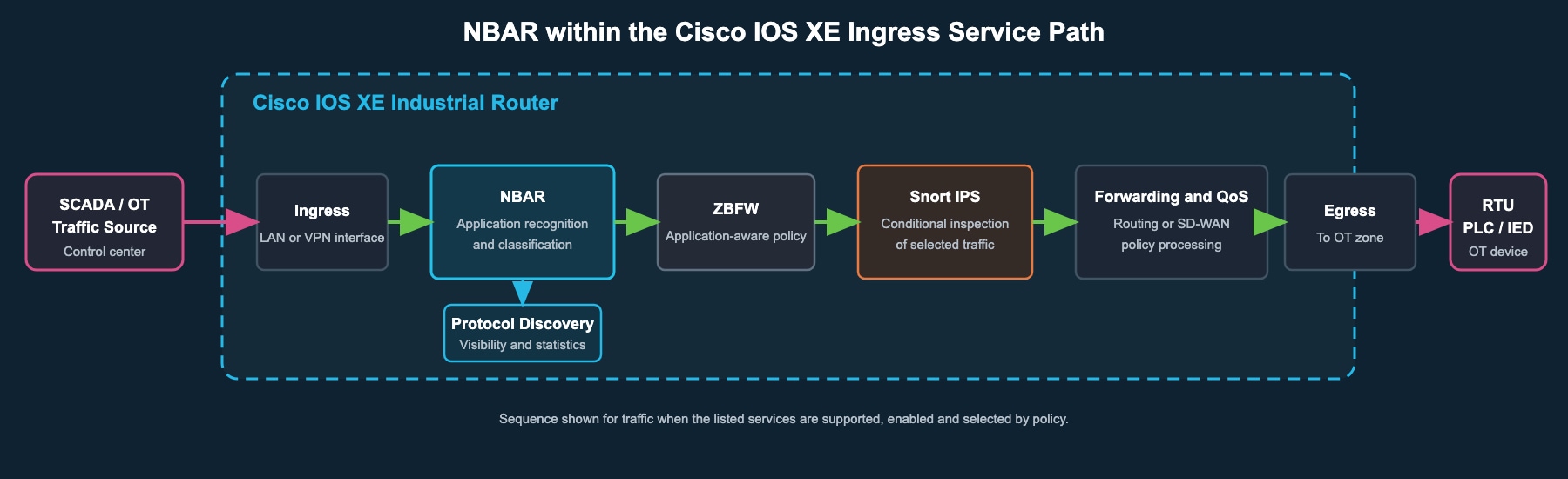
Figure 1. NBAR Application Recognition, Policy Workflow
Cisco Network-Based Application Recognition (NBAR) is an application-classification engine that identifies IP traffic using protocol signatures and packet characteristics. Unlike classification based only on IP addresses and TCP or UDP ports, NBAR can inspect application-layer information and recognize protocols that use dynamic ports or share common transport ports.
NBAR classification operates through the following stages:
● Protocol recognition: NBAR identifies the application or parent protocol, such as Modbus, DNP3, IEC 60870-5-104, MMS IEC 61850, OPCA UA, NTCIP.
● Protocol sub-classification: NBAR examines protocol-specific fields to identify the function, operation or command carried within the parent protocol.
● Traffic-class association: The classification result is referenced by an MQC class map.
● Policy application: MQC applies the configured action, such as visibility, marking, policing or dropping.
● Counter reporting: Protocol Discovery and MQC policy counters provide operational evidence of classified traffic.
NBAR Protocol Packs and Protocol Discovery
An NBAR protocol pack contains the signatures and protocol definitions used by the NBAR engine. Protocol packs allow protocol recognition capabilities to be updated without replacing the complete Cisco IOS XE software image.
The active protocol pack determines:
● The protocols that NBAR can recognize.
● The sub-classification parameters available for each protocol.
● The protocol taxonomy and classification signatures.
● Classification improvements introduced through updated protocol definitions.
The protocol pack must be compatible with the NBAR engine and the installed Cisco IOS XE release. The active pack and its details can be verified using:
show ip nbar protocol-pack active
show ip nbar version
show ip nbar control-plane | include NBAR state:
Router# show ip nbar control-plane | include NBAR state:
NBAR state: ACTIVATED
Router# show ip nbar version
NBAR software version: 57
NBAR minimum backward compatible version: 57
NBAR change ID: BLD_NBAR_XE262_20260709_120537
Loaded Protocol Pack(s):
Name: Advanced Protocol Pack
Version: 79.0
Publisher: Cisco Systems Inc.
NBAR Engine Version: 57
State: Active
Router# show ip nbar protocol-pack active
Active Protocol Pack:
Name: Advanced Protocol Pack
Version: 79.0
Publisher: Cisco Systems Inc.
NBAR Engine Version: 57
State: Active
Protocol Discovery provides interface-level visibility into NBAR-recognized traffic. It records input and output packet counts, byte counts and traffic rates for recognized protocols.
It can be enabled on the required interface as follows:
interface <interface-name>
ip nbar protocol-discovery
The results can be displayed using:
show ip nbar protocol-discovery
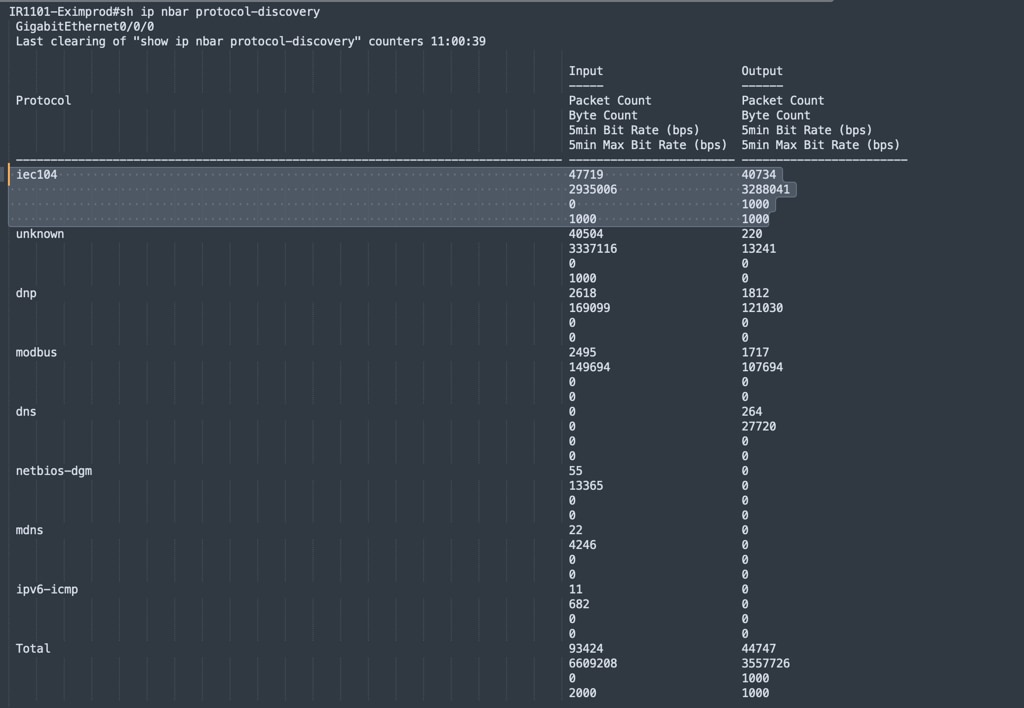
show ip nbar protocol-discovery interface <interface-name>
show ip nbar protocol-discovery protocol
Protocol Discovery is primarily used to confirm that the parent protocol is present and being recognized. Detailed function or command counters are obtained from the MQC classes configured with the corresponding sub-classification matches.
NBAR Classification of Major OT Protocols
NBAR uses protocol signatures and application-layer characteristics to identify supported OT applications traversing an industrial router. Parent-protocol classification identifies the application before any available protocol-specific sub-classification is applied. Parent-protocol classification provides application-level visibility through Protocol Discovery and enables the traffic to be referenced in MQC class maps. For protocols supporting sub-classification, the parent classification can be refined to identify specific services, functions or commands.
| OT protocol |
NBAR protocol name |
Application |
| MMS for IEC 61850 |
mms-iec61850 |
Client-server communication between supervisory systems and IEC 61850 devices. |
| DNP3 |
dnp |
SCADA telemetry and supervisory communication between master stations and outstations. |
| Modbus |
modbus |
Register- and coil-based communication with PLCs and industrial devices. |
| IEC 60870-5-104 |
iec104 |
Telecontrol communication between control centers and remote stations over TCP/IP. |
| OPC Unified Architecture |
opcua |
Interoperable industrial data exchange and information modelling. |
| NTCIP |
ntcip |
Monitoring and control of intelligent transportation equipment. |
NBAR Sub-classification for Industrial Protocols
Protocol sub-classification extends identification beyond the parent industrial protocol. It allows a policy to distinguish monitoring and read operations from commands that can alter device state, control outputs or modify process values.
The available parameters for particular can be verified on the router using:
Router# show ip nbar parameter subclassification dnp
Protocol Parameter Parameter type
dnp confirm enum
dnp read enum
dnp write enum
Router# show ip nbar parameter subclassification modbus
Protocol Parameter Parameter type
modbus encapsulated-transport enum
modbus exception-response enum
modbus mask-write-register enum
modbus read-FIFO-Queue enum
modbus read-coils enum
modbus read-discrete-input enum
modbus read-exception-status enum
modbus read-file-record enum
modbus read-holding-registers enum
modbus read-input-register enum
modbus read-or-write-registers enum
modbus write-file-record enum
modbus write-multiple-coils enum
modbus write-multiple-registers enum
modbus write-single-coil enum
modbus write-single-register enum
Router# show ip nbar parameter subclassification iec104
Protocol Parameter Parameter type
iec104 bitstring-command enum
iec104 clock-synchronization-command enum
iec104 counter-interrogation-command enum
iec104 delay-acquisition-command enum
iec104 double-command enum
iec104 interrogation-command enum
iec104 multiple-type-ids enum
iec104 read-command enum
iec104 regulating-step-command enum
iec104 reset-process-command enum
iec104 setpoint-command-floating enum
iec104 setpoint-command-normalized enum
iec104 setpoint-command-scaled enum
iec104 single-command enum
iec104 test-command enum
Router# sh ip nbar parameter subclassification mms-iec61850
Protocol Parameter Parameter type
mms-iec61850 get-name-list enum
mms-iec61850 identify enum
mms-iec61850 read enum
mms-iec61850 rename enum
mms-iec61850 status enum
mms-iec61850 write enum
Router# sh ip nbar parameter subclassification opcua
Protocol Parameter Parameter type
opcua activate-session enum
opcua create-session enum
opcua create-subscription enum
opcua get-endpoints enum
opcua open-secure-channel enum
opcua publish enum
opcua read enum
opcua write enum
Router# sh ip nbar parameter subclassification ntcip
Protocol Parameter Parameter type
ntcip get-bulk-request enum
ntcip get-next-request enum
ntcip get-request enum
ntcip get-response enum
ntcip inform-request enum
ntcip set-request enum
ntcip snmpv2-trap enum
ntcip trap enum
Understanding DNP3 Sub-classification
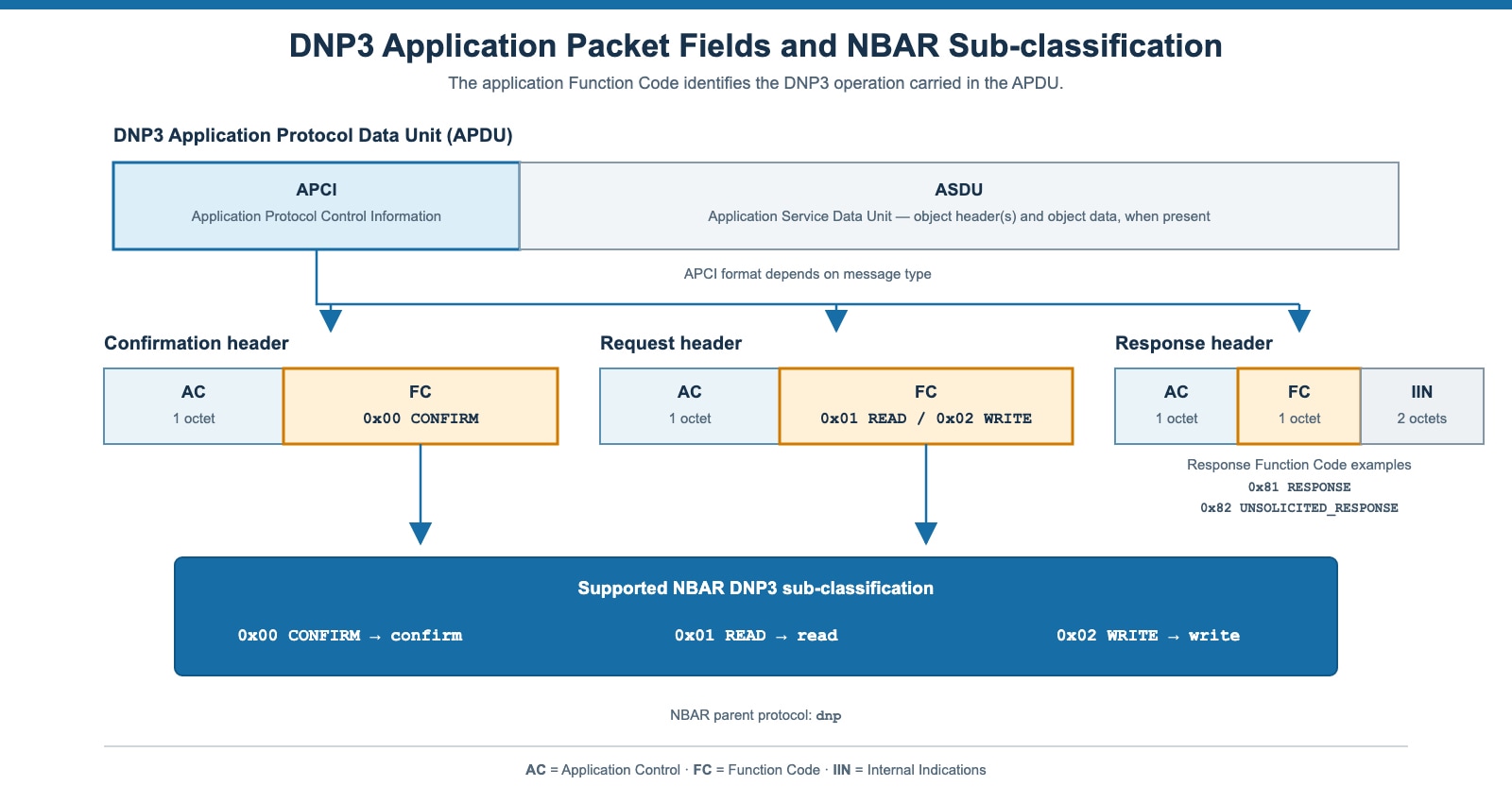
NBAR identifies DNP3 traffic using the protocol name dnp. DNP3 sub-classification provides additional visibility by distinguishing Read, Write and Confirm application-layer functions. DNP3 uses the Enhanced Performance Architecture, consisting of the application, data-link and physical layers. A pseudo-transport function operates between the application and data-link layers to segment and reassemble larger application messages.
| DNP3 sub-classification |
Function |
Function Code |
| Read |
Identifies requests used to retrieve data from a DNP3 outstation. |
1 |
| Write |
Identifies requests used to write data or parameters to a DNP3 outstation. |
2 |
| Confirm |
Identifies application-layer confirmation messages. |
0 |
| Component |
Technical function |
| Application layer |
Carries SCADA requests, responses, function codes and data objects. |
| Pseudo-transport function |
Segments application fragments into units that fit within data-link frames and reassembles them at the receiver. |
| Data-link layer |
Provides source and destination addressing, frame control and error detection. |
| Physical layer |
Transmits DNP3 data over the underlying serial, radio, fibre or Ethernet-based medium. |
The DNP3 application layer is the most relevant layer for NBAR sub-classification because it identifies the operation being performed. A DNP3 application fragment contains the following principal fields:
| Field |
Purpose |
| Application Control |
Indicates fragment boundaries, confirmation requirements and application sequence information. |
| Function Code |
Identifies the requested or reported DNP3 operation. |
| Internal Indications |
Included in application responses to communicate outstation status and error conditions. |
| Object Headers and Data |
Identify the DNP3 data type, representation and point information carried in the message. |
This sub-classification allows a router to distinguish routine monitoring operations from configuration-related write activity while retaining the parent DNP3 classification. The classification result can be associated with an MQC policy for traffic visibility, accounting, marking, policing or other supported policy actions.
Configure the DNP3 class maps
Router(config)# class-map match-any dnp3-read-vis
Router(config-cmap)# match protocol dnp read
Router(config-cmap)# exit
Router(config)# class-map match-any dnp3-write-vis
Router(config-cmap)# match protocol dnp write
Router(config-cmap)# exit
Router(config)# class-map match-any dnp3-confirm-vis
Router(config-cmap)# match protocol dnp confirm
Router(config-cmap)# exit
Associate the classes with an MQC policy
Router(config)# policy-map dnp3-write-drop-test
Router(config-pmap)# class dnp3-write-vis
Router(config-pmap-c)# police cir 8000 conform-action drop exceed-action drop
Router(config-pmap-c)# exit
Router(config-pmap)# class dnp3-read-vis
Router(config-pmap-c)# exit
Router(config-pmap)# class dnp3-confirm-vis
Router(config-pmap-c)# exit
à Attach the policy to the interface carrying the DNP3 traffic:
Router(config)# interface GigabitEthernet0/0/0
Router(config-if)# ip nbar protocol-discovery
Router(config-if)# service-policy input dnp3-write-drop-test
Verify DNP3 classification
Router # show policy-map interface GigabitEthernet0/0/0 input
GigabitEthernet0/0/0
Service-policy input: dnp3-write-drop-test
Class-map: dnp3-write-vis (match-any)
331 packets, 24825 bytes
5 minute offered rate 0000 bps, drop rate 0000 bps
Match: protocol dnp write
police:
cir 8000 bps, bc 1500 bytes
conformed 331 packets, 24825 bytes; actions:
drop
exceeded 0 packets, 0 bytes; actions:
drop
conformed 0000 bps, exceeded 0000 bps
Class-map: dnp3-read-vis (match-any)
113 packets, 9153 bytes
5 minute offered rate 0000 bps
Match: protocol dnp read
Class-map: dnp3-confirm-vis (match-any)
0 packets, 0 bytes
5 minute offered rate 0000 bps
Match: protocol dnp confirm
Class-map: class-default (match-any)
1827 packets, 131496 bytes
5 minute offered rate 1000 bps, drop rate 0000 bps
Match: any
Configuring and Managing NBAR in Cisco Catalyst SD-WAN
Cisco Catalyst SD-WAN Manager provides centralized management of NBAR protocol packs, application visibility and application-aware policies across compatible Cisco IOS XE SD-WAN edge devices. Protocol-pack management involves two separate operations: uploading the protocol pack to SD-WAN Manager and then installing it on selected edge devices.
Protocol-Pack Deployment Workflow:
● Verify prerequisites
Cisco Catalyst SD-WAN Manager Release 20.15.1 or later is required for device protocol-pack upgrades. Cisco SD-AVC must also be installed and enabled in SD-WAN Manager. The protocol pack must be compatible with the device platform, Cisco IOS XE release and NBAR engine version.
● Download the protocol pack
Download the appropriate protocol-pack file from the Cisco Software Download site or the NBAR2 Protocol Pack Library. A protocol pack contains the signatures and protocol definitions used by NBAR to classify applications.
● Upload the protocol pack to SD-WAN Manager
In Cisco SD-WAN Manager, navigate to: Configuration > Application Catalog > Application Source Settings
Under SD-WAN Manager Protocol Pack, select Upload SDWAN Manager Protocol Packs and upload the protocol-pack file. If it is newer than the existing pack, it becomes the reference protocol-pack release used by SD-WAN Manager for device, application and policy-compliance checks.
● Install the protocol pack on edge devices
From the same Application Source Settings page:
◦ Select the required edge devices.
◦ Click Upgrade Device Protocol Pack.
◦ Select the required protocol-pack release.
◦ Start the upgrade immediately or schedule it.
SD-WAN Manager verifies device compatibility before installing the protocol pack. If a device is not currently compatible, Auto upgrade when device is compatible can be selected so that the installation proceeds after the device is upgraded to a supported Cisco IOS XE release.
● Enable application visibility
For Cisco SD-WAN Manager Release 20.15 and later, enabling Application Visibility under the Application Priority and SLA policy additional settings deploys ip nbar protocol-discovery to the service VPN interfaces. When Application-Aware Routing is configured, NBAR is enabled automatically. A CLI add-on template can be used when NBAR must be enabled only on selected LAN interfaces.
Router(config)# policy
Router(config-policy)# app-visibility
Router(config-policy)# exit
Router(config)# interface GigabitEthernet0/0/0
Router(config-if)# ip nbar protocol-discovery
● Configure application-aware policies
Applications recognized by NBAR can be referenced in Catalyst SD-WAN application-aware routing, QoS, traffic and security policies. Installing a protocol pack updates the available application definitions; it does not automatically create or modify application policies.
● Verify protocol-pack status
The Application Source Settings page displays the protocol-pack version installed on each device, device compatibility and upgrade status. Select Sync Compliance to perform an immediate compliance check.
NBAR Capabilities in Catalyst SD-WAN
| Capability |
Availability |
Scope |
| Application visibility |
Supported |
Identifies applications and parent OT protocols using the active protocol pack. |
| Application-aware routing |
Supported |
Matches recognized applications or application lists for SLA-based path selection. |
| ZBFW application matching |
Supported |
Matches recognized parent applications or application lists in firewall rules. |
| OT sub-classification through IOS XE MQC |
Supported |
Matches supported functions such as DNP3 read, write and confirm when exposed by the active protocol pack. |
| OT sub-classification in Catalyst SD-WAN ZBFW rules |
Future release |
Enables firewall rules to match protocol functions such as DNP3 read, write or confirm. |
Industrial Use Cases - NBAR Use Cases in Utility Networks
● Application Visibility
Identifies supported industrial, enterprise and network-management applications traversing utility router interfaces.
● Protocol Discovery
Provides per-protocol input and output packet, byte and bit-rate statistics for application monitoring.
● Industrial Protocol Recognition
Distinguishes supported OT protocols, such as Modbus, DNP3 and IEC 60870-5-104, from other IP traffic.
● Protocol Sub-classification
Identifies supported functions or operations within a recognised parent protocol, providing more granular visibility than port-based classification.
● Application-Aware QoS
Classifies applications into MQC traffic classes for marking, bandwidth allocation, queuing and policing.
● Selective Policy Control
Combines NBAR application classification with network-policy conditions to monitor or restrict selected traffic.
● WAN Bandwidth Management
Provides application-level traffic information for managing bandwidth across substation, field-area and control-centre communication links.
● Traffic Baselining
Establishes normal application and protocol usage patterns, enabling operators to identify significant changes in utility-network traffic.
● Capacity Planning
Uses application packet, byte and bit-rate statistics to support WAN sizing and future bandwidth requirements.
● Policy Verification
Uses MQC class counters to confirm that recognised application traffic is matching the intended traffic class and receiving the configured policy treatment.
NBAR Limitations
● NBAR does not classify non-IP traffic (e.g. Layer 2 non routable traffic like GOOSE), multicast packets, asymmetric stateful flows, or traffic originating from or destined for the NBAR-enabled device.
● NBAR is not supported on Dialer, DVTI, Fast EtherChannel, terminating IPv6 tunnel, or OTV overlay interfaces.
NBAR provides application-aware visibility and classification for routed IP traffic in operational technology networks. In utility substation environments, Protocol Discovery identifies supported applications and provides packet, byte and bit-rate statistics, enabling operators to understand the traffic exchanged between control centres, substations and remote field sites.
Protocol sub-classification extends this capability by identifying supported functions within industrial protocols such as Modbus, DNP3, IEC 60870-5-104, MMS IEC 61850, OPCA UA, NTCIP. This granularity allows routine monitoring traffic to be distinguished from write or command-related operations.
When integrated with MQC, NBAR classification can support application-aware QoS, traffic monitoring and selective policy enforcement. NBAR therefore provides a practical foundation for improving visibility and policy control across routed utility and substation communication networks.
Protocol packs keep the recognition engine current by updating protocol signatures without replacing the device’s Cisco software. MQC then converts the NBAR classification result into an enforceable network policy through monitoring, marking, queuing, policing or dropping, according to the utility’s approved design.
NBAR protocol packs maintain the signatures used for application recognition and allow protocol support to be updated without replacing the Cisco software image. The classification results can then be integrated with MQC to apply application-specific monitoring, marking, queuing, policing or traffic restrictions.
By combining Protocol Discovery, protocol sub-classification and MQC policy integration, NBAR makes routed industrial traffic visible, measurable and policy-relevant. This enables utilities to understand application behaviour, manage network resources and apply network policies according to the operational purpose of the traffic.
● https://www.dnp.org/Portals/0/AboutUs/DNP3%20Primer%20Rev%20A.pdf
● https://www.ciscolive.com/c/dam/r/ciscolive/emea/docs/2026/pdf/BRKOPS-2326.pdf