Cisco Mobility Services Gateway Solution Overview
Available Languages
Bias-Free Language
The documentation set for this product strives to use bias-free language. For the purposes of this documentation set, bias-free is defined as language that does not imply discrimination based on age, disability, gender, racial identity, ethnic identity, sexual orientation, socioeconomic status, and intersectionality. Exceptions may be present in the documentation due to language that is hardcoded in the user interfaces of the product software, language used based on RFP documentation, or language that is used by a referenced third-party product. Learn more about how Cisco is using Inclusive Language.
Cisco Mobility Services Gateway empowers Communication Service Providers (CSPs) to deploy 5G services alongside their existing 2G, 3G, 4G offerings. This provides CSPs with an incremental path to 5G SA and beyond, while maintaining backward compatibility. CSPs can accelerate new revenue opportunities and streamline operations without losing support and functionality with previous mobile network generations. By incorporating sophisticated capabilities like automated configuration and lifecycle management, advanced user plane technologies with persona-based customization, 3GPP compliant handover support across network generations and observability features, CSPs can effectively meet current market requirements and strategically prepare to seize future growth prospects.
In both 4G Evolved Packet Core (EPC) and 5G Standalone (SA) Core architectures, control signalling and user data processing are central to the Control and User Plane Separation (CUPS) framework. Cisco has introduced Mobility Services Control Plane (MSCP), a next-generation control plane product designed to deliver comprehensive session management capabilities spanning across 2G to 5G SA networks — ensuring seamless evolution and backward compatibility for operators transitioning through different generations of mobile technology. Complementing this is our high-performance User Plane Function called Cisco Mobility Services User plane (MSUP), engineered to deliver superior performance via pathbreaking architectural changes.
The control plane handles signalling, mobility, policy and charging control, essentially, the brain of the network while The user plane manages data forwarding and QoS enforcement for optimal performance and scalability – the muscle of the network.
Future-Ready Gateway: Unmatched Throughput, Seamless Evolution
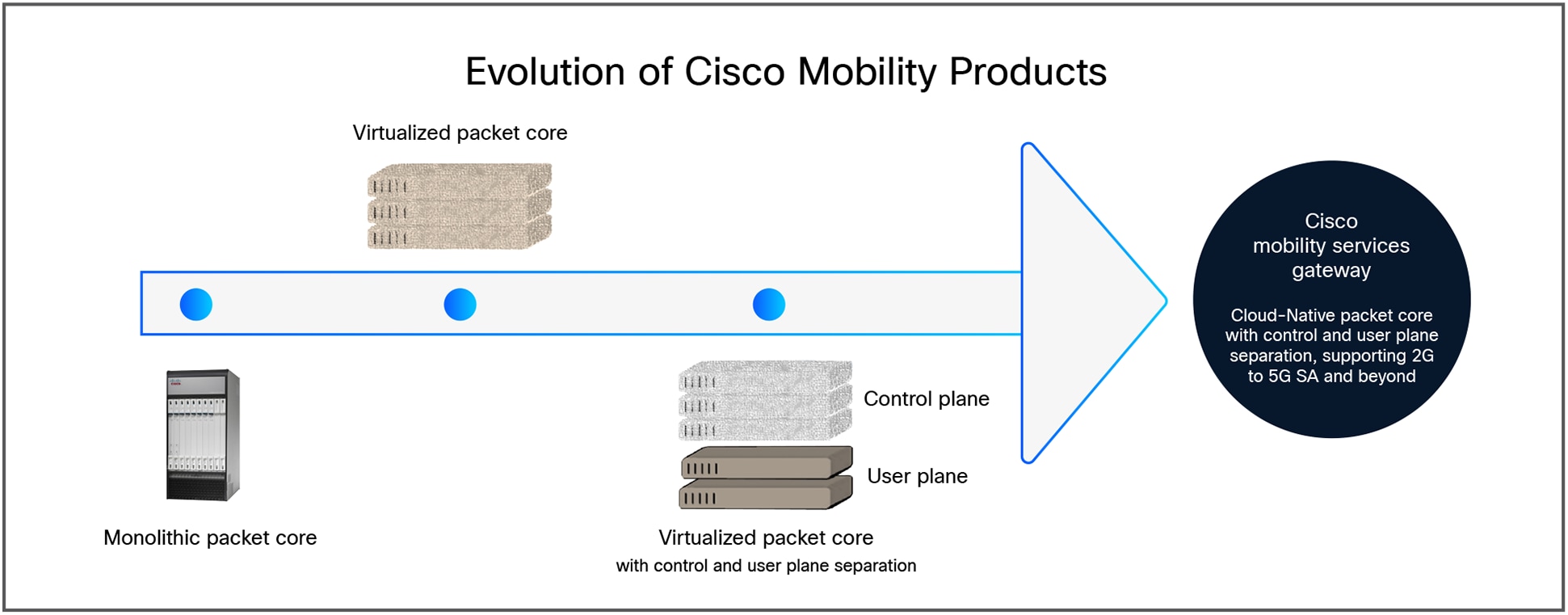
Evolution of Cisco Mobility Products
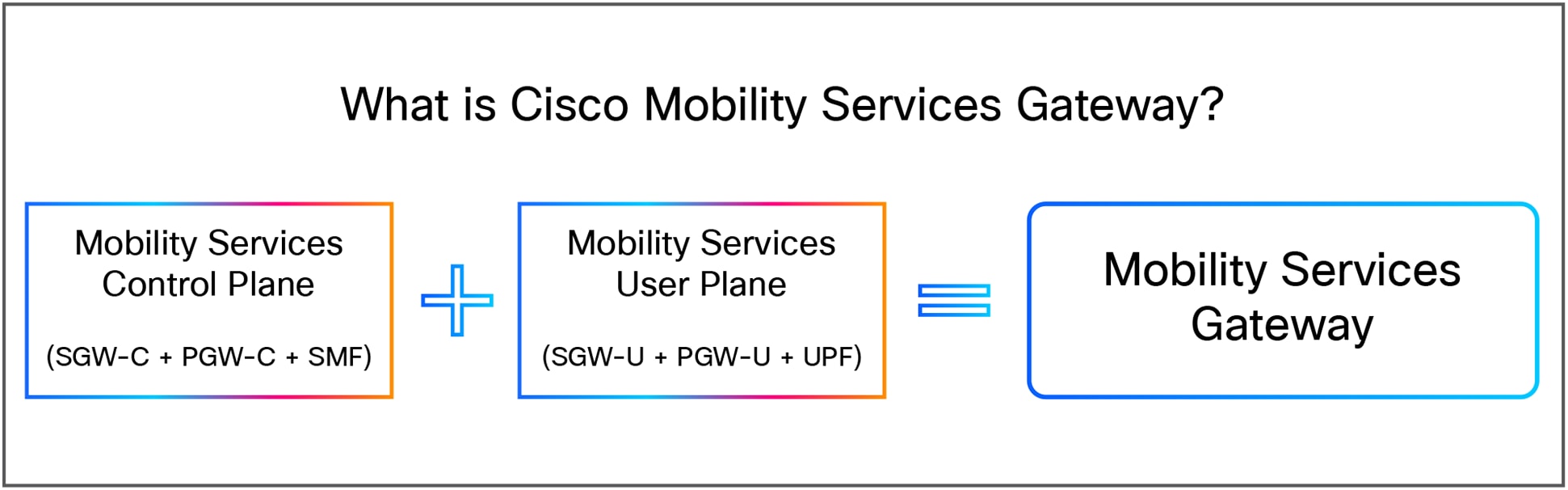
What is Cisco Mobility Services Gateway
From an operational and network planning standpoint, Mobile Network Operators (MNOs) have consistently favoured a unified control plane that supports multiple generations of network interfaces including 2G, 3G, 4G/5G NSA, and 5G SA. Cisco Mobility Services Gateway (MSG) fulfils these requirements by providing a streamlined, cost-effective, and innovative solution designed to ensure seamless interoperability and smooth handovers across different network generations. This cloud-native gateway is engineered to precisely meet the multi-generational needs of CSPs enabling them to efficiently manage legacy and next-generation networks while benefiting from enhanced operational simplicity and innovation.
The Mobility Services Gateway, which entails MSCP and MSUP combined empowers service providers with the flexibility to:
1. Deploy 4G services — with seamless 2G/3G interworking support — while strategically preparing their networks for 5G SA evolution.
2. Launch and operate both 4G and 5G SA services concurrently.
Also, this solution offers a clear transition path towards 5G SA for service providers currently utilizing Cisco CUPS, Virtualized Packet Core and ASR5500-based Gateways. This positions Mobility Services Gateway (MSG) as the preferred, go-to product for service providers aiming to efficiently evolve their networks with minimal disruption and maximum flexibility.
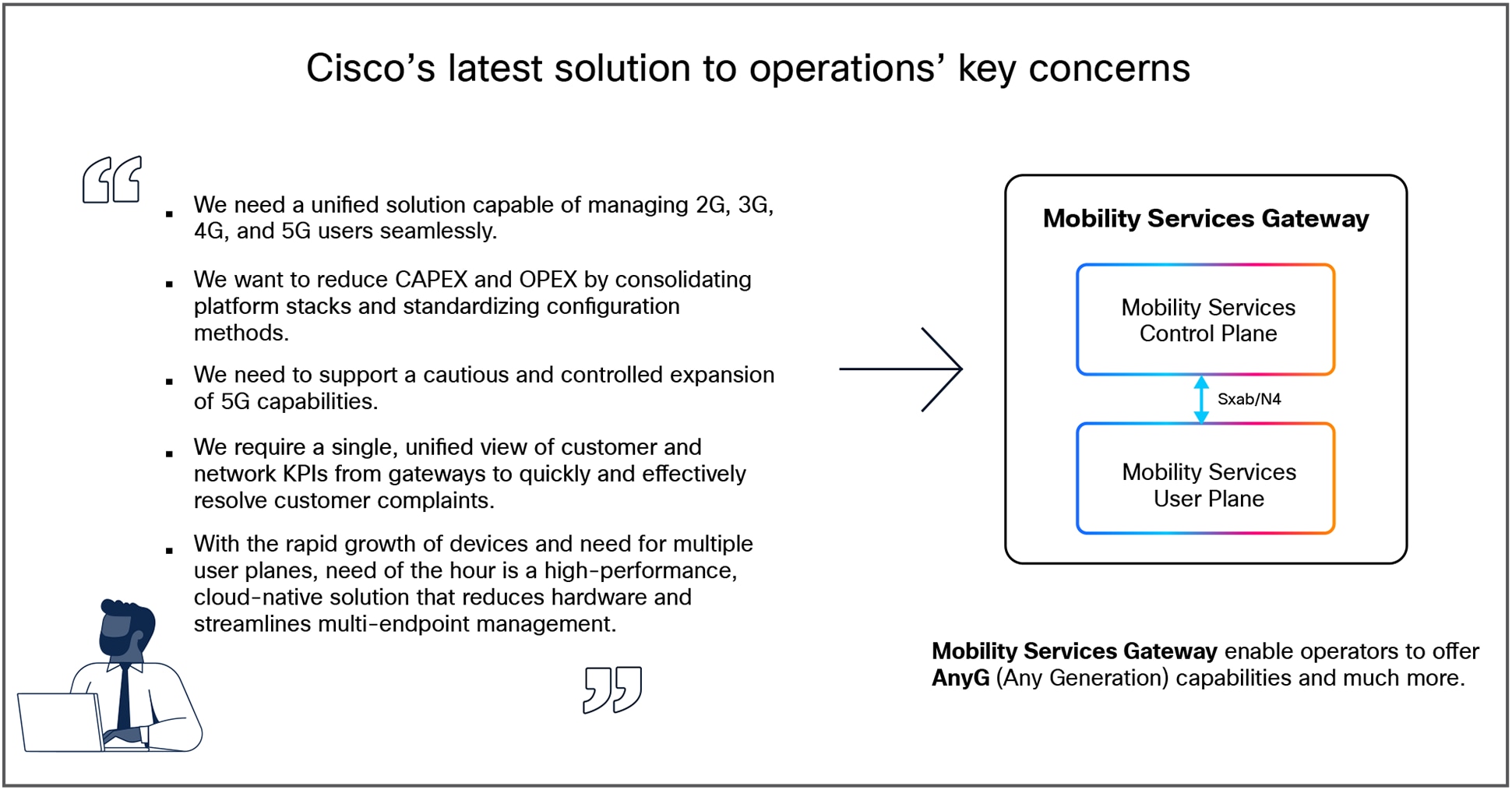
Cisco’s latest solution to Operator’s key concerns
Consistent service across multi-generations: Mobility Services Gateway ensures customers experience uninterrupted connectivity by supporting both 4G and 5G SA users attach to any generation from 2G till 5G SA and by supporting all the 3GPP-compliant handovers between these multi-generational networks.
Competitive footprint: As traffic grows and networks evolve to 5G, CSPs must sustain high performance without exponentially increasing infrastructure costs or footprint. Traditional core architecture typically requires sizable control and user-plane deployments to meet capacity targets. Cisco Mobility Services Gateway addresses this by adopting a cloud-native, CUPS-based design and introducing additional architectural refinements with MSCP and MSUP and thus reducing server requirements while delivering higher performance.
Superlative performance with Mobility Services User Plane: User Plane throughput is a critical performance metric for service providers, directly influencing user experience, network efficiency, and the ability to deliver high-speed, next-generation services. Cisco’s cloud-native User Plane Function (UPF) , built on a microservices architecture, allows CSPs to benefit from superlative throughputs, rolling upgrades that provide uninterrupted service availability and flexible resource configuration for diverse use cases not just from 2G to 5G but also being built to cater to the advanced use cases of 6G. Mobility Services Gateway allows service providers to reap the multitude of benefits offered by this high performing user plane.
User Plane with a Persona: Cisco is committed to being a bridge connecting the people, places and things. The Mobility Services User Plane offers unparalleled flexibility through its ability to configure resources according to specific use cases.
Whether it’s allocating more cores to Vector Packet Processing (VPP) for Fixed Wireless Access (FWA) (“Places”), optimizing for consumer 5G (“People”), or scaling session managers for IoT applications (“Things”), the user plane can adapt to diverse network demands. thereby maximizing the performance and resource efficiency.
Optimized Resource Utilization During 4G to 5G Transition: Future networks must be designed to seamlessly adapt to evolving demands. As Mobility Services Gateway supports both 2G/3G/4G/5G sessions from both 4G/5GNSA and 5G SA users, it also enables CSPs to dynamically optimize compute resources—scaling in when 4G/5GNSA traffic declines and scaling out compute resources to handle the increase in 5G SA traffic.
Improved operational efficiency: Automating configuration and lifecycle management enables service providers to achieve consistent, compliant, and scalable network operations — reducing errors and accelerating service delivery. CSPs can reach this goal with Mobility Services Gateway, as both Mobility Services Control Plane and Mobility Services User Plane can be automated with Cisco Crosswork Network Services Orchestrator (NSO).
Enhanced network reliability: As service provider networks evolve toward autonomous, intent-based, and zero-touch operations, observability becomes a foundational pillar. It helps CSPs transition from reactive monitoring to proactive network issue detection and resolution, resulting in improved customer experience. And that is exactly what Mobility Services Gateway offers to the service providers by supporting its integration with Cisco Provider Connectivity Assurance (PCA). Mobility Services Gateway also ensures that the existing monitoring techniques are supported, again for all generations of traffic that it supports as a gateway function.
Smooth transition to 5G SA with continued 4G operations: The Mobility Services Gateway is designed to maintain functional parity with the existing Cisco CUPS product which enabled many service providers across the globe providing 4G/5G NSA services with its robust features and use cases support. The functional parity mentioned ensures a smooth and straightforward transition for Cisco classic mobility product customers as they move towards 5G SA deployments in the future.
Streamlined multi-generational network management: A major concern for CSPs while introducing 5G SA into their networks is the network infrastructure management aspect that gets added to the existing complexity of running 4G networks. Having multiple platforms to run 4G and 5G SA operations separately is a real challenge that CSPs face. With Mobility Services Gateway service providers can streamline the management of any generation network as it provides a unified deployment platform support for networks providing services through 2G,3G,4G and 5G SA networks. This unified deployment approach eliminates the complexity of running different generational networks on different platforms, thereby simplifying operations across multiple network generations.
Through these benefits, Mobility Services Gateway empowers CSPs to deliver enhanced service experience, driving customer satisfaction and loyalty in the rapidly evolving telecommunications landscape.
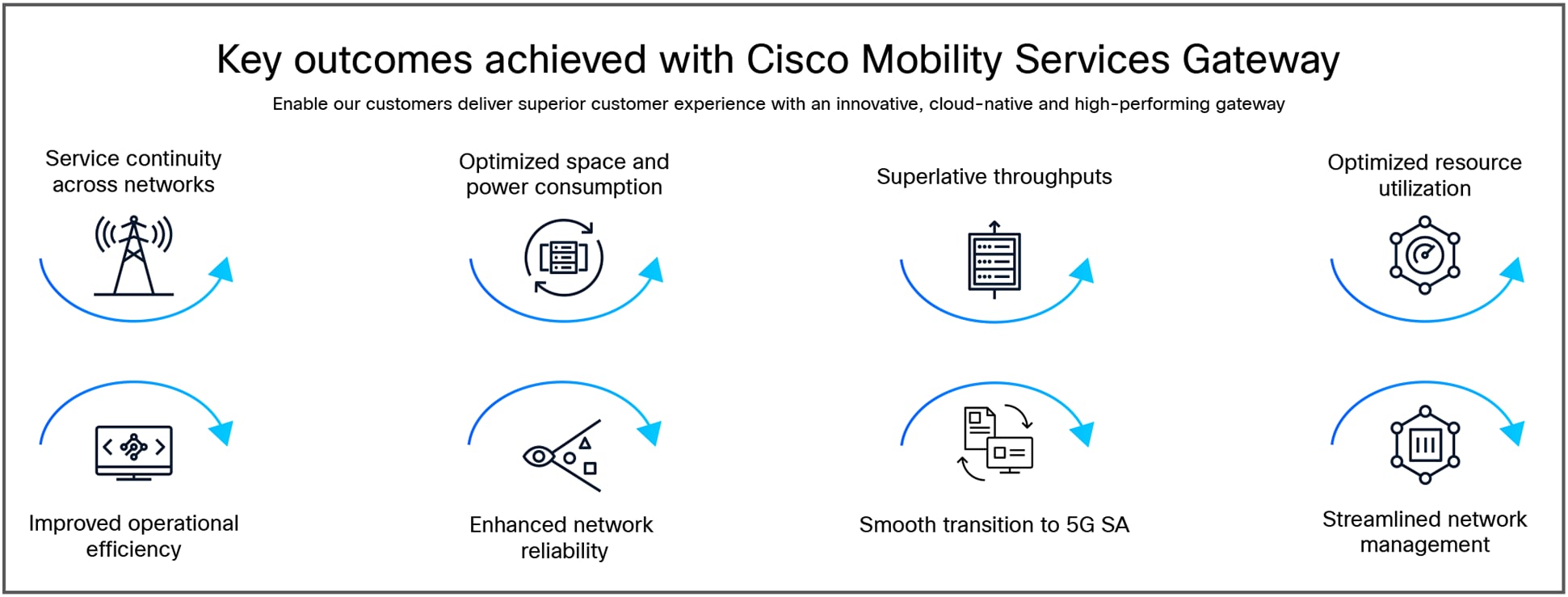
Key outcomes achieved with Cisco Mobility Services Gateway
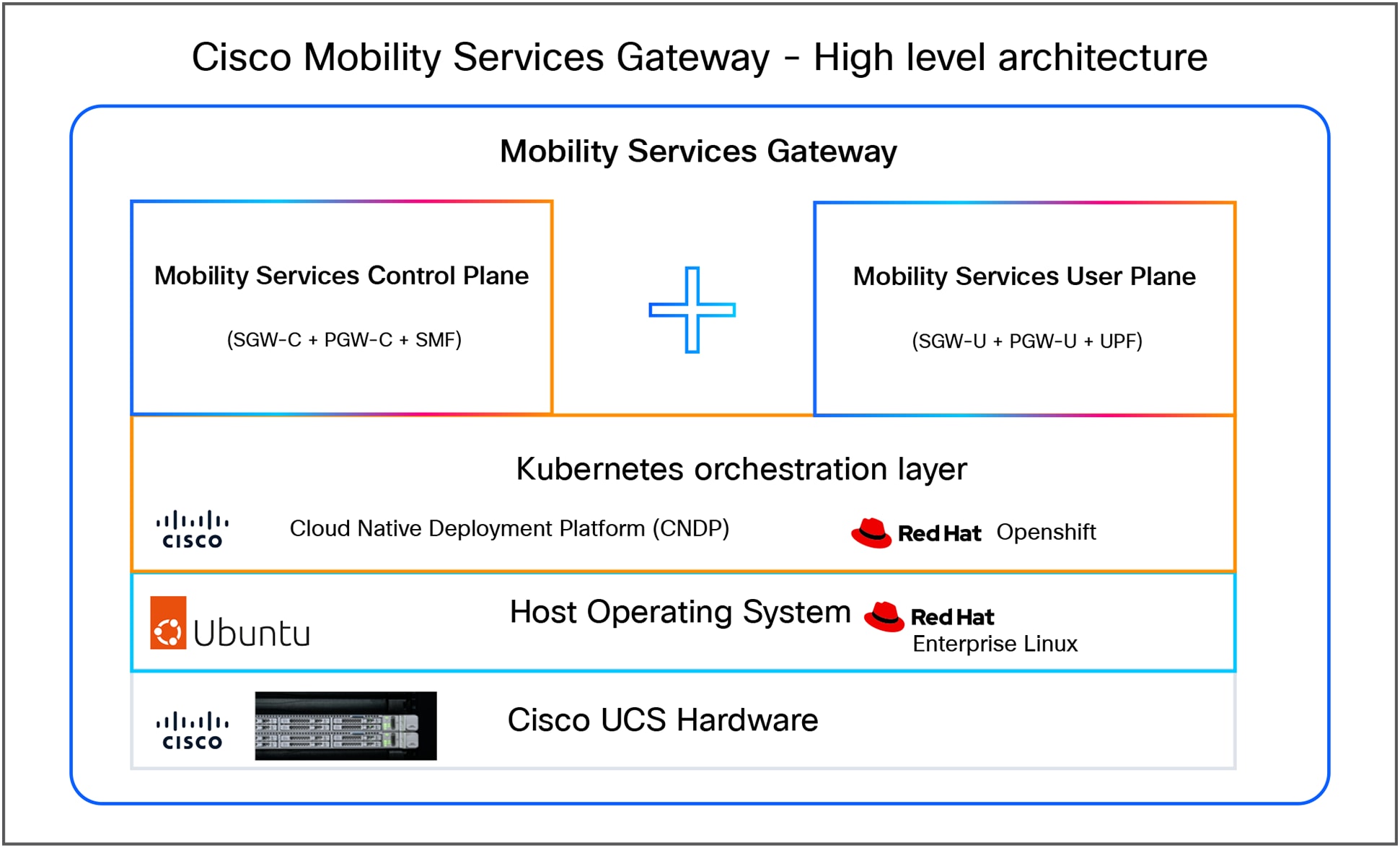
Cisco Mobility Services Gateway – High level architecture
Cisco’s Mobility Services Gateway (MSG) is a cloud-native function that consolidates the control-plane capabilities of Serving Gateway (SGW), Packet Data Network Gateway (PGW), Session Management Function (SMF), and User Plane Function (UPF).
MSG handles sessions across multiple access generations and subscriber types:
● For 5G SA users: 2G, 3G, 4G, and 5G SA sessions.
● For non-5G SA users: 2G, 3G, and 4G/5G NSA sessions.
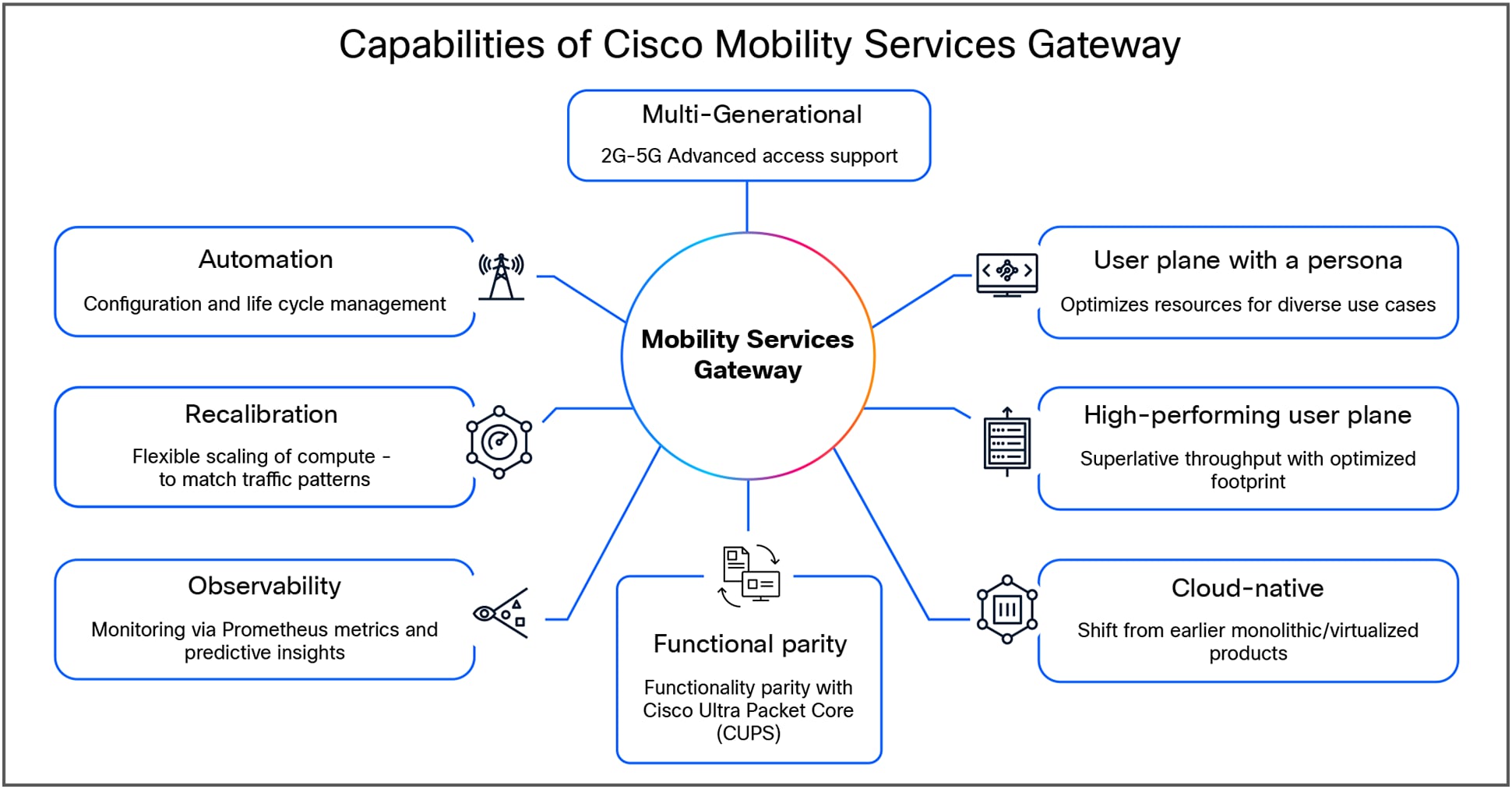
Capabilities of Cisco Mobility Services Gateway
Key capabilities
Deployment on cloud-native platform:
Mobility Services Gateway can be deployed on either Cisco’s Cloud-Native Deployment Platform (CNDP)—a baremetal platform optimized for cloud-native functions with enhanced performance and automation— or Red Hat OpenShift. This cloud-native capability is built to deliver robust security and continuous availability demanded by service provider networks.
Inter-generation attach and handover across different Radio Access Technologies (RATs):
Mobility Services Gateway allows 4G and 5G SA users to attach and access 2G, 3G networks and support 3GPP-compliant handovers across these different access networks.
It supports handovers for non-5G SA users across 2G, 3G, and 4G. For example, a non-5G SA user can attach to or move between 2G, 3G, and 4G access networks. And a 5G SA user can move across 2G, 3G, 4G and 5G.
Table 1. Supported handovers by MSG
| User Subscription |
Initial access technology user has attached to |
Handovers Supported |
| 5G Subscribed |
5G SA |
5G SA <-> 4G |
| 5G Subscribed |
4G |
4G <-> 5G SA, 4G <–> 3G, 4G <–> 2G and 3G <–> 2G |
| 5G Subscribed |
3G |
3G <-> 4G and 3G <-> 2G |
| 5G Subscribed |
2G |
2G <-> 4G, 2G <-> 3G |
| 4G Subscribed |
4G |
4G <-> 3G, 4G <-> 2G, 3G <-> 2G |
| 4G Subscribed |
3G |
3G <-> 4G and 3G <-> 2G |
| 4G Subscribed |
2G |
2G <-> 4G and 2G <-> 3G |
Automate configuration and life cycle management:
Mobility Services Gateway can be automated with Cisco Crosswork Network Services Orchestrator (NSO). Cisco NSO serves as a unified platform for managing network configurations and their lifecycle, enabling rapid service deployments, minimizing human errors, and accelerating time-to-market across 2G, 3G, 4G, 5G Standalone, and future network generations.
Observability across multi-generational networks:
With the implementation of the Mobility Services Gateway, CSPs can achieve a unified and efficient monitoring strategy for both non-5G SA and 5G SA users, all within a single Grafana dashboard. This consolidated approach enhances operational efficiency and simplifies the monitoring process, offering customers a more streamlined and effective method of managing their network environments.
MSG extends beyond the monitoring capabilities to provide observability solutions to its customers by seamlessly integrating with Cisco’s Provider Connectivity Assurance (PCA). This integration unlocks a wide array of features offered by PCA for enhanced observability, enabling comprehensive monitoring across all network generation sessions managed by the gateway. Such robust observability is crucial for optimizing network performance monitoring and management, providing CSPs with superior tools to ensure efficient and effective network operations. Cisco’s PCA seamlessly integrates with CSPs’ Performance and Fault Management Systems via North Bound Interfaces (NBI), allowing the transmission of KPIs, alarms over HTTP/HTTP2, SFTP files, and alert notifications.
Policy and Charging:
Cisco’s Mobility Services Gateway supports comprehensive policy and charging functions for both non-5G SA and 5G SA subscribed users. For non-5G SA users, MSCP utilizes the Gx and Gy interfaces to manage policy and charging. For 5G SA users, it employs N7 and N40 interfaces to address the advanced requirements of 5G networks. The gateway ensures that both 5G and non-5G users experience seamless policy management and charging, crucial for maintaining service quality and operational efficiency in varied network environments. For instance, when a 5G SA user connects to either 2G, 3G, 4G or 5G access networks, they will still be serviced by policy and charging mechanisms via the N7 and N40 interfaces. And when a non-5G SA user connects to either 2G, 3G or 4G access networks, they will be serviced via the Gx and Gy interfaces.
Integration with Cisco Mobility Services User Plane (MSUP)
A notable feature of the Mobility Services Control Plane is its seamless integration with Cisco’s Mobility Services User Plane (MSUP), which enables Mobility Services Gateway to deliver superlative performance by leveraging hardware acceleration capabilities in conjunction with DPUs. This user plane is based on micro-services architecture and supports rolling upgrades, enabling seamless updates and maintenance without disrupting service.
Flexibility in Deployment for User Plane:
Mobility Services User Plane (MSUP) can be deployed efficiently on a single server with as few as 8 CPU cores, providing a compact and resource-optimized solution ideal for smaller scale or localized traffic demands, such as edge locations or smaller data centers. For larger capacity needs, the UPF can seamlessly scale across up to 8 servers yet still operate as a single unified instance. This multi-server deployment supports rapid growth in user traffic. This flexible deployment model ensures high performance and scalability while maintaining simplified management and consistent operation across distributed resources.
Resource calibration:
Mobility Services Gateway empowers CSPs to optimize their compute resources effectively. This is achieved through manual scale-in options of relevant compute resources when traffic on 4G sessions decreases, and scale-out option as 5G session traffic increases. This flexibility ensures that CSPs can dynamically adjust to changing traffic patterns and maintain optimal service delivery.
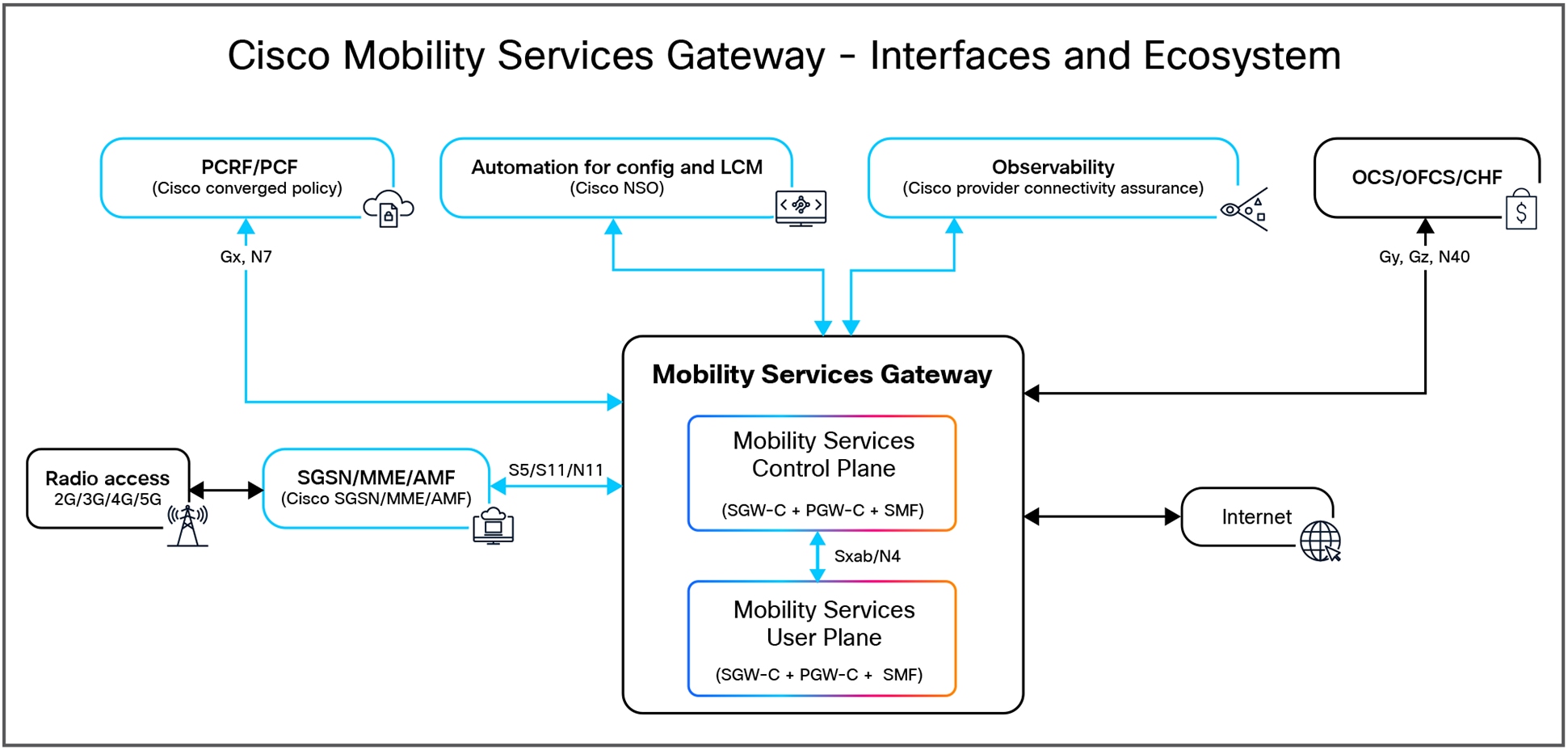
Cisco Mobility Services Gateway – Interfaces and Ecosystem
Cisco’s Mobility Services Gateway empowers CSPs with a bridge to connectivity and help customers deploy coexisting 4G/5G NSA and 5G SA services with support for 2G/3G as well.
Table 2. Use cases supported by MSG
| Use cases |
| Consumer use case examples |
|
● Always-ON consumers with 4G postpaid or prepaid plans.
● Enhanced Mobile Broadband (eMBB) for high-throughput data for video streaming, cloud gaming, and AR/VR.
● Fixed Wireless Access (FWA) to provide home broadband using LTE/NR connectivity.
● 5G SA Advanced use cases (like Redcap devices support etc.,)
● VoLTE/VoNR bearer/QoS support
● Remote users with only 2G/3G connectivity
|
| Enterprise and private network use case examples |
|
● Private 5G/Campus Networks
● Network Slicing for SLA Services
● Edge Computing/MEC Integration
● Remote Workforce Access
|
| IoT and Industrial use case examples |
|
● Massive IoT (mMTC)
● Smart Utilities/Smart City
● Connected Vehicles
|
CSPs are looking at 5G technology as a path to support innovative business solutions, address competitive pressures, and deliver advanced services to their customers. Despite successfully deploying 4G services, CSPs are taking a cautious approach in transitioning to 5G due to various operational and maintenance challenges. These include the intricate nature of operations and the critical need for resource allocation to support the concurrent maintenance of 2G, 3G, 4G and 5G network generations. Managing this dual maintenance can significantly impact both Operational Expenditure (OPEX) and Capital Expenditure (CAPEX).
CSPs are also constrained by data center space limitations and power consumption, which hinders efficient network operations and scaling. These limitations make it harder to expand capacity, modernize infrastructure, and deploy new services in a timely manner, increasing operational complexity and the risk of performance bottlenecks. This situation presents CSPs with a strategic dilemma. While transition challenges may hinder progress towards adopting 5G, failing to advance could delay innovation and weaken their competitive standing in the market.
The Mobility Services Gateway delivers the capabilities that we have with the existing Cisco mobility products, which have a broad customer base and is backed by more than two decades of expertise in the mobility industry. With comprehensive support for a wide range of multi-generational use cases, MSG is ideal whether you are looking to launch new 4G services, operate 4G alongside 5G SA, or continue supporting your existing 4G deployments while preparing for the shift to 5G. Leveraging this solution enables operators to maximize the value of their existing infrastructure and strategically position their network for upcoming advancements and expanded service possibilities.
The Mobility Services Gateway would also be powering Cisco’s Programmable Core solution with its enriching gateway capabilities and enhancing overall network efficiency and performance.
By adopting a cloud-native architecture in the Mobility Services Gateway, Cisco enables modular and scalable network solutions that evolve with the needs of service providers. Cisco’s established history of successful mobility gateway deployments and satisfied clients enhances trust in the performance and reliability of its latest Mobility Services Gateway.
If you’re seeking a gateway that supports all network generations and streamlines your operations and/ or need to understand the licensing details, please reach out to your Cisco Sales representative to arrange a demo of the Mobility Services Gateway and licensing agreements.