Manufacturing Industry Trends
Available Languages
Bias-Free Language
The documentation set for this product strives to use bias-free language. For the purposes of this documentation set, bias-free is defined as language that does not imply discrimination based on age, disability, gender, racial identity, ethnic identity, sexual orientation, socioeconomic status, and intersectionality. Exceptions may be present in the documentation due to language that is hardcoded in the user interfaces of the product software, language used based on RFP documentation, or language that is used by a referenced third-party product. Learn more about how Cisco is using Inclusive Language.
In today’s manufacturing environment, a new convergence is happening. A greater number of technologies are becoming available to meet the dynamics of changing workforces, fragile supply chains, and the ever-present market demand for better and cheaper products and services. However, manufactures still face a unique challenge: how to maximize investments in various technologies to achieve the most impactful Return On Investment (ROI) for these technologies, or as we like to refer to them, “enablers of change.” At the center of this challenge is choice: choice in which technologies to invest in, choice in which projects to apply the technologies to, choice in project scope, and choice in how to mix and match or totally replace existing technologies with new ones. One example of new technology is 5G. Manufacturers should not get lost in the excitement of the technology, but rather should focus on how to use it in such a way that it accelerates their current and future business goals. Maximizing ROI for such a technology requires considering the use cases to apply it to, how to deploy it at scale, and the need for robust tools for maintenance and management.
The top three technology priorities of industrial manufacturing CEOs are:
● Mobility (73%)
● Cybersecurity (72%)
● Data mining and analysis (70%)1
We know that adding mobility to the way people and machines work drives improvements in productivity. Henry Ford saw an 800% increase in output when he moved automobile chassis down an assembly line manned by workers. Today we see this effect by enabling communications and providing information in real time for remote workers in the hybrid work environment. This expanded mobility is providing insights into operations and the monitoring of machine health. It also allows management that provides manufacturers and equipment builders with new business models for maximizing uptime. This in turn is improving productivity for frontline workers, line managers, and field engineers, all of whom must solve problems as they arise. Below are some additional manufacturing use cases that leverage existing mobility technologies:
● Smart devices (text, voice, video), push-to-talk
● Automated guided vehicles (latency < 50 ms)
● Surveillance cameras (latency < 50 ms)
● Human-machine interface (latency < 50 ms)
● Remote expert (latency < 50 ms)
● Augmented reality (latency < 50 ms)
● Mobile work-cell (latency > 100 ms)
● Sensors, actuators (latency > 100 ms)
● Wireless tooling (latency > 100 ms)
● Product downloads (tens of Mbs)
“With latency levels of 2-6 milliseconds demonstrated in tests, coupled with technology improvements such as guaranteed bandwidth sharing and better security, Wi-Fi 6E . . . is suitable for low-latency applications such as mobile AR/VR, gaming, 4K/8K video streaming, etc.”
The sample use cases listed above represent what manufacturers are currently deploying within their operations. With open roaming features from Cisco’s Wi-Fi 6E product line, manufacturers can easily bridge public 5G to private Wi-Fi 6E and have the two technologies work in harmony to preserve the end user experience. [1]
When do you choose 5G over Wi-Fi or other technologies? Again, it all comes down to the use case and whether the technology will scale for more use cases, be easy to manage (configuration, upgrades, and security), and deliver the best ROI.
Cisco is the single vendor that has a multiaccess wireless portfolio, driving customer success for a variety of industry use cases.
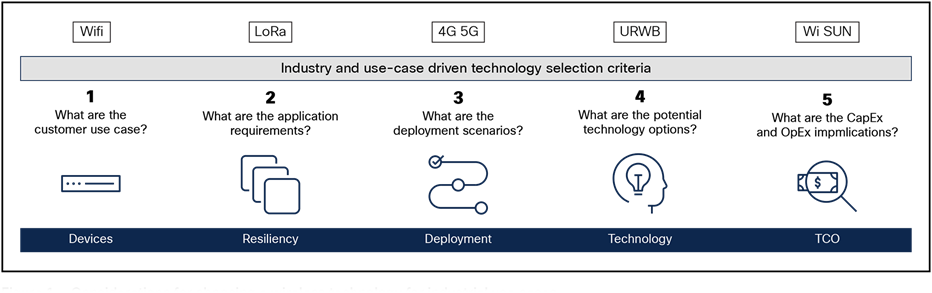
Considerations for choosing a wireless technology for industrial use cases
For some use cases (such as augmented reality and connected products) where high bandwidth and low latency are a must, 5G becomes a viable technology. Then the considerations of scalability and ease of management in your manufacturing operations become the deciding factors in choosing a robust platform that can deliver the best ROI. In the case of automated guided vehicles, for example, you may not want to share a Wi-Fi or 5G network with all the other use cases a mobility technology provides. In that case, you may choose a dedicated Cisco® Ultra-Reliable Wireless Backhaul technology for these mission-critical devices.
Cisco Private 5G combines the technology you need for your select 5G manufacturing use cases with the reliability of Cisco’s design, build, and operate services. This choice removes the concerns that a new technology brings and allows you to focus on rapidly taking your 5G projects from pilot to production so you can start realizing the benefits of your investments.
No matter which technology you choose from all of the mobility technologies in the figure above, always focus on your use case, and your ability to deploy and easily manage the technology at scale. This will provide the maximum ROI for you and keep you out of “pilot purgatory”.