Cisco User Plane Function (for 5G and 4G) Data Sheet
Available Languages
Bias-Free Language
The documentation set for this product strives to use bias-free language. For the purposes of this documentation set, bias-free is defined as language that does not imply discrimination based on age, disability, gender, racial identity, ethnic identity, sexual orientation, socioeconomic status, and intersectionality. Exceptions may be present in the documentation due to language that is hardcoded in the user interfaces of the product software, language used based on RFP documentation, or language that is used by a referenced third-party product. Learn more about how Cisco is using Inclusive Language.
Cisco User Plane Function (UPF) advances converged mobile networks by supporting 5G and 4G on a single virtualized network function. Cisco UPF delivers ultra-fast data by integrating Vector Packet Processing (VPP).
Cisco® User Plane Function (UPF) is a fundamental component of a 3GPP 5G core infrastructure system architecture under Cisco 5G Ultra Cloud Core offering. The UPF represents the data plane evolution of a Control and User Plane Separation (CUPS) strategy and can be geographically distributed to be positioned closer to the end users at the network edge with Mobile Edge Computing (MEC) or even on a customer premises supporting latency-sensitive applications. Cisco UPF is a virtualized network functions converging 5G and 4G while maintaining industry-leading traffic throughput. The UPF is responsible for packet routing and forwarding, packet inspection, QoS handling, and external PDU session for an interconnecting data network.
A primary benefit of 5G is faster data rates, and service providers are making large investments in new 5G radios, packet core, and other network functions to better deliver the 5G promise of fast service. Cisco UPF is designed to meet the challenge with a high-performance forwarding engine for user traffic. Using Vector Packet Processing (VPP) technology, the UPF achieves industry-leading, ultra-fast packet forwarding while retaining compatibility with all the user plane functionality. The UPF exposes the IP packets for critical network identification and routing decisions. The Cisco UPF supports the following:
● Ultra-fast packet forwarding
● Shallow Packet Inspection (SPI)
● Extensive integrated Inline services such as
◦ Deep-Packet Inspection (DPI)
◦ Application Detection and Control (ADC)
◦ Header enrichment
◦ Subscriber firewall
◦ NAT
◦ DNS snooping
◦ Tethering
● Integrated third-party applications for traffic and TCP optimization
● Traffic optimization
| Features |
Benefits |
| Combined 4G/5G User Plane Function (UPF) |
● Enhanced resource efficiency through collapsing the data path, reducing latency, and enhancing user experience
|
| Enable Mobile Edge Computing (MEC) |
● Location-based selection and geo-distributed CUPS enable the Mobile Edge
|
| Multi-Gigabit throughput per PDN |
● Supports up to 5 Gbps throughput, per user equipment
● Integrated VPP framework maximizes high user throughput
|
| Rich inline services |
Provides an extensive list of inline services, including:
● EDNS0 support
● Header enrichment
● Tethering
● DNS snooping
● L7 Deep Packet Inspection (DPI)
● Application Detection and Control (ADC)
● DNS re-addressing
● URL blocking
● Bandwidth limiting
● ACL
● DSCP marking
● And many more
|
| Redundant and resilient |
Rich feature set for a highly available and resilient network:
● Multiple N4, allows UPF to serve more than one SMF at the same time
● N:M Redundancy
● Session recovery (session-level resiliency)
|
| Congestion protection |
|
| Centralized configuration management |
● Centralized configuration management eases operational tasks of configuring hundreds of UPFs
|
Service providers building out their 5G networks need to support ever-increasing demands for new services and improved experiences, while they also work to control costs and complexities by converging tech generations (4G/5G) where possible. Cisco converged UPF does just that.
The “converged data path” feature allows interconnection of the same UE’s session at the UPF instance with cnSGW-C and Session Management Function (SMF)/Inter-Working Function (IWF) to build a converged/collapsed data path and achieve higher throughput. With this feature:
● The UP/UPF selection logic is enhanced to aide same-node selection on cnSGW-C and SMF.
● The Sx-interface Demultiplexer (SxDemux) selects the same Session Manager (SessMgr) instance based on the existing session of N4 or Sxa interfaces, respectively.
● The Sxa session and N4 session correlation is done at SessMgr.
● The data path is allowed to be collapsed in the forwarding plane.
● Extra hop in the subscriber’s data path is eliminated, resulting in reduced latency and improved user experience.
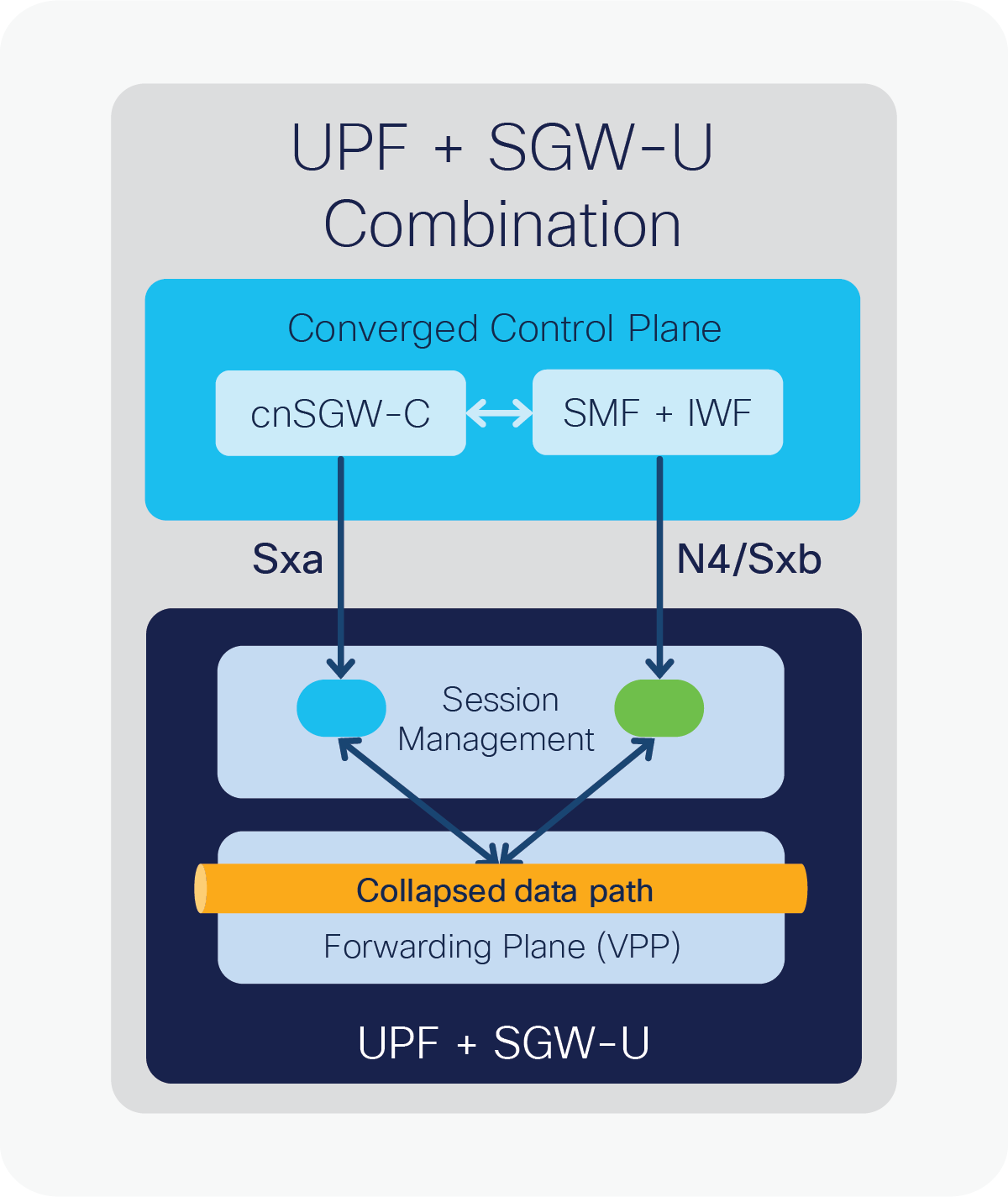
Table 1. Platform Support information
| Product Family |
Platforms Supported |
| 5G UPF |
OSP, VMware, Cisco BM |
Cisco User Plane Function (UPF for 4G and 5G) offers customers two licensing options:
1. Perpetual licensing model
2. Subscription licensing model
In both models, UPF software licenses are network-wide and based on number of sessions. For first-time procurement, there will be a one-time Base Software License, and network-wide Session Licenses will be provided. For any incremental capacity, licenses will be offered with additional session numbers in terms of UPF 1k sessions. There is also an option to enable a Smart License in UPF function.
Smart Software Licensing
Smart Licensing is a cloud-based approach that simplifies the purchase, deployment, and management of Cisco software assets. Entitlements are purchased through your Cisco account via Cisco Commerce Workspace (CCW) and immediately deposited into your virtual account for usage. This eliminates the need to install license files on every device. Products that are smart enabled communicate directly to Cisco to report consumption. A single location – the Cisco Software Central (CSC) – is available to customers to manage Cisco software licenses. License ownership and consumption are readily available to help make better purchase decisions based on consumption or business need.
| Feature |
Description |
| Host Server |
UCS C220 M5 |
| Processor |
2 x Intel® Xeon Gold 6148 (20 cores @ 2.4 GHz) |
| NIC |
2 x Intel XL710 Dual-Port 40G QSFP+ |
| RAM |
384 GB |
| Local Disk Storage |
2 x 1.6 TB SSD RAID-1 |
| Part # |
Product Description |
| UCC5G-UPF-INS-L |
UPF Instance Fee |
| UCC5G-BAS-L-K9 |
UPF Base Minimum to support up to 50K sessions |
| UCC5G-UPF-S31-L |
UPF 1K sessions for sessions beyond 50K and enter the desired quantity |
| UCC5G-UPF-BAS-S |
UCC - User Plane Function (UPF), Base Minimum SIA |
| UCC5G-UPF-S31-S |
UCC - User Plane Function (UPF), 1K Session SIA |
Cisco User Plane Function (4G/5G) has the standard Cisco software warranty.
Using the Cisco lifecycle services approach, Cisco and our partners provide a broad portfolio of end-to-end services and support that can help increase your network’s business value and return on investment. This approach defines the minimum set of activities needed, by technology and by network complexity, to help you deploy and operate Cisco technologies and optimize their performance throughout the network lifecycle. For more information, please visit https://www.cisco.com/go/services.
Flexible payment solutions to help you achieve your objectives
Cisco Capital makes it easier to get the right technology to achieve your objectives, enable business transformation and help you stay competitive. We can help you reduce the total cost of ownership, conserve capital, and accelerate growth. In more than 100 countries, our flexible payment solutions can help you acquire hardware, software, services and complementary third-party equipment in easy, predictable payments. Learn more.
To get more information about Cisco UPF contact us or your local Cisco account team or partner.
Learn more about our 5G products and solutions.