Cisco 400-Gbps QDD BiDi Pluggable Transceiver At a Glance
Available Languages
Bias-Free Language
The documentation set for this product strives to use bias-free language. For the purposes of this documentation set, bias-free is defined as language that does not imply discrimination based on age, disability, gender, racial identity, ethnic identity, sexual orientation, socioeconomic status, and intersectionality. Exceptions may be present in the documentation due to language that is hardcoded in the user interfaces of the product software, language used based on RFP documentation, or language that is used by a referenced third-party product. Learn more about how Cisco is using Inclusive Language.
Expanding Cisco’s bidirectional portfolio
A breakthrough optical technology enabling 400-Gbps link data rates over duplex multimode fiber
The Cisco® 400-Gbps QSFP-DD BiDi Pluggable Transceiver is the next generation of the widely deployed 40-Gbps and 100-Gbps Bidirectional (BiDi) data centers optics. This Quad Small Form- Factor Pluggable Double Density (QSFP-DD) optical transceiver delivers 400 Gigabit Ethernet (400G) data rates over duplex Multimode Fiber (MMF). Using four PAM4 electrical lanes mapped to two optical wavelengths per fiber pair, the Cisco 400-Gbps BiDi transceiver enables high-speed, cost-effective short-reach connectivity with duplex LC connectors. Operating over OM4 or OM5 MMF, it supports reaches of up to 70 meters (OM4) and 100 meters (OM5), providing a simple and scalable path for data center upgrades.
● Reuse existing duplex LC MMF infrastructure to scale from 100G to 400G without new cabling. The reuse of patch panels and patch cords helps ensure minimal disruption.
● Reduce CapEx and OpEx through simplified cabling and faster deployment.
● Enable seamless interoperability with Cisco QSFP-100G-SR1.2 optics at a 100- Gbps rate.
● Leverage KP4 Forward Error Correction (FEC) for robust error performance at 400-Gbps data rates.
Upgrade seamlessly from 100G to 400G
Upgrading from 40G or 100G BiDi to 400G BiDi is seamless because all generations in Cisco’s BiDi optics family share the same duplex LC MMF infrastructure. This continuity allows operators to preserve their existing cabling plant while simply replacing transceivers at each end—no need to add new fiber, replace patch cords, reterminate MPO connectors, or modify patch panels. The Cisco 400G BiDi transceiver leverages the same bidirectional optical signaling concept as Cisco 40G and 100G BiDi. However, 400G BiDi uses two wavelengths per fiber per direction to multiply bandwidth while maintaining backward compatibility with Cisco 100G SR1.2 modules. As a result, data centers can scale link speeds fourfold with minimal disruption, lower upgrade costs, and faster deployment, helping ensure a smooth evolution toward next-generation AI and cloud fabrics.
As shown in Figure 1, the Cisco family of BiDi devices is engineered for interoperability across 40G, 100G, and 400G optics, maintaining consistent duplex LC MMF connectivity. The 400G BiDi is backward compatible with the QSFP-100G-SR1.2 at 100G speed. Likewise, the 400G BiDi uses the same duplex LC connectors and fiber infrastructure, allowing an upgrade path without fiber retermination or MPO conversion. This architecture simplifies migration across all BiDi generations while maximizing reach and reuse of fiber patch panels. This helps ensure seamless upgrades from 40G to 100G to 400G.
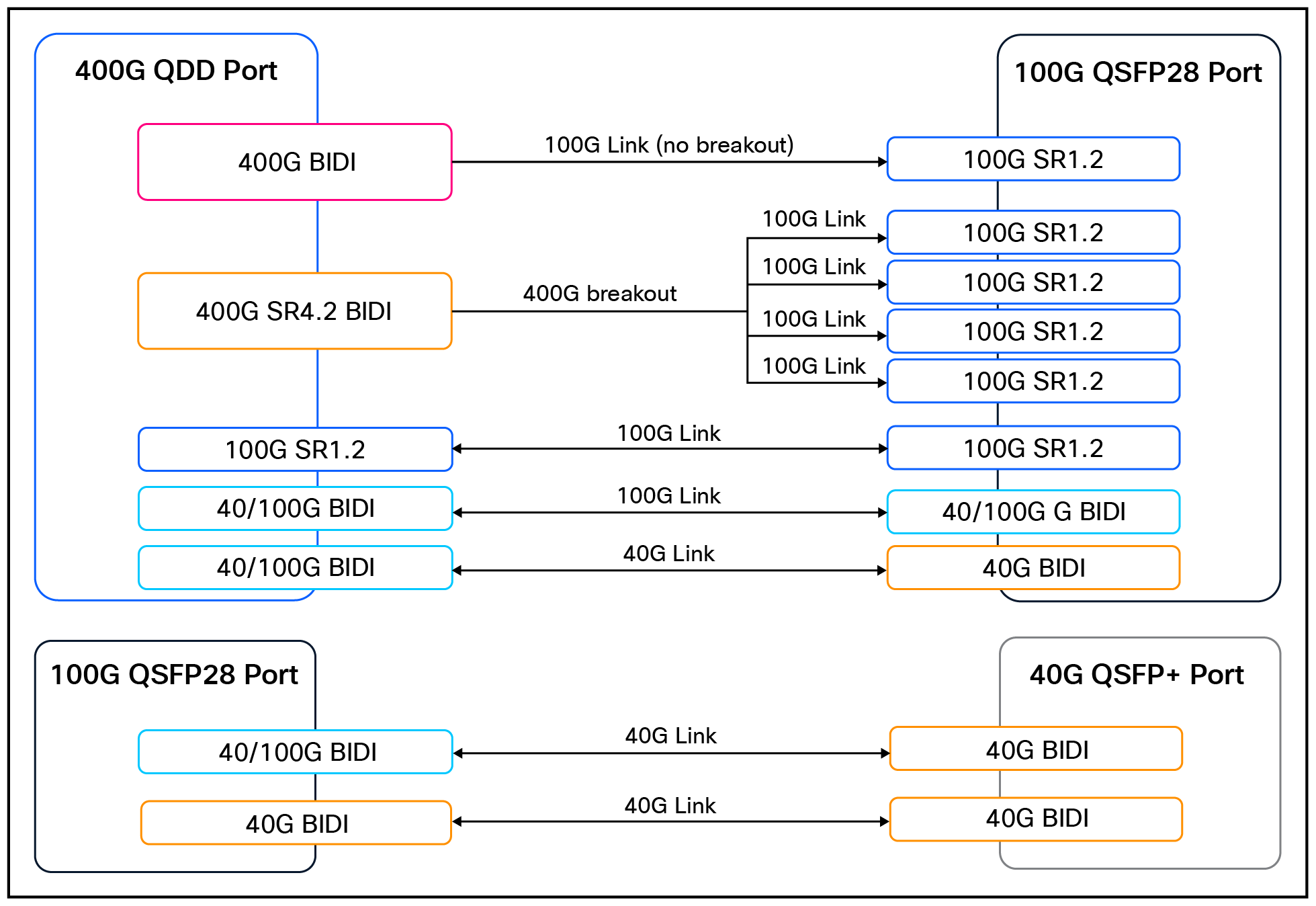
Interoperability options for Cisco’s BiDi portfolio
Maximize the bandwidth of your fiber infrastructure
Cisco 400G BiDi uses fiber efficiently through bidirectional technology and wavelength division multiplexing. Because SR8 and SR4.2 are parallel unidirectional technologies, they require more fiber cabling than 400G BiDi to achieve the same bandwidth.
Cisco 400G BiDi optimizes the use of your fiber trunk cabling in both of the following situations:
● Installed base: There is less disruption with 400G BiDi because no new fiber cables or patch panels are needed as you upgrade bandwidth from a previous generation of BiDi pluggable optics.
● New deployments: Costs are lower due to less fiber trunk cabling needed to support 400-Gbps bandwidth with 400G BiDi.
As shown in Figure 2, Cisco 400G BiDi provides 6.4 Tbps of total bandwidth using 16 fiber pairs (sixteen 400G links). In comparison, SR4.2 delivers 1.6 Tbps—75 percent less—since it uses only four 400G links, while SR8 offers just 800 Gbps, or nearly 90 percent less, with two 400- Gbps links.
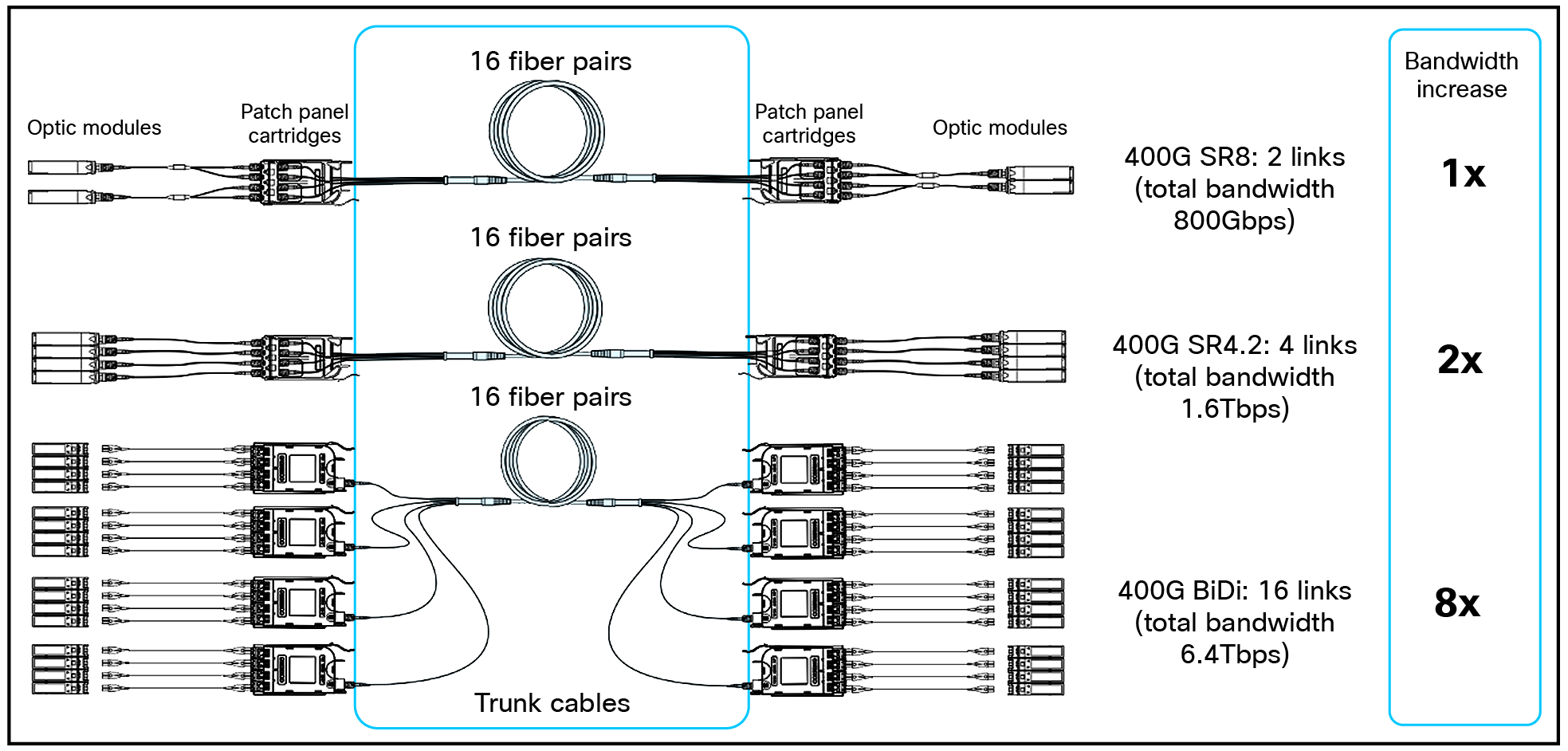
400G BiDi supports 8x more bandwidth with the same number of trunk cable fiber pairs compared to 400G SR8, and 4x more bandwidth compared to 400G SR4.2
In leaf-spine architectures, the Cisco 400G BiDi transceiver can be deployed in both the spine and the leaf node for 400G-to-400G connectivity.
During incremental upgrades, the 400G spine switch can connect to 100G leaf nodes. The 400G ports would be filled with the 400G BiDi transceiver, while the legacy 100G ports would have the QSFP- 100G-SR1.2 transceiver until replaced.
For more information about Cisco transceivers, including the optics product information matrix, compatibility matrix, and interoperability matrix, visit https://www.cisco.com/go/optics.