Cisco Nexus Hyperfabric Enterprise RAFull Stack AI Infrastructure compliant with NVIDIA HGX B300 Enterprise Reference Architecture
Available Languages
Bias-Free Language
The documentation set for this product strives to use bias-free language. For the purposes of this documentation set, bias-free is defined as language that does not imply discrimination based on age, disability, gender, racial identity, ethnic identity, sexual orientation, socioeconomic status, and intersectionality. Exceptions may be present in the documentation due to language that is hardcoded in the user interfaces of the product software, language used based on RFP documentation, or language that is used by a referenced third-party product. Learn more about how Cisco is using Inclusive Language.
Contents
Compute (Node East-West) Network
Converged (Node North-South) Network
Out-of-Band Management Network
Topology with 16 compute nodes (128 GPUs)
Topology with 32 compute nodes (256 GPUs)
Topology with 64 compute nodes (512 GPUs)
Topology with 128 compute nodes (1024 GPUs)
Appendix A – Compute server specifications
Appendix B – Control-node server specifications
Cisco Nexus® Hyperfabric Full Stack AI Infrastructure is an on-premises AI cluster that is managed by a cloud-hosted controller. It empowers and simplifies your AI initiatives and accelerates AI deployments with a comprehensive, integrated, cloud-managed solution. This reference architecture (RA) adheres to the NVIDIA Enterprise Reference Architecture (Enterprise RA) for NVIDIA HGX™ B300 with up to 1024 GPU scale. Figure 1 shows the key components of the solution. The hardware components used in the cluster are described in the next section.
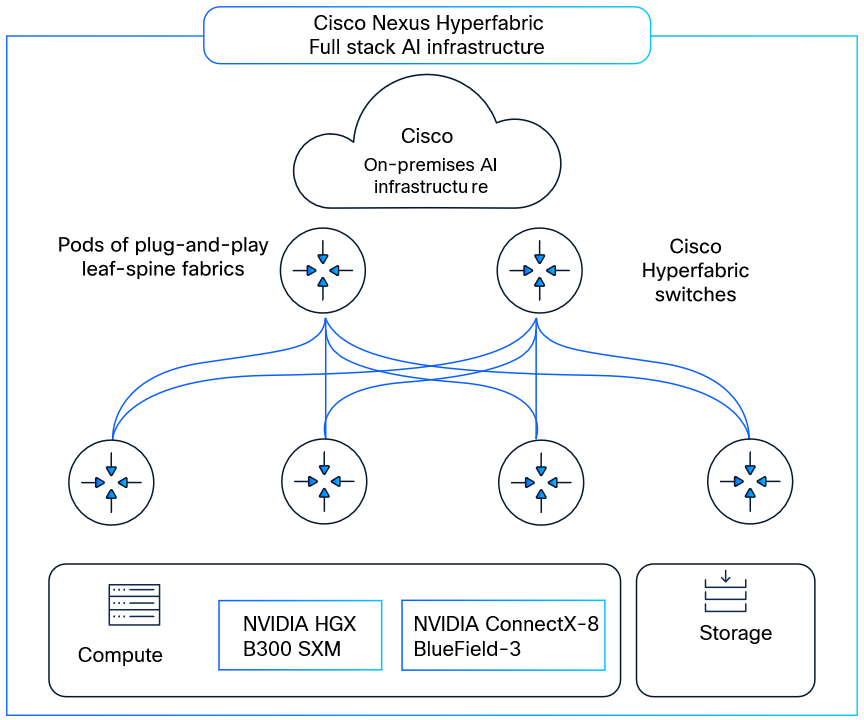
Key components of Cisco Nexus Hyperfabric Full Stack AI Infrastructure
This RA uses NVIDIA-Certified™ HGX™ B300 rack servers in 2-8-9-800 or 2-8-10-800 (C-G-N-B) configuration where C-G-N-B naming convention is defined as:
● C: Number of CPUs in the node.
● G: Number of GPUs in the node.
● N: Number of network adapters (NICs), categorized into:
◦ North/South: Communication between nodes and external systems.
◦ East/West: Communication within the cluster.
● B: Average network bandwidth per GPU in Gigabits per second (GbE).
The 8x NVIDIA B300 SXM GPUs within the server are interconnected using high speed NVLink interconnects. GPU connectivity to other physical servers is via the use of 8x integrated NVIDIA ConnectX®-8 SuperNICs for East-West traffic and via 1x or 2x NVIDIA BlueField®-3 B3240 DPUs for North-South traffic. Cisco UCS C880A M8, Supermicro NB3RT are NVIDIA-Certified™ HGX™ B300 rack servers supported in this RA. Their required specification is captured in Appendix A.
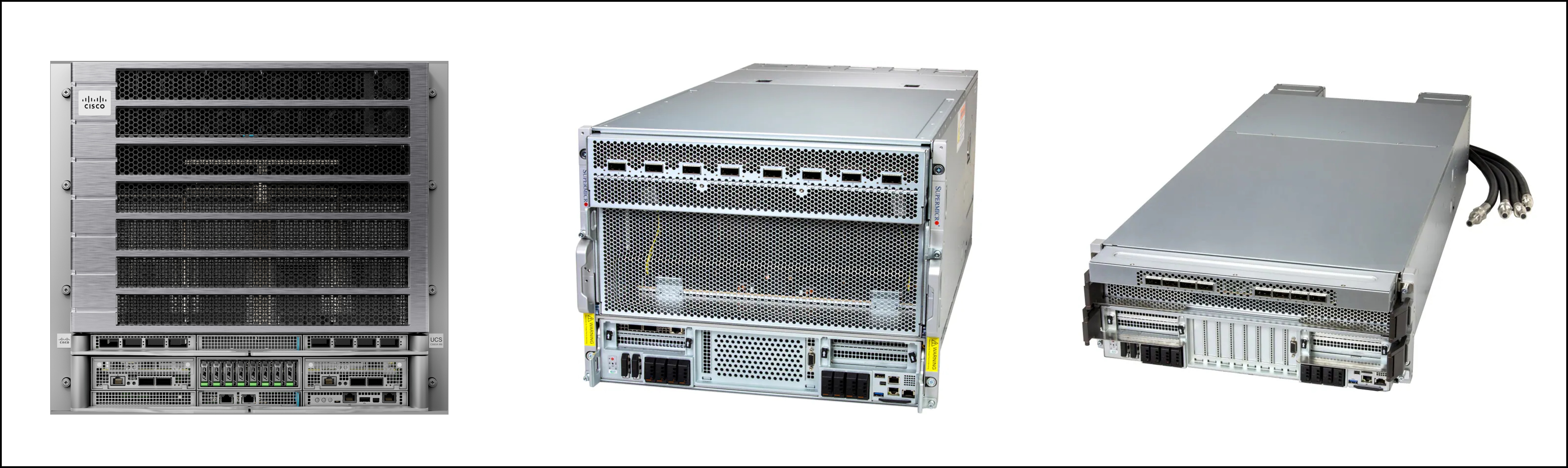
Cisco UCS C880A M8, Supermicro NB3RT Rack Servers with NVIDIA HGX™ B300
The Cisco HF6100-64ED is a Cisco Silicon One™ Ethernet switch ASIC based 2RU switch supporting 64 800G OSFP modules allowing 64 800GE or 128 400GE ports. It will be used in both leaf and spine roles.

Cisco HF6100-64ED switch
The Cisco N9164E-NS4-O is a NVIDIA Spectrum™-4 Ethernet switch ASIC based 2RU switch supporting 64 800G OSFP modules allowing 64 800GE or 128 400GE ports. This switch can be used in both leaf and spine role in East-West compute network as an alternative to HF6100-64ED switch.
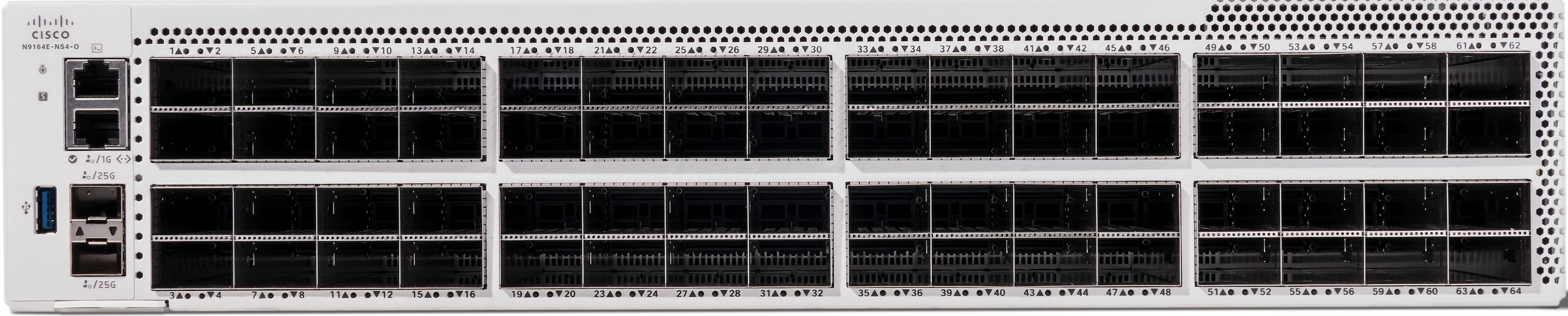
Cisco N9164E-NS4-O switch
The Cisco HF6100-32D is a 1RU Silicon One NPU–based high-density 400G-port–capable switch supporting 32 ports of QSFPDD with breakout support. This switch can be used in the leaf or spine role depending on the requirements of the cluster.

Cisco HF6100-32D switch
The Cisco HF6100-60L4D is a 1RU Silicon One NPU–based high-density switch supporting 60 SFP56 ports capable of 1/10/25/50GE speeds, plus 4 ports of 400 QSFPDD with breakout support. This switch is used in many different roles, such as management network, connectivity to applications and support servers, etc.

Cisco HF6100-60L4D switch
The Cisco UCS C225 M8 Rack Server is a 1RU general-purpose server that can be used in many roles, such as application server, support server, control nodes for Kubernetes (K8s) and Slurm. In this RA, these servers are also used to run the VAST storage solution as described in the “High-Performance Storage” section.

Cisco UCS C225 M8 Rack Server
The following Cisco optics and cables shown in Table 1 are being used on the listed devices.
Table 1. Supported list of optics and cables on different devices
| Device |
Optics and cables |
| B3220, B3240 |
QSFP-400G-DR4 with CB-M12-M12-SMF cable |
| B3220L |
QSFP-200G-SR4 with CB-M12-M12-MMF cable |
| ConnectX-8 |
OSFPR-800G-DR8 with dual CB-M12-M12-SMF cable |
| HF6100-64ED N9164E-NS4-O |
OSFP-800G-DR8 with dual CB-M12-M12-SMF cable |
| HF6100-32D |
QDD-400G-DR4 with CB-M12-M12-SMF cable QDD-400G-SR8-S with CB-M16-M12-MMF cable QDD-2Q200-CU3M passive copper cable QSFP-200G-SR4 with CB-M12-M12-MMF cable |
| HF6100-60L4D |
QDD-400G-DR4 with CB-M12-M12-SMF cable SFP-1G-T-X for 1G with CAT5E cable SFP-10G-T-X for 10G with CAT6A cable |
Overall, the networking topology is split into three separate fabrics:
● Compute (Node East-West) Network
● Converged (Node North-South) Network
● Out-of-Band (OOB) Management Network
Compute (Node East-West) Network
This network is meant for communication between the GPUs via ConnectX-8 SuperNICs configured in 2 x 400G mode. Both single and dual plane fabrics are supported though dual plane fabric is recommended to avoid a single point of failure. In case of single plane, only 1 400G port per ConnectX-8 SuperNIC is used. However, in case of dual planes, 1 400G port per ConnectX-8 SuperNIC is connected to each of the two planes. Table 2, 3 shows the quantity of different units required for building a single and dual plane compute network considering different cluster sizes.
Table 2. Single plane East-West compute fabric table – switch, transceivers, and cable counts
| Compute counts |
Switch counts |
Transceiver counts |
Cable counts |
|||||
| Nodes |
GPUs |
Leaf |
Spine |
Node to leaf |
Switch to switch (800G) |
Node to leaf |
Switch to switch |
|
| Node |
Leaf |
|||||||
| 16 |
128 |
2 |
N/A |
128 |
64 |
64 |
128 |
64 |
| 32 |
256 |
4 |
2 |
256 |
128 |
256 |
256 |
256 |
| 64 |
512 |
8 |
4 |
512 |
256 |
512 |
512 |
512 |
| 128 |
1024 |
16 |
8 |
1024 |
512 |
1024 |
1024 |
1024 |
Table 3. Dual plane East-West compute fabric table – switch, transceivers, and cable counts
| Compute counts |
Switch counts |
Transceiver counts |
Cable counts |
|||||
| Nodes |
GPUs |
Leaf |
Spine |
Node to leaf |
Switch to switch (800G) |
Node to leaf |
Switch to switch |
|
| Node |
Leaf |
|||||||
| 16 |
128 |
4 |
N/A |
128 |
128 |
128 |
256 |
128 |
| 32 |
256 |
8 |
4 |
256 |
256 |
512 |
512 |
512 |
| 64 |
512 |
16 |
8 |
512 |
512 |
1024 |
1024 |
1024 |
| 128 |
1024 |
32 |
16 |
1024 |
1024 |
2048 |
2048 |
2048 |
Converged (Node North-South) Network
The converged North-South network is used for communication with compute, storage, in-band management, support, and end-customer connections. It connects compute nodes using 2 400G ports to two separate switches providing redundancy and high storage throughput. Enough storage facing ports are pre-allocated ensuring 12.5 gbps of network bandwidth per GPU. A total of 16 200G ports (4 800G ports) are also reserved for 8 support servers to allow running Slurm and Kubernetes control nodes, NVIDIA Base Command Manager™ head nodes, and additional control monitoring applications.
Table 4 shows the quantity of different units required for building a converged network considering different cluster sizes.
Table 4. Converged North-South fabric table - switch, transceivers, and cable counts
| Compute counts |
Switch counts |
Transceiver counts |
Cable counts |
|||||||||||||||||
| Nodes |
GPUs |
Leaf |
Spine |
Mgmt leaf |
Storage leaf |
Node to compute |
ISL ports |
Node to mgmt leaf (1/10G) |
Mgmt leaf to |
Storage leaf to |
Spine to customer |
|||||||||
| Node |
Leaf |
800G |
Node |
Leaf |
Leaf |
Spine |
Leaf |
Spine |
Customer (800G) |
Support |
SMF |
CAT6A + CAT5E |
||||||||
| 16 |
128 |
2 |
N/A |
2 |
2 |
32 |
16 |
16 |
N/A |
80 |
4 |
2 |
8 |
4 |
4 |
4 |
76 |
80 |
||
| 32 |
256 |
2 |
N/A |
4 |
2 |
64 |
32 |
32 |
N/A |
160 |
8 |
4 |
8 |
4 |
8 |
4 |
136 |
160 |
||
| 64 |
512 |
4 |
2 |
6 |
2 |
128 |
64 |
128 |
N/A |
320 |
12 |
6 |
16 |
8 |
16 |
4 |
324 |
320 |
||
| 128 |
1024 |
8 |
4 |
12 |
4 |
256 |
128 |
256 |
N/A |
640 |
48 |
24 |
64 |
32 |
32 |
4 |
696 |
640 |
||
Out-of-Band Management Network
The OOB Management network is primarily used for node management connecting to the 1G ports of Base Management Controller (BMC) of the servers and NVIDIA Bluefield®-3 DPUs, and 10G host ports of the servers. The 400G uplinks of OOB management leaf switches are connected to converged North-South spine switches.
Additionally, the 1G management ports of the networking switches need to be connected separately to allow for their configuration and monitoring.
Topology with 16 compute nodes (128 GPUs)
Figure 8 shows the overall cluster topology interconnecting 16 compute nodes with a total of 128 GPUs. Each plane of the compute network uses a pair of HF6100-64ED or N9164E-NS4-O switches with odd rail groups on switch#1 and even rail groups on switch#2. The 8 800G NVIDIA ConnectX-8 SuperNICs on each server are each plugged with OSFPR-800G-DR8 modules allowing 2 400G ports per NIC where the two ports connect to two different planes. With 16 compute nodes, there are a total of 128 800G or 256 400G ports, connecting 128 400G ports to compute network plane1 and 128 400G ports to compute network plane2. Within a plane, 64 400G ports connect to switch#1 and 64 400G ports to switch#2.
The converged North-South network uses a pair of HF6100-64ED switches. The 2 400G NVIDIA Bluefield®-3 DPU ports per compute server connect to two different switches for redundancy. With 16 compute nodes, there are a total of 32 400G DPU ports evenly split between switch#1 and switch#2.
A total of 12 Cisco EBox nodes are used as high-performance storage connected to 2 HF6100-32D storage leaf switches for a total of 48 200G downlinks and 8 400G uplinks evenly split between the two leaf switches.
Every compute node uses 2 10G host management ports, 1 1G server BMC port, 1 or 2 1G DPU BMC ports depending upon if the server has 1 or 2 DPUs. Similarly, each Cisco EBox also requires 1 10G host management port and 1 1G server BMC port. All these ports from 16 compute nodes and 12 storage nodes are connected to 2 HF6100-60L4D OOB management leaf switches.
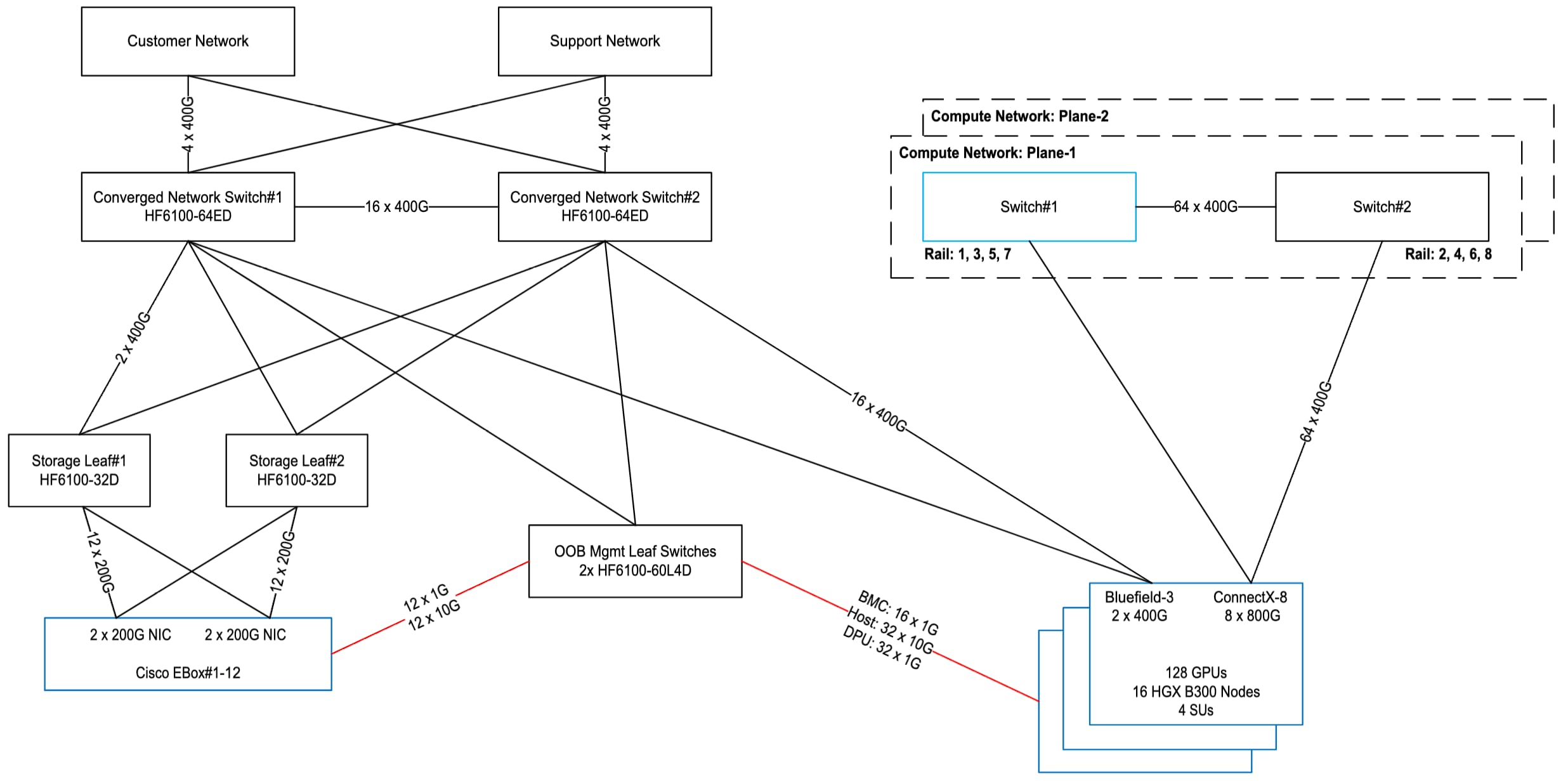
Topology with 16 compute nodes (128 GPUs)
Topology with 32 compute nodes (256 GPUs)
Figure 9 shows the overall cluster topology interconnecting 32 compute nodes with a total of 256 GPUs. Each plane of the compute network uses 4 leaf switches and 2 spine switches. Both HF6100-64ED or N9164E-NS4-O switches can be used. The 4 leaf switches respectively map to rail group 1+5, 2+6, 3+7, 4+8. The 8 800G NVIDIA ConnectX-8 SuperNICs on each server are each plugged with OSFPR-800G-DR8 modules allowing 2 400G ports per NIC where the two ports connect to two different planes. With 32 compute nodes, there are a total of 256 800G or 512 400G ports, connecting 256 400G ports to compute network plane1 and 256 400G ports to compute network plane2. Within a plane, 64 400G ports connect to every leaf switch.
The converged North-South network uses a pair of HF6100-64ED switches. The 2 400G NVIDIA Bluefield®-3 DPU ports per compute server connect to two different switches for redundancy. With 32 compute nodes, there are a total of 64 400G DPU ports evenly split between switch#1 and switch#2.
A total of 12 Cisco EBox nodes are used as high-performance storage connected to 2 HF6100-32D storage leaf switches for a total of 48 200G downlinks and 8 400G uplinks evenly split between the two leaf switches.
Every compute node uses 2 10G host management ports, 1 1G server BMC port, 1 or 2 1G DPU BMC ports depending upon if the server has 1 or 2 DPUs. Similarly, each Cisco EBox also requires 1 10G host management port and 1 1G server BMC port. All these ports from 32 compute nodes and 12 storage nodes are connected to 4 HF6100-60L4D OOB management leaf switches.
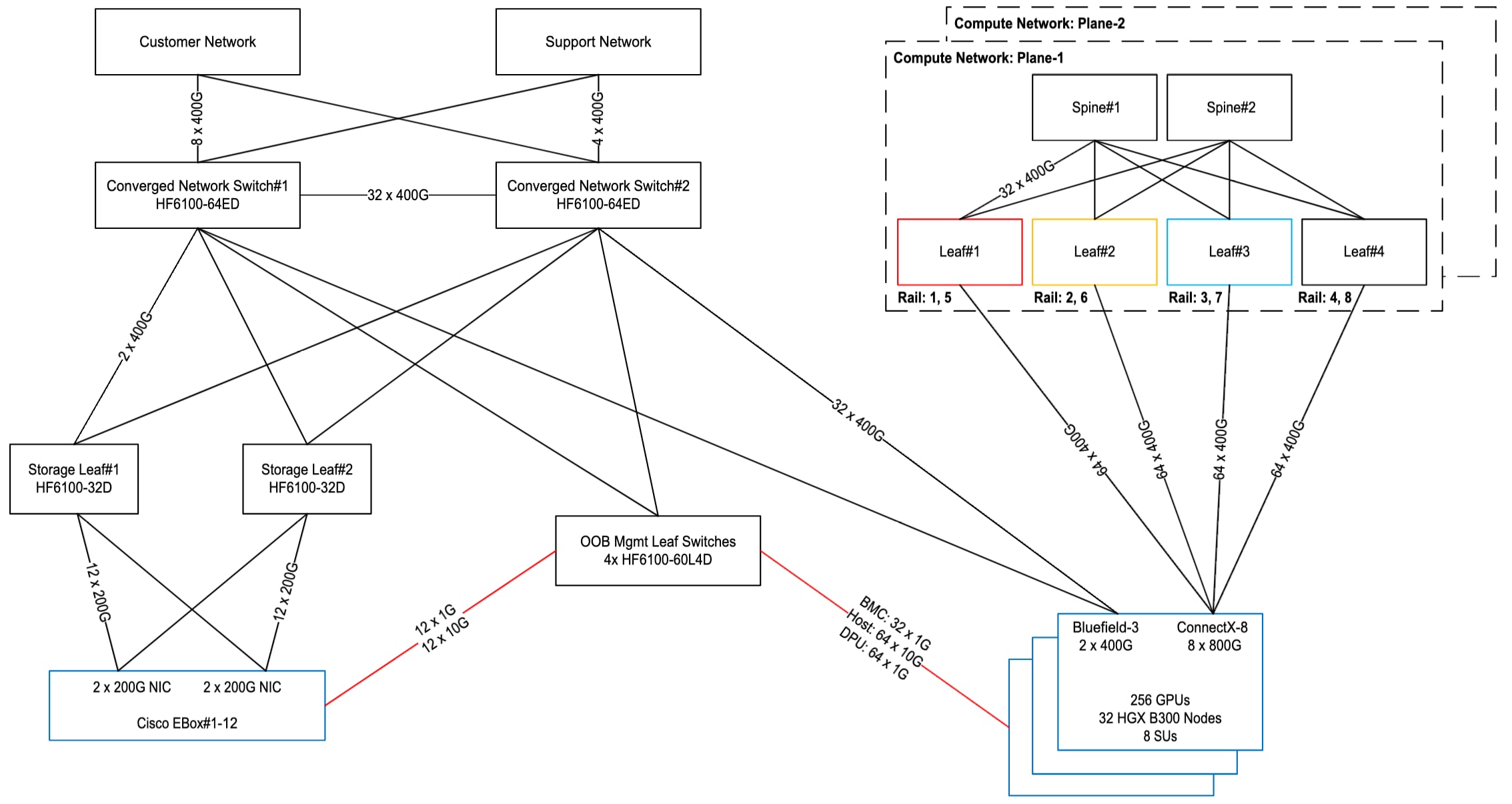
Topology with 32 compute nodes (256 GPUs)
Topology with 64 compute nodes (512 GPUs)
Figure 10 shows the overall cluster topology interconnecting 64 compute nodes with a total of 512 GPUs. Each plane of the compute network uses 8 leaf and 4 spine switches. Both HF6100-64ED or N9164E-NS4-O switches can be used. The 4 pairs of leaf switches respectively map to rail group 1+5, 2+6, 3+7, 4+8. The 8 800G NVIDIA ConnectX-8 SuperNICs on each server are each plugged with OSFPR-800G-DR8 modules allowing 2 400G ports per NIC where the two ports connect to two different planes. With 64 compute nodes, there are a total of 512 800G or 1024 400G ports, connecting 512 400G ports to compute network plane1 and 512 400G ports to compute network plane2. Within a plane, 64 400G ports connect to every leaf switch.
The converged North-South network uses 4 leaf and 2 spine HF6100-64ED switches. The 2 400G NVIDIA Bluefield®-3 DPU ports per compute server connect to two different switches for redundancy. With 64 compute nodes, there are a total of 128 400G DPU ports evenly split between 4 leaf switches (32 x 400G per leaf switch).
A total of 12 Cisco EBox nodes are used as high-performance storage connected to 2 HF6100-32D storage leaf switches for a total of 48 200G downlinks and 16 400G uplinks evenly split between the two leaf switches. If required, the number of Cisco EBox nodes can be expanded to 24 by using 2 x 200G breakout on storage leaf switch downlink ports.
Every compute node uses 2 10G host management ports, 1 1G server BMC port, 1 or 2 1G DPU BMC ports depending upon if the server has 1 or 2 DPUs. Similarly, each Cisco EBox also requires 1 10G host management port and 1 1G server BMC port. All these ports from 64 compute nodes and 12 storage nodes are connected to 6 HF6100-60L4D OOB management leaf switches.
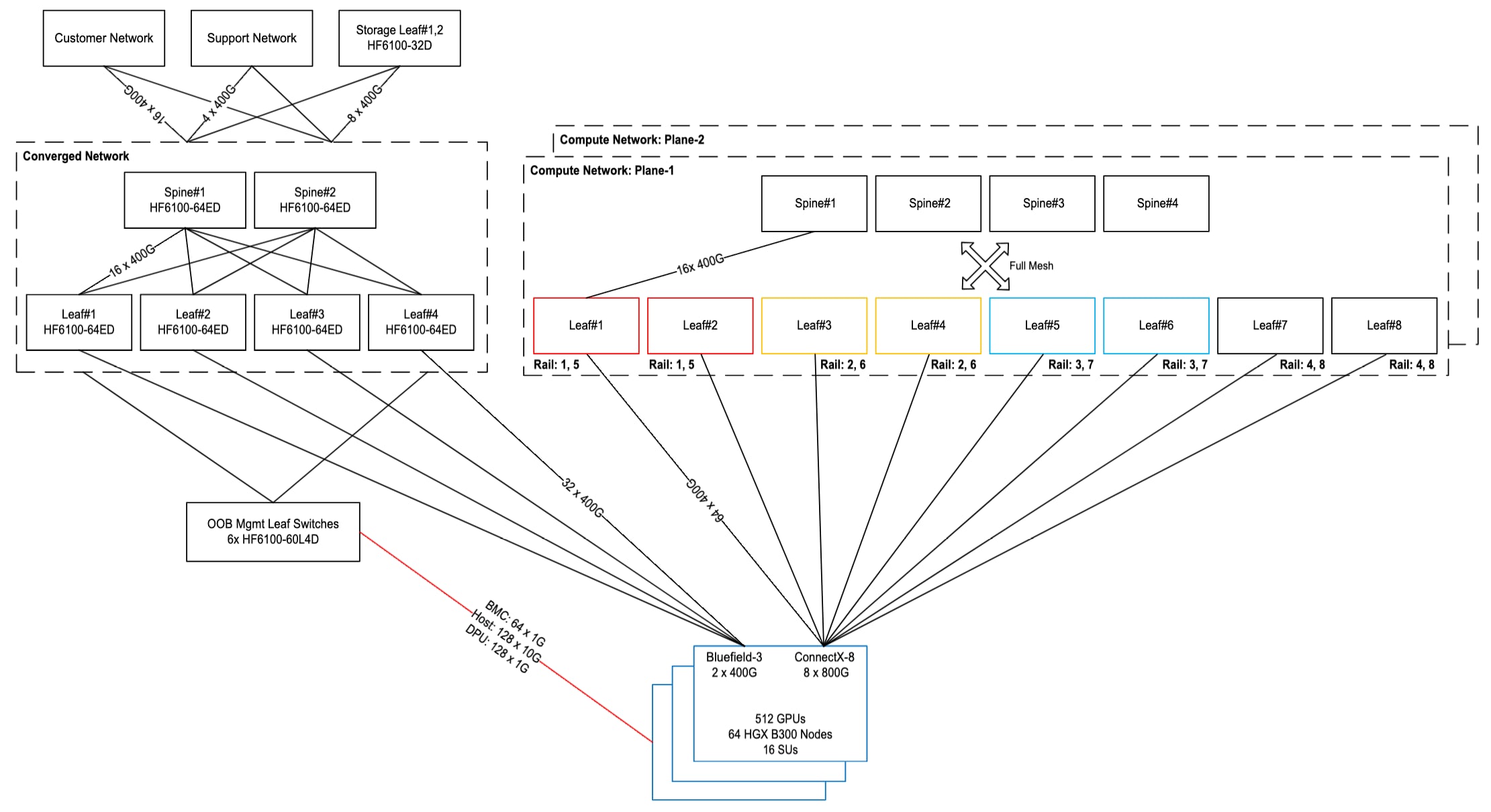
Topology with 64 compute nodes (512 GPUs)
Topology with 128 compute nodes (1024 GPUs)
Cluster topology design interconnecting 128 compute nodes with a total of 1024 GPUs is very similar to the topology used for 64 compute nodes with both compute and converged network using leaf-spine architecture. Each plane of the compute network uses 16 leaf and 8 spine switches. Both HF6100-64ED or N9164E-NS4-O switches can be used. The 4 quad groups of leaf switches respectively map to rail group 1+5, 2+6, 3+7, 4+8. The 8 800G NVIDIA ConnectX-8 SuperNICs on each server are each plugged with OSFPR-800G-DR8 modules allowing 2 400G ports per NIC where the two ports connect to two different planes. With 128 compute nodes, there are a total of 1024 800G or 2048 400G ports, connecting 1024 400G ports to compute network plane1 and 1024 400G ports to compute network plane2. Within a plane, 64 400G ports connect to every leaf switch.
The converged North-South network uses 8 leaf and 4 spine HF6100-64ED switches. The 2 400G NVIDIA Bluefield®-3 DPU ports per compute server connect to two different switches for redundancy. With 128 compute nodes, there are a total of 256 400G DPU ports evenly split between 8 leaf switches (32 x 400G per leaf switch).
A minimum of 12 Cisco EBox nodes are used as high-performance storage connected to 4 HF6100-32D storage leaf switches for a total of 48 200G downlinks and 64 400G uplinks evenly split between the two pairs of storage leaf switches. If required, the number of Cisco EBox nodes can be expanded to 32 by using 2 x 200G breakout on storage leaf switch downlink ports instead of native 200G ports.
Every compute node uses 2 10G host management ports, 1 1G server BMC port, 1 or 2 1G DPU BMC ports depending upon if the server has 1 or 2 DPUs. Similarly, each Cisco EBox also requires 1 10G host management port and 1 1G server BMC port. All these ports from 128 compute nodes and 12 storage nodes are connected to 12 HF6100-60L4D OOB management leaf switches.
Cluster BOM
The BOM for clusters of different sizes using single compute plane is shown in Table 5.
Table 5. BOM of clusters with GPU scale 128 to 1024 using single compute plane
| PID |
Description |
128 GPUs |
256 GPUs |
512 GPUs |
1024 GPUs |
| UCSC-880A-M8-B306 SYS-822GS-NB3RT AS-8126GS-NB3RT SYS-422GS-NB3RT-ALC |
Cisco, Supermicro HGX B300 air and liquid cooled rack server |
16 |
32 |
64 |
128 |
| HF6100-64ED (Converged Network) |
Cisco Hyperfabric switch, 64x800Gbps OSFP |
2 |
2 |
6 |
12 |
| HF6100-64ED N9164E-NS4-O (Compute Network) |
Cisco Hyperfabric switch, 64x800Gbps OSFP |
2 |
6 |
12 |
24 |
| HF6100-64ED (Both Converged and Compute Network) |
Cisco Hyperfabric switch, 64x800Gbps OSFP |
4 |
8 |
18 |
36 |
| HF6100-60L4D |
Cisco Hyperfabric switch 60x50G SFP28 4x400G QSFP-DD |
2 |
4 |
6 |
12 |
| HF6100-32D |
Cisco Hyperfabric switch, 32x400Gbps QSFP-DD |
2 |
2 |
2 |
4 |
| OSFP-800G-DR8 |
OSFP, 800GBASE-DR8, SMF dual MPO-12 APC, 500m (integrated heat sink) |
174 |
468 |
994 |
2012 |
| OSFPR-800G-DR8 |
OSFP, 800GBASE-DR8, SMF dual MPO-12 APC, 500m (riding heat sink) |
128 |
256 |
512 |
1024 |
| QDD-400G-DR4 |
400G QSFP-DD transceiver, 400GBASE-DR4, MPO-12, 500m parallel |
12 |
16 |
28 |
112 |
| QSFP-400G-DR4 |
400G QSFP112 transceiver, 400GBASE-DR4, MPO-12, 500m parallel |
48 |
80 |
144 |
272 |
| QSFP-200G-SR4-S |
200G QSFP transceiver, 200GBASE-SR4, MPO-12, 100m |
96 |
96 |
96 |
96 |
| SFP-1G-T-X |
1G SFP |
60 |
108 |
204 |
396 |
| SFP-10G-T-X |
10G SFP |
44 |
76 |
140 |
268 |
| CB-M12-M12-SMF |
MPO-12 single-mode cables |
268 |
648 |
1348 |
2744 |
| CB-M12-M12-MMF |
MPO-12 multi-mode cables |
48 |
48 |
48 |
48 |
| CAT5E |
Copper cable for 1G |
60 |
108 |
204 |
396 |
| CAT6A |
Copper cable for 10G |
44 |
76 |
140 |
268 |
| UCSC-C225-M8N (storage server) |
Cisco UCS C225-M8 1RU Rack Server |
12 |
12 |
Min: 12 Max: 24 |
Min: 12 Max: 32 |
| UCSC-C240-M8 UCSC-C245-M8SX (support server) |
Cisco UCS C240-M8 2RU Rack Server Cisco UCS C245-M8 2RU Rack Server |
8 |
8 |
8 |
8 |
The BOM for clusters of different sizes using dual compute plane is shown in Table 6.
Table 6. BOM of clusters with GPU scale 128 to 1024 using dual compute plane
| PID |
Description |
128 GPUs |
256 GPUs |
512 GPUs |
1024 GPUs |
| UCSC-880A-M8-B306 SYS-822GS-NB3RT AS-8126GS-NB3RT SYS-422GS-NB3RT-ALC |
Cisco, Supermicro HGX B300 air and liquid cooled rack server |
16 |
32 |
64 |
128 |
| HF6100-64ED (Converged Network) |
Cisco Hyperfabric switch, 64x800Gbps OSFP |
2 |
2 |
6 |
12 |
| HF6100-64ED N9164E-NS4-O (Compute Network) |
Cisco Hyperfabric switch, 64x800Gbps OSFP |
4 |
12 |
24 |
48 |
| HF6100-64ED (Both Converged and Compute Network) |
Cisco Hyperfabric switch, 64x800Gbps OSFP |
6 |
14 |
30 |
60 |
| HF6100-60L4D |
Cisco Hyperfabric switch 60x50G SFP28 4x400G QSFP-DD |
2 |
4 |
6 |
12 |
| HF6100-32D |
Cisco Hyperfabric switch, 32x400Gbps QSFP-DD |
2 |
2 |
2 |
4 |
| OSFP-800G-DR8 |
OSFP, 800GBASE-DR8, SMF dual MPO-12 APC, 500m (integrated heat sink) |
302 |
852 |
1762 |
3548 |
| OSFPR-800G-DR8 |
OSFP, 800GBASE-DR8, SMF dual MPO-12 APC, 500m (riding heat sink) |
128 |
256 |
512 |
1024 |
| QDD-400G-DR4 |
400G QSFP-DD transceiver, 400GBASE-DR4, MPO-12, 500m parallel |
12 |
16 |
28 |
112 |
| QSFP-400G-DR4 |
400G QSFP112 transceiver, 400GBASE-DR4, MPO-12, 500m parallel |
48 |
80 |
144 |
272 |
| QSFP-200G-SR4-S |
200G QSFP transceiver, 200GBASE-SR4, MPO-12, 100m |
96 |
96 |
96 |
96 |
| SFP-1G-T-X |
1G SFP |
60 |
108 |
204 |
396 |
| SFP-10G-T-X |
10G SFP |
44 |
76 |
140 |
268 |
| CB-M12-M12-SMF |
MPO-12 single-mode cables |
460 |
1160 |
2372 |
4792 |
| CB-M12-M12-MMF |
MPO-12 multi-mode cables |
48 |
48 |
48 |
48 |
| CAT5E |
Copper cable for 1G |
60 |
108 |
204 |
396 |
| CAT6A |
Copper cable for 10G |
44 |
76 |
140 |
268 |
| UCSC-C225-M8N (storage server) |
Cisco UCS C225-M8 1RU Rack Server |
12 |
12 |
Min: 12 Max: 24 |
Min: 12 Max: 32 |
| UCSC-C240-M8 UCSC-C245-M8SX (support server) |
Cisco UCS C240-M8 2RU Rack Server Cisco UCS C245-M8 2RU Rack Server |
8 |
8 |
8 |
8 |
Cisco has partnered with VAST Data to onboard their AI OS on Cisco UCS C225-M8N Rack Servers in EBox architecture: together, they provide the storage subsystem for this RA. This product is called Cisco EBox and it is NVIDIA-Certified high-performance storage for both NVIDIA and Cisco Enterprise Secure AI Factory. VAST Data supports a “Disaggregated Shared Everything” (DASE) architecture that allows for horizontally scaling storage capacity and read/write performance by incrementally adding servers to a single namespace. Additional features include native support for multitenancy, multiprotocol (NFS, S3, SMB), data reduction, data protection, cluster high availability, serviceability of failed hardware components etc.
Figure 13 shows the overall network connectivity and BOM with 12 storage servers. For data path, each server uses two NVIDIA BlueField-3 B3220L 2x200G SuperNICs – NIC0 is used for internal network within the servers, allowing any server to access storage drives from any other server, and NIC1 is used for external network supporting client traffic such as NFS, S3, and SMB. The 1G BMC and 10G x86 management ports are connected to a management leaf switch.
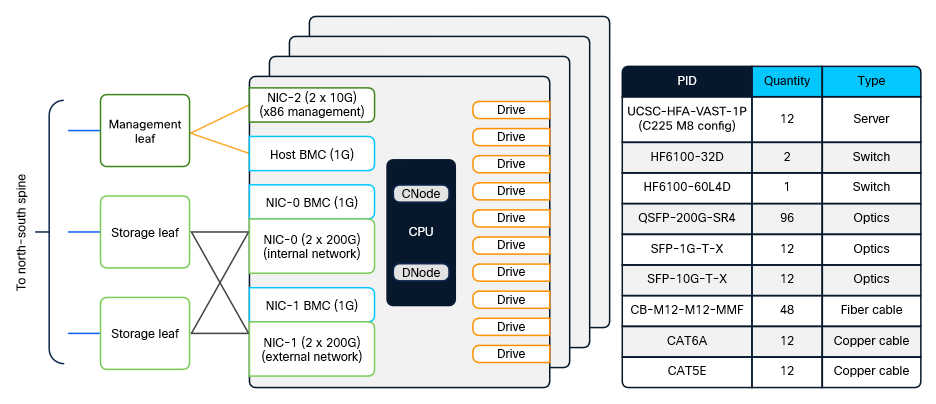
Block diagram and BOM of storage sub-system
Beside Cisco EBox, other NVIDIA-Certified storage partners can also be used in this reference architecture.
Cisco Nexus® Hyperfabric controller is required to provision and manage the entire networking fabric. It fully manages the configuration target state, switch software versions etc. It ingests telemetry from switches and NICs on compute and storage nodes for end-to-end network visibility and optimization of network performance. Enterprises can also utilize the available programmability interfaces to fully integrate with the controller via their automation frameworks.
Cisco Intersight is used to do provisioning of the Cisco compute servers as well as their end-to-end life cycle management. It also supports integration with other automation frameworks via RESTful APIs. Enterprises can also choose to use on-premises NVIDIA Base Command Manager or additional open-source or custom tools or frameworks for compute-node provisioning.
The Cisco EBox storage controller (also known as VAST Management Service) will be used for configuration and monitoring of the high-performance storage. RESTful APIs are supported for integration with automation frameworks.
This reference architecture includes NVIDIA AI Enterprise, deployed and supported on NVIDIA-Certified Cisco UCS C880A M8 and Supermicro NB3RT Rack Servers. NVIDIA AI Enterprise brings together optimized microservices, frameworks and libraries for AI development with advanced GPU orchestration and infrastructure management into a production-grade software suite. It enables the deployment of leading open-source tools and AI models, lowers infrastructure costs and reduces time to market while ensuring reliable, secure, and scalable operations.
NVIDIA NIM™ gives developers ready-to-run containers and standard APIs for serving AI models on NVIDIA GPUs.
The NVIDIA Spectrum™-X Networking technology significantly improves the performance and efficiency of Ethernet-based GPU and storage networks. Its benefits are available with Cisco SiliconOne based Hyperfabric switches when connected to NVIDIA ConnectX-8 and BlueField-3 SuperNICs and Fine Grain Load Balancing (FGLB) license enabled. Spectrum-X License is not required when deploying East-West compute network with the use of N9164E-NS4-O switch.
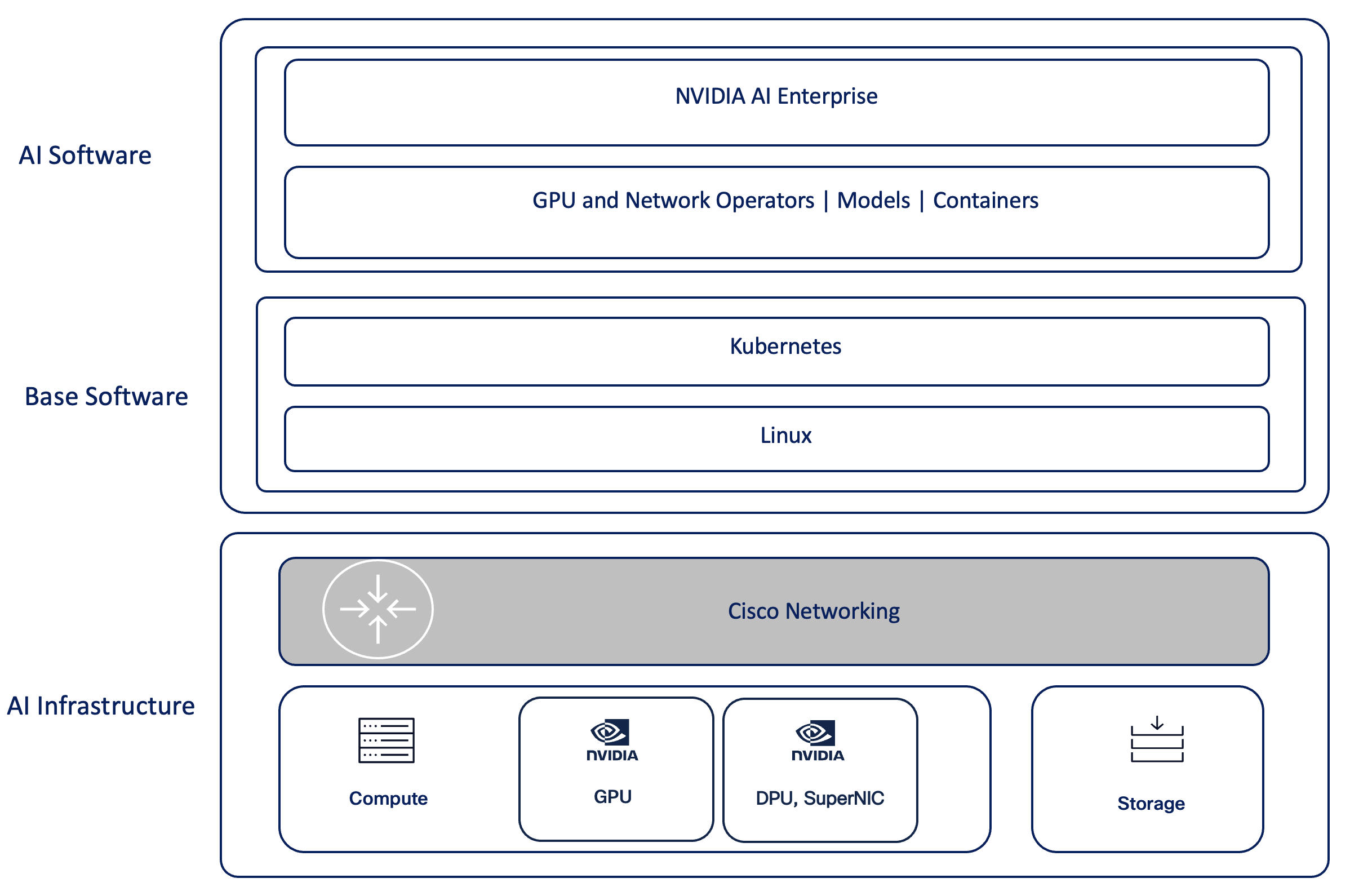
Compute-server software stack
Customers can run their choice of OS distribution and software versions as per the NVIDIA AI Enterprise, drivers, and CNS compatibility matrix published by NVIDIA.
Security in AI infrastructure is very crucial to ensure confidentiality, integrity, and high availability against adversarial attacks by implementing robust access controls and host and network isolation to prevent unauthorized access or manipulation. A number of Cisco security technologies, as enumerated below, are available that can be deployed by Enterprises to configure, monitor, and enforce end-to-end security right from applications to overall infrastructure. The complete integration of these technologies into the end-to-end workflow is beyond the scope of this RA.
Observability is a key element of AI infrastructure to ensure continuous visibility and reliability and to provide high-performance by tuning as well as proper infrastructure scaling. It also facilitates debugging, aids security, and helps maintain trustworthy and effective AI systems. Cisco Splunk® is an industry-leading observability solution for Enterprises to ingest significant amounts of telemetry and gain in-depth visibility. It’s integration within the end-to-end workflow is beyond the scope of this RA.
The overall solution has been thoroughly tested on all aspects of management plane, control plane, and dataplane, combining compute, storage, and networking. The compute nodes are NVIDIA-Certified Systems™. The Cisco EBox high-performance storage solution has achieved NVIDIA-Certified Storage validation at the NCP level. A number of benchmark test suites (such as HPC Benchmark, IB PerfTest, NCCL Test, MLCommons Training, and Inference benchmarks) have also been run to evaluate end-to-end performance and assist with tuning. Different elements and entities of the NVIDIA AI Enterprise ecosystem have been brought up and tested to evaluate a number of enterprise-centric customer use cases around fine-tuning, inferencing, and RAG.
In short, Cisco Nexus Hyperfabric Full Stack AI Infrastructure is a fully validated AI cluster solution, offering customers an integrated AI infrastructure powered by NVIDIA accelerated computing.
Appendix A – Compute server specifications
| Area |
Details |
| Compute + Memory |
2x 6th Gen Intel Xeon or AMD Turin CPUs each with 64 cores 32x 128GB DDR5 RDIMMs, up to 6,000 MT/S (max supported memory config) |
| Storage |
2x 960GB M.2 SATA or NVMe boot drives with HW RAID controller Up to 8 PCIe Gen 5 x4 E1.S NVMe SSDs |
| GPUs |
8x NVIDIA B300 GPUs with 8x ConnectX-8 (OSFP based) integrated on the board |
| Network Cards |
1x or 2x PCIe x16 FHHL NVIDIA BlueField®-3 B3240 crypto enabled North-South NIC 1 OCP 3.0 X710-T2L for host management |
Appendix B – Control-node server specifications
The following table shows the minimum specifications of control, management, and support server.
Table 7. Minimum specification of control, management, and support rack server
| Area |
Details |
| Compute + memory |
1 or 2 Latest AMD or Intel x86 CPUs with minimum 64-cores total 512GB DDR5 RDIMMs |
| Storage |
Dual 1 TB M.2 SATA or NVMe SSD with RAID (boot device) |
| Network cards |
1 PCIe x16 FHHL NVIDIA BlueField-3 B3220 configured in DPU mode 1 OCP 3.0 X710-T2L (2 x 10G RJ45) for x86 host management |
| Power supply |
2x PSU with N+1 redundancy |
| BMC |
1G RJ45 for host management |