Breaking the 25G Barrier: 50G Performance with Cisco UCS 6600 Series FIs White Paper
Available Languages
Bias-Free Language
The documentation set for this product strives to use bias-free language. For the purposes of this documentation set, bias-free is defined as language that does not imply discrimination based on age, disability, gender, racial identity, ethnic identity, sexual orientation, socioeconomic status, and intersectionality. Exceptions may be present in the documentation due to language that is hardcoded in the user interfaces of the product software, language used based on RFP documentation, or language that is used by a referenced third-party product. Learn more about how Cisco is using Inclusive Language.
The Cisco UCS® Fabric Interconnect 6652 introduces a cost-effective modernization path for data centers requiring 10/25/50G Ethernet and 64G Fibre Channel (FC) environments without the need to transition to 100G Ethernet. This document highlights how 50G Ethernet, paired with 64G Fibre Channel, offers superior performance and cost benefits compared to 25G Ethernet, supporting evolving bandwidth demands while maintaining efficiency and flexibility.
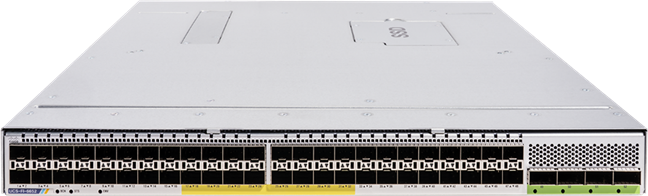
Fabric Interconnect 6652
Cost-effective solution for blade and rack customers
The FI 6652 is designed to serve both blade and rack server environments. For most customers, especially those with blade servers. 25G Ethernet remains the standard and provides robust, fully supported connectivity. The FI 6652 ensures that both blade and rack deployments benefit from a cost-effective, unified architecture, with flexible options for future growth.
50G Ethernet capability and 64G Fibre Channel integration
● Unified high-speed connectivity: The FI 6652 supports 50G Ethernet ports alongside the industry's first 64G Fibre Channel for C-Series rack servers, enabling a seamless and simplified transition. This unified fabric supports Ethernet and Fibre Channel protocols on the same platform, providing flexible options as bandwidth needs grow.
● Next-Generation Architecture: Powered by Cisco’s Next Gen Cloud Scale ASIC, the FI 6652 delivers robust 8.44 Tbps–bandwidth performance with low latency and lossless fabric capabilities. The fabric interconnect supports multiple traffic classes over a lossless Ethernet fabric, ensuring consistent quality of service (QoS) for both LAN and SAN traffic.
● Port density and versatility: The 1RU FI 6652 features 52 ports, including:
◦ 32 SFP 10/25/50G Ethernet ports
◦ 16 unified SFP ports supporting 10/25/50G Ethernet or 16/32/64G Fibre Channel
◦ 4 QSFP-DD 40/100/400G Ethernet uplinks
This high-density design supports broad interoperability with the Cisco UCS X-Series Modular System, Cisco UCS B-Series blade servers, Cisco UCS C-Series rack servers, Cisco® MDS and Brocade SAN switches, and Cisco Nexus® FEX connectivity.
Cost-effective 25G solution for blade and rack customers
For the majority of existing Cisco UCS customers, blade servers are the foundation of the data center. The FI 6652 continues to provide a cost-effective, highly compatible 25G solution for blade and rack server environments. 25G Ethernet remains the optimal and fully supported standard for UCS servers, delivering the performance and reliability required by most workloads.
Enhanced performance for rack direct-attach connectivity
Existing rack server customers equipped with Cisco UCS VIC 15000 series or newer adapters can double their Ethernet bandwidth by deploying 50G SFP transceivers with the Cisco UCS Fabric Interconnect 6652. These 50G SFPs are priced comparably to 25G SFPs, enabling a cost-effective upgrade path. It is important to note that to leverage 50G Ethernet connectivity, both a VIC 15000 series (or newer) adapter and compatible 50G SFP transceivers are required.
Advantages of 50G Ethernet over 25G Ethernet
● Bandwidth efficiency: Upgrading from 25G to 50G Ethernet nearly doubles the Ethernet bandwidth available to rack servers, providing 50G connectivity at a similar cost and power consumption level as 25G. This enables customers to meet growing data demands without significant infrastructure overhaul.
● Cost-effectiveness: The dual-rate SFP transceivers used in 50G Ethernet support both 25G and 50G data rates, allowing a smooth and cost-effective migration path. Rack server customers (using Cisco VIC 15000 series or newer adapters and above.) can initially deploy 25G and upgrade to 50G without replacing hardware, reducing capital expenditure and operational disruption.
Why 50G Ethernet with 64G Fibre Channel is better and cheaper
● Unified system architecture: The FI 6652, combined with the Cisco UCS X-Series Modular System, Cisco UCS C-Series rack servers, and Cisco Intersight®, delivers a truly unified system that operates consistently across blades and racks, on-premises and edge, with a single policy and management model. This reduces complexity and operational costs compared to managing separate server, network, and SAN silos.
● Performance and scalability:The new fabric interconnects with 50G links deliver enhanced support for high-performance computing and storage environments, providing lower latency and higher aggregate throughput across the infrastructure. This advancement ensures that current 25G blade connectivity is fully optimized, while also enabling seamless scalability and readiness for future growth as higher-speed devices are introduced.
● Power and space efficiency: The 1RU form factor with high port density and a front-to-back cooling design ensures efficient use of rack space and power, contributing to lower total cost of ownership (TCO).
● Broad ecosystem support: Compatibility with multiple generations of Intel® and AMD servers, Cisco MDS and Brocade SAN switches, and various fabric extenders ensures investment protection and interoperability.
Cisco UCS VIC 15000 Series Support for 50G
The Cisco UCS Virtual Interface Card (VIC) 15000 Series supports a wide range of speeds including 10/25/40/50/100/200 Gigabit Ethernet and Fibre Channel over Ethernet (FCoE). Specifically, the VIC 15000 series include quad-port 10/25/50G cards designed for Cisco UCS C-Series rack servers, enabling high-performance 50G Ethernet connectivity. This capability allows rack servers to leverage the same unified fabric as blade servers, simplifying network architecture and management.
Benefits of connecting rack servers to fabric interconnects
Connecting rack servers directly to Cisco UCS fabric interconnects using Cisco UCS VIC 15000 adapters offers significant advantages over traditional Fibre Channel host bus adapters (HBAs). The unified fabric approach reduces the need for separate SAN infrastructure and costly FC HBAs, lowering total cost of ownership. Additionally, VIC adapters provide hardware port-channeling for link redundancy and higher bandwidth aggregation, supporting up to 200Gbps throughput per VIC with four ports of 50G.
By adopting 50G Ethernet connectivity with VIC 15000 and fabric interconnects, customers gain a cost-effective, scalable, and simplified solution that delivers robust performance without the expense and complexity of dedicated Fibre Channel HBAs. This unified approach aligns with the Cisco UCS vision of converged LAN, SAN, and management traffic over a single fabric, enhancing operational efficiency and reducing capital and operational expenditures.
Upgrading to 50G Ethernet with 64G Fibre Channel on the Cisco UCS Fabric Interconnect 6652 offers:
● For Cisco UCS rack server customers, nearly twice the Ethernet bandwidth compared to 25G at similar cost and power
● Scalable migration path, allowing customers to deploy 10- or 25G connectivity today and scale to 50G as requirements grow
● Unified LAN and SAN fabric with lossless, low-latency performance
● High-density, versatile port configurations supporting diverse workloads
● A unified management model reducing operational complexity and costs
This makes the FI 6652 an optimal choice for customers seeking a cost-effective, high-performance, and future-ready data center fabric solution—whether they are deploying blade, rack, or hybrid server environments.