of organizations are planning to deploy AI inferencing at the edge within 12 months.*
of organizations are moving to integrated AI solutions for edge/on-premises within 12 months.*
Agentic AI at the edge is an infrastructure investment decision, not just a technology trend. Unlike predictive models that surface insights for human review, agentic AI systems can reason, plan, and act in real time at the source. That raises the bar for edge infrastructure and capital planning: organizations need AI-ready capacity faster, less risk of stranded edge spend, and a more defensible path than piecemeal site-by-site buildouts.
of organizations are planning to deploy AI inferencing at the edge within 12 months.*
of organizations are moving to integrated AI solutions for edge/on-premises within 12 months.*
The biggest barrier to scaling edge AI isn’t the technology—it’s the “DIY” trap. Building infrastructure from scratch, site by site, invites the cost surprises, delays, and rework that early adopters now regret. Without a repeatable foundation, every new site adds budget unpredictability, governance friction, and a recommendation that is harder to defend to stakeholders.
94%
of organizations with active AI deployments report regrets with their initial AI infrastructure strategy.*
82%
of organizations agree that their AI infrastructure needs to keep pace with security threats.*
67%
expect their network to hit its limits as an AI bottleneck within 12 months.*
Plan before you build. The top regret is skipping a rigorous cost analysis.
Security needs to be built in, not bolted on, as the edge becomes an attractive target for cybercrimes.
Performance matters—if your infrastructure isn’t built for the edge, your AI is essentially “data-starved.”
Replace one-off, “snowflake” edge buildouts with an integrated, pre-validated platform that makes costs more predictable, reduces operational risk, and speeds the move from pilot to repeatable deployment.
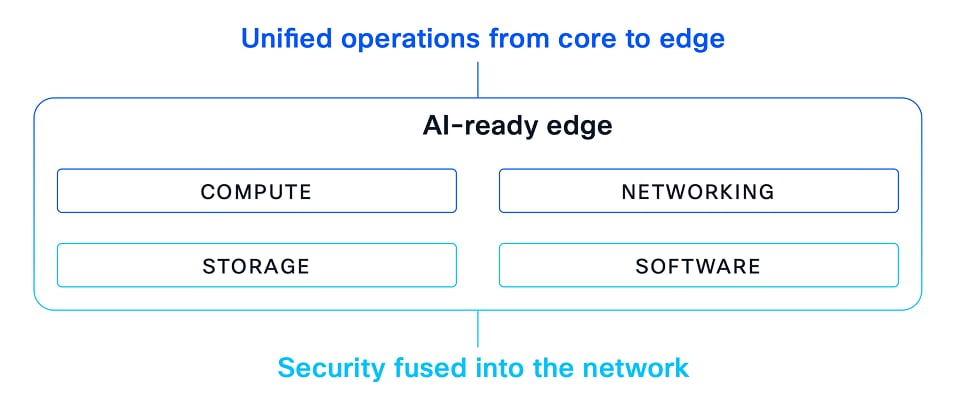
To thrive in the agentic AI era, infrastructure must function as a cohesive system, not isolated parts. Siloed hardware and software cause fragmented performance, inconsistent security, and scaling challenges. A full-stack approach treats the edge as a true data center extension. The ideal solution uses a unified platform that abstracts complexity at every layer. This approach must:
Integrate the full stack: Compute, networking, storage, software, and security must work together.
Ecosystem integration: Hardware plus infrastructure software and ISVs ensure consistency and automation for AI workloads at the edge.
Centralize operations: Enable zero-touch provisioning and fleet-wide visibility.
Embed security: Build protection into the architecture, not as an afterthought.
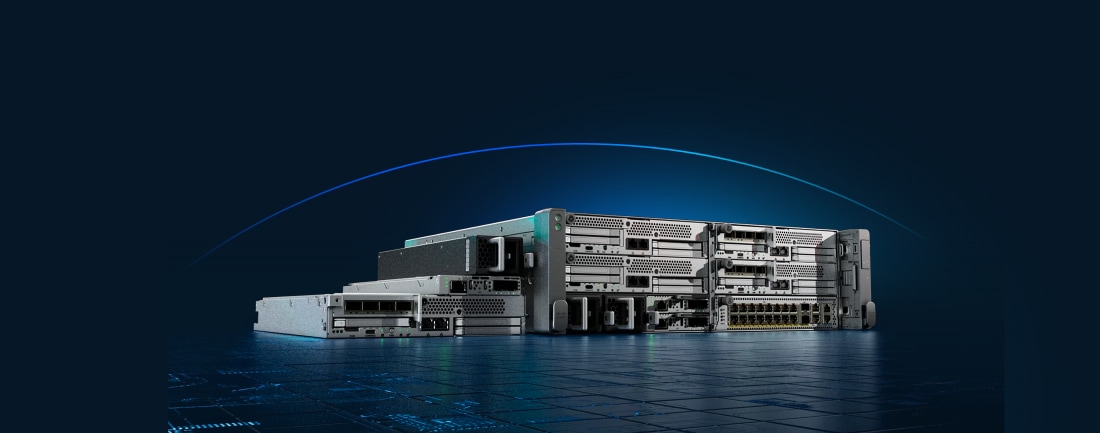
Cisco Unified Edge is built to evolve with you, not against you. Reuse chassis power and cooling infrastructure across multiple generations of compute, networking, and GPU technologies, enhancing longevity, sustainability, and serviceability. This modular architecture lets organizations adopt technology at their pace, simplifying lifecycle management with less risk. It’s a unified foundation that matures alongside your AI strategy, keeping your operations agile long after the first deployment.
Modular architecture: Edge-optimized system integrating compute, network, storage, software, and security for simplified edge deployment and operations.
Run any workload: Personalization for any use case through interchangeable support for compute and network nodes.
Future-ready performance An integrated 25-gigabit, high-performance network for fast node-to-node communications.
Seamless serviceability: Redundant, hot-swappable modules and easy node replacement simplifies maintenance for remote sites.
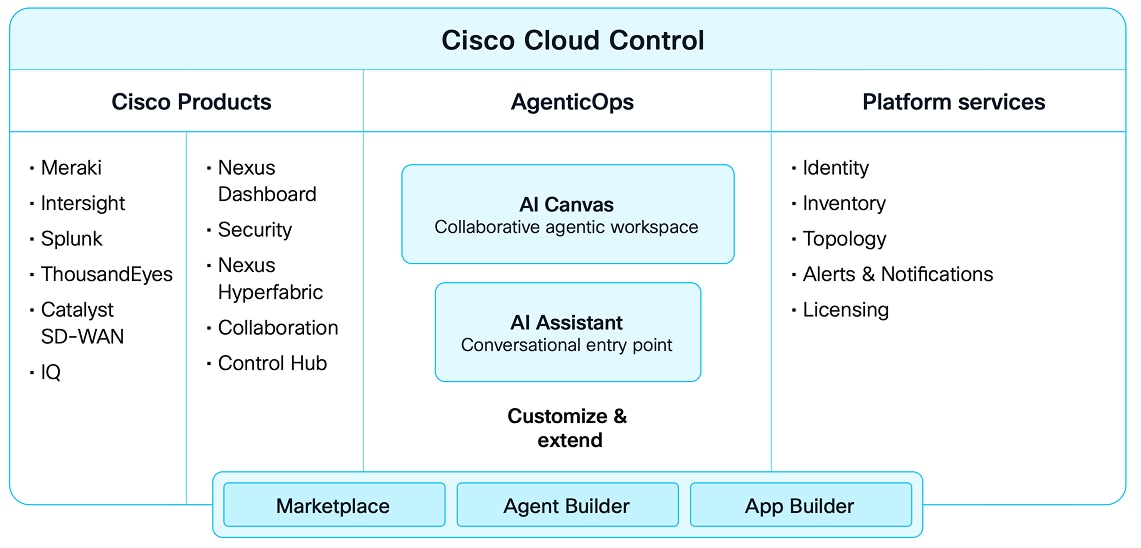
Edge IT relies on specialized tools, yet operational challenges often span multiple domains. Cisco Cloud Control unifies Cisco’s deep networking, security, and compute into a single environment. This integration provides shared management and consistent access, allowing teams to monitor assets, understand connectivity, and resolve issues efficiently without the burden of rebuilding context across platforms.
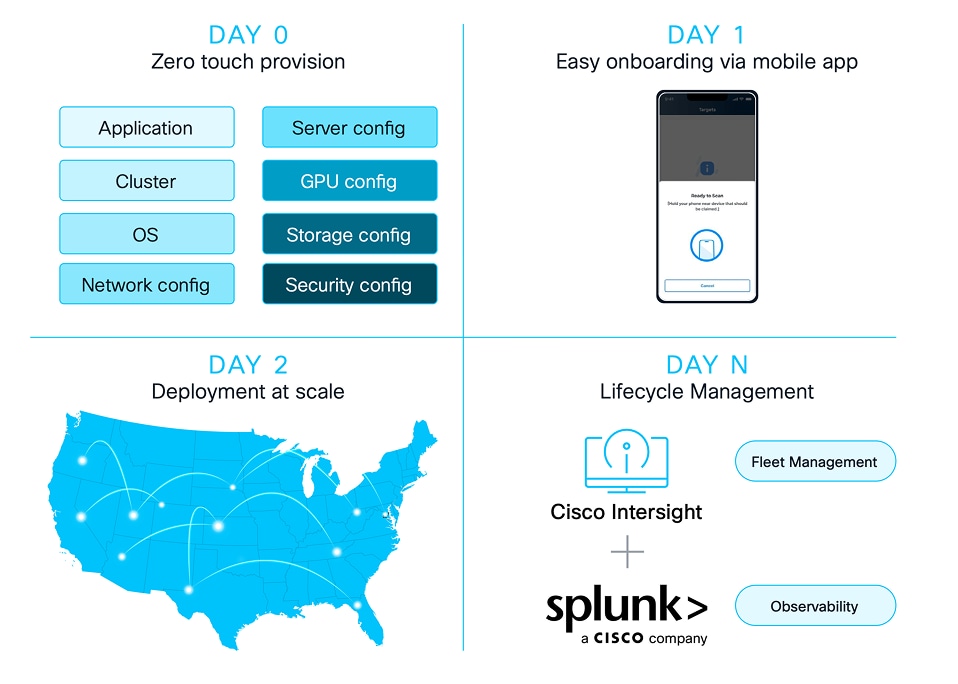
Managing edge infrastructure can be a logistical challenge because unique “snowflake” configurations and manual processes hinder scale and AI readiness. Cisco Intersight centralizes management into a single, cloud-based control plane, transforming how you operate edge infrastructure across its entire lifecycle:
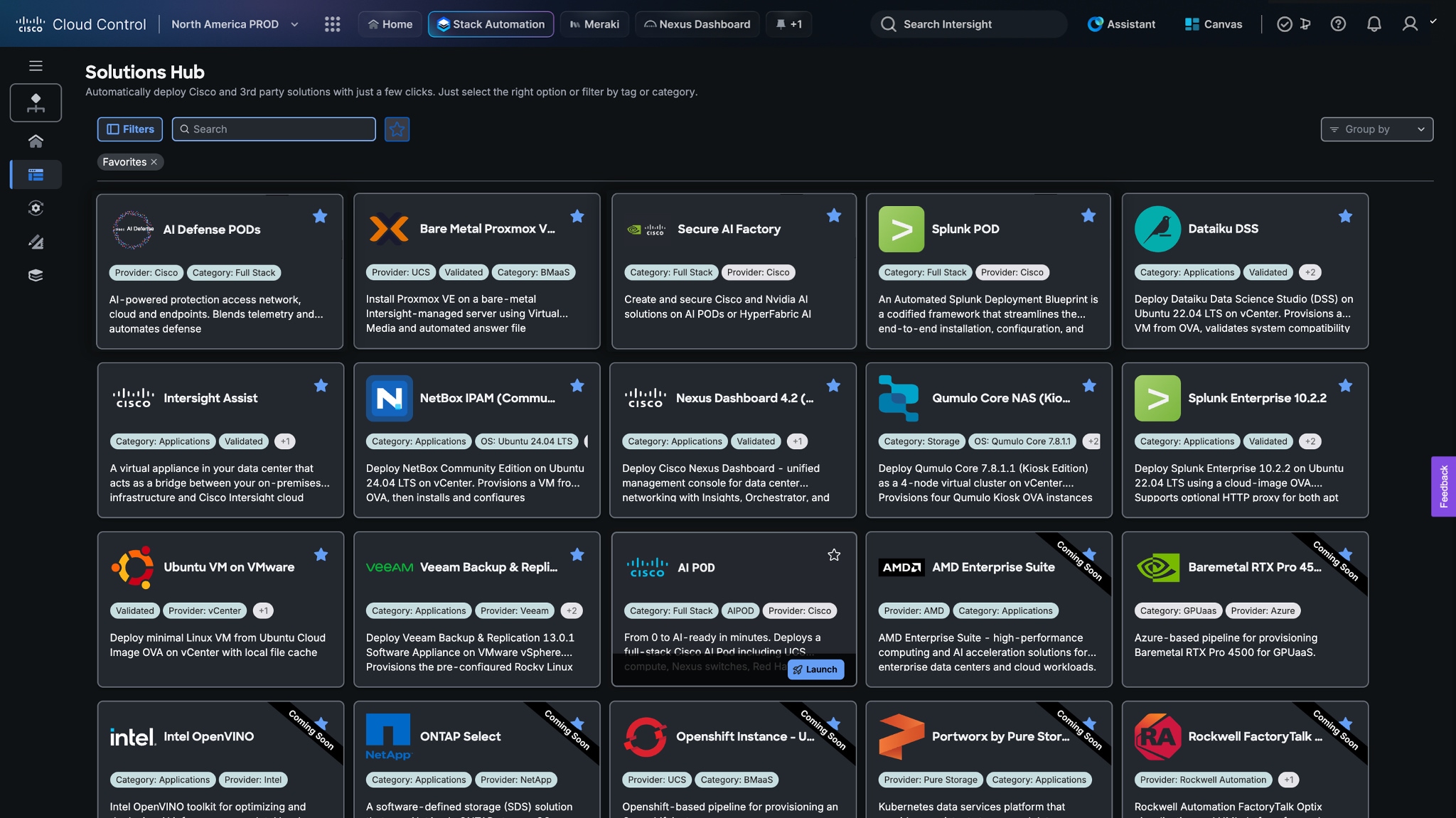
Your business is ready to innovate and scale, but your IT team is hindered by fragmented, manual deployment processes that limit agility. Stack Automation by Quali, co-developed with Cisco, removes these barriers by orchestrating physical hardware, virtual compute, and ISV applications into production-ready environments within hours. This intelligent platform eliminates manual trial and error, accelerating time to value while ensuring system stability and serviceability. By automating complex configurations, it frees teams to focus on high-value service delivery instead of infrastructure management.
Co-developed with Cisco
Plan and fully deploy Cisco and third-party solutions
Organizations grapple to replicate data center–grade robustness and consistency in distributed edge environments, leading to fragmented architectures that are difficult to secure, manage, and scale. To capture the full potential of AI, enterprises require more than hardware; they need a foundation that integrates seamlessly with existing software ecosystems, ensuring consistency and automation for complex AI workloads at the edge.
Cisco partners with industry leaders to deliver edge infrastructure as robust as core data centers, providing reliable, scalable, and automated infrastructure software essential for AI workloads. These partnerships help enterprises overcome operational challenges and accelerate AI adoption at the edge.
Nutanix on Cisco Unified Edge offers a hyperconverged platform that supports virtual machines, containers, and AI workloads while simplifying edge deployment and lifecycle management.
Cisco Unified Edge utilizing Red Hat’s advanced compute platform and AI Inference Server, delivers a consistent and reliable foundation for AI workloads across data center and edge environments.
Organizations often struggle to deploy AI solutions and achieve fast ROI because of a fragmented software market that complicates vendor selection. This challenge is compounded by a lack of rigorous compatibility testing, which creates uncertainty when scaling at the edge. Furthermore, integration friction from managing disparate systems creates operational bottlenecks that stall deployment and significantly delay time to value for the business.
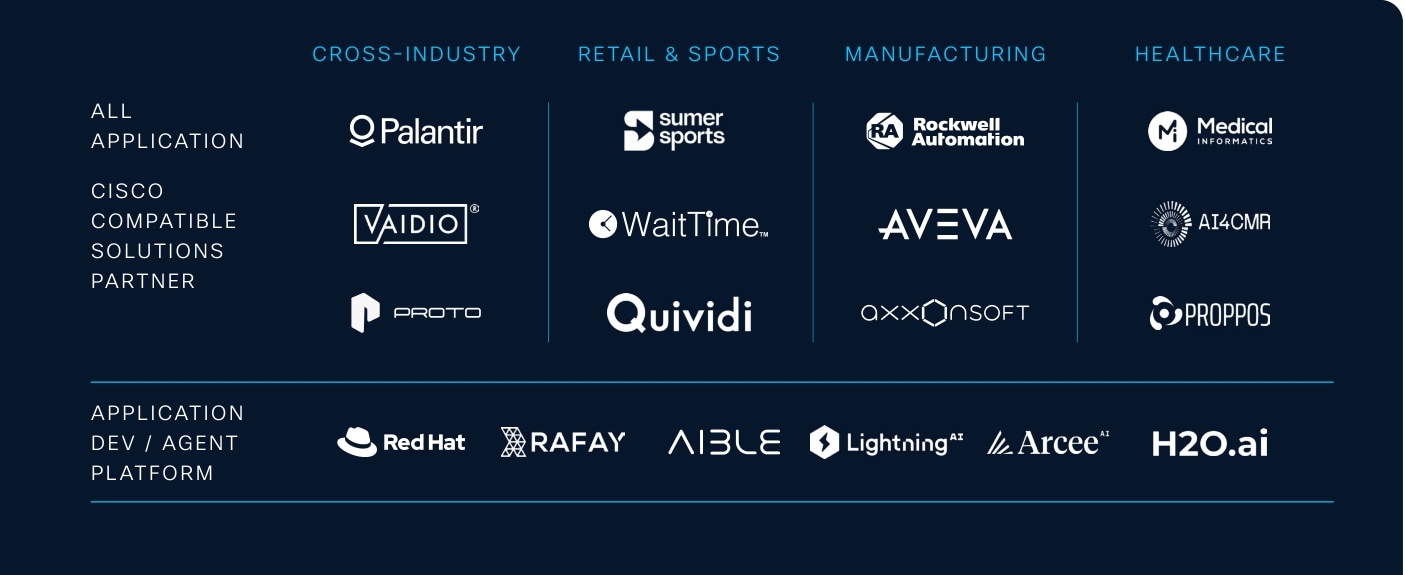
Cisco is transforming this experience through Cisco Compatible Solutions for AI, a curated ecosystem of independent software vendors (ISVs). We evaluate and test these partners on our infrastructure to ensure deployment confidence and accelerated time to value.
Cisco and Rockwell Automation integrate Rockwell’s manufacturing expertise with Cisco edge infrastructure to transform factory floors into intelligent, self-optimizing environments, enhancing operational outcomes at the edge.
Transforming retail and venue experiences with real-time crowd management and intelligent analytics, WaitTime leverages Cisco edge infrastructure to optimize customer flow and operational efficiency.
Sickbay uses Cisco edge infrastructure to collect and correlate bedside data, delivering real-time, augmented diagnosis systems that empower medical professionals with critical patient insights.
Security at the edge remains a critical vulnerability. AI at the edge places models, applications, and devices closer to both physical and cyber threats. Expanding attack surfaces, bolt-on security tools, and manual patch cycles make these sites attractive targets, while configuration drift across thousands of nodes silently weakens defenses. Cisco multilayered AI security capabilities help protect edge infrastructure, data, and AI models and agents across the enterprise, from devices to data centers.
Cisco Unified Edge
Trusted
Infrastructure
Physical Security
Security
Operations and
Observability*
Trusted Access*
Segmentation
AI Model Security*
Application protection
*Additional capabilities
Organizations deploying AI workloads at the edge face challenges from fragmented data silos across compute, network, and security layers, causing visibility gaps that lead to reactive troubleshooting, increased downtime, and stalled innovation. Disconnected infrastructure hinders the performance needed for modern AI models.
Splunk addresses these issues by transforming raw machine data into a unified, real-time intelligence layer. Integrated with Cisco Cloud Control, Splunk correlates cross-domain data at the source, enabling a shift from reactive monitoring to predictive observability. This allows for system resilience and resource optimization, and supports autonomous agentic operations at scale to meet evolving AI demands.

*Source: Where Should AI Live? The AI Infrastructure Report, Omdia, August 2026.