
About The Kraft Group
A diversified holding company, the Kraft Group’s family of businesses includes the New England Patriots and Gillette Stadium, along with ventures in manufacturing, real estate and other industries.
The Kraft Group needs technology to simplify delivery of its broadcast capabilities at Gillette Stadium and beyond.
A diversified holding company, the Kraft Group’s family of businesses includes the New England Patriots and Gillette Stadium, along with ventures in manufacturing, real estate and other industries.
To efficiently deliver world-class digital content at Gillette Stadium for all events on its busy, multi-use calendar, the Kraft Group needed to shift to in-house production.
Gillette Stadium provides an unforgettably smooth experience for potentially more than 60,000 guests at each event—supported by advanced, reliable technology:
Transitioning to an in-house broadcast model with minimal downtime has improved operational efficiency and control.
The stadium delivers premium content from the venue and can offer state-of-the art broadcast facilities to third-party partners.
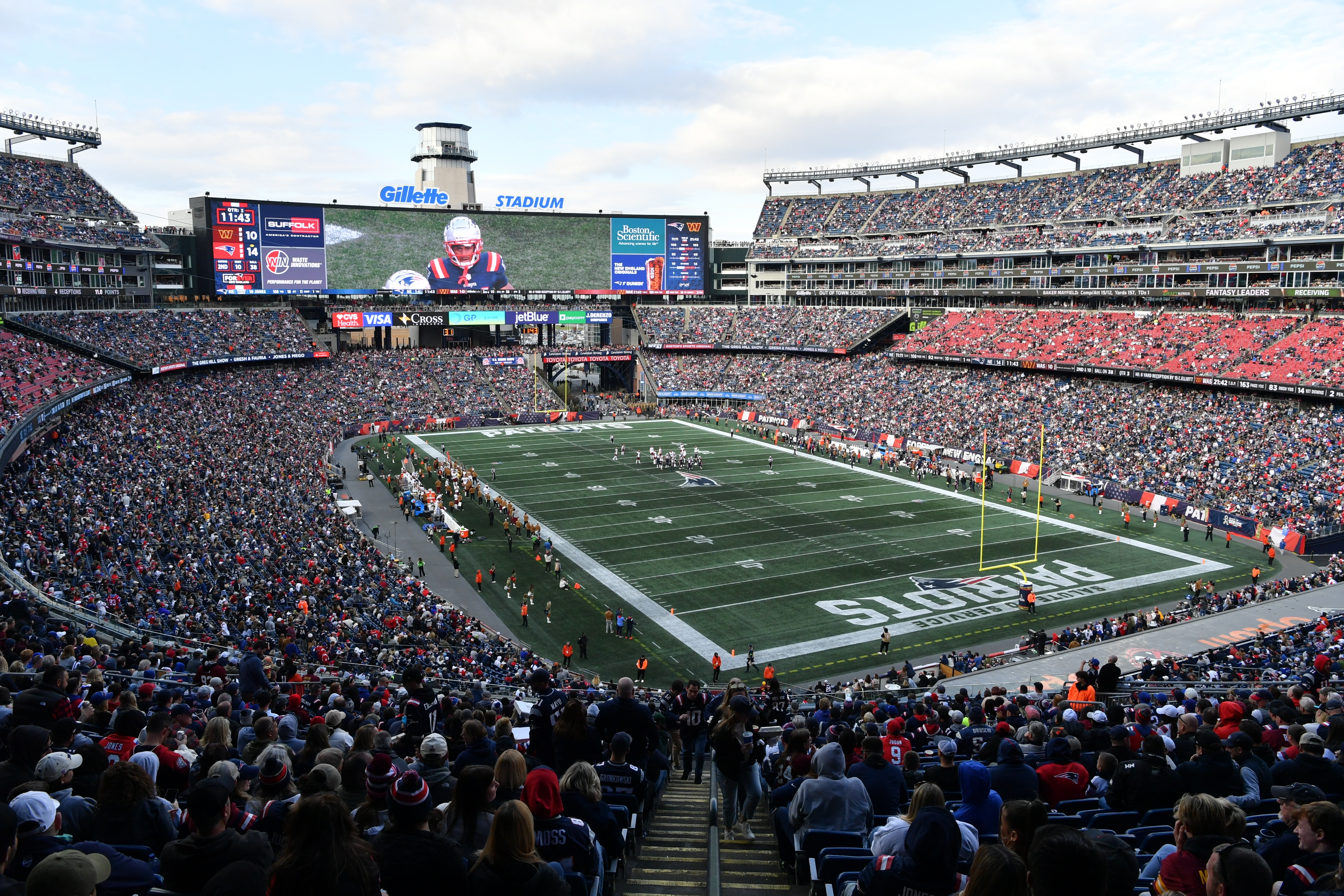
Gillette Stadium has the capacity to host more than 60,000 fans at every event it hosts, from New England Patriots home games to New England Revolution soccer matches, concerts, industry conventions, and more. The iconic venue is designed to deliver an unforgettable experience. The Kraft Group, with a robust family of businesses including Gillette Stadium, the Patriots and Revolution, approach each event with a commitment to entertain with no margin for error. Everything must function perfectly for those attending, performing, and working behind the scenes.
However, operating a multi-use, year-round stadium presents unique challenges. Complicating this, all of Gillette Stadium's events required the use of external broadcast trucks to produce content. "We had to bring in trucks for every event," says Michael Israel, Chief Information Officer of the Kraft Group. This arrangement required the stadium's IT teams to help set up individual broadcast pods throughout the facilities, over and over again for each event.
The Kraft Group is a diversified, family-owned company with a broad family of businesses that includes sports, paper and packaging, and real estate. Its corporate mission centers on building long-term business relationships and fostering a culture of continuous improvement. Upgrading Gillette Stadium's system or introducing innovations was inhibited by limited downtime, as the stadium is in near-constant use. Yet that outsourced, fragmented system was too inefficient to scale rapidly and ensure the premium experience that guests expect and demand.
"A smart stadium encompasses everything about entertainment for our guests, from entry to concessions. We are competing against your home, your couch, your TV," says Israel. For the modern consumer to want to leave their cozy, multi-screen entertainment rooms and come out for a stadium experience, every touchpoint needs to be frictionless and the live action on the field must be augmented by enhanced digital content.
To achieve these state-of-the-art ambitions, Israel's team needed to first reduce the friction in its own infrastructure. "One of the biggest challenges of the renovation was the need to bridge our core stadium business side with the broadcaster side," Israel said. "We wanted to consolidate everything on our IP environment. We decided it was time to build an in-house production facility."
Moving from an outsourced broadcast model to an in-house one required a reliable and scalable network foundation to support increased operational complexity while also ensuring high-quality content delivery. Israel and his team collaborated with Cisco Services and partner Acadia Technology Group to architect and implement what would become the largest technological infrastructure renovation in Gillette Stadium's 23-year history.
One challenge to this project loomed particularly large: timing. "Because of the nature of our stadium, we have very minimal downtime when our infrastructure isn’t being used for soccer, concerts, or football. We had to fit that renovation schedule in between these various seasons," says Israel. "Cisco Services helped us achieve our goal by planning properly, architecting properly, and getting things up and running. Most importantly, we were able to do this work and be ready for our football season right at its onset."
At the heart of this transformation is the Cisco IP Fabric for Media (IPFM) solution based on N9000 Series switches with Nexus Dashboard—technology that has powered the broadcast of additional prestigious sporting events across the world, including the FIFA Women's World Cup. For the Kraft Group, Cisco IPFM powers a content facility that, along with the Cisco Edge Intelligence solution, drives digital signage, Internet Protocol television (IPTV), and real-time operational controls, allowing Israel's team to produce 4K content in-house that can be broadcast anywhere in Gillette Stadium.
"We may have three hours during an event to entertain our guests, so the ability to spin something up quickly is critical for us," says Israel. "If we have, for example, a player appearance that wasn't scheduled, and all of a sudden we need to start up a pod in the stadium, the ability to just plug in and get it going—while we're still running an event—is critical." With this agility, he adds, "our teams can be anywhere in the stadium, can be engaging with us, and can move on the fly."
Simplification of the system provides additional agility. Cisco N9000 Series switches with Nexus Dashboard for automation and visibility provide a backbone for centralized management of IoT devices and A/V technologies on the network, including Gillette Stadium's north end videoboard, which holds the distinction of the largest curved-radius videoboard in the United States. "Whether it's audio, visual, IPTV, ribbon boards, or videoboard, all of this technology is now controlled over one common network and secured through our platforms in a way that hadn't traditionally been done before," says Israel.
This is a critical differentiator when there's more to manage. On a non-event day when only the Kraft Group's office staff is in the building, Israel's team may only have to manage traditional or AI-based business solutions. But when there's a full-stadium event with 3000 televisions viewed by more than 60,000 fans, his team must scale up quickly.
"We have to monitor that traffic, watch what's happening across the network, and at the same time, make sure we're delivering a safe and secure solution to our guests," says Israel. "It's a lot to do in a short period of time. The Cisco IPFM network, because of its standardization, allows us to distribute content throughout the stadium to all our stakeholders effortlessly, quickly, and crisply."
Israel relies heavily on Acadia and Cisco’s expertise and collaboration to ensure that issues are pinpointed, addressed, and resolved as rapidly as possible.
"Any deployment isn't going to just be about being connected; if it isn't protected, we can't even consider it," says Kevin Hynes, President of Acadia Technology Group. Cisco Secure Firewalls are deployed throughout the venue to protect the stadium, staff, players, and guests from advanced cyber threats. Cisco Secure Malware Analytics running across the broadcast network infrastructure helps monitor, detect, and stop threats in their tracks.
"When you think about the video going to the boards or video leaving the stadium, it better be secure, because if it isn't, we could have an incident that would be exponentially negatively impactful," says Hynes.
As a benchmark for innovation, Gillette Stadium is more capable than ever of delivering great experiences that fans will remember. Not only does the facility offer one of the most sophisticated broadcast setups in the country, it has also added this capability in a way that strengthens the Kraft Group's businesses.
"Cisco Services designed a fabric network for us that was implemented on time and on budget, but more importantly, now allows us to manage our own destiny," says Israel. "We're able to bring our operational costs down. We're able to spin up our control room whenever we need it without having to plan in advance. And we're able to bring these benefits to our third-party providers that come into the stadium. Whether we have concert promoters coming in or specific convention-type programs happening on a day-to-day basis, we're able to use that production facility to bring content out to these folks economically."
The Patriots coaching staff and players also rely on Webex throughout the week to connect with media, but it doesn't stop there. The Kraft Group plans to deliver extensive fan experience improvements leveraging AI, and also plans to extend its Cisco-powered network to a new player training facility.
"We're only at the beginning of what this network will be able to deliver to us," says Israel. “We work with Cisco weekly on looking at potential ways to bring new AI-based solutions into the network to deliver unique content, but more importantly, expand what our network will be able to do. While we really don't even know yet what the future holds, we're prepared for it."
Our customer stories transcend geography and sector to offer universal lessons in achievement.
Technology has changed how we live and work
Leading organizations are innovating with Cisco solutions to connect, secure, and transform.
Organizations like yours rely on Cisco
Each industry has its own challenges that require tailored solutions.
You are a changemaker, innovator, and discoverer
We want to help you share your story. Learn more about how you can build your organization's profile—and your own—as you expand your network.
Discover how Philips Stadium in the Netherlands uses smart tech, AR, and data to enhance fan engagement and security.
Discover Cisco data center networking solutions for secure, scalable, seamless connectivity across your entire organization.