Release Notes for UCC SMF, Release 2026.03.0
Available Languages
Bias-Free Language
The documentation set for this product strives to use bias-free language. For the purposes of this documentation set, bias-free is defined as language that does not imply discrimination based on age, disability, gender, racial identity, ethnic identity, sexual orientation, socioeconomic status, and intersectionality. Exceptions may be present in the documentation due to language that is hardcoded in the user interfaces of the product software, language used based on RFP documentation, or language that is used by a referenced third-party product. Learn more about how Cisco is using Inclusive Language.
- US/Canada 800-553-2447
- Worldwide Support Phone Numbers
- All Tools
 Feedback
 Feedback
Ultra Cloud Core - Session Management Function, Release 2026.03.0
Ultra Cloud Core - Session Management Function, Release 2026.03.0
This Release Notes identifies changes and issues related to the software release of 5G Converged Core Session Management Function (SMF).
The key highlights of this release include:
· In-service upgrades and high availability: Enhances system uptime and session continuity by enabling seamless software upgrades and node recovery across multi-server clusters with minimal service disruption.
· ULB integration for GTPC and PFCP traffic: Enhances network reliability and scalability by leveraging the ULB to intelligently distribute control-plane traffic, ensuring consistent performance and optimal resource utilization.
· Common charging IDs in roaming scenarios: Simplifies billing processes by maintaining consistent charging records across different networks, ensuring accurate and unified quota management.
· High uptime and session continuity: Introduces capability that ensures the services remain active and user sessions are preserved during software updates or system recoveries, providing a seamless experience for customers and maintaining high network reliability even at large scales.
· Automated power and performance optimization: Reduces operational costs by automatically optimizing energy consumption while ensuring the network maintains peak performance and service reliability.
· Standardized S-NSSAI mapping for roaming: Improves the reliability of roaming services by ensuring accurate network slice mapping, which prevents session failures and enhances interoperability between different mobile networks.
· Standardized session state reporting: Improves network reliability and 3GPP compliance by ensuring the AMF receives the correct session status during failed connection attempts, enabling better error recovery and more consistent service.
· WPS priority paging enhancement: Guarantees the successful delivery of high-priority services by dynamically updating paging requests to ensure critical calls receive the necessary network precedence.
· SCP model-D resilience: Enhances service continuity and network reliability by enabling seamless failover and optimized routing between critical network functions.
For more information about Ultra Cloud Core - Session Management Function, see the Related resources section.
Release lifecycle milestones
The following table provides EoL milestones for Cisco UCC SMF software:
Table 1. EoL milestone information for UCC SMF, Release 2026.03.0
| Milestone |
Date |
| First Customer Ship (FCS) |
23-July-2026 |
| End of Life (EoL) |
23-July-2026 |
| End of Software Maintenance (EoSM) |
22-Jan-2028 |
| End of Vulnerability and Security Support (EoVSS) |
31-Jan-2028 |
| Last Date of Support (LDoS) |
31-Jan-2029 |
These milestones and the intervals between them are defined in the Cisco Ultra Cloud Core (UCC) Software Release Lifecycle Product Bulletin available on cisco.com.
This section provides a brief description of the new software features introduced in this release.
Table 2. New software features for UCC SMF, Release 2026.03.0
| Product impact |
Feature |
Description |
| Software Reliability |
This release enhances SCP Model-D communication by supporting SBI binding headers for AMF, PCF, and CHF interactions. The SMF stores and uses binding information to improve routing, enable alternate NF selection during failover by SCP. |
|
| Software Reliability |
This release introduces ULB-based ingress and egress routing for GTPC traffic, enabling scalable traffic distribution. The enhancement optimizes control-plane traffic handling and supports efficient scaling in cloud-native deployments. |
|
| Software Reliability |
vSMF supports inclusion of the mapped S-NSSAI in PDU Session Establishment Accept messages for home-routed inbound roaming sessions. This enhancement ensures 3GPP-compliant NSSAI mapping, improves interoperability between visited and home networks, and prevents session activation failures caused by missing mapped slice information. No additional configuration is required. |
|
| Software Reliability |
This release introduces ULB-based ingress and egress routing for PFCP traffic, enabling scalable traffic distribution. The enhancement optimizes PFCP control-plane traffic handling and supports efficient scaling in cloud-native deployments. |
|
| Upgrade |
When a user roams between networks, both the visited and home SMF must use the same Charging ID for the PDU session. This prevents charging data fragmentation, avoids duplicate or mismatched records, and ensures accurate billing and quota management. The Charging ID acts as a session anchor, supporting both online and offline charging in converged deployments. |
|
| Upgrade |
Upgrade and resiliency for multi-server HA deployment in SMF
|
This feature helps maintain high uptime and session continuity by scaling the control plane across multi-server clusters. It enables the large-all deployment model to have node resiliency with minimal session loss using in-service software upgrades. This feature allows to upgrade or recover nodes with lesser disruption, supporting ongoing service availability at scale. |
| Software Reliability |
This feature optimizes energy efficiency for the control-plane workloads by automatically tuning BIOS, NIC, and CPU power settings using Intel ® Intelligent Power Management (IPM). This integration ensures the Cisco UCS clusters maintain peak performance while significantly reducing power consumption. This feature enables these savings through the SMI Cluster |
|
| Software Reliability |
This feature allows the network operators to configure a heartbeat skew to send heartbeat messages earlier than the negotiated interval for NRF interworking. It helps prevent NF suspensions due to network delay, improving reliability of SMF communication with the NRF. Command introduced: hearbeat interval seconds skew value |
|
| Software Reliability |
WPS priority paging enhancement
|
Ensures high-priority (WPS) calls receive correct network priority precedence by enabling the SMF to dynamically update or re-issue paging requests if an elevated priority is detected during an active paging procedure. Default setting: Enabled |
This section provides a brief description of the behavior changes introduced in this release.
Table 3. Behavior changes for UCC SMF, Release 2026.03.0
| Description |
Behavior changes |
| PDU session rejection for barred subscribers |
Previous Behavior: The SMF continued with PDU session establishment even if Operator Determined Barring (ODB) was active in the subscription data received from the UDM. New Behavior: The SMF now correctly enforces Operator Determined Barring. If the SessionManagementSubscriptionData received from the UDM includes the odbPacketServices attribute set to ALL_PACKET_SERVICES, the SMF will reject the PDU session establishment request. Customer Impact: This change ensures compliance with 3GPP standards and allows network operators to successfully restrict data services for specific subscribers via ODB, preventing unauthorized PDU session creation. |
| Handling incorrect display of metrics and EDR status |
For a PDU session established in 5G, if SMF receives a Modify Bearer Request while there is no active 5G-to-4G handover, SMF sends the MBR with a failure cause. Previous Behavior: The SMF sends the MBR with a failure cause the, however incorrectly pegs the stats "smf_gtpc_msg_stats" and "smf_service_stats" as Success. The EDR is also marked as Success. This displays incorrect status of the metrics and EDR. New Behavior: The SMF sends MBR with failure cause and correctly pegs the "smf_gtpc_msg_stats" and "smf_service_stats" metrics as failure with a reason "invalid_rat_type". The EDR is also marked as Failure. Customer impact: The metrics and EDR status are displayed correctly. |
| Change in timing for PDU session type comparison in SMF |
Previous Behavior: When processing a PDU session setup, the SMF compared the UE-requested PDU session type with the DNN-configured PDU session type after receiving the UDM subscription. If the types did not match, the PDU session setup was rejected at this stage. New Behavior: The SMF now performs the comparison between the UE-requested PDU session type and the DNN-configured PDU session type before interacting with the UDM. If there is a mismatch, the PDU session setup is rejected immediately, eliminating the need for further UDM interaction. This change streamlines the setup process, reduces resource usage, and prevents avoidable signaling with the UDM when the session types are incompatible. |
| SMF includes upCnxState=DEACTIVATED in 404 error responses during PDU session reactivation [CSCwj98519]
|
Previous Behavior: For an absent or cleared PDU session, SMF returned a 404 Context Not Found response when it received an SmContextUpdate request with upCnxState=ACTIVATING. The response did not include upCnxState=DEACTIVATED. New Behavior: For an absent or cleared PDU session, SMF returns a 404 Context Not Found response when it receives an SmContextUpdate request with upCnxState=ACTIVATING. The response now includes upCnxState=DEACTIVATED. Customer Impact: · Improves compliance with 3GPP TS 29.502. · Provides the AMF with the correct PDU session state during failed reactivation attempts. |
| UE-initiated release request forwarding without 5GSM cause in roaming
|
Previous Behavior: In roaming scenarios, when the vSMF received a UE-initiated release request without a 5GSM cause in the NAS message, it did not forward the UE NAS message to the hSMF. As a result, the hSMF responded with a failure because it expected the UE NAS message to be included during the UE-initiated release procedure, even when the 5GSM cause was absent. New Behavior: The vSMF now forwards the UE NAS message to the hSMF for UE-initiated release requests in roaming scenarios regardless of whether the NAS message contains a 5GSM cause. Consequently, the N16 message now includes the UE NAS message even when the 5GSM cause is not present, ensuring interoperability with hSMF implementations that expect the NAS message to be forwarded. |
| Enforcement of RFC-compliant HTTP/2 callback URL in SBI messages
|
Previous Behavior: The SMF accepted callback URLs from SBI peers where the full absolute URL (including scheme, authority, and path) was carried in the HTTP/2 :path pseudo-header. For example, a full URL like http://192.0.2.10/callbacks/v2/notifyUri/2097157/chargingNotification was accepted in the :path header. New Behavior: The SMF now accepts only the RFC-compliant path component in the HTTP/2: path pseudo-header. The host and port must be carried separately in the :authority header. If a request carries a non-conforming: path (i.e., includes scheme and authority), the SMF rejects the request and closes the stream. For example, the accepted :path would be /callbacks/v2/notifyUri/2097157/chargingNotification without the scheme and authority. |
This table lists the resolved issues in this specific software release.
Note: This software release may contain bug fixes first introduced in other releases. To see additional information, click the bug ID to access the Cisco Bug Search Tool. To search for a documented Cisco product issue, type in the browser: <bug_number> site:cisco.com
Table 4. Resolved issues for UCC SMF, Release 2026.03.0
| Bug ID |
Description |
| SMF does not send upCnxState attribute set to DEACTIVATED during PDU session reactivation. |
|
| Session with PDN type not matching DNN config is successful when UDM fails to respond to subscription fetch. |
|
| PDU/PDN setup: After subscription response, check ODB status and reject create if enabled. |
|
| Discovery response with multiple profiles priority, no capacity. |
|
| Unexpected URR ID was assigned by the SMF for session-level monitoring, resulting in the UPF not reporting usage for that URR. |
|
| SMF does DNS query for FQDN resolution of SEPP and SMF instance id from hSMF. |
|
| SMF sending local query to dns-server. |
|
| SMF Metric- udmEndpoint not coming in msg_status=“accepted” for N10. |
|
| SMF-monsub - unsent parameters from chf set -1. |
|
| smf service restart generic.nasEncodePduSessionReleaseRequest. |
|
| vSMF stalls roaming PDU Session Modification when home-side SEPP rejects the update. |
|
| vSMF fails to forward NAS message to hSMF when release cause code is missing. |
|
| vSMF release due to qos flow descriptor missing. |
This table lists the open issues in this specific software release.
Note: This software release may contain bug fixes first introduced in other releases. To see additional information, click the bug ID to access the Cisco Bug Search Tool. To search for a documented Cisco product issue, type in the browser: <bug_number> site:cisco.com
Table 5. Open issues for UCC SMF, Release 2026.03.0
| Bug ID |
Description |
| gtpc s11 pod go routine constantly showing high during longevity run post SMI upgrade. |
|
| Temporary idle-to-active procedure failures during CCG and SMI rolling upgrade. |
|
|
|
Multiple ipm-agent pods restarting with exit code 0 during longevity run. |
| S5/S11 CEPS degradation and GTPC-EP pod restart during CCG and SMI rolling upgrade. |
This section lists compatibility information of the Cisco UCC software products that are verified to work with this version of the UCC SMF software.
Table 6. Compatibility information for UCC SMF, Release 2026.03.0
| Product |
Supported Release |
| Ultra Cloud Core SMI |
2026.03.1.08 |
| Ultra Cloud CDL |
2.3.0 |
| Ultra Cloud Core UPF |
2026.03.0 |
| Ultra Cloud cnSGWc |
2026.03.0 |
This section provides information about the release packages associated with UCC SMF software.
Table 7. Software packages for UCC SMF, Release 2026.03.0
| Software Package |
Description |
Release |
| ccg-2026.03.0.SPA.tgz |
The SMF offline release signature package. This package contains the SMF deployment software, NED package, as well as the release signature, certificate, and verification information. |
2026.03.0 |
| ncs-6.4.8.3-ccg-nc-1.1.2026.03.0.tar.gz |
The NETCONF NED package. This package includes all the yang files that are used for NF configuration. Note that NSO is used for the NED file creation. |
6.4.8.3 |
| ncs-6.1.14-ccg-nc-1.1. 2026.03.0.tar.SPA.tgz |
6.1.14 |
Cloud native product version numbering system
The show helm list command displays detailed information about the version of the cloud native product currently deployed.
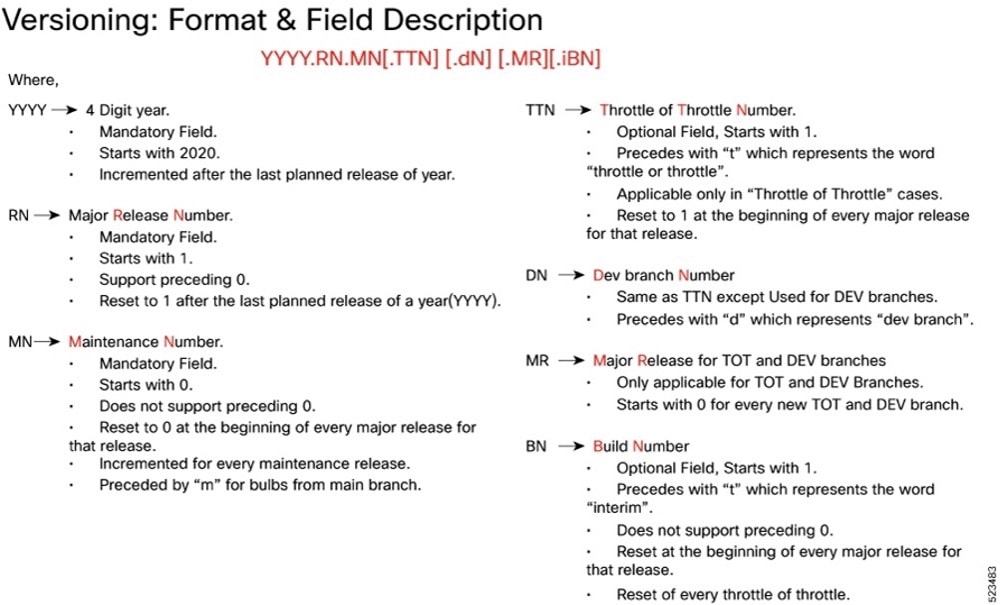
Image checksum information is available through Cisco.com Software Download Details. To find the checksum, hover the mouse pointer over the software image you have downloaded.
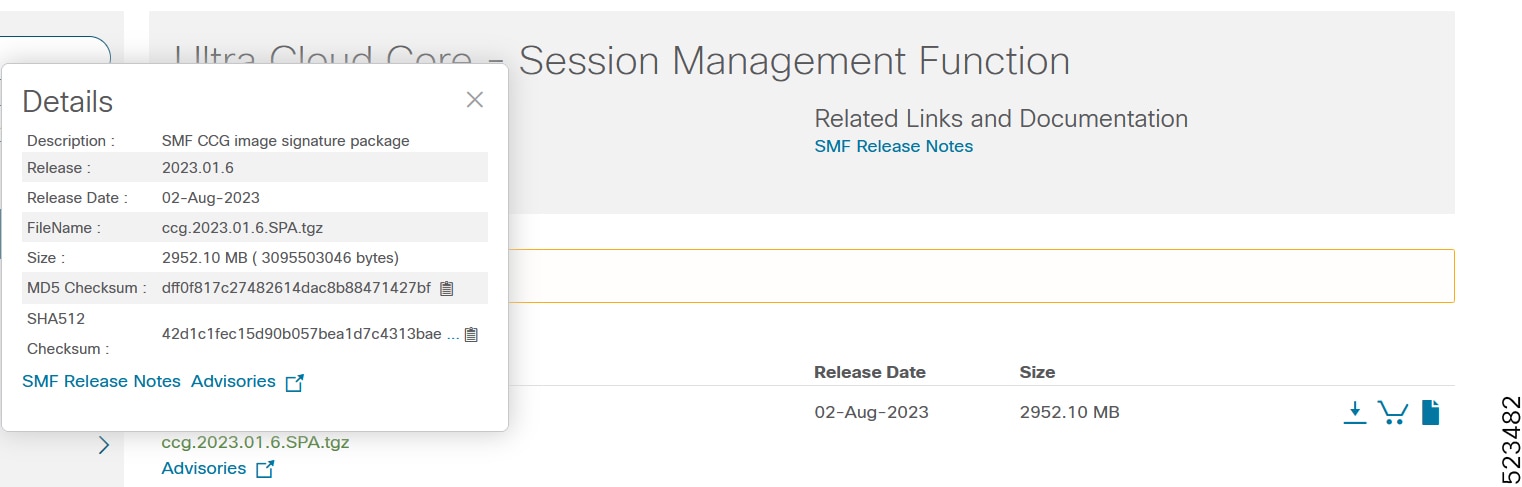
To validate the information, calculate a SHA512 checksum using the information in the following table and verify that it matches the one provided on the software download page.
To calculate a SHA512 checksum on your local desktop, see this table.
Table 8. Checksum calculations per operating system
| Operating System |
SHA512 checksum calculation command examples |
| Microsoft Windows |
Open a command line window and type the following command: > certutil.exe -hashfile <filename.extension> SHA512 |
| Apple MAC |
Open a terminal window and type the following command: $ shasum -a 512 <filename.extension> |
| Linux |
Open a terminal window and type the following command: $ sha512sum <filename.extension> OR $ shasum -a 512 <filename.extension> |
| Note: <filename> is the name of the file. <extension> is the file type extension (for example, .zip or .tgz). |
|
If the SHA512 checksum does not match, we advise you not to attempt upgrading any systems with the corrupted software image. Download the software again and verify the SHA512 checksum again. If there is a constant mismatch, please open a case with the Cisco Technical Assistance Center.
This table provides key resources and links to the support information and essential documentation for SMF and other Ultra Cloud Core (UCC) products.
Table 9. Related resources and additional information
| Resource |
Link |
| SMF documentation |
|
| cnSGWc documentation |
|
| SMI documentation |
|
| UPF documentation |
|
| Service request and additional information |
Cisco and the Cisco logo are trademarks or registered trademarks of Cisco and/or its affiliates in the U.S. and other countries. To view a list of Cisco trademarks, go to this URL: www.cisco.com/go/trademarks. Third-party trademarks mentioned are the property of their respective owners. The use of the word partner does not imply a partnership relationship between Cisco and any other company. (1110R)
Any Internet Protocol (IP) addresses and phone numbers used in this document are not intended to be actual addresses and phone numbers. Any examples, command display output, network topology diagrams, and other figures included in the document are shown for illustrative purposes only. Any use of actual IP addresses or phone numbers in illustrative content is unintentional and coincidental.
© 2026 Cisco Systems, Inc. All rights reserved.