Release Notes for UCC SMF, Release 2026.01.2
Available Languages
Bias-Free Language
The documentation set for this product strives to use bias-free language. For the purposes of this documentation set, bias-free is defined as language that does not imply discrimination based on age, disability, gender, racial identity, ethnic identity, sexual orientation, socioeconomic status, and intersectionality. Exceptions may be present in the documentation due to language that is hardcoded in the user interfaces of the product software, language used based on RFP documentation, or language that is used by a referenced third-party product. Learn more about how Cisco is using Inclusive Language.
- US/Canada 800-553-2447
- Worldwide Support Phone Numbers
- All Tools
 Feedback
 Feedback
Ultra Cloud Core - Session Management Function, Release 2026.01.2
Ultra Cloud Core - Session Management Function, Release 2026.01.2
This Release Notes identifies changes and issues related to the software release of 5G Converged Core Session Management Function (SMF).
The key highlights of this release include:
· Duplicate static IP detection on Attach over Attach PDU sessions: Enables RAT-aware IP conflict detection to prevent session rejections during 4G/5G transitions.
· Enhanced geo-redundant Lawful Interception: Ensures continuous regulatory compliance and data integrity across geographically distributed.
· Seamless 2G/3G and 5G interoperability: Allows legacy 2G/3G systems to work seamlessly with new 5G technology.
· Optimized NRF routing via custom API roots: Gives operators better control over where network traffic is sent, making it easier to manage complex or multi-vendor setups.
For more information about Ultra Cloud Core - Session Management Function, see the Related resources section.
Release lifecycle milestones
The following table provides EoL milestones for Cisco UCC SMF software:
Table 1. EoL milestone information for UCC SMF, Release 2026.01.2
| Milestone |
Date |
| First Customer Ship (FCS) |
30-Jan-2026 |
| End of Life (EoL) |
30-Jan-2026 |
| End of Software Maintenance (EoSM) |
31-July-2027 |
| End of Vulnerability and Security Support (EoVSS) |
31-July-2027 |
| Last Date of Support (LDoS) |
31-July-2028 |
These milestones and the intervals between them are defined in the Cisco Ultra Cloud Core (UCC) Software Release Lifecycle Product Bulletin available on cisco.com.
This section provides a brief description of the new software features introduced in this release.
Table 2. New software features for UCC SMF, Release 2026.01.2
| Product impact |
Feature |
Description |
| Software reliability |
Duplicate static IP detection on Attach over Attach PDU sessions |
This feature provides duplicate IP detection to be RAT-aware. The mechanism now restricts conflict detection to the same RAT type, preventing erroneous session rejection when users transition between 4G and 5G sessions. Command introduced: rat no-match and attributes session-type all — when both these commands are configured in the Event Management policy, the system rejects new session and releases the old session. |
| Software Reliability |
3GPP-compliant Lawful Interception support for geo-redundant deployments |
This support enables automatic replication of LI data across geo-redundant. For more information about this feature, contact Cisco account representative. |
| Software Reliability |
SMF supports 2G and 3G sessions over N7 and N40 interfaces with PCF and CHF. For Release 15 and Release 16 PCF/CHF, the SMF excludes unsupported attributes (for example, RAT Type and ULI) and does not include the UserLocationInfoTime information element when ULI is not present, ensuring backward compatibility. |
|
| Software Reliability |
The 3GPP-SBI-target-APIroot header lets operators set a target API root URI for registration, deregistration, subscription, unsubscription, update, and discovery messages. SMF includes this header in each HTTP request to NRF, ensuring requests reach the desired destination based on deployment needs. Command introduced: · profile message-handling nf-type nf_type { mh-profile mh_profile_name { service name type service_name_type { message type [ nf-register { header 3gpp-sbi target-apiroot api_root_uri } | nf-deregister { header 3gpp-sbi-target apiroot api_root_uri } | nf-update { header 3gpp-sbi-target-apiroot api_root_uri } | nf-status-subscribe { header 3gpp-sbi-target-apiroot api_root_uri } | nf-status unsubscribe { header 3gpp-sbi-target-apiroot api_root_uri } ] } } } — Used to configure the target API root URI for NF management messages. · profile message-handling nf-type nf_type { mh-profile mh_profile_name {service name type service_name_type {message type nf-discover {header 3gpp-sbi target-apiroot api_root_uri } } } }—Used to configure the target API root URI for NF discovery. Default Setting: Disabled – Configuration Required |
This section provides a brief description of the behavior changes introduced in this release.
Table 3. Behavior changes for UCC SMF, Release 2026.01.2
| Description |
Behavior changes |
| Incorrect PLMN_CH trigger in CHF update during inter-RAT HO [CSCwt35295] |
Previous Behavior: During an inter-RAT handover (HO), the SMF was incorrectly sending a CHF Update with a PLMN_CH trigger to the CHF, even when no actual PLMN change had occurred. New Behavior: The PLMN change detection logic has been corrected. The SMF now sends a CHF Update with a PLMN_CH trigger to the CHF only when a verified PLMN change is detected during an inter-RAT HO. Customer Impact: This correction eliminates unnecessary signaling to the CHF, leading to improved system efficiency and reduced load on the CHF. |
This table lists the resolved issues in this specific software release.
Note: This software release may contain bug fixes first introduced in other releases. To see additional information, click the bug ID to access the Cisco Bug Search Tool. To search for a documented Cisco product issue, type in the browser: <bug_number> site:cisco.com.
Table 4. Resolved issues for UCC SMF, Release 2026.01.2
| Bug ID |
Description |
| SMF |
|
| GeoPod TriggerGR takes more time when multiple etcd get operation timed-out |
|
| Add Retry mechanism to etcd Grant during setTTL. |
|
| PLMN_CH trigger getting armed for inter-RAT HO. |
|
| Debug message required when N16 update is suppressed. |
|
| Redirect URL sent from PCF is observed only in the FAR of the access side for 5G calls. |
|
| ConfigMap with null values seen as <no value> with scale config. |
|
| Upon session report with zero usage for online RG, CDR drop is not happening. |
|
| Incorrect BCM in Create PDP Context Response in SMF. |
|
| SMF does not handle create over create from different RAT (4G to wifi/5G). |
|
| IoT |
|
| Incorrect BCM in Create PDP Context Response in SMF. |
|
This table lists the open issues in this specific software release.
Note: This software release may contain open bugs first identified in other releases. To see additional information, click the bug ID to access the Cisco Bug Search Tool. To search for a documented Cisco product issue, type in the browser: <bug_number> site:cisco.com.
Table 5. Open issues for UCC SMF, Release 2026.01.2
| Bug ID |
Description |
| IoT |
|
| GSN Address format is not correct in Create PDP Context response in SMF. |
|
Compatibility
This section lists compatibility information of the Cisco UCC software products that are verified to work with this version of the UCC SMF software.
Table 6. Compatibility information for UCC SMF, Release 2026.01.2
| Product |
Supported Release |
| Ultra Cloud Core SMI |
2026.01.1.i08 |
| Ultra Cloud CDL |
2.1 |
| Ultra Cloud Core UPF |
2026.01.0 |
| Ultra Cloud cnSGWc |
2026.01.2 |
This section provides information about the release packages associated with UCC SMF software.
Table 7. Software packages for UCC SMF, Release 2026.01.2
| Software Package |
Description |
Release |
| ccg-2026.01.2.SPA.tgz |
The SMF offline release signature package. This package contains the SMF deployment software, NED package, as well as the release signature, certificate, and verification information. |
2026.01.2 |
| ncs-6.4.8.2-ccg-nc-1.1. 2026.01.2.tar.SPA.tgz |
The NETCONF NED package. This package includes all the yang files that are used for NF configuration. Note that NSO is used for the NED file creation. |
6.4.8.2 |
| ncs-6.1.14-ccg-nc-1.1. 2026.01.2.tar.SPA.tgz |
6.1.14 |
Cloud native product version numbering system
The show helm list command displays detailed information about the version of the cloud native product currently deployed.
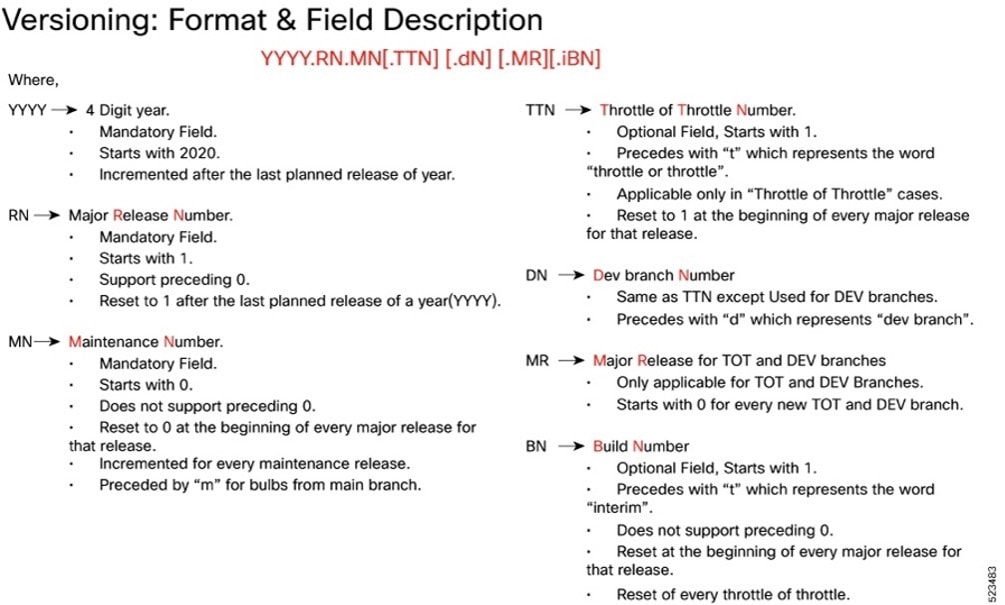
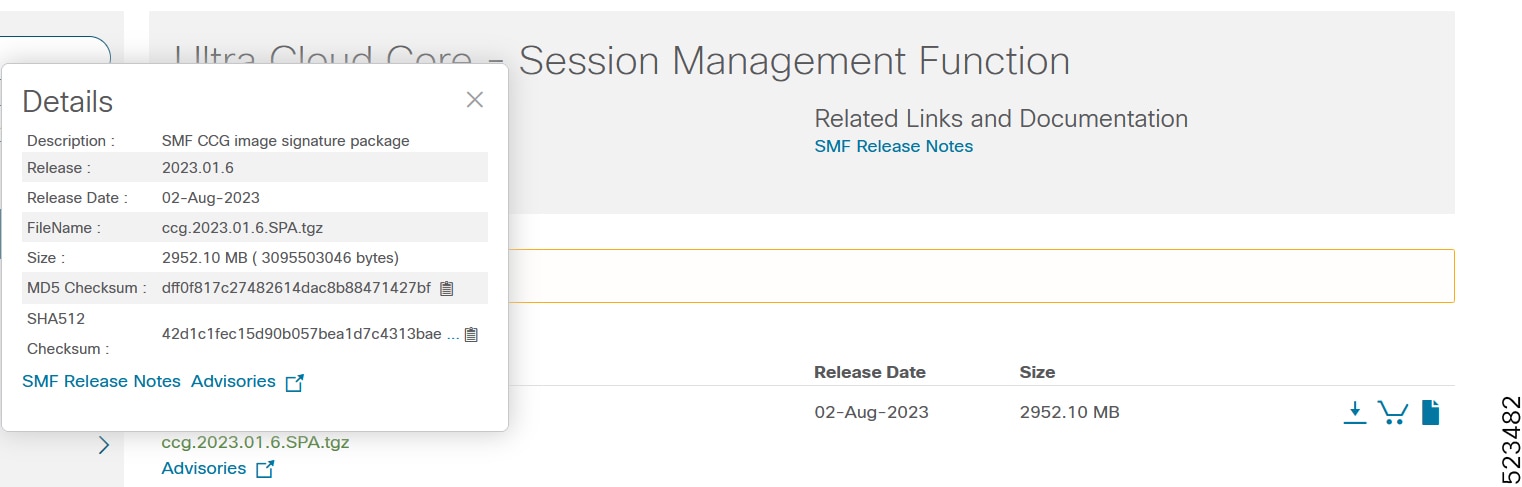
Image checksum information is available through Cisco.com Software Download Details. To find the checksum, hover the mouse pointer over the software image you have downloaded.
To validate the information, calculate a SHA512 checksum using the information in the following table and verify that it matches the one provided on the software download page.
To calculate a SHA512 checksum on your local desktop, see this table.
Table 8. Checksum calculations per operating system
| Operating System |
SHA512 checksum calculation command examples |
| Microsoft Windows |
Open a command line window and type the following command: > certutil.exe -hashfile <filename.extension> SHA512 |
| Apple MAC |
Open a terminal window and type the following command: $ shasum -a 512 <filename.extension> |
| Linux |
Open a terminal window and type the following command: $ sha512sum <filename.extension> OR $ shasum -a 512 <filename.extension> |
| Note: <filename> is the name of the file. <extension> is the file type extension (for example, .zip or .tgz). |
|
If the SHA512 checksum does not match, we advise you not to attempt upgrading any systems with the corrupted software image. Download the software again and verify the SHA512 checksum again. If there is a constant mismatch, please open a case with the Cisco Technical Assistance Center.
This table provides key resources and links to the support information and essential documentation for cnSGWc and other Ultra Cloud Core (UCC) products.
Table 9. Related resources and additional information
| Resource |
Link |
| SMF documentation |
|
| cnSGWc documentation |
|
| SMI documentation |
|
| UPF documentation |
|
| Service request and additional information |
Cisco and the Cisco logo are trademarks or registered trademarks of Cisco and/or its affiliates in the U.S. and other countries. To view a list of Cisco trademarks, go to this URL: www.cisco.com/go/trademarks. Third-party trademarks mentioned are the property of their respective owners. The use of the word partner does not imply a partnership relationship between Cisco and any other company. (1110R)
Any Internet Protocol (IP) addresses and phone numbers used in this document are not intended to be actual addresses and phone numbers. Any examples, command display output, network topology diagrams, and other figures included in the document are shown for illustrative purposes only. Any use of actual IP addresses or phone numbers in illustrative content is unintentional and coincidental.
© 2026 Cisco Systems, Inc. All rights reserved.