- About This Guide
- Cisco Voice Switch Service Module Introduction
- Cisco Voice Switch Service Module Description
- Configuring VoIP Switching Applications
- Configuring Switches for AAL2 Trunking Applications
- Configuring VXSM Features
- VXSM as a Signaling Gateway
- VXSM as a Transcoding Gateway
- Implementing Lawful Intercept on VXSM
- Configuring Lawful Intercept Support
- Loading and Upgrading VXSM Code Images
- VXSM Troubleshooting
- Media Gateway Clocking
Cisco Voice Switch Service Module Introduction
This chapter provides an overview of the Cisco Voice Switch Service Module (VXSM) and the organization of this document.
VXSM is a front card and back card set that operates in either a Cisco MGX 8880 or a Cisco MGX 8850 /PXM-45 chassis. There are three card sets that supports 4 OC-3 ports, 6 DS3 ports, and 48 T1 or E1 ports.
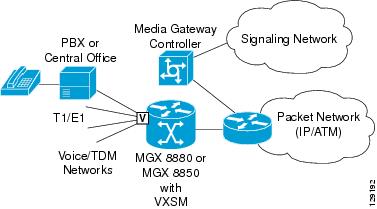
A Cisco MGX 8880 or Cisco MGX 8850 equipped with one or more VXSM card sets operates as a Media (Voice) Gateway. The voice traffic is carried on conventional time-division multiplexed (TDM) voice circuits, including modem and fax data that are transported over IP or Asynchronous Transfer Mode (ATM) packet-switched networks (Figure 1-1). Each VXSM card can be configured as one or more virtual media gateways.
Further, a VXSM card functions as an Signaling System 7 (SS7) signaling gateway and also as a media gateway.
Figure 1-1 MGX 8880 or MGX 8850 and VXSM as a Media Gateway
VXSM supports:
• Voice over IP (VoIP) switching applications
•Voice Trunking nonswitching applications
•Signaling gateway applications
•Transcoding applications
VoIP Switching Applications
In VoIP switching applications, VXSM operates in conjunction with the PXM-45c card, along with either of the following:
•RPM-XF card—Used when the packet network side supports IP traffic (for example, an Ethernet network).
•AXSM card—Used when the packet network employs ATM to carry IP traffic.
In these applications, voice traffic is switched between lines and trunks on the TDM and packet networks. The switching function is under the control of an external media gateway controller (often referred to as a call agent or softswitch). VoIP transmission of voice over a wide area packet network is often accomplished using an MPLS based network for routing the IP voice packets.
In this application, a VXSM Card can be configured to backhaul Q.931 (using RUDP or SCTP) layer 3 traffic to the call agent. VXSM card terminates layer 2 for Q.931 protocols.
Trunking, Nonswitching Applications
In trunking, nonswitching applications, VXSM operates in conjunction with PXM-45c and AXSM cards. Voice traffic is routed onto pre-provisioned ATM trunks according to pre-configured parameters. A media gateway controller is not used in this application.
Using up-to-date semiconductor technology and a bank of digital signal processors, each VXSM card can support the following example capacities:
•A four OC-3 card set supports up to 8064 DS0s with 50 calls per second and an average call hold time of 161 seconds.
•A 48 T1 card set supports up to 1152 DS0s with 13 calls per second and an average call hold time of 90 seconds.
•A 48 E1 card set supports up to 1488 DS0s with 17 calls per second and an average call hold time of 90 seconds.
The Cisco MGX 8880 and Cisco MGX 8850 chassis provide 12 card slots that are shared between any installed VXSM, AXSM, and PRM cards.
Applications for a VXSM equipped Cisco MGX 8880 or MGX 8850 include:
•Wireless or wireline tandem switch replacement or offload.
•ATM trunks between distributed mobile switching centers (MSCs) in wireless networks.
•Wireless and wireline aggregation over ATM trunks.
Signaling Gateway Applications
A VXSM card can be configured to provide the functions of a signaling gateway between SS7 and IP networks. Communication are be established between entities, such as Signaling End Points, on a SS7 network and Application Servers, such as a Media Gateway Controller, on an IP network.
Up to 16 DS0s on a VXSM card are configured as SS7 signaling lines on which signaling messages to and from the SS7 network using the Message Transfer Part (MTP) 1, 2, and 3 layers of the SS7 protocol stack. Received messages have the MTP3 component extracted and relayed onto the IP network using the M3UA, SCTP, and IP protocol stack. The interworking at the MTP3 level is performed by a Nodal Interworking Function (NIF).
Transcoding Gateway Applications
VXSM card can be configured to provide the functions of a transcoding gateway between two media gateways that are involved in a call using different bearer capabilities, such as different codec algorithms. The VXSM Transcoding channel operates only on IP packets.
Using This Guide
This guide provides a general description of the features and functions of VXSM and describes how VXSM can be configured for switching and nonswitching applications. VXSM commands are explained in detail.
Use this document with the Cisco Voice Switch Services (VXSM) Command Reference for MGX Switches and Media Gateways, Release 5.6.21.
In addition to the VXSM card, the configuration sections of this guide cover other components such as PXM-45c, AXSM, and RPM-XF cards in some detail. For a more complete description of these components, how to configure them, and how to use their commands, refer to:
•Cisco MGX 8850 Multiservice Switch Overview, Release 1.1.3
•Cisco MGX 8850 (PXM45/PXM1E), Cisco MGX 8950, and Cisco MGX 8830 Command Reference, Release 5.2
•Cisco MGX Route Processor Module (RPM-XF) Installation and Configuration Guide, Release 4
In addition to the command line interface, you can perform many management and configuration tasks using the Cisco Media Gateway Manager (MGM) and Cisco WAN Manager (CWM). For details, refer to Cisco Wide Area Network Manager User's Guide, Release 15. and the User Guide for Media Gateway Manager.
For the latest information on any of these products, refer also to the appropriate release notes.
 Feedback