
Overview of Cisco ISE instances on OCI
Cisco ISE on Oracle Cloud Infrastructure
Cisco ISE is available on Oracle Cloud Infrastructure (OCI) in two forms: Image and Stack. We recommend that you use the stack type to install Cisco ISE because this resource type is customized for ease of use for Cisco ISE users.
This figure shows an example of a deployment connected to Oracle Cloud.
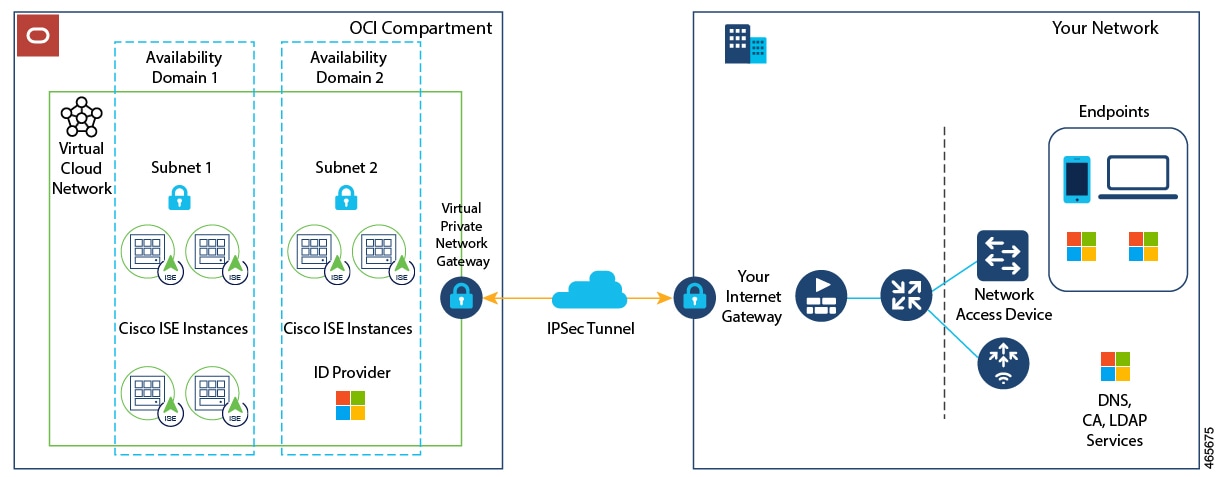
To configure and install Cisco ISE on OCI, you must be familiar with certain OCI features and solutions. Before you begin, understand compartments, availability domains, images, shapes, and boot volumes.
OCI uses Oracle CPUs (OCPUs) as its compute resource unit. One OCPU equals two vCPUs. For more information, refer to Oracle Cloud Infrastructure Documentation.
 Important
Do not clone an existing OCI image to create a Cisco ISE instance.
OCI instances supported by Cisco ISE
You can use these OCI instances with Cisco ISE.
| OCI instance type | OCPU | OCI instance memory (in GB) |
|---|---|---|
| Standard3.Flex This instance supports the Cisco ISE evaluation use case. 100 concurrent active endpoints are supported. |
2 | 16 |
|
Optimized3.Flex |
8 | 32 |
| 16 | 64 | |
| Standard3.Flex | 4 | 32 |
| 8 | 64 | |
| 16 | 128 | |
| 32 | 256 |
The Optimized3.Flex shapes are compute-optimized instances. They are best suited for use as PSNs for compute-intensive tasks and applications.
The Standard3.Flex shapes are general purpose shapes that are best suited for use as PAN or MnT nodes or both. These shapes are intended for data processing tasks and database operations.
If you use a general purpose instance as a PSN, the performance numbers are lower than that of a compute-optimized instance as a PSN.
The Standard3.Flex (4 OCPU, 32 GB) shape must be used as an extra-small PSN only.
From Cisco ISE release 3.5, Standard3.Flex instances with these configurations are not supported:
- 2 OCPUs and 16 GB memory
- 8 OCPUs and 64 GB memory
For information on the scale and performance data for OCI instance types, refer to the Performance and Scalability Guide for Cisco Identity Services Engine.