
Overview of Cisco ISE instances on Azure
Cisco ISE on Azure cloud
Cisco ISE is available on Azure cloud services. To configure and install Cisco ISE on Azure cloud, you must be familiar with Azure cloud features and solutions. Familiarize yourself with these Azure cloud concepts before starting:
- Subscriptions and resource groups
- Azure Virtual Machines. Refer to Instances, Images, SSH Keys, Tags, and VM Resizing.
Azure deployment methods
You can deploy Cisco ISE on Microsoft Azure using an Azure application or an Azure VM.
There are no differences in cost or Cisco ISE features when you deploy Cisco ISE using an Azure application or an Azure VM.
We recommend using the Azure application for these advantages it offers in comparison to the Azure VM:
- Azure application allows you to easily configure Cisco ISE-specific choices directly through its UI instead of a user-data field as in the case of Azure VM configuration.
- At the initial configuration of an Azure application, you can choose an OS disk volume ranging between 300 and 2400 GB. However, during the initial configuration of an Azure VM, you can change the OS disk volume to a fixed set of values provided in the Azure portal. You must carry out more steps after Cisco ISE installation and launch to reconfigure the virtual machine.
- You can directly choose from the specific Azure VM sizes that Cisco ISE supports.
- You can configure a static private IP address at the initial configuration.
You can use the Azure VM if:
- you do not use the Azure portal UI to deploy Cisco ISE.
- you need to use one of the additional settings that are available in the Azure VM configuration workflow.
This is an example of a deployment connected to the Azure cloud.
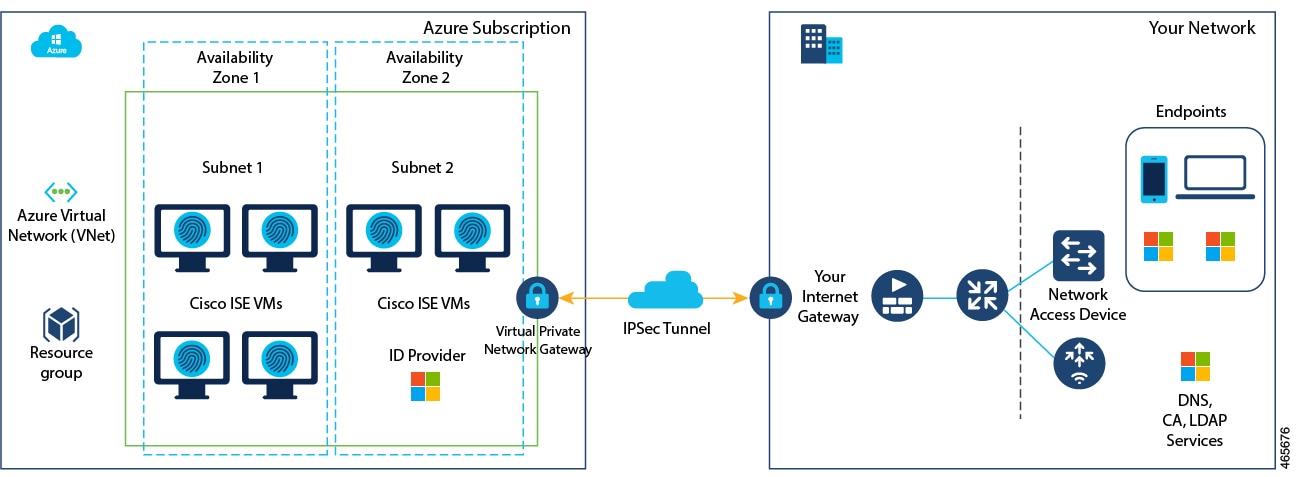
In addition to these deployment methods, you can also use Cisco Developed Terraform Script to install and automatically create multi-node Cisco ISE deployments on Azure.
 Note
NoteDo not clone an existing Azure cloud image to create a Cisco ISE instance.
Azure VM sizes supported by Cisco ISE
Cisco ISE can be installed by using one of these Azure VM sizes.
|
Azure VM sizes |
vCPU |
RAM (in GB) |
|---|---|---|
|
Standard_D4s_v4 This instance supports the Cisco ISE evaluation use case. 100 concurrent active endpoints are supported. |
4 |
16 |
|
Standard_D8s_v4 |
8 |
32 |
|
Standard_F16s_v2 |
16 |
32 |
|
Standard_F32s_v2 |
32 |
64 |
|
Standard_D16s_v4 |
16 |
64 |
|
Standard_D32s_v4 |
32 |
128 |
|
Standard_D64s_v4 |
64 |
256 |
From Cisco ISE release 3.5, Standard_D4s_v4 and Standard_D16s_v4 VMs are not supported.
The Fsv2-series Azure VM sizes are compute-optimized and are best suited for use as PSNs for compute-intensive tasks and applications.
The Dsv4-series are general purpose Azure VM sizes that are best suited for use as PAN or MnT nodes or both and are intended for data processing tasks and database operations.
If you use a general purpose instance as a PSN, the performance numbers are lower than the performance of a compute-optimized instance as a PSN.
The Standard_D8s_v4 VM size must be used as an extra small PSN only.
For information on the scale and performance data for Azure VM sizes, refer to the Performance and Scalability Guide for Cisco Identity Services Engine.
NoteMicrosoft may retire, restrict, or change the availability, reservation purchase, or reservation renewal support for Azure VM sizes over time. Cisco periodically updates the list of Azure VM sizes supported for Cisco ISE as Azure platform support and Cisco ISE cloud integration evolve.
Review the latest Microsoft Azure VM lifecycle and reservation guidance before deploying, resizing, or purchasing reservations for Cisco ISE on Azure.
The most recent Microsoft guidance indicates changes beginning July 1, 2026, affecting Reserved VM Instance purchases and renewals for certain VM series, including the Fsv2 series. This list includes Cisco ISE-supported VM sizes such as Standard_F16s_v2 and Standard_F32s_v2.
If you are replacing Standard_F16s_v2 or Standard_F32s_v2, which are no longer available for reserved instance renewals, Cisco strongly recommends using Standard_D32s_v4 as the alternative Cisco ISE-supported VM size. These instances remain available on a Pay-As-You-Go basis until Microsoft discontinues support.