Outgoing Trunk Group ID and Carrier ID for H.323 VoIP Networks
Available Languages
Table Of Contents
Outgoing Trunk Group ID and Carrier ID for H.323 VoIP Networks
Related Features and Technologies
Supported Standards, MIBs, and RFCs
Outgoing Trunk Group ID and Carrier ID for H.323 VoIP Networks
Feature History
This document describes the Outgoing Trunk Group ID and Carrier ID for H.323 VoIP Networks feature in Cisco IOS Release 12.2(2)XU. It includes the following sections:
•
Supported Standards, MIBs, and RFCs

Note
Feature Overview
The Outgoing Trunk Group ID and Carrier ID for H.323 VoIP Networks feature provides an enhancement to Registration, Admission, and Status (RAS) Admission Confirmation and Location Confirm messages. RAS messages now include a circuitInfo field that provides trunk group label or carrier ID information for remote endpoints (gateways) in H.323 networks. This feature also adds trunk group label and carrier ID support for the alternate endpoint field in the Gatekeeper Transaction Message Protocol (GKTMP) Response Admission Request (ARQ), Admission Confirmation (ACF), Location Request (LRQ), and Location Confirm (LCF) messages.
This feature allows a gatekeeper to specify a primary route-server trunk group as the destination to which a call is to be routed. The gatekeeper provides the IP address of the terminating gateway and the trunk group label or carrier ID of that gateway (in the circuitInfo field) to the requesting gateway. The GKTMP application server provides the trunk group label or carrier ID of the terminating gateway to the gatekeeper in the Response ARQ, ACF, LRQ, or LCF messages. The gatekeeper converts the trunk group ID or carrier ID information and sends it in the circuitInfo field of its RAS message to the requesting gateway.
The GKTMP application server may also provide a list of alternate gateways in the Response ARQ, ACF, LRQ, or LCF messages that the gatekeeper sends to the requesting gateway. The alternate gateway list includes a separate call signal address and circuitInfo field (trunk group label or carrier ID) for each alternate gateway. The gatekeeper removes identical alternate gateway routes from the consolidated alternate gateway list before sending the list to the requesting gateway.
Note
Figure 1 illustrates that this feature allows the gatekeeper in Zone 1 to receive routing information from the primary gateway, Gateway 2 in Zone 2, and from the alternate gateway, Gateway 3, also in Zone 2. The routing information is passed from the gatekeeper in Zone 1 to requesting Gateway 1.
Figure 1 Topology of Routing Between Zone 1 and Zone 2
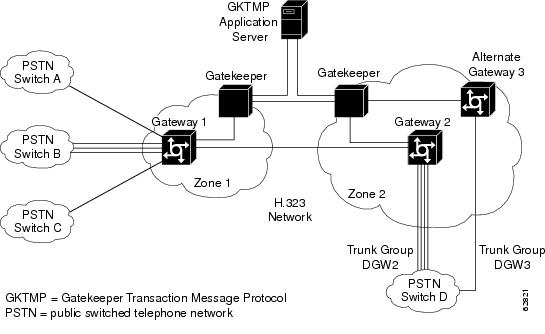
The RAS message includes a new field called circuitInfo. The information in the circuitInfo field corresponds to the information in the new Q and J tags in the GKTMP message. The trunk group label (Q tag) or carrier ID (J tag) of the primary gateway is provided in the alternateEndpoint structure of the GKTMP message, along with the call signal address of the primary gateway. The trunk group label or carrier ID of each alternate gateway is also provided in the alternateEndpoint structure of the GKTMP message. The Q and J tags of each alternate gateway are embedded inside the existing A-tagged fields of the GKTMP message, as shown in the following example:
A=c:{I:172.18.194.1:1720} J:CARRIER_IDA=c:{I:10.1.1.1:1720} Q:TRUNK_GROUP_LABELThe following is an example of a RAS message from a gatekeeper to a requesting gateway. (The gatekeeper has converted the information in the Q and J fields of the GKTMP message that it received from the GKTMP application server.) The RAS message contains two alternate endpoints, each of which has a circuitInfo field:
alternateEndpointscallSignalAddressipAddress :'AC12C826'Hport 1720circuitInfodestinationCircuitIDgroupgroup "CARRIER_ID"!callSignalAddressipAddress :ip 'AC12C816'Hport 1720circuitInfodestinationCircuitIDgroupgroup "TRUNK_GROUP_LABEL"
Note
Benefits
The gatekeeper can now send distinct circuit information for each alternate endpoint in the RAS ACF and LCF message, providing the gateway with more routing choices.
Restrictions
•
•
•
Related Features and Technologies
•
•
Related Documents
The following documents are available from the Cisco.com website:
•
•
•
•
•
•
Supported Platforms
Gateway
•
•
•
Gatekeeper
•
•
•
Supported Standards, MIBs, and RFCs
Standards
Cisco has submitted the following contribution to the ITU-T to add a new element in the Endpoint structure to forward circuit information for each alternate endpoint returned by the gatekeeper in the ACF message: "ITU-T SG16 Contribution AVD-2103: Circuit Information Signalling for Alternate Endpoints."
MIBs
No new or modified MIBs are supported by this feature.
To obtain lists of supported MIBs by platform and Cisco IOS release, and to download MIB modules, go to the Cisco MIB website on Cisco.com at the following URL:
http://www.cisco.com/public/sw-center/netmgmt/cmtk/mibs.shtml
RFCs
No new or modified RFCs are supported by this feature.
Prerequisites
•
•
•
Configuration Tasks
None
Configuration Examples
None
Command Reference
None
 Feedback
Contact Cisco
- Open a Support Case

- (Requires a Cisco Service Contract)