Configure 5G Non-Standalone Differential Online Charging
Available Languages
Contents
Introduction
This document describes how to configure Presence Reporting Area (PRA)-based differential charging for 5G Non-Standalone (NSA) deployments.
Prerequisites
Requirements
Cisco recommends that you have knowledge of these topics:
- PRA
- Mobility Management Entity (MME)
- Serving Gateway (SGW)
- Packet Data Network Gateway (PGW)
- Policy and Charging Rules Function (PCRF)
- Online Charging System (OCS)
- User Equipment (UE) mobility in 5G NSA Option 3x
- Dual Connectivity with New Radio (DCNR)
- Diameter Gx policy and charging procedures
Components Used
The information in this document is based on StarOS 21.28.x.
The information in this document was created from the devices in a specific lab environment. All of the devices used in this document started with a cleared (default) configuration. If your network is live, ensure that you understand the potential impact of any command.
Deployment Requirements
| Item | Requirement |
|---|---|
| MME PRA mapping |
MME can map the S1 user-plane (S1-U) Internet Protocol (IP) transport address of the 5G base station to a PRA identifier. |
| PGW PRA support |
PGW supports the PRA event trigger toward PCRF. |
| PRA identifier |
PCRF is configured with the same PRA identifier used by MME. |
| PCC rulebase selection |
PCRF can choose the required Policy and Charging Control (PCC) rulebase when the reported PRA status changes. |
Background Information
Purpose
PRA-based differential charging allows a 5G NSA deployment to apply different online-charging treatment when a subscriber moves between 4G and 5G coverage.
PRA represents an area in the 3GPP packet domain for reporting UE presence for policy-control or charging purposes. In this design, PRA state represents whether a DCNR UE is inside or outside the configured 5G coverage area.
Solution Overview
1. PCRF subscribes to the PRA event trigger.
2. PGW stores the PRA action and forwards the request toward SGW.
3. MME detects a 4G-to-5G or 5G-to-4G mobility event and maps the 5G base-station S1-U transport address to the configured PRA identifier.
4. MME reports the PRA status to SGW, and SGW forwards it to PGW.
5. PGW reports the PRA information toward PCRF.
6. PCRF changes the applicable PCC rulebase based on the PRA state.
7. The user plane applies the resulting charging and policy changes.
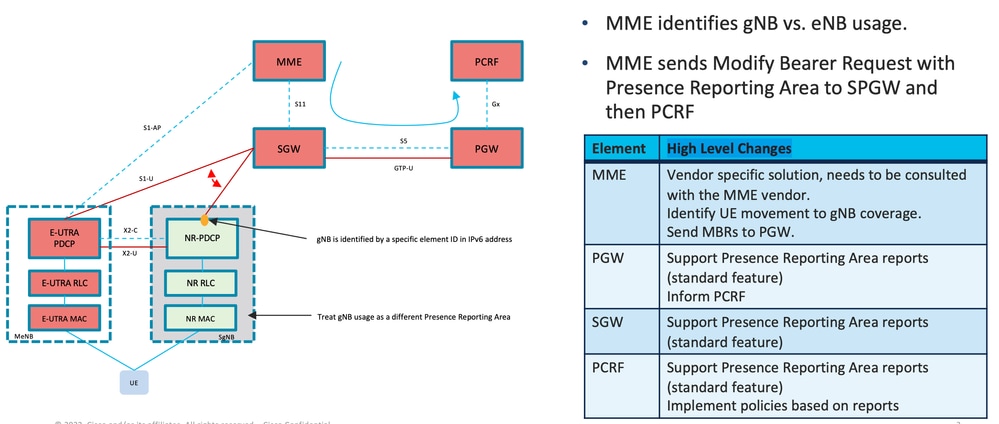 High level setup architecture
PRA Status
| UE Location | PRA State | Reported Status | Charging Result |
|---|---|---|---|
| Inside configured 5G coverage |
Inside PRA |
In area (0) |
PCRF chooses the configured 5G charging treatment |
| Outside configured 5G coverage |
Outside PRA |
Out of area (1) |
PCRF chooses the configured 4G charging treatment |
Mobility Flows
X2 Handover
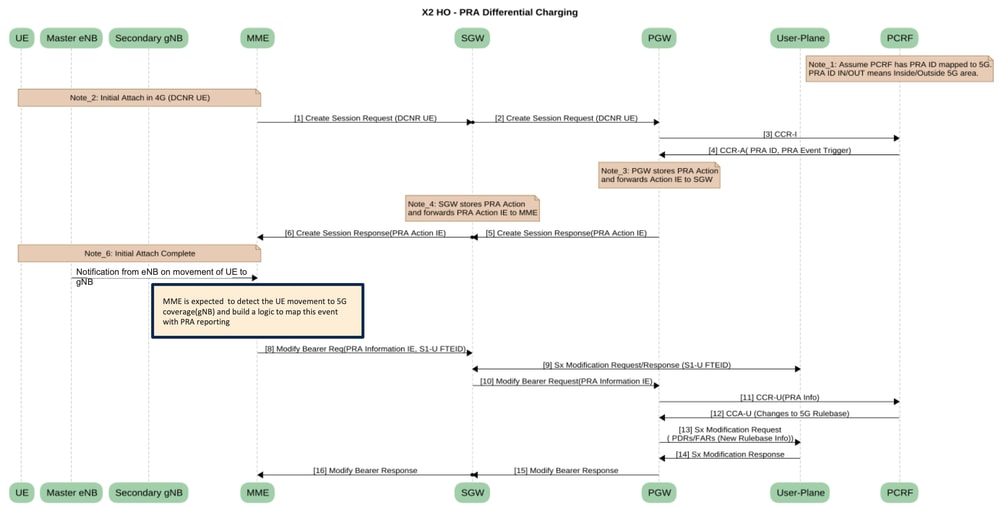 X2-HO – PRA Differential Charging
X2 Handover with SGW Relocation
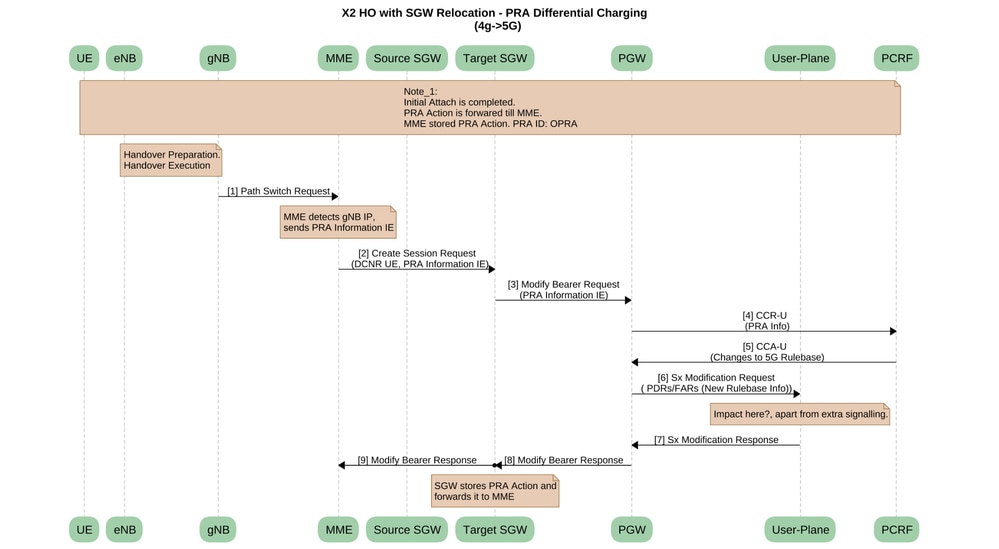 X2 HO with SGW Relocation - PRA Differential Charging (4g5g)
S1 Handover without SGW Relocation
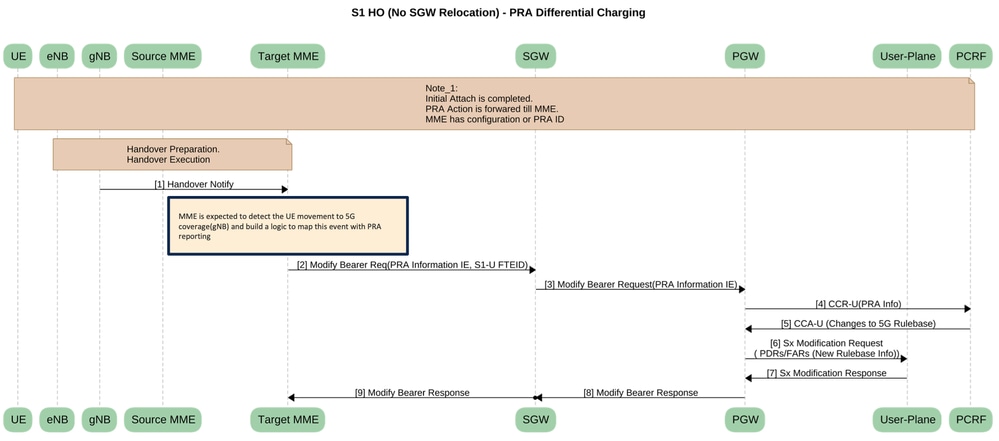 S1 HO (No SGW Relocation) - PRA Differential Charging
Gn/Gp Mobility toward PGW
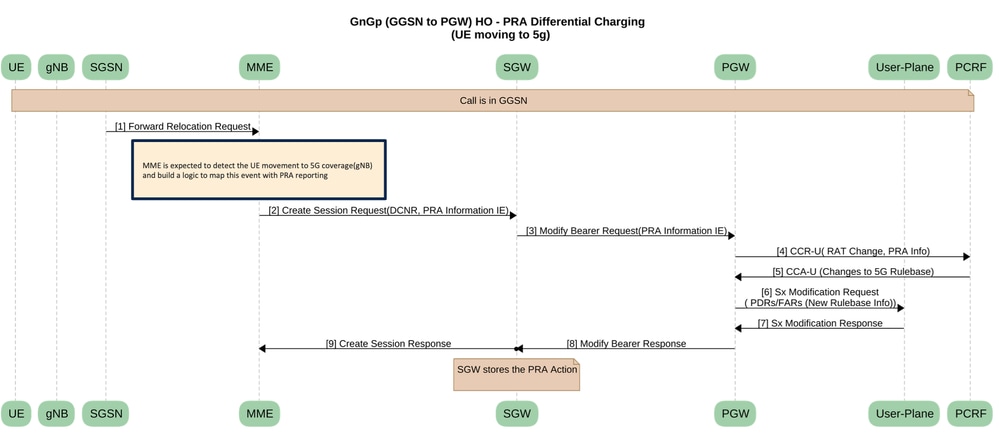 GnGp (GGSN to PGW) HO – PRA Differential Charging (UE Moving to 5g)
Before You Begin
Required Configuration Inputs
| Input | Required Value or Object |
|---|---|
| MME context |
Existing MME context name used by the target MME service. |
| MME service |
Existing MME service name that will be associated with the PRA profile. |
| PRA profile and identifier |
PRA profile name and PRA identifier. The identifier must match the value configured on PCRF. |
| 5G coverage prefixes |
gNB S1-U IPv4 and/or IPv6 prefixes that identify the configured 5G coverage area. |
| Gateway context and service |
Existing gateway context and IMS authorization service used for policy-control configuration. |
| Active charging service |
Existing active charging service name used for the 5G charging rule. |
| 5G charging objects |
Rule definition name, group-of-ruledefs name, priority, charging action, Rating Group, and rulebase name required by the charging design. |
| PCRF PRA handling |
Confirmation that PCRF is configured for the PRA event trigger and can choose the required PCC rulebase for the configured PRA state. |
Deployment and Impact Considerations
| Item | Requirement or Impact |
|---|---|
| Deployment type |
This solution applies to 5G NSA option 3x deployments. |
| Customization |
This solution is a customization rather than a globally deployed default configuration. |
| Validation |
End-to-end field validation is required before production enablement. |
| CCR-U signaling |
Frequent movement between 4G and 5G increases Credit-Control-Request Update (CCR-U) signaling. |
| Gx signaling |
Additional Gx signaling can increase PCRF processing load. |
| CUPS signaling |
Control and User Plane Separation (CUPS) deployments can generate additional Sx interface session modifications. |
| Flow transitions |
Rulebase changes can cause additional slow-path and fast-path flow transitions. |

Caution: Validate signaling volume, PGW/SGW capacity, PCRF capacity, and charging behavior in a representative test environment before broad production enablement.
Configure PRA-Based Differential Charging
Step 1. Configure the PRA Profile on MME
1. Enter Long-Term Evolution (LTE) policy configuration mode.
2. Create the PRA profile and assign the PRA identifier that matches the PCRF configuration.
3. Add the S1-U Internet Protocol version 4 (IPv4) or Internet Protocol version 6 (IPv6) prefixes that identify the 5G coverage area.
configure
  lte-policy
    pra-profile <pra_profile_name> <pra_id>
      gnb-s1u ipv6-prefix <ipv6_prefix_1>
      gnb-s1u ipv6-prefix <ipv6_prefix_2>
      gnb-s1u ipv6-prefix <ipv6_prefix_3>
    exit
end
Note: A PRA profile can contain up to 50 IPv4 subnets and 50 IPv6 subnets.
Step 2. Associate the PRA Profile with the MME Service
Associate the configured PRA profile with the target MME service.
configure
  context <mme_context_name>
    mme-service <mme_service_name>
      associate pra-profile <pra_profile_name> <pra_id>
endNote: Association or disassociation of the PRA profile does not restart the MME service.
Step 3. Enable PRA Reporting on the Gateway
Enable PRA information reporting in the gateway policy-control configuration.
configure
  context <context_name>
    ims-auth-service <service_name>
      policy-control
        diameter encode-supported-features cno-uli
end
The cno-uli feature token enables PRA information reporting. The diameter encode-supported-features command controls encoding and transmission of the Supported-Features Attribute-Value Pair (AVP).
Step 4. Configure the 5G Charging Rule
Create a separate Rating Group (RG) and charging rule for 5G usage. Use deployment-specific rule names and priorities.
configure
  active-charging service <active_charging_service_name>
    group-of-ruledefs <5g_group_name>
      group-of-ruledefs-application gx-alias
      add-ruledef priority <priority> ruledef <5g_ruledef_name>
    exit
    ruledef <5g_ruledef_name>
      ip any-match = TRUE
    exit
    rulebase <rulebase_name>
      action priority <priority> static-and-dynamic ruledef <5g_ruledef_name> charging-action <5g_charging_action>
    exit
end
Configure the 5G charging action with the RG required by the charging design. Use separate Rating Groups for 5G and 4G usage when required by the charging design.
Verify the Configuration
Step 1. Verify the PRA State from MME
| Mobility Event | Presence Reporting Check | Expected Status |
|---|---|---|
| UE moves into 5G coverage |
Inside presence reporting is True. |
In area (0) |
| UE moves into 4G coverage |
Inside presence reporting is False. |
Out of area (1) |
Step 2. Verify Gateway PRA Reporting
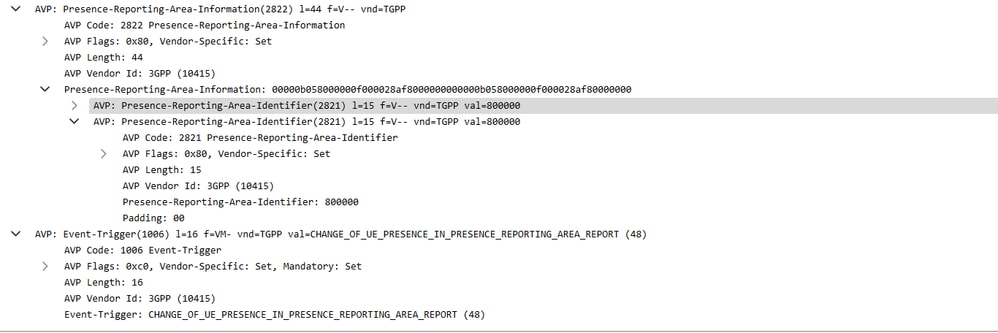
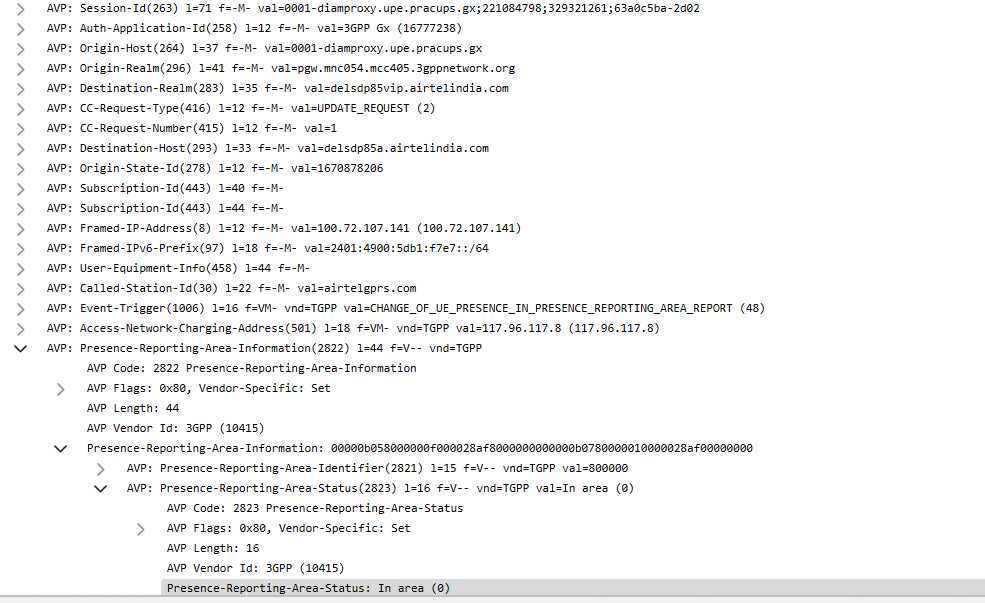
Confirm that gateway signaling contains the expected PRA information and that policy signaling toward PCRF reflects the configured PRA trigger.
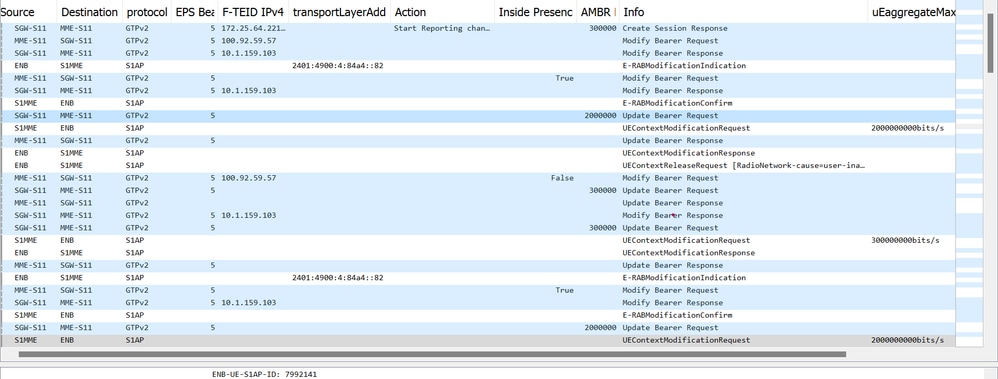
Step 3. Verify the Initial Credit-Control Exchange
Verify the applicable Credit-Control-Request Initial (CCR-I) and Credit-Control-Answer Initial (CCA-I) messages.
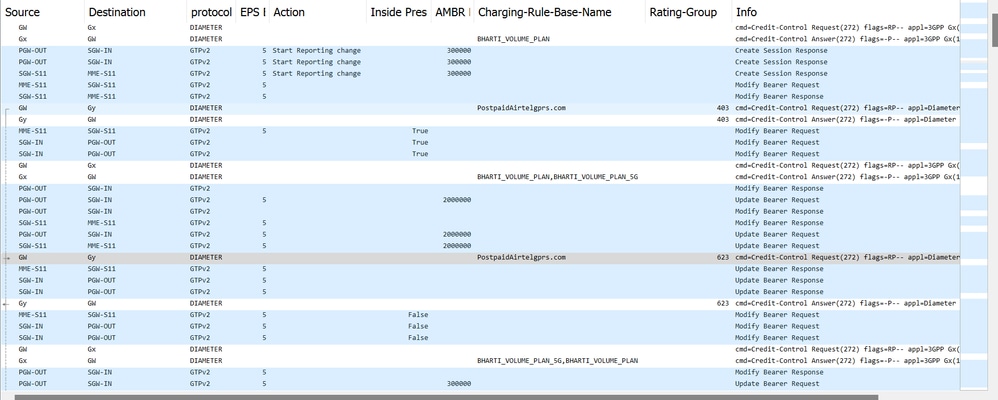 CCR-I
CCR-I
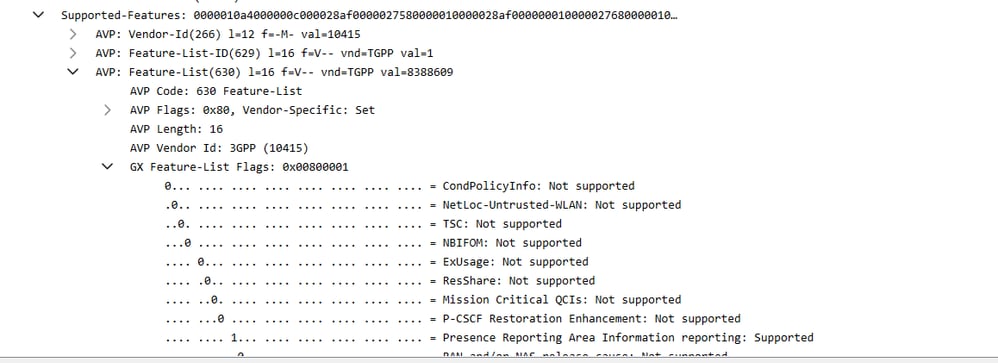 CCA-I
CCA-I
Step 4. Verify Differential Charging
1. Move the test UE into the configured 5G coverage area.
2. Confirm that the PRA state changes to In area (0).
3. Confirm that PCRF applies the configured 5G PCC rulebase and charging treatment.
4. Move the UE back to 4G coverage.
5. Confirm that the PRA state changes to Out of area (1).
6. Confirm that PCRF restores the configured 4G PCC rulebase and charging treatment.
Expected Behavior
| Event | Expected Result |
|---|---|
| UE enters configured 5G coverage |
MME reports PRA In area (0); PGW forwards PRA information to PCRF; PCRF selects the 5G charging policy |
| UE leaves configured 5G coverage |
MME reports PRA Out of area (1); PGW forwards PRA information to PCRF; PCRF chooses the 4G charging policy |
| UE repeatedly moves between 4G and 5G |
Additional CCR-U and policy-control signaling is generated as the PRA state changes |
Revision History
| Revision | Publish Date | Comments |
|---|---|---|
3.0 |
10-Sep-2026
|
Updated Content |
1.0 |
11-Aug-2024
|
Initial Release |

 Feedback
Contact Cisco
- Open a Support Case

- (Requires a Cisco Service Contract)