Unlocking the Sky: Cisco’s Airport Modernization Blueprint White Paper
Available Languages
Bias-Free Language
The documentation set for this product strives to use bias-free language. For the purposes of this documentation set, bias-free is defined as language that does not imply discrimination based on age, disability, gender, racial identity, ethnic identity, sexual orientation, socioeconomic status, and intersectionality. Exceptions may be present in the documentation due to language that is hardcoded in the user interfaces of the product software, language used based on RFP documentation, or language that is used by a referenced third-party product. Learn more about how Cisco is using Inclusive Language.
How digital infrastructure is shaping the future of aviation
The horizon of global travel is expanding at an unprecedented pace. By 2030, passenger traffic is projected to exceed a staggering 12 billion passengers annually, driven predominantly by explosive growth in the Asia-Pacific and Middle East regions.[21]
Dubai International Airport anticipates reaching 100 million passengers by the end of 2026,[4][5] Tokyo Haneda saw a 9% increase to 86 million passengers in 2024,[4] and New Delhi's Indira Gandhi International Airport is set to serve over 100 million annually within 2 years.[6]
This isn't just a forecast; it's a monumental opportunity and a challenge for the world's airports.
This white paper delves into how airports can navigate this complex, high-growth environment, transforming challenges into opportunities through strategic technological investments and exploring the critical strategies and technologies required to navigate this new era of aviation.
As a global technology leader with an unmatched presence across the world’s critical infrastructure, Cisco has the proven expertise to power and secure the largest, most complex assets. With a track record of successful airport deployments worldwide, Cisco’s vision for the future of aviation puts robust digital infrastructure at the core—enabling airports to deliver more efficient operations, enhanced security, and exceptional passenger experiences.
Consider the visionary scale of Changi Airport's Terminal 5 (T5) in Singapore, a multibillion-dollar endeavor that commenced construction in 2025, designed to boost annual capacity by 50 million passengers and significantly enhance the nation's tourism landscape by the mid-2030s and beyond.[23] Similar strategic expansions at Vietnam's Phu Quoc International Airport increased its tourism revenue by up to 43% annually prior to the pandemic,[24] while Thailand's 6 billion baht investment in Phuket International Airport is poised to generate 500 billion baht in tourism revenue in the late 2025/26 high season.[25] With aeronautical revenues—derived from essential services to airlines—accounting for a substantial 53.6% ($79 billion) of total airport revenue in 2023,[22] the imperative for airports to evolve is clear.
To meet this escalating demand and capitalize on new revenue opportunities, airports must prioritize operational excellence and end-to-end customer experiences. Enhancing efficiency in critical areas like check-in, security screening, and baggage handling is paramount.
Research indicates that optimized operations can boost overall efficiency by approximately 16%, slash wait times by up to 23%, and elevate customer satisfaction by 8% above current numbers.[7] This significant growth opportunity, driven by both passenger expectations and operational imperatives, can be fully unlocked only through advanced digital transformation.
The justification for airport modernization has never been clearer, including investments in digital infrastructure to support the capacity demand from growing passenger volumes and provide new and seamless passenger experiences that keep passengers returning to their chosen hubs or destinations.
Defining the airport of the future
Airports are no longer merely points of departure and arrival; they have evolved into dynamic hubs where passengers increasingly seek valuable experiences beyond the flight itself.[1]
More than just transit points, airports are powerful economic engines, acting as critical gateways that unlock new tourism revenue and fuel national prosperity.
Cisco’s vision for an airport is to provide seamless, secure, and memorable air travel experiences for passengers and to serve as a convenient commercial hub for nontravelers. It is designed to serve as the ultimate commercial experience center for all consumers, while also providing reliable, secure, and efficient services to airlines, passengers, nonpassengers, and retail and hospitality business owners. Additionally, it aims to simplify airport operations through focused automation, observability, and AI-driven solutions.
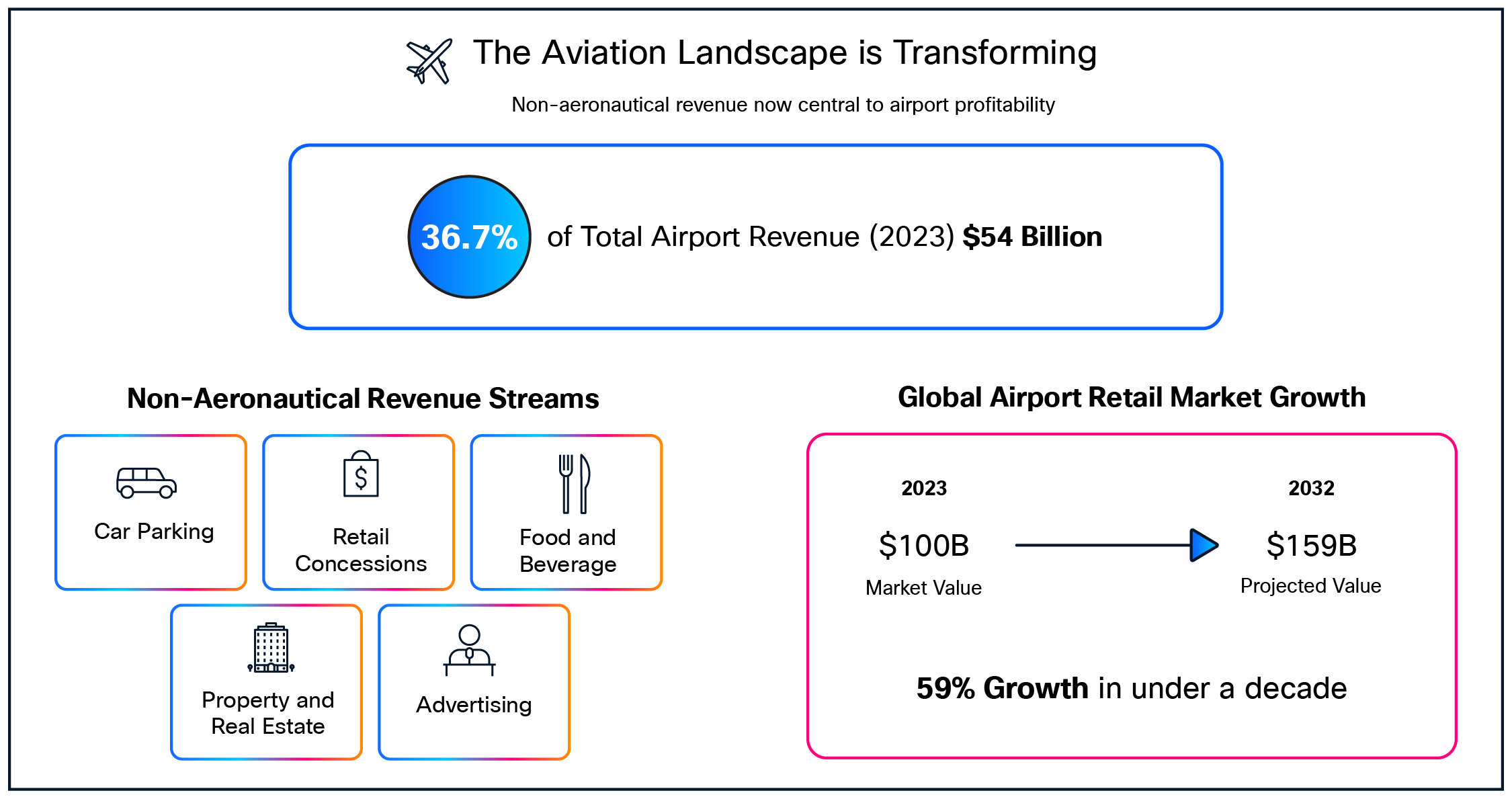
Non-aeronautical revenue for airports
As airports evolve into digital ecosystems, technology and robust digital infrastructure will serve as the foundation of this transformation—and Cisco can help.
“We want technology to anticipate and meet individual passenger needs, making experiences more enjoyable, efficient, and secure”
Passenger experience
Journey 360
Once upon a time, your airport journey began the moment you arrived at the terminal. Today, it kicks off right in your hand—on your device. Airports have evolved from mere transportation hubs into vibrant “experience centers” where the journey starts at home and flows seamlessly through every touchpoint.
Forget clearly delineated zones like airside, landside, and groundside. Now, interactions weave through all segments, blending physical and digital worlds. While airside remains the exclusive runway for planes and cargo, landside is buzzing with retail and services that must keep pace with growing foot traffic—both in person and online. Shopping is omnichannel, and convenience is king.
The magic? Digital airport infrastructure. It is the new gatekeeper, guiding travelers from the first tap to the final boarding call, unlocking endless opportunities for revenue and delight.
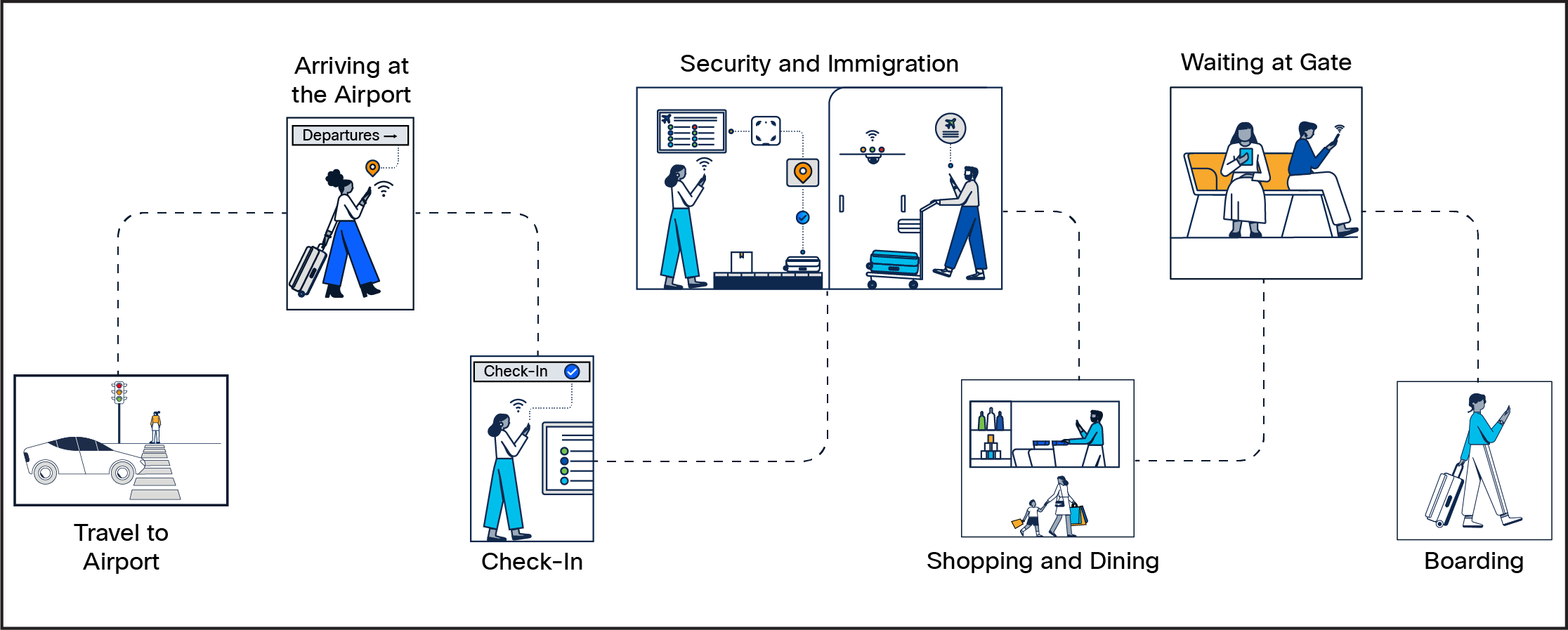
The customer experience involves constant management and handoffs between people, process, and technologies
People, process, and technology alignment
In an industry where passengers have more choices and higher expectations than ever, delivering a truly competitive customer experience requires a seamless integration of people, processes, and technology. Today’s travelers are digitally literate, well-informed, and accustomed to instant information and personalized service.
Airports must respond by designing processes that anticipate and address individual needs, empowering staff to use technology to provide proactive assistance and deploying advanced technologies that enhance every stage of the journey. Enhanced personalization—through tailored recommendations and services—ensures that passengers feel recognized and valued, while robust health, safety, and accessibility features foster trust and inclusivity. Real-time information delivered via digital signage and mobile devices puts guidance and updates directly in the traveler's hand, reducing uncertainty and stress. Meanwhile, emerging tools like Augmented Reality (AR) and Virtual Reality (VR) create new opportunities for engagement, from interactive wayfinding to immersive entertainment and retail experiences.
In this environment of fierce competition between airports, airlines, and destinations, only those that strategically triangulate people, processes, and technology will consistently deliver the cutting-edge passenger experiences that win loyalty and drive growth.
Elements of a digitized airport
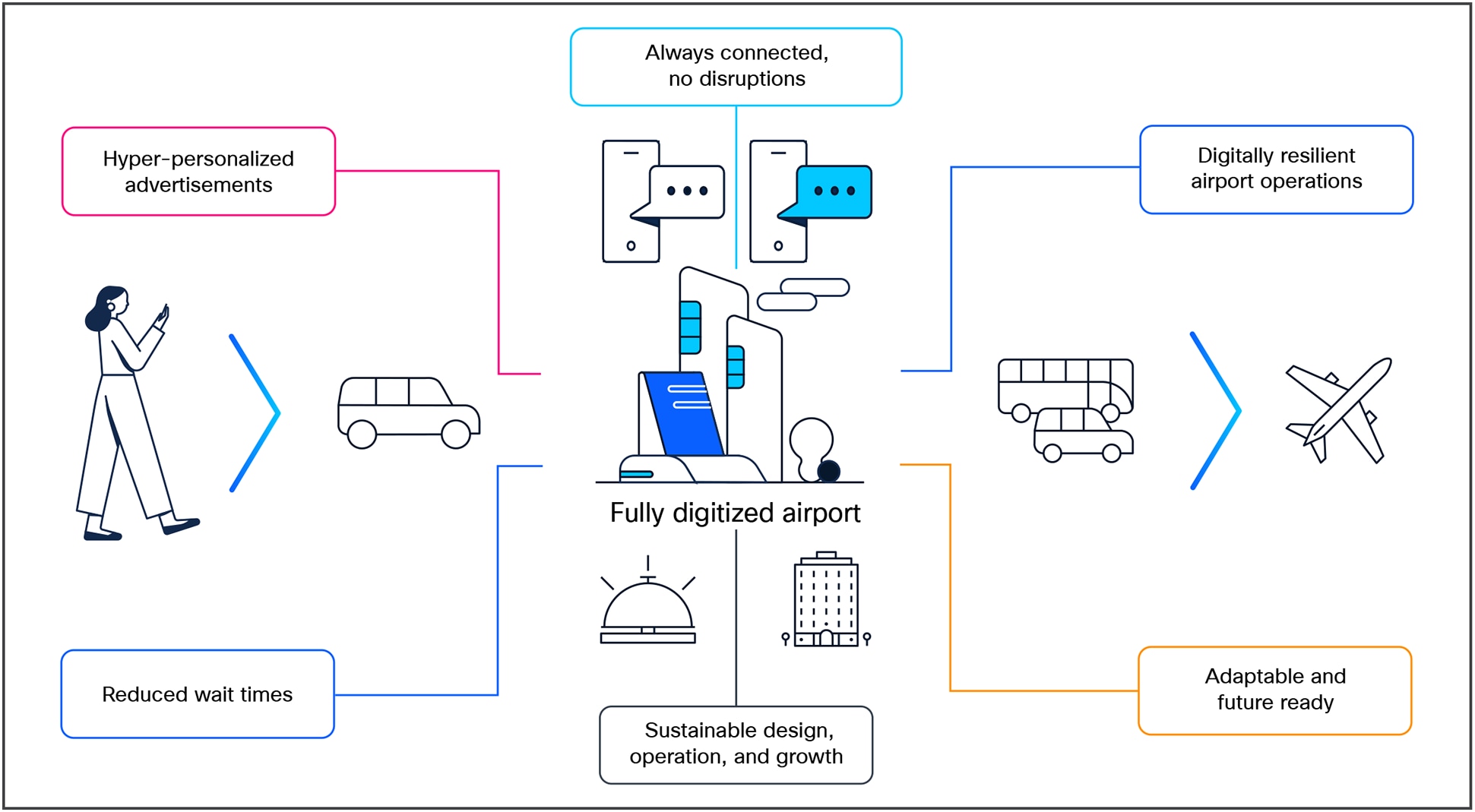
Elements of a digital airport
Hyper-personalized experiences
Harnessing the power of data enables airports to unlock new levels of personalization, operational efficiency, and revenue growth. Airports can drive growth by using passenger profiles to offer tailored, tiered experiences—including play areas for families, VR centers, or premium lounges—through a single application. These offerings can be adjusted based on spending patterns and user data, including dwell time, to enhance passenger satisfaction and revenue opportunities. Dynamic, flexible advertising platforms improve reach and effectiveness for both the airport and its partners. Parking is another key revenue and data collection source. Agentic AI systems can monitor and manage these utilities to boost efficiency and optimize costs. By analyzing data from user profiles and network infrastructure (e.g., access points), airports can understand passenger behaviors, enabling more targeted ads and offers for both operators and retailers.
For example, the Greater Toronto Airports Authority (GTAA) uses Cisco® Spaces to gain passenger insights based on location, context, and past preferences. This enables the airport to engage passengers in real time with promotional offers tailored to their current location within the airport. Additionally, GTAA aims to monetize its wireless network by offering sponsorship programs for brands seeking promotional visibility across the airport’s website, wireless portal, and passenger emails. This approach replaces the previous blanket advertising method with a more personalized and targeted experience, benefiting both passengers and airport vendors by increasing engagement and revenue opportunities.[11]
Reduced wait times
Airports today strive to eliminate passenger wait times at every turn—whether they are just setting out, using autonomous transport, checking in, going through security or customs, or boarding. This effortless journey is brought to life by a host of technologies: real-time traffic and wayfinding updates, crowd sensing, self-service kiosks with integrated visa readers, home baggage check-in, face-based contactless immigration, and digital boarding passes. With these innovations, passengers’ airport adventure is as seamless as possible.
Emerging innovations in airports include AI-driven baggage and customs inspections, advanced health screening technologies, intelligent queue management systems, digital signage for crowd density control, “buy and go” duty-free delivery services, and passport-free border controls. Adopting a digital-first approach enables continuous improvements in airport operations, supports on-time departures and arrivals, reduces passenger wait times, and creates additional discretionary time for travelers.
Aéroports de Montréal, encompassing Pierre Elliott Trudeau International and Mirabel International airports, exemplifies this transformation. In partnership with Wipro, Cisco implemented a secure, software-defined converged network architecture that supports touchless travel services such as biometric-enabled check-ins, self-service baggage drop-off, and AI-powered passenger assistance. This infrastructure modernization has enhanced operational efficiency and passenger experience, accelerating the airport’s recovery and readiness during the COVID-19 pandemic.
The network foundation supports new capabilities like touchless check-in kiosks, remote agent assistance, and zero-trust security, all contributing to a frictionless and “no wait” passenger journey.[10]
Always connected, no disruptions
To remain competitive and meet evolving passenger expectations, airports must prioritize investment in fully connected, high-speed, and observable digital infrastructure. Passengers increasingly demand seamless integration of airport amenities and services—from home-to-airport baggage delivery and accurate aircraft loading to AI-powered assistants that guide them to gates and deliver tailored retail experiences. Centralizing all services through a robust mobile application, supported by seamless wireless connectivity, is now essential.
Wayfinding, personalized advertisements, predictive recommendations, and real-time notifications enhance both convenience and satisfaction for travelers. They also enable timely communication from airlines about schedules and traffic, as well as personalized travel recommendations. Strategic investments not only streamline airport operations and ensure safety but also create a differentiated, superior traveler experience—driving long-term growth, increased passenger loyalty, and stronger stakeholder confidence.
The Cisco Spaces platform at the Greater Toronto Airports Authority enables location and context awareness to tailor passenger engagement and provide seamless Wi-Fi authentication, further enhancing the passenger experience by delivering timely, relevant information and offers based on passenger location within the airport.[11]
Sustainable design and operations
A focus on sustainability is an investment not just in the planet but also in operating cost reduction. For example, Power over Ethernet (PoE) can reduce energy costs by up to 52% compared to traditional AC-powered endpoints, according to industry estimates.[12] Sustainable materials (like polymers), renewable energy, and circular designs are critical to modern airport builds and also prepares buildings for increased power needs as demand for data and connectivity increase. For example, to reduce the carbon footprint of Changi’s T5 terminal, the terminal building will be equipped with solar panels, smart building management systems, and a district cooling system combined with thermal energy storage. It will also be ready for viable alternative fuels, including the use of sustainable aviation fuel, and for the provision of fixed ground power and cooling for aircraft parked at the gates.[26]
Sustainability in airports with Cisco infrastructure is achieved through the integration of converged networks, modern hybrid data centers, and energy-efficient backbone spine systems. Cisco promotes the concept of a "Smart Zero" network [27] that is circular in design, intelligent, secure, highly visible, resilient, privacy compliant, and energy efficient. Active monitoring of resource consumption is a critical metric when managing sustainability, and Cisco’s solutions enable airports to reduce energy consumption, optimize operations, and support smart building initiatives, all while maintaining high security and operational resilience.
Digital resilience
Cybersecurity is essential for airports to ensure resilient, low-risk operations. Infrastructure should be adaptable and prepared for both cyberattacks and unexpected events. Adopting a zero-trust architecture—by eliminating implicit trust and continuously monitoring access—reduces risk, minimizes the attack surface, and limits the impact of breaches.
Cisco’s technology is secure by design. Unparalleled observability solutions like Splunk®, Cisco ThousandEyes®, and AppDynamics® can capture and correlate all the relevant data in an airport environment, and Cisco Software-Defined Access (SD-Access) can incorporate this data to provide zero-trust access across the endpoints connecting to the airport. Cisco Secure Access provides secure internet connectivity for all guests, passengers, airport operators, and services. Cisco, Wipro, and Google have teamed together to provide one of the most secure airport infrastructures to a renowned Middle East airline.[15] Complemented by agentic AI systems that can analyze vast amounts of data in real time, Cisco’s solutions optimize resource allocation for various airport functions, such as baggage handling, security screening, and crowd management. By using predictive analytics, agentic AI can anticipate passenger flow, adjust staffing levels, and manage flight schedules more effectively, thus reducing risk to business-as-usual processes and improving cyber resilience.
Evolving with emerging innovations
Leveraging automation and augmenting the workforce with advanced technologies are essential for streamlining complex airport operations, enhancing efficiency, and enabling staff to focus on higher-value tasks.
Airports involve a lot of manual intervention for processes like immigration and baggage services. The same applies to gate assistance, aircraft readiness, and other operations that require coordination by people. One critical aspect the airport business will be investing in is the ability to automate some of these operations to achieve cost efficiencies. Integration with Airport Collaborative Decision-Making (ACDM) systems and processes is paramount, and the introduction of AI in such scenarios makes the process much simpler to execute.
With the increase in data and telemetry, airport owners need to be able to monetize this incredible asset. “Smart” aircraft readiness mechanisms, baggage reclaim, aircraft cleaning, etc. all rely on continuous uptime and data accuracy to provide operators with the best insights for decision making. Investment in AI-ready infrastructure is a solid starting point, with basic applications and workloads performing inferencing to begin with and expanding to fine-tuning use case-specific models in the future. Inserting agentic AI systems complemented with digital twin technologies into airport operations and collaborative decision making can provide the capability to run simulations involving various analytics and enforcement software on the digital twin to identify possible reactions to the triggers, instead of running them in production.
The return on investment for AI is highest when applied to processes that benefit from rapid, intelligent decision making—especially those processes that are manual or have only basic automation. Investing in AI-driven operations improvements and AI-ready infrastructure will be critical for airport owners.
A transformation framework for airports
The Airport Transformation Framework is a core component of the Modernization Blueprint, highlighting two equally important parts: business outcomes and technology capabilities. This framework was developed to bridge the broader airport vision with measurable business outcomes, and to identify the technology enablers necessary to achieve that vision. Drawing on insights from various airport transformation initiatives, Cisco believes that an airport’s vision should be to become an extraordinary commercial hub that is both reliable and resilient.
Business outcomes for airport owners
To achieve this broader vision, airport owners and operators should focus on key business drivers. The important business drivers are primarily to enhance operational efficiency, to maintain business continuity with limited risk, and in turn to invest in providing a seamless, convenient passenger experience. Cisco’s vision for airports supports these goals.
Driving revenue growth: Leaders must ensure strong returns for investors by adopting robust investment strategies focused on technology modernization and continuous improvement. Airports need to evolve with changing consumer demands by digitizing and automating revenue streams, modernizing infrastructure to enhance operations, mitigating investment risks, and elevating customer experiences. These efforts collectively drive sustainable revenue growth and operational resilience and efficiency. Airport owners must also balance aviation- and non-aviation-related revenue streams to ensure a sustainable and scalable business model.
Maintaining business continuity: A comprehensive airport risk management plan must cover all operations, emphasizing strong business continuity and adaptability, as highlighted by the COVID-19 pandemic. Cyberthreats such as ransomware, phishing, supply chain attacks, and unauthorized access pose significant risks to airport infrastructure, potentially disrupting operations, exposing sensitive data, and endangering public safety. For instance, in October 2022, major U.S. airports including Atlanta, Chicago, Los Angeles, New York, Phoenix, and St. Louis experienced Distributed Denial of Service (DDoS) attacks on their public websites, attributed to the threat group KillNet.[8] In 2025, a string of cyberattacks crippled the European airports.[9] Zero trust by design is a key principle driving secure, resilient, and reliable airport transformations.
Enhancing operational efficiency: An airport has multiple segments working hand in hand, and orchestrating and integrating these into an efficient pattern leads to better operations and increased revenue. The same applies across landside and airside operations. Efficiency is derived from clear, observable, and secure systems. Airport terminal service segments greatly benefit from autonomous operations when augmented with agentic AI that integrates with multiple channels (omnichannel integration), which is what owners and operators will be expecting in the near future. Streamlining and converging digital assets not only greatly improves the ability to control and manage your digital infrastructure but also leads to cost-saving efficiencies.
Emerging technology enablers
As airports navigate rapid digital transformation, adopting emerging technologies like AI, integrated data platforms, and quantum-safe security is essential for future-proofing operations and unlocking new value in the aviation ecosystem. Here we explore three core enabling technologies that Cisco believes will be transformative for the aviation industry.
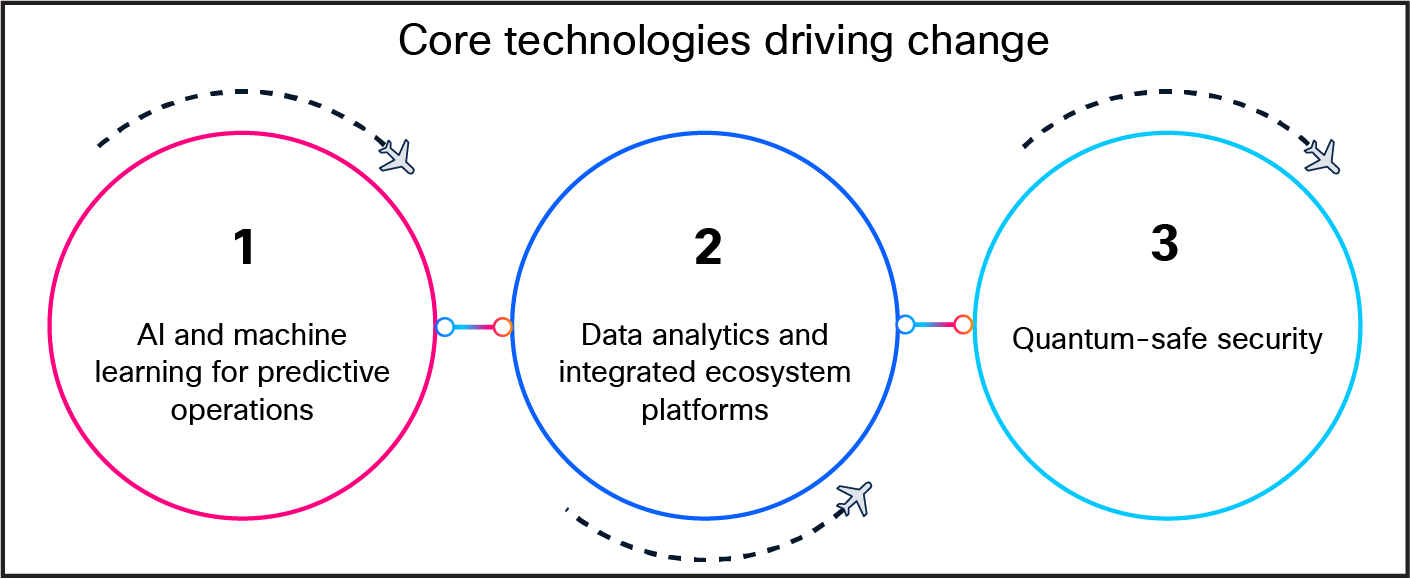
Core technologies driving change
Artificial intelligence and machine learning for intelligent operations and smart retail
As data and telemetry proliferate, airports face a crucial imperative: to effectively monetize this invaluable asset. This means understanding their key AI use cases, identifying strategic priorities, and making the best investments for the AI era. It is fair to assume that most modern technical initiatives, including robotics, autonomous cars, and smart devices, will be driven by artificial intelligence. A solid starting point is investing in AI-ready infrastructure. Initially, airports can deploy basic applications for inferencing and gradually expand to fine-tuning more specific models. AI workloads will need high-performance computing and high-speed networks. These advanced capabilities can then be offered as a service to both airlines and consumers. Already, innovations like AI-driven wayfinding, digital concierges, and AI-powered inventory management are tangible use cases for airports and airlines. Looking ahead, autonomous agents or agentic AI will transform how consumers and airport operators interact with their environment. Advanced analytics will leverage all available data to create detailed customer profiles, enabling hyper-personalized marketing.
Beyond data consumption and intelligent processing, AI is fundamentally reshaping business and security operations. By providing AI-driven insights into specific triggers and an unparalleled ability to process historical events, AI will offer airport operations invaluable guidance on optimizing business strategies and securing critical infrastructure.
Data analytics and integrated ecosystem platforms
While diverse and independent ecosystems within airports may mitigate certain risks associated with downtime and security breaches, at the same time they impede the adoption of AI, which relies on the seamless exchange and processing of data across multiple systems. In the absence of a unified data infrastructure, AI solutions are deprived of the comprehensive information necessary to deliver accurate predictions, facilitate optimized decision making, and enable seamless automation across critical functions such as passenger flow management, baggage handling, and air traffic control. For example, an AI-driven platform intended to optimize gate assignments would be rendered ineffective without real-time access to both flight schedules and ground operations data. To enable successful AI integration, it is imperative for airports to dismantle these data silos by investing in robust data integration platforms, establishing standardized data protocols, and cultivating a culture of data sharing among all airport stakeholders—including airlines, ground handlers, and security agencies.
Quantum safe
With critical data in mind, Post-Quantum Cryptography (PQC) is critical for airports because they manage vast amounts of highly sensitive and long-lived data, operate complex interconnected systems, and represent vital national infrastructure, making them prime targets for future quantum attacks. The "harvest now, decrypt later" threat means that data encrypted with current, quantum-vulnerable methods could be collected today and decrypted by powerful quantum computers in the future, compromising sensitive passenger information, security protocols, and operational data that needs to remain confidential for decades. Given the severe consequences of a breach—ranging from national security risks and economic disruption to public safety hazards—airports must proactively adopt PQC to ensure the long-term integrity and confidentiality of their communications, systems, and stored data, thereby safeguarding against a looming cyberthreat and maintaining trust and operational resilience.
Airport digitization is more than technology
No business or technical outcome can be achieved by technology alone. Cisco believes that, due to the complexity of airport environments, it is essential to establish an architecture management office that includes key stakeholders from every business area and drives integration with ecosystem partners. This will help ensure alignment and drive transformation across all airport systems.
Service management will also play a critical role—especially in areas such as AI operations, data management, and quantum readiness. The workforce will need to design new processes and develop new skills to support these enhancements. In addition, applications should be updated to a modular, service-oriented format. This approach will provide the flexibility needed to achieve the resilience and security that airports envision.
Cisco covers the key infrastructure capabilities
The framework below provides a guide to building innovative technology solutions while also helping ensure efficient and resilient operations. It will also help attract and retain top talent to develop, deploy, and manage airport systems. The framework covers every layer—from setting a clear vision and identifying business priorities to strategic planning, technology adoption, operational excellence, service management, integration with ecosystem partners, and, last but not least, infrastructure. This holistic approach helps future-proof airport operations, enabling continuous growth and adaptation in a fast-changing industry.
Cisco is uniquely positioned to lead in aviation IT infrastructure, thanks to its distinctive approach to architecture management. Cisco's service management framework for architectures addresses the following critical aspects:
● Strategy to support the airport’s business drivers.
● Technology and capabilities to achieve the right outcomes.
● People and skillsets to manage and operate the architecture.
● Processes to help manage the right operational model from an airport context.
● An extensive partner ecosystem and system integrators, who will provide the best solutions and support to our customers.
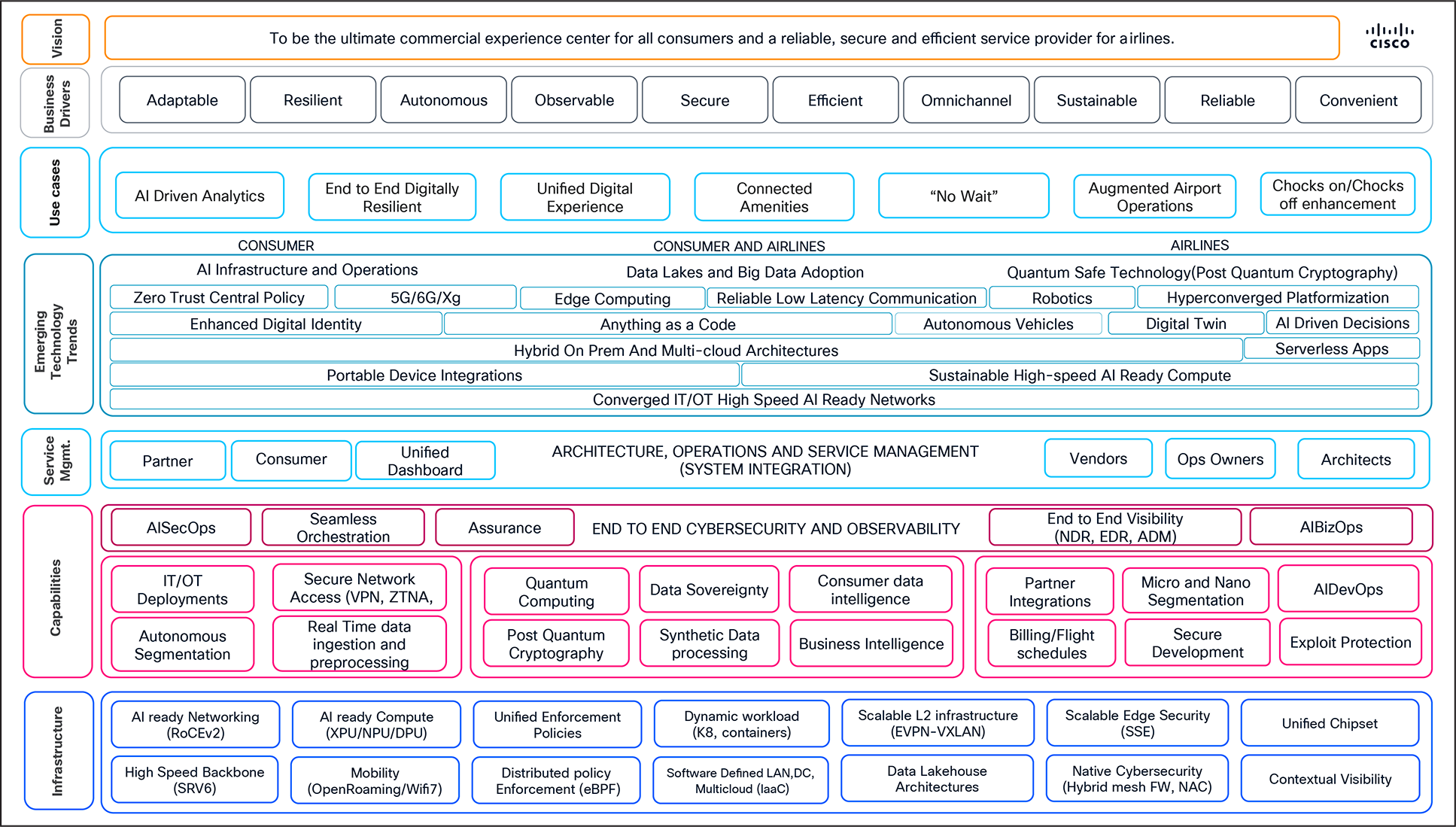
An airport transformation framework
Cisco’s Airport Modernization Blueprint
Cisco’s portfolio fosters a comprehensive and technologically advanced ecosystem, enabling the five pillars of Cisco’s Airport Modernization Blueprint. Demonstrated through successful airport deployments including Dubai[16] and Bengaluru[17] and many top international airports, Cisco remains committed to delivering secure connectivity, always-available services, contextual observability, and smart operations.
Cisco’s technology offerings encompass the full scope of airline IT systems. This includes shaping and managing the consumer experience, establishing innovative operating models to achieve business objectives, providing guidance in identifying key metrics, and overseeing the architecture from initial concept through implementation and ongoing management.
Cisco's solutions blueprint for the airport of the future is referred to as ASCEND (Airport Secure Connected Environment for next-generation Digitalization). The ASCEND framework describes an end-to-end digital infrastructure capability required for modern airport deployment. Cisco is playing a key role in this transformation, driving the future of airports by integrating cutting-edge technologies that revolutionize operations, elevate the passenger experience, and safeguard critical infrastructure. At the core of this evolution lies a powerful digital ecosystem, built on robust technology and infrastructure. With cybersecurity as a top priority, we embrace zero-trust principles to help ensure the highest levels of safety for both passengers and operations.
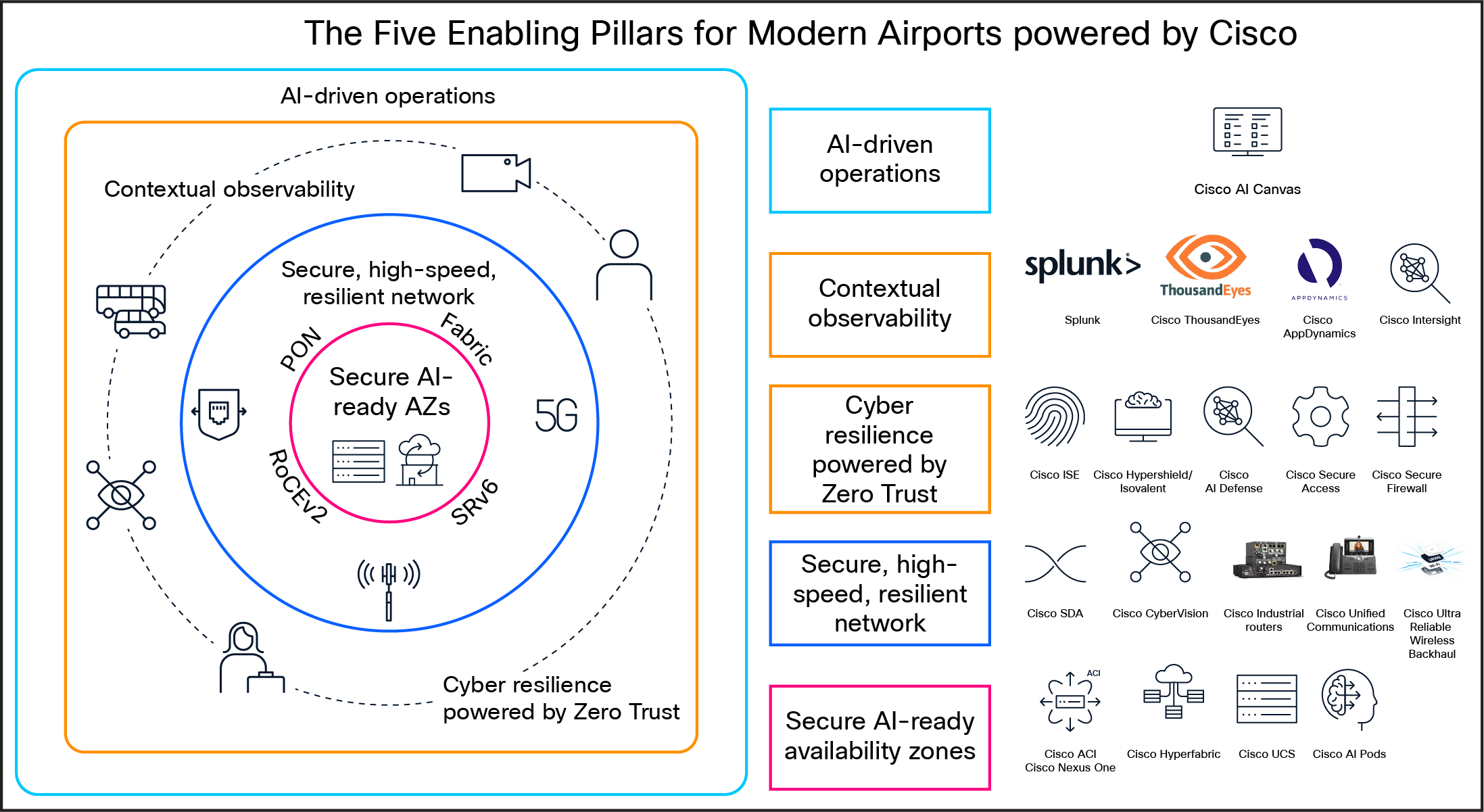
Cisco's solutions blueprint for the airport of the future is referred to as ASCEND (Airport Secure Connected Environment for Next-gen Digitalization)
The ASCEND blueprint outlines how we are approaching the Airport Modernization Blueprint through these five pillars:
1. Secure AI-ready availability zones to facilitate critical resilience across various geographies.
2. Secure, high-speed, resilient networks to facilitate high-speed communication across various systems and subsystems.
3. Contextual observability to provide context to airport operations as well as business data.
4. Cyber resilience powered by zero trust to secure the airport digitally and improve its posture against attacks.
5. AI-driven operations to enable simple and scalable airport operations.
Pillar 1: Secure, high-speed, resilient networks

Cisco solutions for secure, high-speed, resilient networks
Cisco delivers intelligent, secure, and automated network solutions that enable organizations to accelerate digital transformation, scale efficiently, and maintain resilient connectivity from users to applications in a cloud-first world. The network underpins the convergence of digital transformation and net-zero sustainability goals.
Converged network
Cisco’s infrastructure—including Catalyst® 9000 and IE9300 switches—unifies IT and OT networks in airports, delivering energy-efficient, highly secure, and visible connectivity. Software-Defined Access (SD-Access) enables network segmentation and scalability by overlaying virtual networks on physical infrastructure, helping ensure host mobility, consistent policy, and automated provisioning. For example, Bengaluru International Airport Terminal 2 has enhanced operations with SD-Access. Network convergence enables seamless automation, zero-trust security, and robust connectivity for applications like Wi-Fi, baggage handling, security, and IoT sensors.[17].
Smart spaces
Cisco Spaces and advanced Wi-Fi, such as the Cisco Catalyst 9100 Access Points and Wi-Fi 7, enable location-based services and high-performance wireless connectivity. Toronto’s Pearson Airport uses Cisco Spaces for tailored passenger engagement and seamless Wi-Fi logins, while also improving operations through asset tracking and queue monitoring. Features like Cisco CleanAir® Pro, GPS-enabled access points for 6-GHz band compliance, and flexible antenna options support robust, regulatory-compliant deployments.[11]
Seamless mobility and collaboration
OpenRoaming provides automatic, secure Wi-Fi by federating access and identity providers, eliminating manual logins and enhancing user experience with encrypted connections. This frictionless onboarding allows airports to enforce access policies and gather analytics for better security and service.
Cisco IP phones and its Unified Collaboration Solution provide reliable, high-quality voice communication that enhances coordination among airport staff and stakeholders. These IP phones enable features such as call forwarding, voicemail, and presence awareness, which are critical in the fast-paced airport environment. The deployment of Cisco IP phones facilitates efficient communication across various airport departments, improving response times and operational efficiency. Their support for mobility and wireless connectivity allows airport personnel to stay connected while moving throughout the facility, helping ensure continuous communication without disruption. Additionally, Cisco IP phones offer robust security and scalability, making them well suited to handle the complex and demanding communication needs of airports, ultimately contributing to improved passenger service and operational safety.
Observability and ecosystem integration
Cisco Catalyst Center delivers AI/ML-driven network insights and automated remediation to optimize performance and energy use. SD-Access helps ensure zero-trust segmentation for secure IoT and user access. Cisco Spaces integrates with Catalyst Center, offering unified, scalable cloud-based location services, real-time monitoring, and open APIs for personalized experiences and operational optimization.[13][14]
Low-latency communication
Cisco Ultra-Reliable Wireless Backhaul (URWB), Wi-Fi 7, and private 5G offer ultra-low-latency, high-speed mobile networks for real-time airport coordination and IoT connectivity. These solutions support critical communications—such as airside operations and crowd management—while advanced wireless technologies detect crowd density and prioritize application performance.
Key capabilities that Cisco technologies provide
● Low-latency communication networks.
● Wi-Fi 7 fully automated software-defined networking.
● Secure converged networks.
● High-speed connectivity.
● Rugged and industry-grade hardware for airside use cases.
● Ultra-reliable wireless.
Pillar 2: Secure AI-ready compute

Cisco solutions for secure AI-ready compute
The Cisco Nexus® 9000 family—powered by cloud-scale Application-Specific Integrated Circuits (ASICs) and Cisco Silicon One™—anchors modern data centers with high-density, low-latency, and energy-efficient switching, supporting diverse airport workloads like AI, IoT, digital twins, real-time analytics, and business applications.
The portfolio supports 800G Ethernet for massive bandwidth and RDMA over Converged Ethernet v2 (RoCEv2) for high-performance, low-latency data movement, and features advanced telemetry, granular security, and microsegmentation for deep visibility and robust protection. Nexus Hyperfabric delivers intelligent, highly automated networking for seamless connectivity across hybrid and multicloud environments. Modular AI PODS and compute-network-storage integration allow scalable, flexible infrastructure for evolving airport needs.
Nexus 9300 Series Smart Switches with embedded Data Processing Units (DPUs) bring capabilities like Cisco Hypershield™ to the network, accelerating in-fabric security and services. The unified Nexus Dashboard and AI Assistant simplify operations, unify policy management, and deliver intelligent insights—making Cisco’s portfolio a comprehensive, future-ready solution for airport IT.
As airports look to unlock more value from their data, Cisco AI PODS enable easy AI infrastructure deployment, while partnerships with Nvidia bring Cisco UCS® servers for demanding AI workloads.
Key capabilities
● Resilient Availability Zone design.
● RDMA over Converged Ethernet v2.
● AI-ready scalable compute.
● Segmentation by design.
● Software-defined, automated, and AI-driven.
● Infrastructure as code.
● Rugged, industry-grade solutions.
Pillar 3: Contextual observability

Cisco solutions for contextual observability
A next-generation airport Security Operations Center (SOC) integrates advanced technologies for robust, resilient, and intelligent security management tailored to airports. A converged network and unified operations center for both IT and OT delivers contextual data for real-time decisions. AI-driven operations further enhance information processing and actionable outcomes, made possible through Splunk’s extensive integration capabilities.
Splunk excels in observability, correlating multiple data sources to deliver actionable intelligence. At Dubai Airport, Splunk’s AI-powered platform unifies real-time insights across infrastructure, optimizing security queues and baggage handling and enabling 95% of passengers to clear security in under 5 minutes. It also manages the world’s largest baggage system, tracks Wi-Fi performance, and supports smart facility management for sustainable capacity expansion and superior customer experience.[16]
Cisco ThousandEyes provides end-to-end visibility into network and application performance, helping airports ensure seamless connectivity and optimal digital experiences for passengers and staff. With globally distributed agents, ThousandEyes monitors everything from Software as a Service (SaaS) and cloud services to internal infrastructure, quickly identifying and resolving issues that impact passenger experience. Its effectiveness is seen in improved outcomes for airports and airlines like EasyJet.[18]
AppDynamics delivers complete visibility into hybrid cloud environments, enabling airlines such as Alaska Airlines to detect and resolve application issues rapidly. Its automated application mapping and transaction tracing support high service reliability and optimized user experiences, driving operational efficiency and customer satisfaction.[19]
Together, Cisco’s observability solutions—Splunk, ThousandEyes, and AppDynamics—help airports optimize operations, improve passenger satisfaction, and ensure safety and security through continuous monitoring and rapid incident response.
Key capabilities
● Unified airport operations center architecture
● Flexible multiplatform solution
● Improved metrics on detection and response
● Real-time monitoring
● Rapid incident response
Pillar 4: Cyber resilience powered by zero trust

Cisco solutions for cyber resilience powered by zero trust
Cisco’s portfolio is architected with zero trust as a core principle. The Cisco secure service edge solution (Cisco Secure Access) delivers secure connectivity to both the internet and internal segments through a state-of-the-art zero-trust network access architecture. Secure mobile app development helps ensure that consumer data and critical success flows are meticulously mapped and documented within the DevOps cycle and Continuous Integration/Continuous Delivery (CI/CD) pipeline. With AI embedded into modern solutions, Cisco Secure Access and AI Defense establish essential guardrails, helping ensure that AI initiatives are secure by design.
Cisco technologies fortify continuous airport operations by delivering resilience against cyberattacks—spanning anticipation, prevention, and rapid recovery across complex, interconnected systems. This resilience is underpinned by ongoing verification and granular segmentation, rigorously enforcing authorized access and mitigating lateral movement threats. Security safeguards extend seamlessly across cloud, IoT, mobile, and hybrid environments, empowering workforce agility without compromising cyber defense.
Cisco’s next-generation firewall and Secure Access solutions embody Secure Access Service Edge (SASE) paradigms, helping ensure that all airport users and resources benefit from dynamic, authorized access. Unified policy frameworks, powered by Cisco Identity Services Engine (ISE) and Cisco Hypershield, enable consolidated policy management via a single dashboard. The integration of AI Defense within Cisco Secure Access further elevates security for AI-driven user and workload access, with the future being the integration of the next generation observability platform AI Canvas orchestrating zero-trust identity propagation, segmentation, and enforcement.
Centralized security policies—administered through a unified policy framework—are enforced on DPU-enabled switches, creating a pioneering hybrid mesh firewall architecture. Consistent group-based access and identity-driven controls are realized across Cisco ACI (endpoint groups), VXLAN-EVPN fabrics (group policy objects), and Cisco SD-Access (security group tags), operationalizing a seamlessly integrated zero-trust ecosystem. Bengaluru International Airport T2, for example, has deployed secure and resilient networks leveraging Cisco’s SD-Access solution.[17]
Key capabilities
● End-to-end zero-trust security
● Unified policy management
● AI-integrated secure access
● Hybrid mesh firewall architecture
Pillar 5: AI-driven operations

Cisco solutions for AI-driven operations
Agentic AI is shaping the next phase of airport operations. AI agents will serve as the interface for the airport’s AI infrastructure, enabling the deployment of local AI models to support advanced use cases such as real-time data processing for personalized advertising. Lounges will leverage these capabilities to display updated schedules and allow convenient booking of amenities, directly from unified applications using live data.
AI-driven operations enhance both day-to-day efficiency and broader business outcomes for airports. These solutions are designed to improve passenger experiences, optimize resource allocation, reduce operational costs, and increase revenue through automation and informed decision making. Additionally, they support improved security, operational planning, and capacity management while helping mitigate cyber risks.
Given the range of Cisco’s technology offerings, dashboard management can become complex. Innovations from Cisco CX and AI Canvas enable a unified dashboard that provides comprehensive visibility across the airport’s technology landscape, supporting proactive event prediction and correlation. Cisco AI Canvas is a generative-AI powered collaborative workspace that unifies real-time telemetry, network intelligence, and cross-domain insights to help IT teams diagnose and resolve issues faster. It provides a shared environment where operators can visualize data, explore AI-driven recommendations, and work together on troubleshooting in a structured, guided manner, significantly improving operational efficiency. This capability is central to Cisco’s next-generation Agentic Operations strategy, positioning AI Canvas as the hub where humans and AI agents jointly analyze problems, automate tasks, and accelerate mean-time-to-resolution by leveraging Cisco’s Deep Network Model and platform data [3]. Combined with Cisco’s AI-ready infrastructure, this approach delivers a robust observability solution for airport operators.
Key capabilities
● AI-driven airport operations
● Proactive event correlation
● Autonomous decision making for selected processes
● Improved operational efficiency and cost management
● Enhanced collaboration across airport functions
Bringing it to reality: The logical architecture
At the heart of effective service provisioning within an airport environment are the critical applications and databases that underpin daily operations for airport authorities, airlines, and retail partners. These digital systems manage everything from passenger check-in and baggage handling to real-time flight information, retail transactions, and hospitality services. A robust, high-speed network infrastructure helps ensure secure and reliable access to these services for all stakeholders—including passengers, airline staff, retail operators, and even nontraveling visitors—enabling seamless interactions across the airport ecosystem.
By achieving comprehensive observability across these applications, databases, and network infrastructure, airport operators gain real-time insights into system performance, user experience, and emerging issues. This holistic visibility is essential for maintaining operational continuity, optimizing resource allocation, and quickly addressing potential disruptions. Furthermore, when observability is paired with advanced AI-driven analytics, airports can progress toward autonomous operations—where routine processes are intelligently automated, incidents are proactively resolved, and services are continuously optimized. This results in enhanced operational efficiency, improved passenger experiences, and the ability to rapidly adapt to evolving demands within the airport environment.
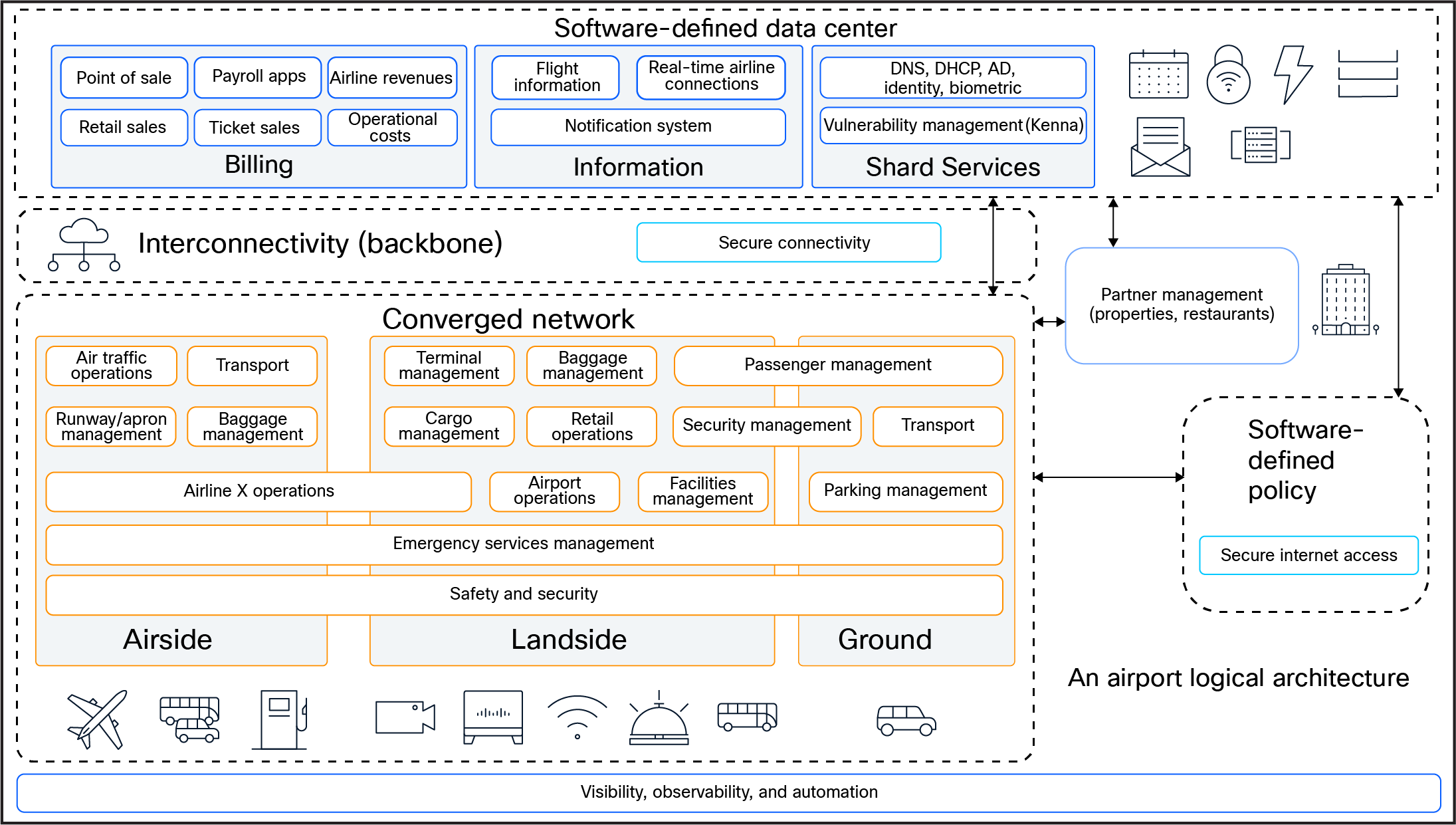
Airport logical architecture - a practical adoption of a digital resilient architecture for airport
The figure above showcases a practical implementation of the blueprint. An airport logical architecture provides a holistic foundation for digital transformation. IT teams leverage it to build, manage, and evolve airport technology environments, while business users use it to drive operational improvements, innovation, and enhanced passenger experiences.
The architecture helps ensure that all technology investments are coordinated, scalable, and aligned with the airport’s strategic objectives.
Cisco’s Design Principles for the Digital Airport
Modern airports need more than just the right technology—they also require clear design principles to guide investment. A unified architecture enables rapid, scalable IT expansion across airports without redesigning each site. The following design principles support a unified, secure, and resilient airport IT architecture.
Design principles are crucial as they provide foundational guidelines that help ensure consistency, efficiency, and effectiveness in the development and operation of any system or solution.
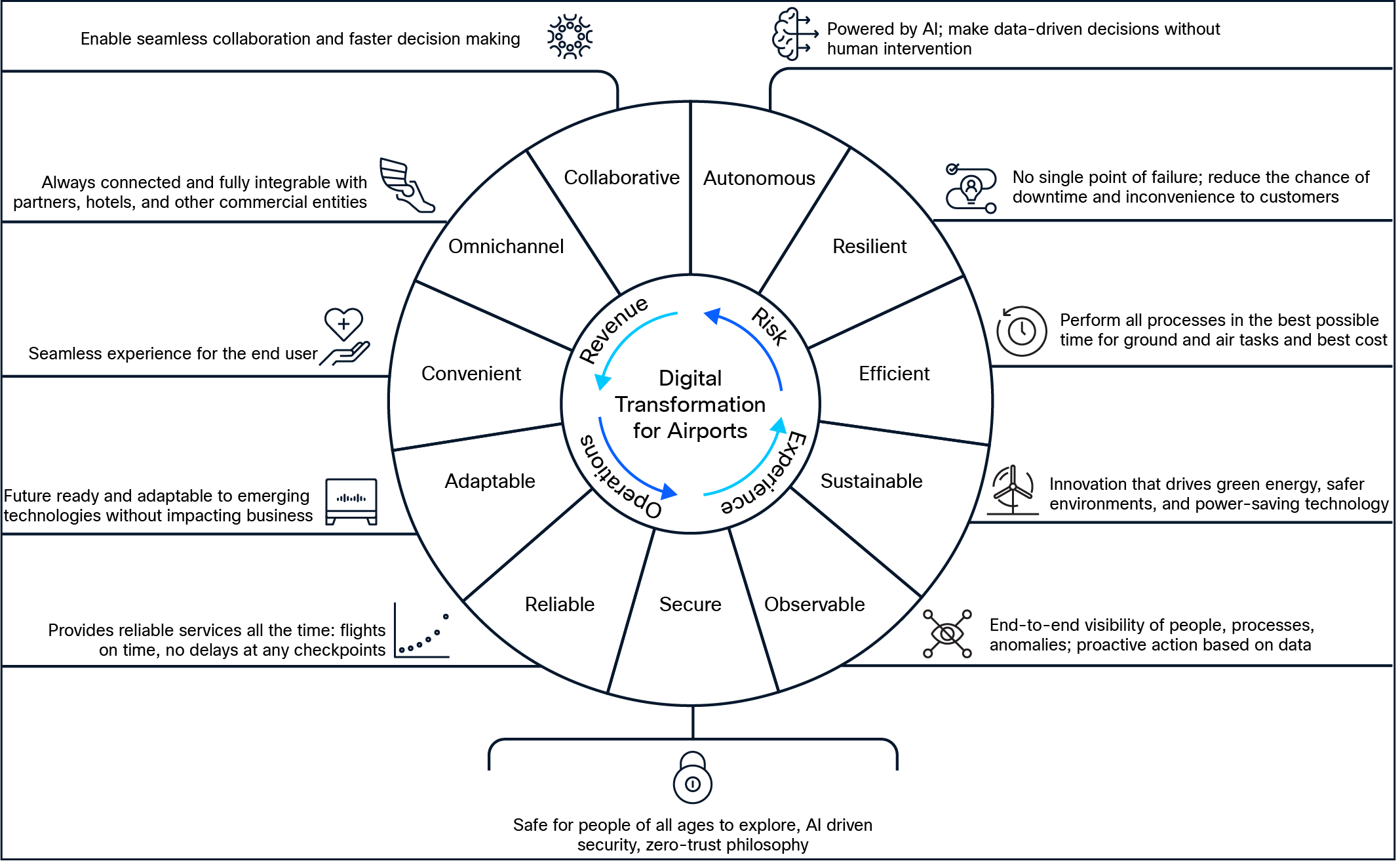
IT infrastructure design principles for the digital airport
Autonomous: Airports must be able to autonomously make data-driven decisions to optimize operational efficiency, particularly when confronting dynamic crowd conditions, critical emergency situations, and the imperative for resilient traffic management.
Resilient: The airport needs to be able to withstand unplanned events and unforeseen delays. The “domino effect” across the airport ecosystem needs to be contained if an event occurs. Similarly, an airport must be able to protect and remediate dynamic cyberthreats and minimize lateral movements if a network is compromised.
Efficient: Maximum efficiency demands meticulously tailored processes, encompassing everything from IT infrastructure, building materials, and operations to product deployments and their ongoing management, power consumption, equipment placement, and passenger-related workflows.
Reliable: To ensure a seamless experience for travelers, the airport must prioritize resilience and efficiency, enabling it to maintain reliable operations even amid changes in flight schedules, environmental factors, and other dynamic conditions that could otherwise disrupt flights and passenger journeys.
Sustainable: Innovation and investment should focus on advancing green energy, enhancing safety, and promoting energy-saving technologies. Solutions must be able to scale with growing demand while remaining environmentally responsible.
Observable: You cannot operate what you cannot see. All activities from the various ecosystems of the airport must be collated and integrated at one location. Centralized visibility is essential for effective coordination, real-time decision making, and proactive management across airport operations.
Secure: The fundamental factor driving consumer loyalty to a service is trust. For an airport, this translates into an essential need for reliability. Travelers must be confident in their ability to complete planned journeys, secure appropriate accommodation during disruptions, and expect a consistently safe and secure environment.
Convenient: Convenience has become a critical factor for modern airports. As airports evolve from mere transportation hubs to experiential centers, they must be easily accessible and straightforward to do business with, and must offer a seamless experience for all visitors. This includes providing a wide range of activities and services that cater to diverse consumer segments and age groups, ensuring convenience at every touchpoint.
Omnichannel: While airports are traditionally anchored in the aviation industry, they hold the potential to become powerful multi vertical experience hubs. To truly elevate convenience and drive new revenue opportunities, airports must go beyond aviation partners and strategically integrate with a wider ecosystem—retail, hospitality, mobility, wellness, entertainment, financial services, and more. By orchestrating these partnerships into a single, frictionless digital platform—accessible through one intuitive app—airports can transform from transit points into destination experiences. This is not merely a technology initiative; it is a strategic business imperative that positions airports as consumer-centric, digitally enabled marketplaces of the future.
Adaptable: Today, “software-defined” architectures are at the forefront of network innovation; tomorrow, the focus may well shift to “AI-driven” networks. Similarly, while cybersecurity solutions are currently often deployed on-premises, the future may see a transition to cloud-based models. Although technology trends continue to evolve, the business outcomes remain constant. Airport architectures need to be future-ready, capable of accommodating emerging technological advancements rather than being limited to the requirements of the present moment.
Collaborative: Airport systems must enable rapid collaboration and agile decision making, as numerous scenarios demand swift, decisive action. Critical choices must be made in real time, necessitating an infrastructure that seamlessly supports and accelerates this process.
Maximizing value through Cisco CX
Deploying complex environments, such as those with large-scale operations, requires a strategy that translates business drivers into practical implementation. To facilitate the realization of this blueprint, a structured approach is proposed, as illustrated in the following figure, designed to guide organizations through the critical phases of technology standardization and digital transformation.
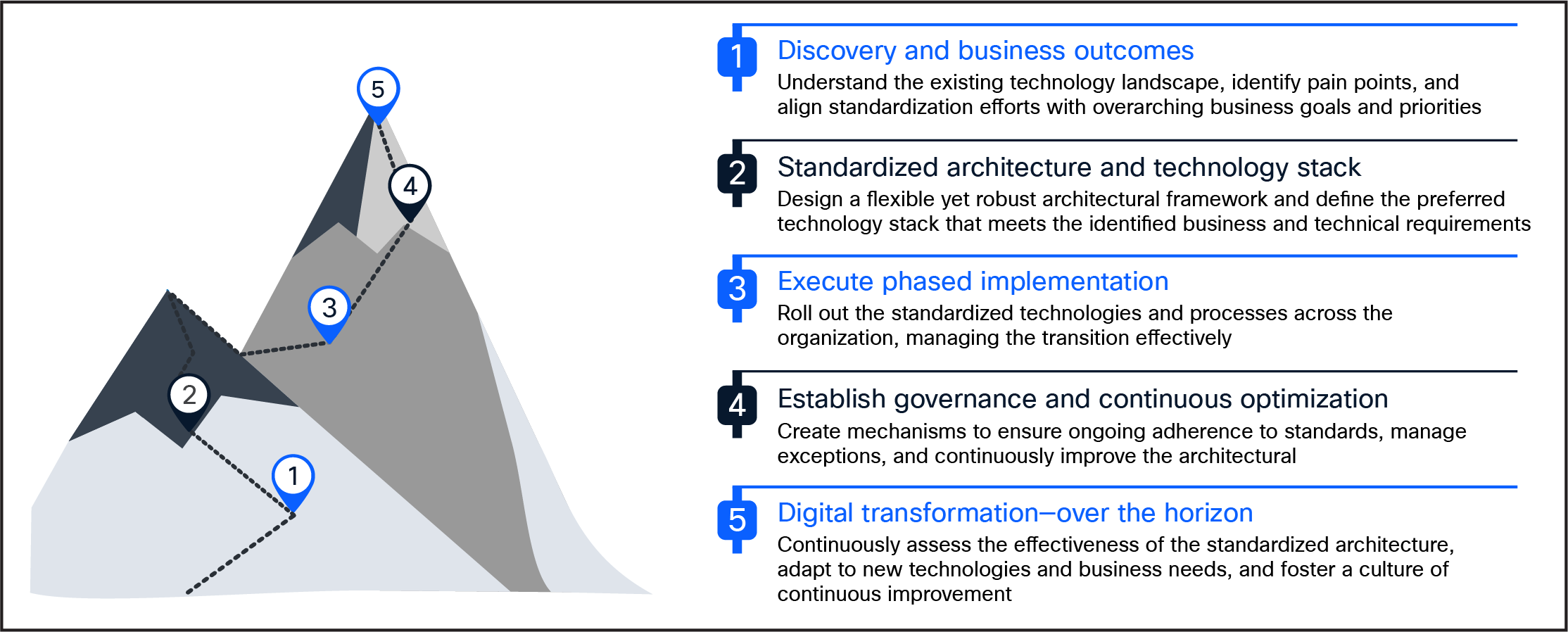
An approach for implementing an airport architecture
Cisco Customer Experience (CX) offers a comprehensive approach to designing, building, and implementing technology solutions that help organizations achieve their strategic objectives. Cisco CX collaborates closely with customers to understand their unique challenges, business processes, and desired outcomes. During the design phase, Cisco CX architects tailored solutions that align with current and future needs, helping ensure scalability, security, and interoperability. This end-to-end partnership enables organizations to maximize their technology investments and confidently innovate in an ever-changing environment.
Cisco’s portfolio integrates seamlessly with the airport ecosystem
The aviation sector is characterized by its immense complexity, involving a vast array of interconnected "moving parts" such as airlines, airport infrastructure developers and operators, air traffic management, workforce and employees, retailers, and passengers. This intricate ecosystem is further shaped by critical government stakeholders and regulators, alongside essential technology partners and service providers, all interacting within and impacting local and global communities.
To navigate this complexity effectively, the sector requires a robust regulatory and policy environment that actively fosters innovation and technological advancement rather than stifling it. Such an environment is crucial for managing the inherent risks associated with security, user experiences, and safeguarding the overall health, security, and performance of the aviation industry. This necessitates an openness to innovation, the adoption of open platforms (including through research and industry investment), and a willingness to embrace new ways of operating at scale to ensure continued progress and resilience.
At Aéroports de Montréal, Cisco CX played a pivotal role in accelerating digital transformation amid the COVID-19 pandemic. By introducing touchless check-in, biometric boarding, and enhanced cybersecurity, the partnership enabled safer, more efficient airport navigation. Cisco CX also streamlined network migration and engineered a stable, agile infrastructure for critical systems. Strategic support empowered the airport IT team to reduce downtime, manage complexity, and maintain high performance, resulting in improved operational efficiency and greater passenger satisfaction.[10]
As the aviation sector anticipates handling 12 billion passengers by 2030, a clear need arises to scale operations with both efficiency and security. The goal is to accommodate this significant growth while ensuring seamless customer experiences and maintaining efficient operations.
Airports have evolved beyond simple transport hubs into complex environments, integrating retail, transportation, and experiential services. They are now important economic contributors for organizations and national economies. Operators face the ongoing demand to manage continuous digital infrastructure with high availability while optimizing productivity. Concurrently, IT teams must address the limitations of legacy systems to support the increasing requirements of AI workloads and expanding application portfolios.
This blueprint has outlined five essential pillars or “ASCEND” (Airport Secure Connected Environment for Next-generation Digitalization) designed to establish a digitally resilient and efficient airport environment. These pillars—secure, high-speed, resilient networks; secure AI-ready availability zones; contextual observability; cyber resilience powered by zero trust; and AI-driven operations—are fundamental across all airport functions.
Visionary leadership will shape the future of global travel
Modern aviation is at a collective inflection point. All aviation stakeholders—airport operators, IT teams, systems integrators, retail tenants, technology vendors, and airlines—must collectively prepare for the increasing scale, complexity, and risks of growing passenger volumes. This raises a critical question: Are airports adequately positioned to leverage the AI era and realize the significant revenue opportunities enabled by advanced digital infrastructure?
Realizing the transformative potential of advanced use cases, sophisticated applications, and powerful AI workloads within the airport environment hinges entirely on a robust and secure foundational infrastructure. Without a clear digital blueprint or master plan for modernizing the airport's core infrastructure, the ability to innovate and compete is compromised, leaving operations vulnerable to obsolescence. Technology decisions today must be made with a strategic foresight of 5 to 10 years, accounting for cycles of upgrades and potential obsolescence. This demands a flexible, highly scalable technology architecture that can not only accommodate today's demands but also seamlessly adapt to emerging technologies and unforeseen threats that have yet to materialize.
Prioritizing this foundational strength and future-ready planning is not merely an option, it is an imperative for any airport aiming to thrive in the rapidly evolving landscape of global aviation. To navigate this intricate path successfully, it is crucial to partner with a technology advisor who truly understands the inherent complexities of the aviation sector, its end-to-end requirements, deeply embedded ecosystems, and critical need for interoperability. This partner must be equipped to respond to the unique challenges and demands of this highly specialized vertical.
Only Cisco combines the power of the network with industry-leading security, comprehensive observability, and seamless collaboration platforms. We operate at incredible scale and in mission-critical environments globally, with our network omnipresent through 37 million networking devices, across 1M+ customers in 150 countries including more than 82,000 government organizations[28].
Our deep expertise across infrastructure, security, and software-defined solutions, coupled with a relentless commitment to innovation and global support, positions us uniquely to help airports build the resilient, intelligent, and secure foundations necessary for tomorrow's advanced operations. Drawing on our deep expertise in airport networking, we are committed to shaping the future of global air travel and ensuring the seamless movement of people around the world.
Choosing the right strategic technology partner is a critical step toward unlocking your airport's future potential and ensuring its enduring success.
[1] Airport Dimensions, Airport Experience 2025 Report, https://downloads.ctfassets.net/mlhfk7pjn0ow/4EKDlneSYooBGIvBcw7mZF/299bf63c5369df05fc8d455fac685d67/AX25_Airport_Experience_Research.pdf.
[2] Fortune Business Insights, Airport Retail Market, https://www.fortunebusinessinsights.com/airport-retail-market-110581.
[3] Cisco, Announcing AI Canvas, Revolutionizing IT with Agentic Ops: https://newsroom.cisco.com/c/r/newsroom/en/us/a/y2025/m06/announcing-cisco-ai-canvas-revolutionizing-it-with-agenticops.html.
[4] Dorothy Neufeld, Visual Capitalist, Ranked: The Busiest Airports in the World, https://www.visualcapitalist.com/ranked-the-busiest-airports-in-the-world/.
[5] Deena Kamel, The National, Dubai Airport to Reach 100-Million Passengers Mark by the End of 2026, Earlier Than Planned, https://www.thenationalnews.com/business/aviation/2025/04/30/dubai-airport-to-reach-100-million-passengers-mark-by-the-end-of-2026-earlier-than-planned/.
[6] The Economic Times, Delhi Airport Aims 24 Million Annual Passenger Traffic in 1-2 years; More International Connectivity: DIAL CEO, https://economictimes.indiatimes.com/industry/transportation/airlines-/-aviation/delhi-airport-aims-24-million-annual-passenger-traffic-in-1-2-years-more-international-connectivity-dial-ceo/articleshow/120203765.cms.
[7] International Airport Review, Digital Transformation to Better Serve Airport Passengers: A Case Study of Shenzhen Airport, https://www.internationalairportreview.com/article/162818/digital-transformation-to-better-serve-airport-passengers-a-case-study-of-shenzhen-airport/.
[8] Cisco, Grounded by Cybersecurity: Protecting the Aviation Industry from Digital Threats, https://blogs.cisco.com/customerexperience/grounded-by-cybersecurity-protecting-the-aviation-industry-from-digital-threats.
[9] The Strait Times, European Airports Snarled by Cyber Attack, Disruption to Stretch into Sept 21, https://www.straitstimes.com/world/europe/cyberattack-causes-disruption-at-airports-in-brussels-berlin.
[10] Cisco, A World-Class Airport Transforms for Growth, https://www.cisco.com/c/m/en_us/customer-experience/customer-stories/aeroports-de-montreal.html.
[11] Cisco, GTAA Improves Passenger Experiences and Engagement with Cisco DNA Spaces, https://spaces.cisco.com/enhancing-passenger-experiences-engagement-for-gtaa/.
[12] Cisco, Transforming Workplace Infrastructure with Ultraefficient PoE Enabled Computing and Displays, https://www.cisco.com/c/en/us/td/docs/engineering_alliances/transforming_workplace_infrastructure_with_ultraefficient_poe_enabled_computing_and_displays.html.
[13] Cisco, Harnessing Innovation for the Health of Our Planet, https://www.cisco.com/site/us/en/about/purpose/environmental-sustainability/index.html.
[14] Cisco, Validated Profile: Transportation – Airport (SD-Access) Vertical, https://www.cisco.com/c/en/us/td/docs/cloud-systems-management/network-automation-and-management/catalyst-center/cisco-validated-solution-profiles/validated_profile_transporation_airport.html.
[15] Wipro, Transforming Airport Security Operations for One of the Middle East's Largest Airlines, https://www.wipro.com/partner-ecosystem/strategic-cisco/videos/transforming-airport-security-operations-for-one-of-the-middle-easts-largest-airlines/.
[16] Cisco, Dubai Airports Flies into the Future with Splunk, https://www.splunk.com/en_us/customers/success-stories/dubai-airports.html.
[17] Cisco, Bengaluru International Airport Limited: Case Study (video), https://video.cisco.com/detail/video/6275493679001.
[18] Cisco, EasyJet Competes Through Business Transformation with ThousandEyes, https://www.thousandeyes.com/resources/easyjet-case-study.
[19] Airport Industry-News, AppDynamics Case Study – Alaska Airlines, https://airportindustry-news.com/appdynamics-case-study-alaska-airlines/.
[20] Cisco, Cisco IT Data Center Sustainability, https://www.cisco.com/c/en/us/solutions/collateral/enterprise/cisco-on-cisco/cisco-it-dc-sustainability-wp.html.
[21] Airport Council International, Joint ACI World-ICAO Passenger Traffic Report, Trends, and Outlook, https://aci.aero/2025/01/28/joint-aci-world-icao-passenger-traffic-report-trends-and-outlook/.
[22] Airport Council International, Airports Face Financial Challenges Despite Air Traffic Rebound, ACI World Economics Report Reveals, https://aci.aero/2025/04/28/airports-face-financial-challenges-despite-air-traffic-rebound-aci-world-economics-report-reveals/.
[23] Changi Airport Group, Terminal 5, https://www.changiairport.com/en/corporate/about-us/future-developments.html#tabs-47304eb06b-item-21cc20f244-tab.
[24] Vietnam Net Global, Investment in Small Airports Helps Local Economies Take Off: Experts, https://vietnamnet.vn/en/investment-in-small-airports-helps-local-economies-take-off-experts-2069241.html.
[25] Private World, Phuket Airport Targets Expansion to Accommodate More Tourist Arrivals, https://www.theprivateworld.com/2024/07/phuket-airport-targets-expansion-to-accommodate-more-tourist-arrivals/.
[26] Changi Airport Group, Sustainable Changi, https://www.changiairport.com/en/corporate/our-sustainability-efforts/environment/rooftop-solar.html.
[27] Cisco, Smart Zero, https://www.cisco.com/c/dam/global/en_au/solutions/industries/pdfs/smart-zero.pdf.
[28] Cisco, Cisco Annual Report 2025, https://www.cisco.com/c/dam/en_us/about/annual-report/2025-cisco-full-annual-report.pdf.
Avinash Naduvath, Digital Transformation Lead Architect, Cisco Customer Experience.
Sarah Jane Yee, Business Transformation Lead, ASEAN Cisco.
Senthil Kumar, Principal Architect, Cisco Customer Experience.
Atahar Khan, Principal Architect, Cisco Customer Experience.
Mark Krischer, Principal Solutions Engineer, Cisco.
Kenan Yorucu, Services Sales Leader, Cisco Sales.
Hui Ming Liew, Singapore Country Digital Acceleration Director, Cisco.