Full-Stack Software-Defined Manufacturing Solution Overview
Available Languages
Bias-Free Language
The documentation set for this product strives to use bias-free language. For the purposes of this documentation set, bias-free is defined as language that does not imply discrimination based on age, disability, gender, racial identity, ethnic identity, sexual orientation, socioeconomic status, and intersectionality. Exceptions may be present in the documentation due to language that is hardcoded in the user interfaces of the product software, language used based on RFP documentation, or language that is used by a referenced third-party product. Learn more about how Cisco is using Inclusive Language.
Accelerating AI-powered autonomous operations
The Full-Stack Software-Defined Manufacturing solution from Cisco and Rockwell Automation enhances production quality, efficiency, and plant resilience by offering operational visibility and preparing for future AI insights and autonomous operations, helping businesses stay competitive as they evolve.
It provides a regulatory-compliant cybersecurity strategy from edge to cloud, crucial for plant availability and the manufacturing ecosystem’s trustworthiness to support innovation and growth.
● Simplified and secure IT/OT convergence: Autonomous operations require extremely high levels of network reliability and cybersecurity, as well as low latency. System failures or breaches can have significant consequences. The joint stack is built on robust Cisco® networking technology and validated Converged Plantwide Ethernet (CPwE) architectures, combined with integrated Cisco Operational Technology (OT) security.
● Seamless data flow for AI and analytics: Autonomous systems are fundamentally data-driven, relying on vast amounts of real-time data from the OT environment to feed AI models and analytics engines (often hosted in the cloud on platforms like FactoryTalk® Hub or Cisco Unified Edge. The joint stack, designed for IT/OT convergence, creates the necessary secure, high-bandwidth data pipelines between sensors/controllers at the edge and the compute resources (edge or cloud).
● Scalable infrastructure for autonomous workloads: The joint stack leverages Cisco’s capabilities in edge computing, high-performance data center infrastructure (such as Cisco UCS® for AI), and multicloud connectivity to provide the scalable compute and network resources required to host and run these demanding workloads efficiently and reliably.
● Optimized performance with AI infrastructure and observability: Cisco’s AI-enabling infrastructure (Unified Edge, Secure AI Factory) helps ensure efficient processing, while its observability tools provide end-to-end visibility into network paths, application performance, and cloud connectivity. This allows potential issues impacting autonomous processes to be identified and resolved proactively, providing consistent performance and availability.
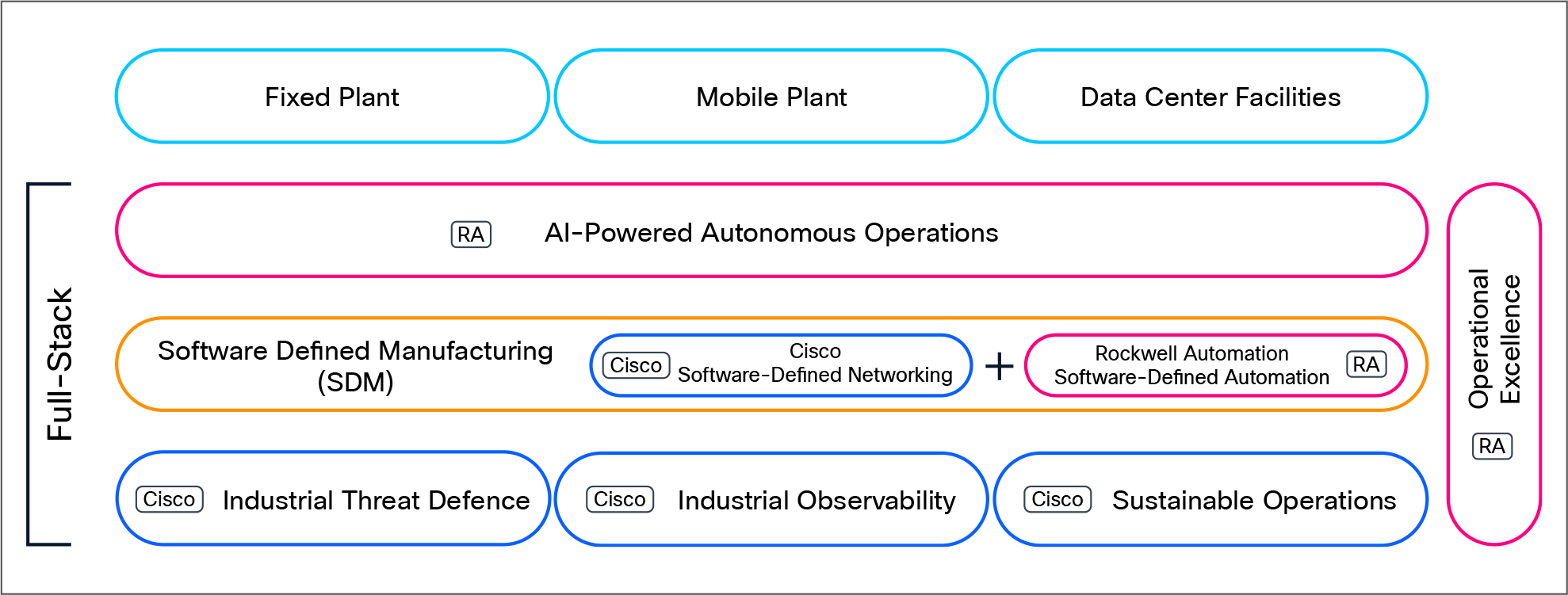
Components of the Full-Stack Software Defined Manufacturing solution
Businesses in today’s industrial landscape must adapt to be more agile, scalable, and resilient due to competitive and geopolitical pressures, yet traditional network and automation systems are often inflexible, limiting future capabilities like AI-powered autonomous operations.
Key issues that you may be facing when accelerating your autonomous operations journey include the following:
● Integrating existing OT systems with digital platforms, sensors, and networks required for autonomous operations is complex and costly. This restricts data collection, interoperability, and the deployment of unified data analytics strategies.
● Accessing reliable, accurate, and contextualized data from the plant floor is difficult. The massive volume and velocity of data from connected cells, machines, material, products, and sensors can be overwhelming to manage, store, and process effectively. This limits the ability to train effective AI/ML models and to perform real-time analytics.
● Cybersecurity: Increased connectivity between IT and OT systems drastically expands the attack surface. Legacy OT systems often lack modern security features, and upgrades/patching is difficult.
● Scalability: Many companies successfully implement pilot projects but struggle to scale those solutions effectively and cost-efficiently across multiple production lines or entire plants. Challenges in standardization, infrastructure readiness across sites, and managing complexity at scale often arise.
● Workforce skills.
The Full-Stack Software-Defined Manufacturing reference design brings together software-defined networking, software-defined automation, and the critical foundations of Cisco Industrial Threat Defense, industrial observability, and sustainable operations. When combined with AI-powered autonomous operations and operational excellence, the full-stack design enables customers to support the evolutionary shift from automation to autonomy.
● Increased agility and flexibility
● Improved efficiency and productivity
● Operational excellence
● Innovation and new business models
The Full-Stack Software Defined Manufacturing solution uses software control and virtualization to optimize production, enhance security, and increase sustainability. By analyzing real-time data and virtualizing traditional Industrial Automation and Control Systems (IACS), Software Defined Manufacturing boosts flexibility, reduces costs, and improves efficiency.
Manufacturing companies face numerous challenges. Rigid production systems, designed for efficiency and stability with a high degree of predictability, are reaching their limits. Rigid structures are difficult to adapt to unpredictable market demands. This is due to the tight coupling between hardware and software, which makes it difficult to implement necessary system adjustments because local changes can be made only by physical intervention.
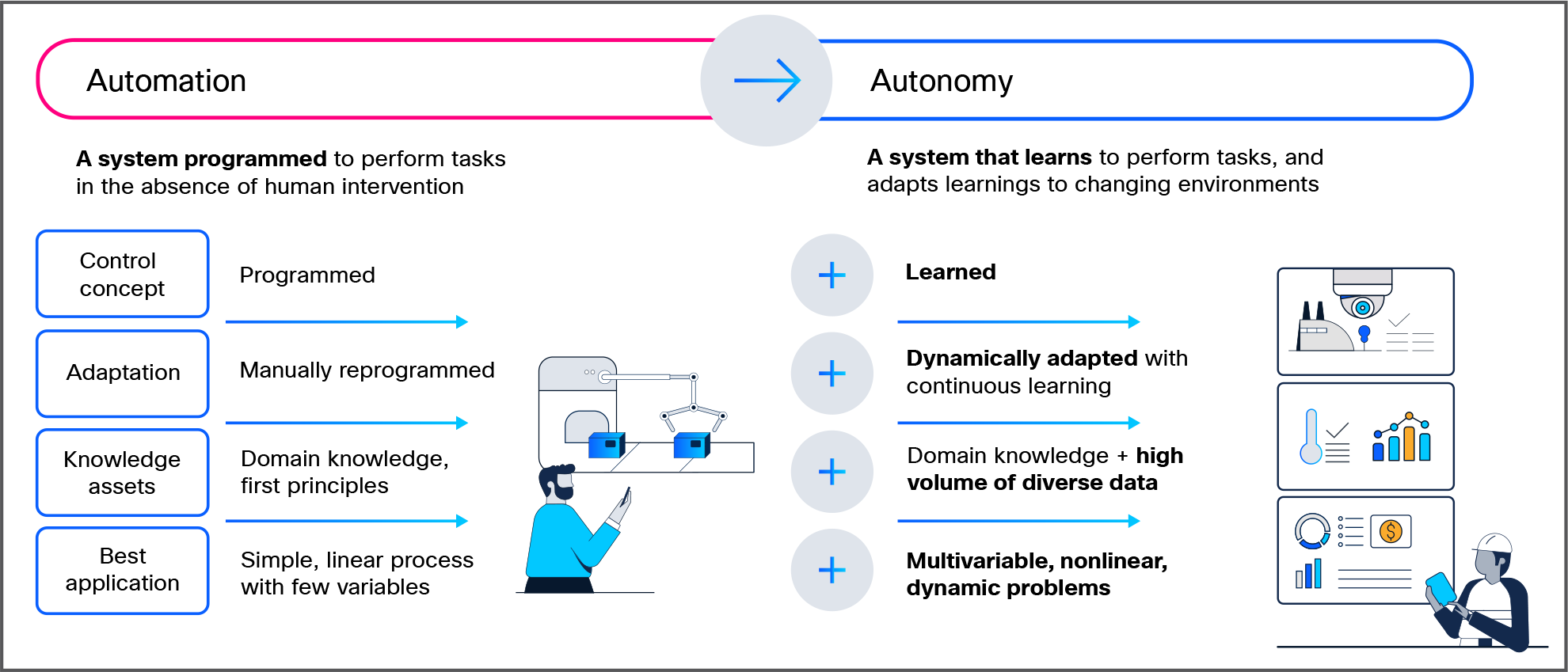
From automation to autonomy
This obsolescence and lack of flexibility leads to higher maintenance and operating costs, as well as inefficient use of resources. Another challenge is the presence of data silos, which hinder the efficient exchange of information between departments and systems. This makes data-driven decision-making more difficult and complicates the analysis and optimization of processes.
With the connected enterprise driving interconnected systems and intelligent automation, Software Defined Manufacturing leverages edge computing, AI, and digital twins to transform manufacturing.
The Full-Stack Software Defined Manufacturing solution is the foundation for AI-powered autonomous operations. AI and autonomous systems capabilities will change the industrial automation landscape from automation (a system programmed to perform tasks in the absence of human intervention) to autonomy (a system that learns to perform tasks and adapts learnings to changing environments).
● Maximize production efficiency: Connect moving vehicles (automated guided vehicles, autonomous mobile robots, etc.) and mobile tooling.
● Seamlessly connect IT and OT: Bridge the gap between industrial control systems and enterprise networks for unified operations.
● Strengthen cyber and operational resilience: Protect critical assets from disruptions, cyberthreats, and unplanned outages.
● Simplify industrial networks: Reduce deployment complexity with scalable, software-driven solutions.
● Enhance system maintainability: Achieve long-term reliability with predictive maintenance, real-time insights, and automation.
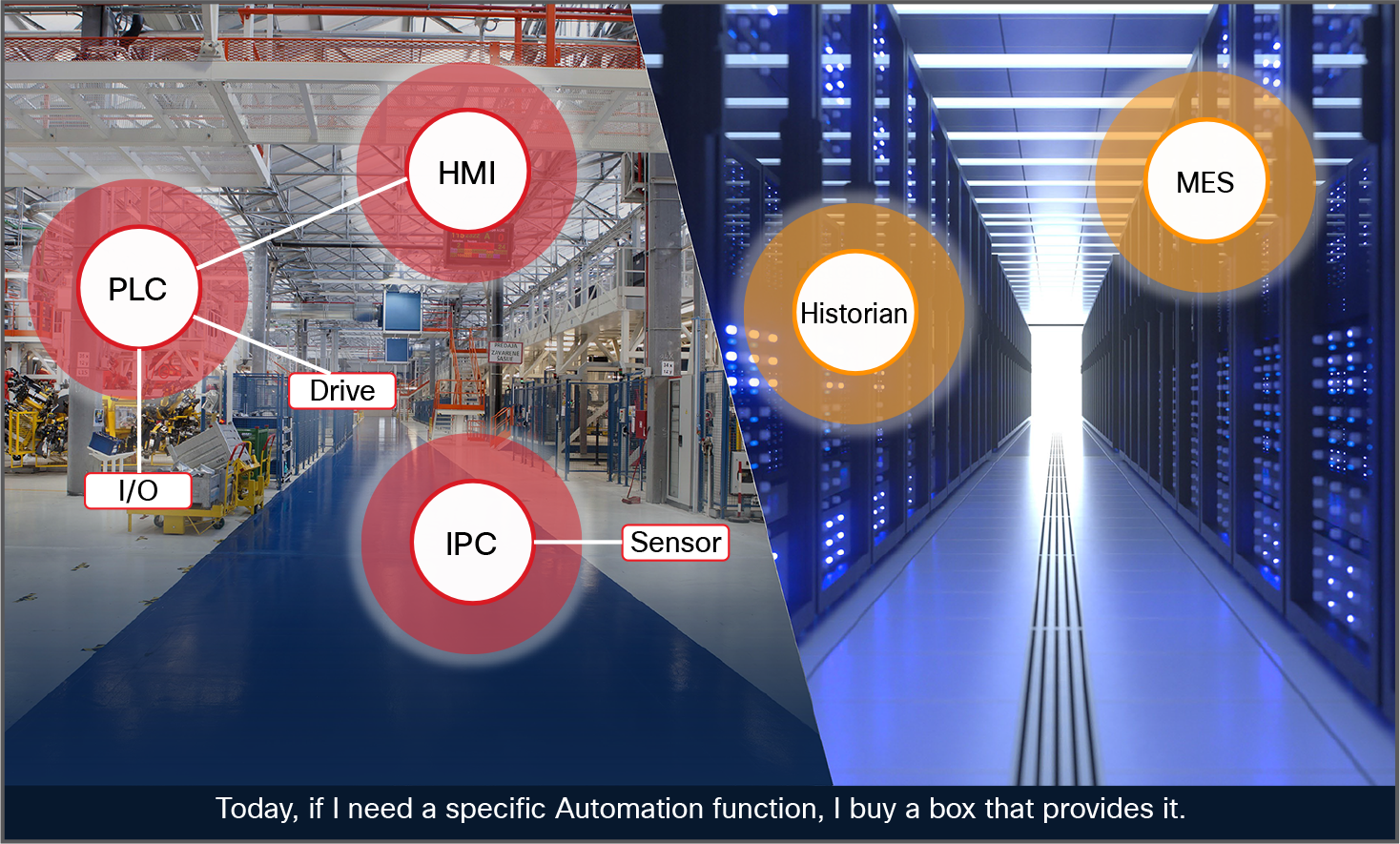
Traditional automation
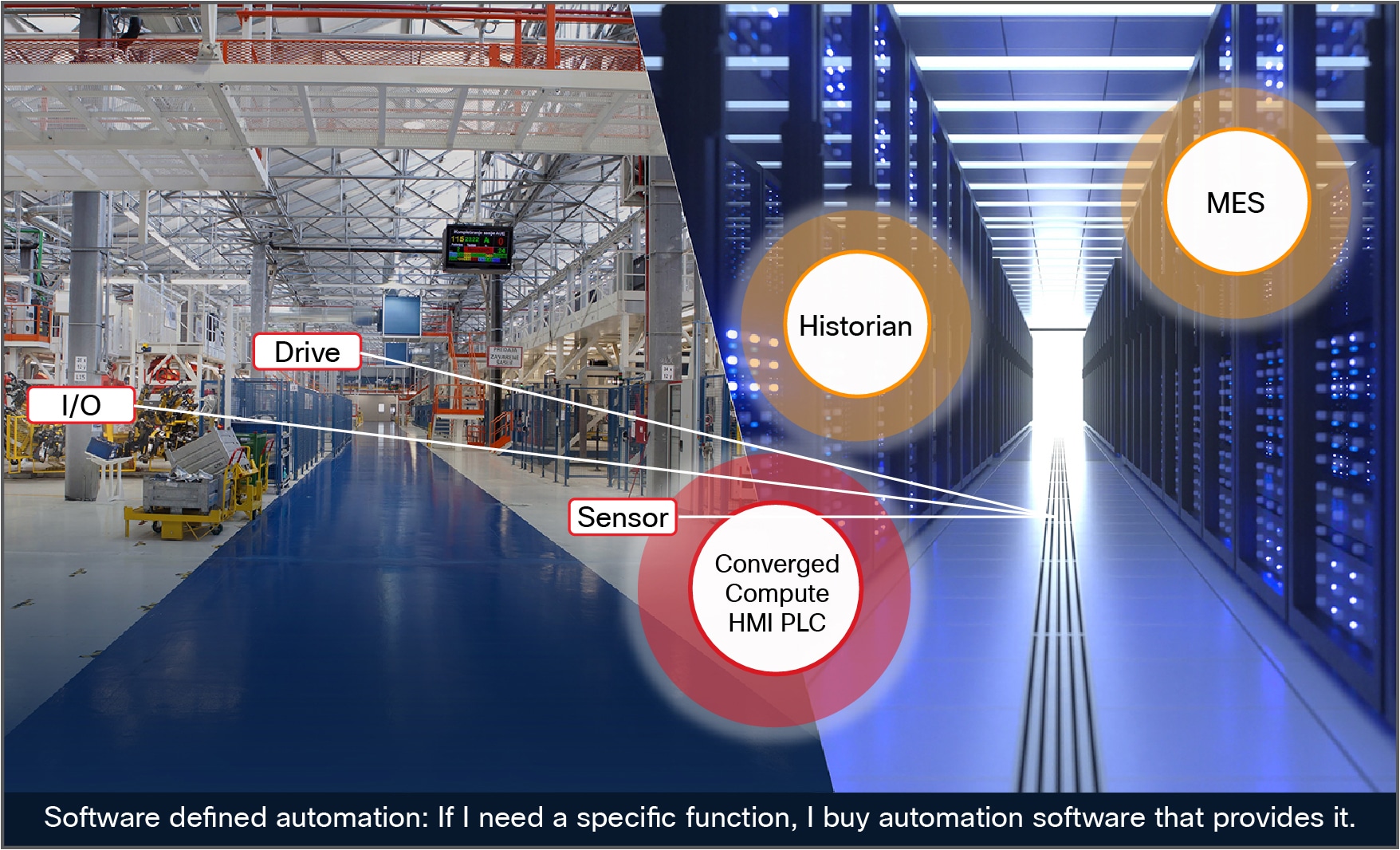
Software-defined automation
The shift to autonomous operations requires embedded security across endpoints, networks, and data flows. Protocol-level data privacy, endpoint protection, and recovery capabilities are essential to ensure resilience and compliance with ISA/IEC 62443, NIST, and TSA standards.
Full-stack Software Defined Manufacturing enhances flexibility, reduces costs, and improves overall efficiency through the following capabilities:
● Resilient and secure network for autonomous operations: Rockwell Automation and Cisco’s “full-stack” approach delivers a high-performance, manageable network fabric tailored for OT environments. It helps ensure real-time data flow between sensors, actuators, controllers, edge devices, and cloud platforms, enabling autonomous decision-making and control loops. Integrated Cisco security solutions protect the expanded attack surface by segmenting critical processes, detecting threats, enforcing granular access policies, and securing remote connections.
● AI-driven enablement and self-optimizing systems: The Full-Stack Software Defined Manufacturing solution’s specialized edge compute, AI infrastructure, and multicloud capabilities provide a secure and scalable foundation for deploying advanced AI/ML models. These systems enable real-time process adjustments based on data inputs, maximizing efficiency, quality, and throughput while supporting dynamic reconfiguration and data-driven decision-making.
● Agility, resilience, and workforce empowerment: The solution enhances operational agility by enabling quick adaptation to changing demands and market conditions. Systems are designed to detect and adapt to disruptions autonomously, while human workers are empowered to focus on strategic oversight, innovation, and system improvement, supported by actionable data insights.
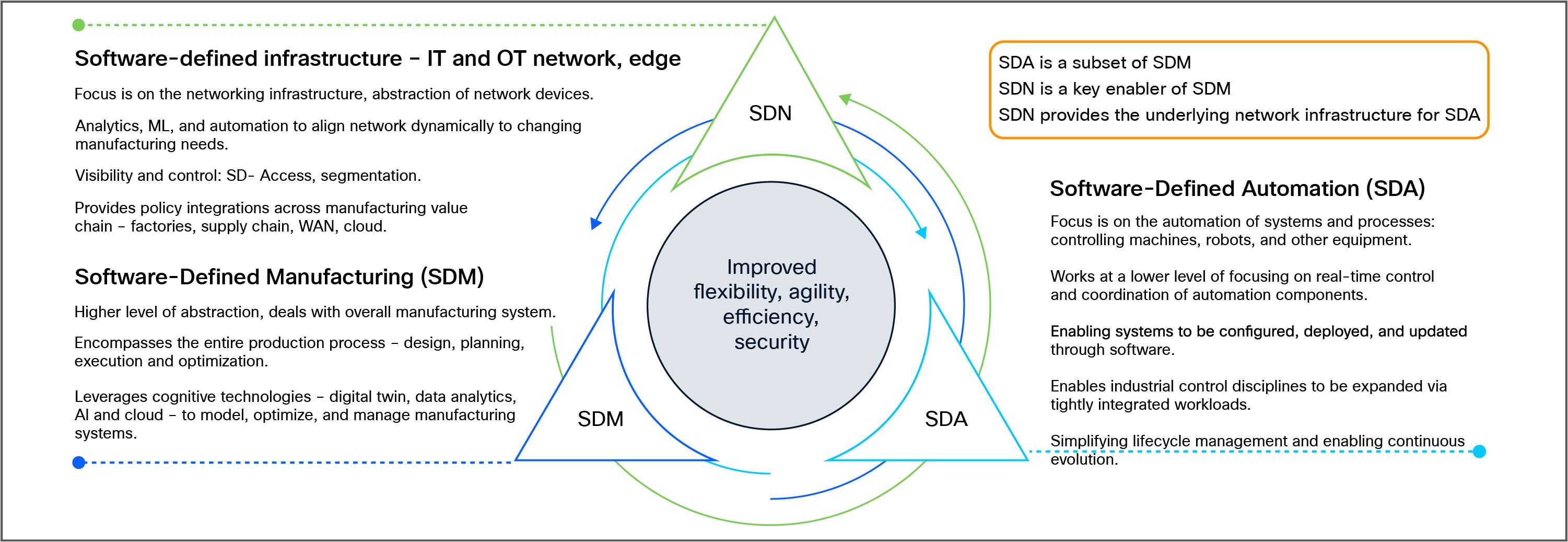
Benefits of software-defined manufacturing
Key features and components of the Full-Stack Software Defined Manufacturing solution include:
● Rockwell Automation’s integrated hardware and software portfolio, advancing AI-powered autonomous operations by integrating data from various sources, including design tools (Automation programming with AI Knowledge) and real-time operational data. Within this integrated virtual space, manufacturers can perform detailed simulation, emulation, and virtual commissioning.
● Network infrastructure, providing robust and secure industrial wired and wireless networks and network topologies.
● Data and analytics, enabling the collection, contextualization, and analysis of data from across the enterprise. This includes using AI and machine learning (AI/ML), simulation, and digital twins for designing, testing, commissioning, and optimizing autonomous systems.
● Cloud integration, leveraging on-premises, hybrid, and public cloud platforms.
● Cybersecurity, integrating robust cybersecurity measures at every level (device, network, application).
● Network automation, streamlining network provisioning, configuration changes, and maintenance tasks and reducing downtime, workloads, and the risk of human errors. Scalability is an essential factor for automating a manufacturing network with a large number of network devices.
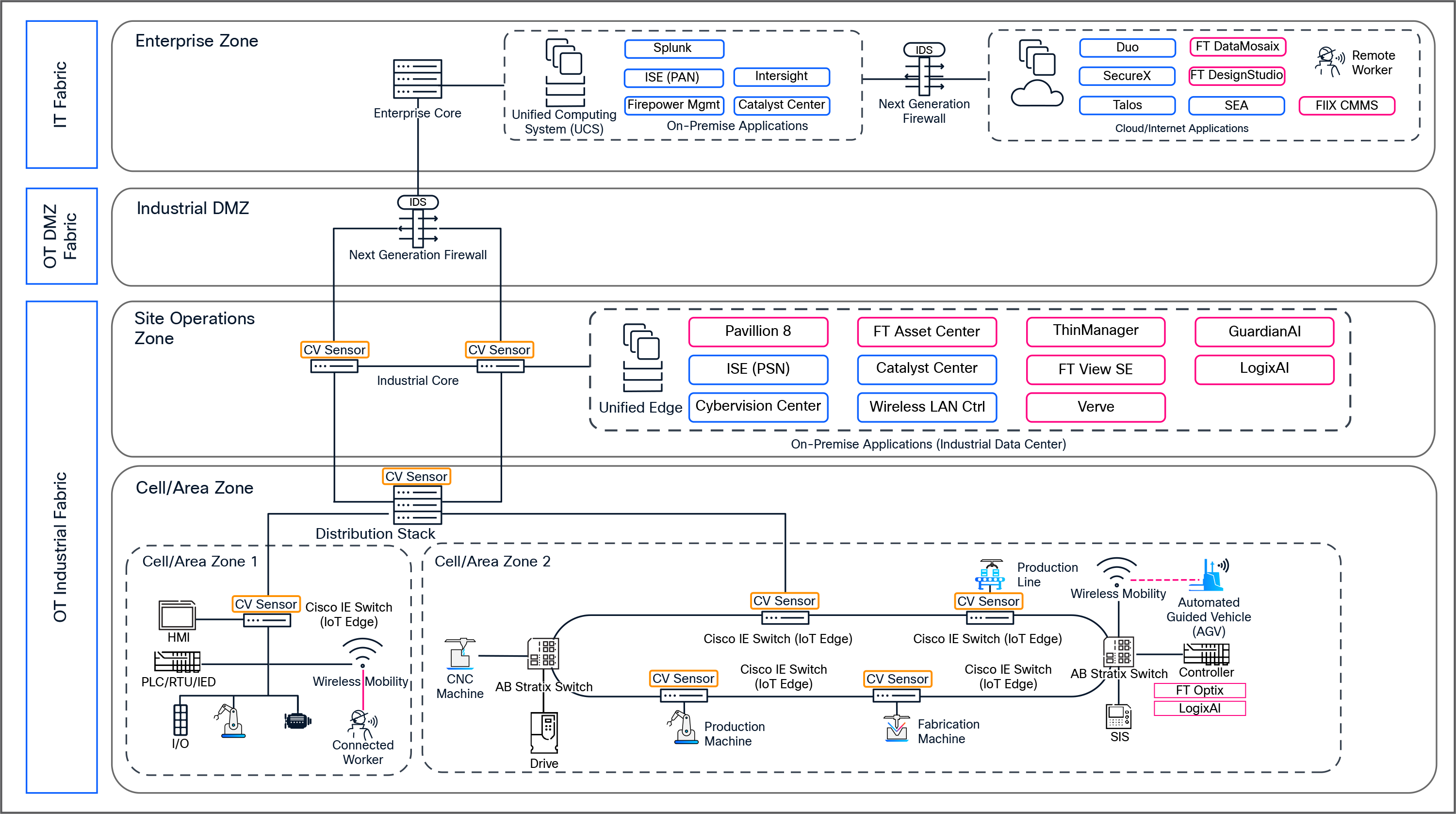
Full-Stack Software-Defined Manufacturing reference design
The Full-Stack Software Defined Manufacturing solution encompasses the entire production process, from design and planning to execution and optimization, providing a higher level of abstraction to deal with the overall manufacturing system. Software-defined networking is a key enabler, providing the underlying network infrastructure for software-defined automation.
Table 1. Use cases for the Full-Stack Software Defined Manufacturing solution
| Use case |
Description and benefits |
| Cloud-based engineering with Design Studio |
● Cloud-based development environment
● AI powered automated creation, test and knowledge availability
● Multiuser collaboration
● Secure cloud-to-edge communications
|
| AI for predictive maintenance |
● Predictive maintenance and condition-based monitoring
● Increased operational efficiency
● Enhanced resource management
● Cost-effective implementation
|
| AI modeling at the edge |
● Predictive maintenance and cost efficiency
● Improved product quality
● Enhanced operational efficiency
● User-friendly solutions
|
| Software-defined networking for manufacturing |
● Minimized downtime and production losses
● Enhanced disruption management
● Increased flexibility and adaptability
● Accelerated time to market and cost efficiency
|
| Cybersecurity – AI edge to cloud |
● Improved customer trust in manufacturing ecosystem
● Ability to meet government and industry regulation requirements
● Ability to handle disruptions
|
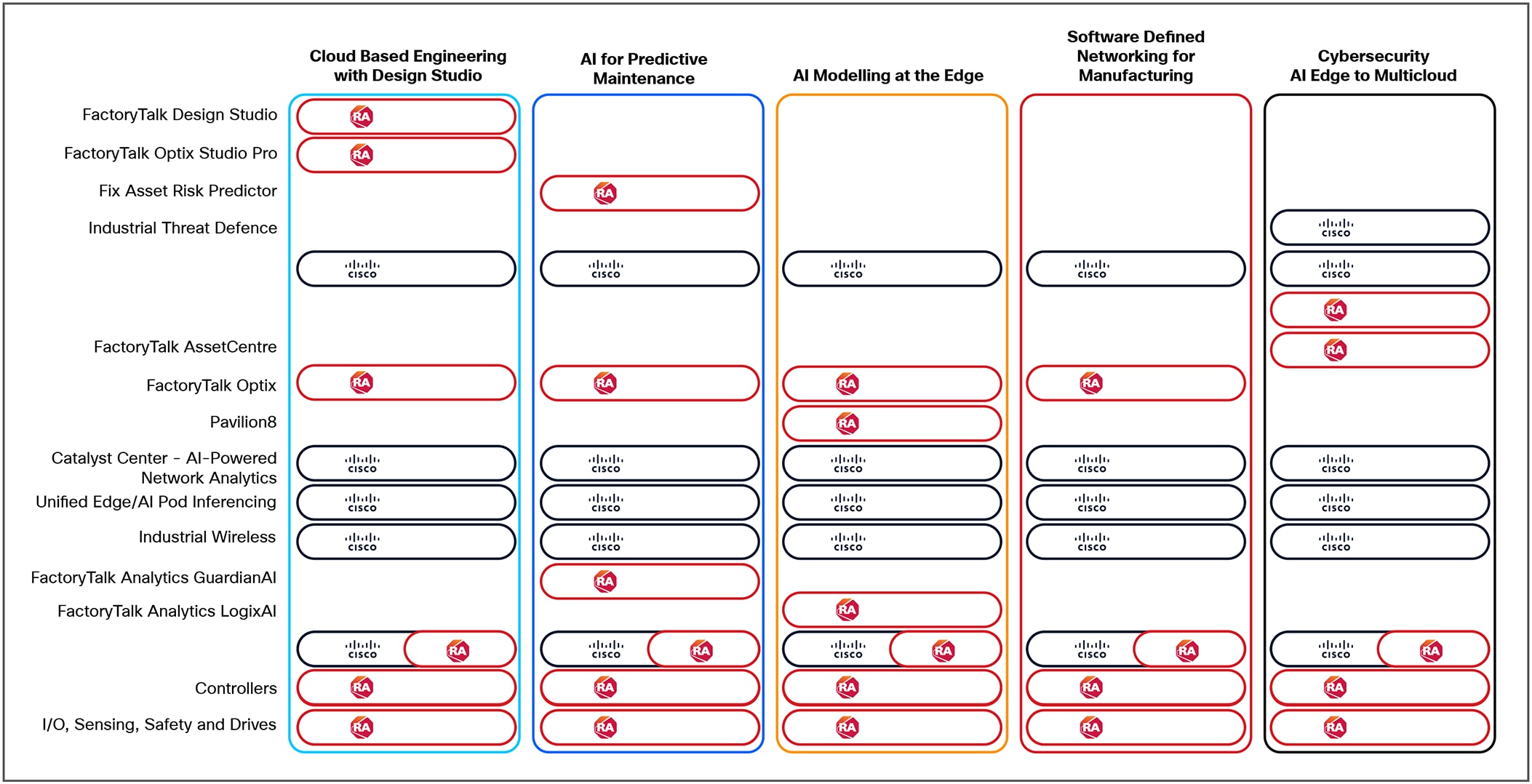
Full-Stack Software-Defined Manufacturing Use Cases
How Rockwell Automation and Cisco provide expertise to customers
Rockwell Automation and Cisco bring together their respective strengths in OT and IT to offer comprehensive solutions for modern manufacturing challenges. Here’s how they provide their expertise to customers:
Converged Plantwide Ethernet (CPwE): Rockwell Automation and Cisco have developed the CPwE architecture, a set of tested and validated designs that help manufacturers build a secure, scalable, and resilient network infrastructure. This architecture integrates IT and OT systems, helping ensure seamless connectivity and robust security.
LifecycleIQ® Services: Rockwell Automation’s LifecycleIQ® Services, enhanced by Cisco’s Cyber Vision solution, offer advanced cybersecurity threat detection and response capabilities. These services help manufacturers protect their networks from cyberthreats and ensure business continuity.
Digital transformation solutions: Together, Rockwell Automation and Cisco provide solutions that support digital transformation initiatives. These solutions include industrial IoT, predictive analytics, and smart manufacturing technologies that enhance operational efficiency and agility.
Industry-specific expertise: The partnership offers tailored solutions for various industries, including water and wastewater, food and beverage, life sciences, mining, and oil and gas. This industry-specific expertise helps ensure that the solutions meet the unique challenges and regulatory requirements of each sector.
Training and support: Rockwell Automation and Cisco provide extensive training and support to help customers implement and manage their network infrastructure. This includes hands-on training, virtual labs, and access to a wealth of resources and documentation.
Converged Plantwide Ethernet (CPwE)
CPwE is a validated design jointly created by Cisco and Rockwell Automation that helps customers and partners securely and reliably build EtherNet/IP industrial automation and control systems.
CPwE has served the industry for well over 10 years and has been instrumental in helping the transition toward EtherNet/IP connected enterprise plants. While CPwE is still relevant and applicable, customer requirements have been evolving since its inception.
Building upon the original CPwE design as the foundation, the Full Stack Software Defined Manufacturing architecture represents the next evolution of the design.
Just as CPwE helped guide customers toward an EtherNet/IP-based design, the Full-Stack Software Defined Manufacturing solution will help prepare and guide customers and partners as they prepare to take advantage of autonomous operations and AI.
For additional information, visit Validated Designs for Digital Manufacturing – Converged Plantwide Ethernet (CPwE): https://www.cisco.com/c/m/en_us/solutions/industries/manufacturing/cpwe-experience.html.
The Cisco and Rockwell Automation Advantage
Cisco and Rockwell Automation have been global strategic partners for over 18 years, leading the digital transformation for the connected enterprise by bringing industrial automation together with industrial networking and security solutions. Today, Cisco and Rockwell Automation are once again leading change in the industrial automation landscape as it evolves to embrace full-stack Software Defined Manufacturing and enabling the shift from automation to autonomy.
Cisco is a global leader in IT networking and cybersecurity with decades of experience securing enterprise networks, bringing a deep understanding of IT security principles, technologies, and best practices.
Rockwell Automation is a global leader in industrial automation and control systems with unparalleled expertise in OT environments, industrial protocols, and manufacturing processes.
Only Cisco and Rockwell Automation can deliver the full-stack combination of AI-enabled autonomous operations, software-defined manufacturing, Industrial Threat Defense, industrial observability, sustainable operations, and operational excellence.
For additional information, visit Cisco and Rockwell Automation - Cisco
For additional information on Cisco software-defined networking, visit Software-Defined Networking (SDN) Definition - Cisco
For additional information on Cisco Catalyst™ Center, visit Cisco Catalyst Center Network Management - Cisco
For additional information on Cisco Industrial Threat Defense, visit Products - Cisco Industrial Threat Defense At a Glance - Cisco