Full-Stack Software Defined Manufacturing – Artificial Intelligence for Predictive Maintenance Solution Overview
Available Languages
Bias-Free Language
The documentation set for this product strives to use bias-free language. For the purposes of this documentation set, bias-free is defined as language that does not imply discrimination based on age, disability, gender, racial identity, ethnic identity, sexual orientation, socioeconomic status, and intersectionality. Exceptions may be present in the documentation due to language that is hardcoded in the user interfaces of the product software, language used based on RFP documentation, or language that is used by a referenced third-party product. Learn more about how Cisco is using Inclusive Language.
Accelerating AI-powered autonomous operations – Monitor industrial assets, predict potential equipment failures, and optimize maintenance activities
The Full-Stack Software-Defined Manufacturing solution from Cisco and Rockwell Automation enhances production quality, efficiency, and plant resilience by offering operational visibility and preparing for future AI insights and autonomous operations, helping businesses stay competitive as they evolve.
It provides a regulatory-compliant cybersecurity strategy from edge to cloud, crucial for plant availability and the manufacturing ecosystem’s trustworthiness to support innovation and growth.
AI-based predictive maintenance enhances asset reliability, operational efficiency, and workforce productivity by enabling real-time monitoring and intelligent decision-making at the edge. It empowers technicians and plant managers to anticipate failures, reduce downtime, and optimize maintenance schedules—keeping operations resilient and cost-effective.
This solution leverages Rockwell Automation’s FactoryTalk® Maintenance Suite—including Guardian AI, FIIX Asset Risk Predictor, and FT Optix—deployed on Cisco® edge compute and AI PODs. Together, they form a full-stack architecture that integrates OT data sources like Variable-Frequency Drives (VFDs) and Programmable Logic Controllers (PLCs) with edge-based machine learning models, enabling fast, secure, and scalable analytics.
Predictive maintenance uses AI to analyze historical and live data, detect anomalies, and forecast equipment health. It replaces reactive maintenance with proactive strategies, helping manufacturers avoid costly disruptions and extend asset life. The system also supports closed-loop control, allowing real-time adjustments based on predictive insights.
Cisco’s secure infrastructure, including Cisco Firepower® Threat Defense firewalls, helps ensure that data flows between edge and cloud/on-premises systems are protected while maintaining low latency and high availability. This architecture is designed to scale across multiple plants and asset types, making it ideal for industries like automotive, food and beverage, energy, and discrete manufacturing.
AI-based predictive maintenance is a foundational capability of the Full-Stack Software-Defined Manufacturing (SDM) solution from Cisco and Rockwell Automation. It enables manufacturers to unlock the full potential of their data, improve decision-making, and prepare for autonomous operations—while staying competitive in a rapidly evolving industrial landscape.
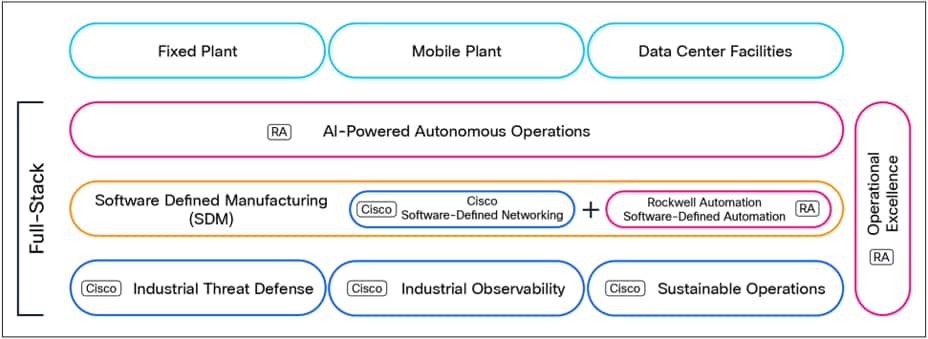
Components of the Full-Stack Software Defined Manufacturing solution
Modern industrial operations face increasing pressure to be agile, scalable, and resilient in the face of global competition, supply chain disruptions, and evolving customer demands. Traditional maintenance strategies—often reactive or scheduled—struggle to keep pace with these challenges, leading to unplanned downtime, inefficient resource use, and rising operational costs.
AI-based predictive maintenance, as part of the Full-Stack Software Defined Manufacturing reference design, addresses these challenges by enabling real-time asset monitoring, intelligent anomaly detection, and proactive maintenance planning.
By analyzing data from OT devices like VFDs and PLCs at the edge, the system delivers actionable insights without relying on cloud latency. Maintenance teams can anticipate failures, optimize schedules, and extend asset life—all while maintaining secure, scalable connectivity across the plant network.
Cisco’s infrastructure helps ensure secure data flows between edge and cloud/on-premises systems, supporting both centralized and distributed deployments
AI-based predictive maintenance is a critical enabler of autonomous operations and operational excellence. It helps manufacturers evolve from automation to autonomy, unlocking new levels of efficiency, reliability, and competitiveness.
● Minimized downtime and improved reliability
AI-based predictive maintenance identifies potential failures before they occur, allowing maintenance teams to intervene proactively. This reduces unplanned downtime and helps ensure continuous operation of critical assets.
● Enhanced safety and compliance
By monitoring asset health in real time and detecting anomalies early, the system helps prevent hazardous failures and supports compliance with industry safety standards and regulations.
● Scalability and flexibility across plants
The architecture supports deployment across multiple sites and asset types. Whether on-premises or cloud-based, it adapts to diverse operational environments and scales with your business needs.
● Optimized resource utilization and cost savings
Maintenance is performed only when needed, reducing unnecessary interventions, labor costs, and spare parts inventory. This leads to more efficient use of resources and lower operating expenses.
● Accelerated digital transformation and operational excellence
The integration of edge AI, secure connectivity, and intelligent analytics enables faster decision-making, supports autonomous operations, and drives continuous improvement across your manufacturing processes.
● Rising demand for intelligent maintenance
Industrial organizations are under pressure to increase uptime, reduce costs, and improve sustainability. According to a recent report by Markets and Markets, the global predictive maintenance market is expected to grow from $6.9 billion in 2021 to $28.2 billion by 2026, driven by the need for real-time asset monitoring and data-driven decision-making.
As manufacturers adopt digital transformation strategies, they face challenges in integrating legacy systems, managing vast amounts of operational data, and deploying AI at scale. Traditional maintenance models—reactive or time-based—are no longer sufficient to meet the demands of modern production environments.
● Operational complexity and skills gap
Operational Technology (OT) teams often struggle with limited visibility into asset health, siloed data sources, and a shortage of skilled personnel to manage complex systems. Predictive maintenance powered by AI helps bridge this gap by automating insights and enabling proactive interventions.
However, deploying AI in industrial settings requires secure, scalable infrastructure and edge computing capabilities to process data close to the source. This is where Cisco’s edge compute and AI PODs and Rockwell’s FactoryTalk® Maintenance Suite come together to deliver a full-stack solution.
● Security and scalability are nonnegotiable
As more devices connect to the network, cybersecurity becomes a top priority. Cisco’s Intelligent Threat Defence ensures secure data flows between edge and cloud/ on-premises systems, while the modular architecture supports expansion across multiple plants and asset types.
AI-based predictive maintenance is not just a trend—it’s a strategic imperative for manufacturers aiming to stay competitive, resilient, and future-ready.
The AI-based predictive maintenance solution is a modular, full-stack architecture combining Rockwell Automation’s FactoryTalk® Maintenance Suite with Cisco’s edge compute and AI infrastructure. Customers can deploy the solution on-premises, in the cloud, or in hybrid environments, depending on their operational needs.
● Rockwell Automation FactoryTalk® Analytics Guardian AI: A machine learning engine that monitors asset behavior and detects anomalies.
● Rockwell Automation FIIX Asset Risk Predictor: A cloud-based Computerized Maintenance Management System (CMMS) that evaluates asset health and risk levels.
● Rockwell Automation FT Optix: A visualization and Human-Machine Interface (HMI) tool that collects and displays operational data.
● Cisco edge compute and AI PODs: Ruggedized edge platforms that host AI models and analytics engines close to the data source. Cisco’s new Unified Edge is an all-in-one compute device that incorporates networking, security, and compute to serve as an AI platform at the edge.
● Cisco Firepower Threat Defense firewalls: Next-generation firewalls that secure plant networks and data flows.
This solution is designed to work with existing industrial devices like VFDs, PLCs, and sensors, eliminating the need for additional hardware.
Key capabilities
● Real-time monitoring: Collects live data from industrial assets and visualizes it through FT Optix.
● Anomaly detection: Guardian AI uses machine learning to identify deviations from normal asset behavior.
● Predictive insights: FIIX generates risk scores and maintenance recommendations based on historical and real-time data.
● Edge intelligence: Cisco edge PODs process data locally, reducing latency and enabling faster decision-making.
● Secure connectivity: Cisco Firepower Threat Defense firewalls help ensure encrypted, policy-driven communication across the plant network.
Models and options
Deployment models:
● Edge only: Ideal for remote or latency-sensitive environments where cloud connectivity is limited.
● Hybrid: Combines edge processing with cloud-based analytics for scalable insights.
● Cloud-centric: Suitable for centralized operations with high compute availability.
Component variants:
● Guardian AI: Available as a standalone edge module or integrated with FactoryTalk® Edge Manager.
● FIIX CMMS: Offered in tiered subscription models based on asset volume and analytics depth.
● Cisco edge PODs: Configurable with different compute and storage capacities to match workload requirements.
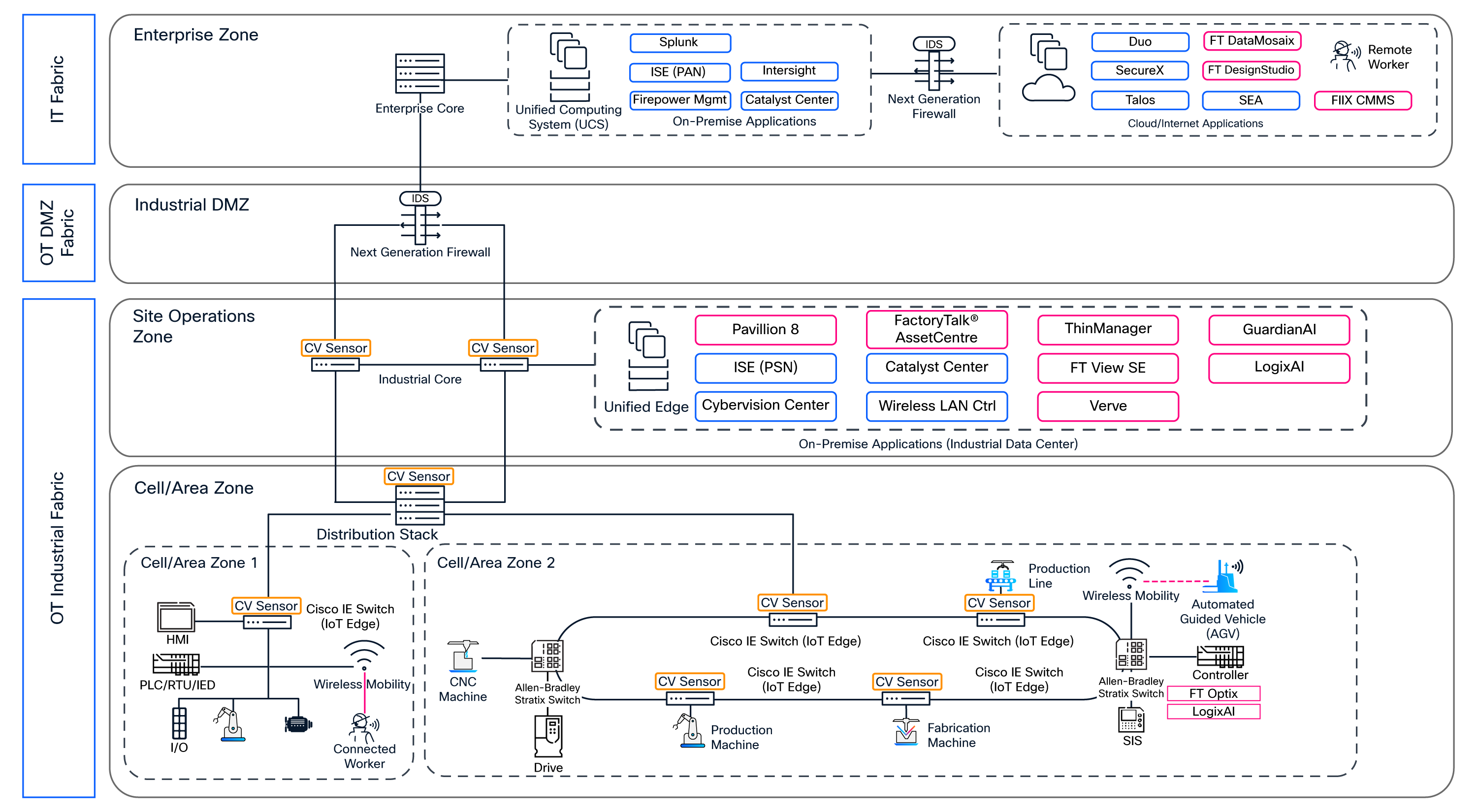
Full-Stack Software-Defined Manufacturing reference design
This architecture enables maintenance teams to shift from reactive to proactive strategies, improving uptime, reducing costs, and enhancing asset performance.
In today’s industrial landscape, agility, intelligence, and resilience are no longer optional—they’re essential. That’s where full-stack Software-Defined Manufacturing (SDM) comes in. Software Defined Manufacturing is a modern approach that transforms traditional manufacturing environments into intelligent, software-driven ecosystems. It enables you to orchestrate operations, optimize asset performance, and respond to disruptions in real time—all through a unified, scalable architecture.
This solution brings together the best of Rockwell Automation and Cisco technologies to deliver predictive maintenance powered by edge AI. By integrating Rockwell Automation FactoryTalk® Analytics Guardian AI, FIIX Asset Risk Predictor, and FT Optix and Cisco edge compute and AI PODs, you get a full-stack Software Defined Manufacturing platform that’s secure, scalable, and insight driven.
Here’s how it works:
● Data collection: Your existing industrial devices—like VFDs and PLCs—generate rich operational data. This data is captured by Rockwell Automation FT Optix, which acts as the HMI and visualization layer.
● AI-driven analysis: The data flows to Rockwell Automation FIIX Asset Risk Predictor and Guardian AI, where machine learning models analyze asset behavior, detect anomalies, and predict failures.
● Edge intelligence: Cisco edge compute and AI PODs host these analytics engines locally, enabling real-time decision-making without relying on cloud latency.
● Secure connectivity: Cisco Firewall Threat Defense firewalls help ensure secure data transmission across your plant network, whether the solution is deployed on-premises or in the cloud.
Together, these components form a full-stack Software Defined Manufacturing solution that empowers you to shift from reactive to proactive maintenance, reduce downtime, and improve operational efficiency. It’s not just about collecting data—it’s about turning that data into action.
Boost industrial efficiency with AI-powered predictive maintenance
Challenge 1: Reduce downtime and optimize performance with smart analytics.
Example: Keep production flowing with smarter maintenance.
By continuously monitoring asset health and performance, the solution helps you schedule maintenance only when needed—reducing unnecessary interventions and keeping your production lines running smoothly.
Challenge 2: Turn real-time data into actionable insights at the edge.
Example: Unlock instant intelligence from your machines.
With Cisco edge compute and Rockwell’s analytics tools, you can process data from your industrial assets—like VFDs and PLCs—right where it’s generated. This means faster insights, quicker decisions, and less reliance on cloud latency.
Challenge 3: Predict failures before they happen with edge AI and automation.
Example: Stay ahead of breakdowns with predictive AI.
Using Guardian AI and FIIX Asset Risk Predictor, you can detect anomalies and forecast equipment failures before they disrupt operations. AI models trained on your asset data help you move from reactive to proactive maintenance.
Challenge 4: Empower your plant with intelligent, secure, and scalable AI.
Example: Scale smart, stay secure, and operate with confidence.
Cisco’s secure edge infrastructure, combined with Rockwell’s scalable analytics, gives you a future-ready platform. Whether you’re deploying on-premises or in the cloud, your plant operations stay protected and adaptable.
Challenge 5: Drive operational excellence through proactive asset monitoring.
Example: Make every asset count with proactive monitoring.
Real-time visibility into asset conditions allows your teams to act before issues escalate. With predictive alerts and risk scores, you can prioritize maintenance tasks and improve overall equipment effectiveness.
“To maximize AI’s productivity benefits in a manufacturing environment, connecting islands of automation is critical. Connecting multiple lines in a plant and then connecting multiple plants can generate petabytes of data. Some applications make sense to go back to the data center; that will continue to happen. But other decisions need to be made in real time at the edge—especially on a manufacturing floor. Edge computing requires an integrated platform approach where the compute, the networking, and of course, the security all come together. Performant, secure networking at the edge is absolutely essential.”
Blake Moret
chairman and CEO of Rockwell Automation
Table 1. Use cases
| Industry name |
Use case |
| Life sciences manufacturing |
Monitoring critical equipment such as centrifuges, HVAC systems, and cleanroom compressors. Helps ensure compliance with strict regulatory standards by preventing unexpected failures and maintaining environmental control systems essential for product integrity. |
| Mining |
Monitoring heavy-duty assets like conveyors, crushers, and ventilation systems. Reduces costly downtime in remote operations by predicting mechanical failures and optimizing maintenance schedules for high-impact equipment. |
| Tire manufacturing |
Monitoring curing presses, mixers, and extruders. Improves production consistency and reduces scrap rates by identifying wear and tear before it affects product quality or throughput. |
| Data center |
Monitoring cooling systems, Uninterruptible Power Supply (UPS) units, and power distribution equipment. Improves uptime and energy efficiency by predicting failures in critical infrastructure, reducing risk of service disruption. |
| Food and beverage manufacturing |
Monitoring packaging lines, refrigeration units, and fluid pumps. Prevents spoilage and contamination by helping ensure equipment reliability, while optimizing maintenance to meet hygiene and safety standards. |
How Rockwell Automation and Cisco provide expertise to customers
Rockwell Automation and Cisco bring together their respective strengths in OT and IT to offer comprehensive solutions for modern manufacturing challenges. Here’s how they provide their expertise to customers:
Converged Plantwide Ethernet (CPwE): Rockwell Automation and Cisco have developed the CPwE architecture, a set of tested and validated designs that help manufacturers build a secure, scalable, and resilient network infrastructure. This architecture integrates IT and OT systems, helping ensure seamless connectivity and robust security.
LifecycleIQ® Services: Rockwell Automation’s LifecycleIQ® Services, enhanced by Cisco’s Cyber Vision solution, offer advanced cybersecurity threat detection and response capabilities. These services help manufacturers protect their networks from cyberthreats and ensure business continuity.
Digital transformation solutions: Together, Rockwell Automation and Cisco provide solutions that support digital transformation initiatives. These solutions include industrial IoT, predictive analytics, and smart manufacturing technologies that enhance operational efficiency and agility.
Industry-specific expertise: The partnership offers tailored solutions for various industries, including water and wastewater, food and beverage, life sciences, mining, and oil and gas. This industry-specific expertise helps ensure that the solutions meet the unique challenges and regulatory requirements of each sector.
Training and support: Rockwell Automation and Cisco provide extensive training and support to help customers implement and manage their network infrastructure. This includes hands-on training, virtual labs, and access to a wealth of resources and documentation.
Challenge: A global tire manufacturer faced frequent unplanned downtime due to curing press failures, impacting production schedules and increasing scrap rates.
Solution: By deploying Rockwell’s FactoryTalk® Guardian AI and FIIX Asset Risk Predictor on Cisco edge compute PODs, the company gained real-time visibility into press performance and predictive alerts for mechanical wear.
Benefits:
● Reduced downtime by 30% across critical assets
● Improved product quality and consistency
● Optimized spare parts inventory and maintenance scheduling
● Achieved ROI within 9 months of deployment
The Cisco and Rockwell Automation Advantage
Cisco and Rockwell Automation have been global strategic partners for over 18years, leading the digital transformation for the connected enterprise by bringing industrial automation together with industrial networking and security solutions. Today, Cisco and Rockwell Automation are once again leading change in the industrial automation landscape as it evolves to embrace full-stack software-defined manufacturing and enable the shift from automation to autonomy.
Cisco is a global leader in IT networking and cybersecurity, with decades of experience securing enterprise networks, bringing a deep understanding of IT security principles, technologies, and best practices.
Rockwell Automation is a global leader in industrial automation and control systems, with unparalleled expertise in OT environments, industrial protocols, and manufacturing processes.
Only Cisco and Rockwell Automation can deliver the full-stack combination of AI-enabled autonomous operations, software-defined manufacturing, Industrial Threat Defense, industrial observability, sustainable operations, and operational excellence.
For additional information, visit Cisco and Rockwell Automation - Cisco
For additional information on Cisco software-defined networking, visit Software-Defined Networking (SDN) Definition - Cisco
For additional information on Cisco Catalyst™ Center, visit Cisco Catalyst Center Network Management - Cisco
For additional information on Cisco Industrial Threat Defense, visit Products - Cisco Industrial Threat Defense At a Glance - Cisco