Application-Aware Path Selection in SRv6 Networks
Available Languages
Bias-Free Language
The documentation set for this product strives to use bias-free language. For the purposes of this documentation set, bias-free is defined as language that does not imply discrimination based on age, disability, gender, racial identity, ethnic identity, sexual orientation, socioeconomic status, and intersectionality. Exceptions may be present in the documentation due to language that is hardcoded in the user interfaces of the product software, language used based on RFP documentation, or language that is used by a referenced third-party product. Learn more about how Cisco is using Inclusive Language.
Enterprise and service-provider WANs increasingly adopt Segment Routing over IPv6 (SRv6) as a programmable underlay. Meanwhile, application traffic grows more encrypted and dynamic, and AI workloads increasingly dominate this traffic. These AI workloads do not map cleanly to traditional quality of service (QoS) markings.
Routing and steering traffic solely on Differentiated Services Code Point (DSCP) values is a coarse, trust-dependent approach. Application-aware routing identifies traffic at Layer 7 and binds it to transport policies that enforce distinct path service-level agreements (SLAs). Cisco Network-Based Application Recognition (NBAR2) performs this identification on Cisco IOS XE.
The application-aware routing model follows this sequence:
1. NBAR classifies the traffic.
2. Enhanced Policy-Based Routing (ePBR) assigns a Forward Class.
3. A Per-Flow Policy (PFP) applies flow-specific handling.
4. A Per-Destination Policy (PDP) applies destination-specific handling.
5. SRv6 steers the traffic along a path that meets the SLA constraints.
This white paper explains why the application-aware model complements DSCP-only routing. It also describes how NBAR
● recognizes applications on IOS XE
● adds support for AI protocols through recent NBAR protocol-pack updates
● enables you to architect SRv6 PDP and PFP policies that deliver differentiated SLAs for each application.
Finally, this white paper describes how Cisco ThousandEyes closes the assurance loop by correlating application and path visibility.
Introduction
The problem
Wide-area network (WAN) operators traditionally rely on two mechanisms:
● Quality of service (QoS) marking, which uses the Differentiated Services Code Point (DSCP), IP Precedence, or Multiprotocol Label Switching (MPLS) Experimental (EXP) bits.
● Destination-based routing, which uses the prefix, virtual private network (VPN), or Border Gateway Protocol (BGP) next-hop.
Neither mechanism answers two key questions:
● Which application does this flow represent?
● What transport service-level agreement (SLA) does the flow require?
The DSCP indicates how a packet claims to be treated, but it does not identify the application that generated the flow. In modern environments, including encrypted software-as-a-service (SaaS), Quick UDP Internet Connections (QUIC) or Hypertext Transfer Protocol version 3 (HTTP/3), artificial intelligence (AI) application programming interfaces (APIs), and shadow IT, the DSCP alone cannot support intent-based path selection.
Application-aware routing solution
Application-aware routing identifies applications deeply at the network edge and steers flows onto paths that meet application-specific service-level agreements (SLAs). On the Cisco 8000 Series Secure Routers:
| Layer |
Technology |
Role |
| Application identification |
NBAR2 (DPI + signatures) |
Classify flows by application/protocol |
| Ingress marking |
MQC + ePBR |
Map applications to Forward Classes (FC 0–7) |
| Per-flow steering |
SRv6-TE PFP |
Map FC → color (SLA intent) |
| Per-destination path |
SRv6-TE PDP |
Compute/steer explicit or dynamic SRv6 paths |
| SLA enforcement |
Flex-Algo, PCE, Performance Measurement |
Delay-optimized, affinity-constrained paths |
| Application identification |
NBAR2 (DPI + signatures) |
Classify flows by application/protocol |
| Assurance and validation |
Cisco ThousandEyes (Traffic Insights + synthetics) |
Correlate NBAR app-ID with path SLA outcomes |
Limitations of DSCP-based routing
DSCP is an assertion, not an identity
The DSCP is a 6-bit field that reflects a marking decision. The network cannot independently verify that traffic marked Expedited Forwarding (EF) is real-time collaboration traffic. The network also cannot verify that a bulk backup was not marked EF.
| Scenario |
DSCP limitation |
| Default enterprise endpoints |
Most traffic arrives as DSCP 0 (Best Effort) |
| Encrypted SaaS (HTTPS, QUIC) |
Port 443 carries thousands of distinct applications |
| Guest / IoT / unmanaged devices |
No consistent marking policy |
| Cloud egress |
Provider rewrites or strips markings at boundary |
| AI/LLM API traffic |
Typically, HTTPS; indistinguishable from generic web at L3/L4 |
DSCP does not survive semantic boundaries
● Webex meeting media vs. Webex AI transcription
● GitHub Copilot vs. generic GitHub HTTPS
● OpenAI API calls vs. browsing openai.com
Operational fragility
DSCP-based steering requires end-to-end trust across the LAN, the WAN edge, the carrier, and the cloud. Network-Based Application Recognition (NBAR) operates at the first trusted enforcement point: the Secure Router.
Benefits of application-aware routing
True application identity
Network-Based Application Recognition (NBAR2) classifies more than 1,400 applications without client cooperation. To classify these applications, NBAR2 inspects:
● payloads
● flow state
● Domain Name System (DNS) transactions
● Transport Layer Security (TLS) Server Name Indication (SNI)
● Hypertext Transfer Protocol (HTTP) patterns, and
● proprietary signatures.
First-packet and early-flow classification
Network-Based Application Recognition (NBAR) uses these classification techniques:
● Domain Name System (DNS)-based learning: NBAR correlates DNS responses with subsequent flows.
● Socket cache: NBAR remembers recently classified server endpoints.
● Stateful multipacket inspection: NBAR tracks dynamic ports, such as those used by Session Initiation Protocol (SIP) and File Transfer Protocol (FTP).
● Deep packet inspection (DPI): NBAR performs regular expression matching and field extraction on Hypertext Transfer Protocol (HTTP), Real-time Transport Protocol (RTP), and Citrix traffic.
● Encrypted traffic analytics: NBAR matches the Server Name Indication (SNI) and Common Name (CN) without decrypting the traffic.
The SNI is a Transport Layer Security (TLS) extension that the client sends in the ClientHello message. The SNI carries the target hostname in cleartext, such as api.openai.com, so that the server can select the correct certificate before the session is encrypted. NBAR reads the SNI to identify the intended destination application without decrypting the traffic.
The CN is an identity field in the server's X.509 TLS certificate. Servers often use the CN alongside Subject Alternative Name (SAN) entries. NBAR can match the CN or SAN from the server's certificate response when it classifies encrypted flows. This match provides a second signal when the SNI is absent, or it validates the classification.
Together, SNI and CN matching enable NBAR to distinguish applications that share port 443 and encrypted payloads, such as OpenAI API traffic and generic HTTPS browsing.
This capability enables you to enforce policy before enough packets arrive to infer intent from the DSCP alone.
Granular SLA binding
| Application (NBAR) |
SLA intent |
SRv6 color |
Path constraint |
| webex-media |
Loss <1%, latency <150ms, jitter <30ms |
102 |
Min-delay, voice-video slice |
| open-ai / anthropic-ai |
Loss <1%, latency <300ms |
103 |
Low-loss path |
| ftp / ms-update |
Latency <500ms, loss <5% |
101 |
High-bandwidth, cost-optimized |
| youtube / netflix |
Best effort |
100 |
Default IGP / best-cost |
NBAR and DSCP: complementary classification for SRv6 steering
NBAR and the DSCP address different parts of the classification problem. Used together, they strengthen Segment Routing over IPv6 (SRv6) Per-Flow Policy (PFP) steering. The same PFP and Per-Destination Policy (PDP) machinery applies whether you set the Forward Class from NBAR, the DSCP, or both.
| Aspect |
DSCP-based PFP |
NBAR-based PFP |
Combined (recommended) |
| Classification input |
match dscp ef |
match protocol webex-media |
match protocol + match dscp |
| Trust model |
Trusts endpoint marking |
Independent DPI at edge |
NBAR validates; DSCP reinforces QoS |
| Encrypted SaaS |
All appear as DSCP 0 |
Distinguished by SNI/signature |
NBAR identifies; DSCP queues |
| AI workloads |
Invisible (HTTPS) |
open-ai, anthropic-ai, etc. |
NBAR steers; DSCP queues |
Protocol-pack agility
Cisco ships NBAR signatures in Protocol Packs that update independently of Cisco IOS XE images.
Closed-loop visibility
Application-aware routing and Segment Routing over IPv6 (SRv6) steering require you to validate that the policies work as intended. Cisco ThousandEyes on the Secure Router provides this assurance layer. Refer to Cisco ThousandEyes in the application-aware SRv6 solution for a detailed treatment of ThousandEyes in the overall solution.
How NBAR works on Cisco IOS XE
NBAR2 architecture
● Protocol Pack — compiled signature library
● Flow table — stateful per-flow context
● Classification pipeline — DNS-learned → ports → multi-packet → static → encrypted
● MQC integration — match protocol
Classification methods
| Method |
Description |
Example |
| Static port |
Well-known TCP/UDP ports |
DNS (53), NTP (123) |
| Stateful inspection |
Track negotiations across packets |
SIP, FTP, RTSP |
| Deep packet inspection |
Parse headers and payload fields |
HTTP URL, RTP payload type |
| DNS-based learning |
Map DNS answer → flow 5-tuple |
SaaS first-packet ID |
| TLS SNI / cert CN |
Classify encrypted flows |
api.openai.com |
| Custom protocols |
Operator-defined ip nbar custom |
Internal app on port 8443 |
| Attribute matching |
Group by category, business-relevance |
match protocol attribute traffic-class |
Procedure 1. Implementation on Cisco 8000 series secure routers
Step 1. Enable NBAR protocol discovery:
interface GigabitEthernet0/0/0
ip nbar protocol-discovery
Step 2. Load the latest protocol pack:
ip nbar protocol-pack bootflash:PP78-0-0.ppack
show ip nbar protocol-pack active
Router#sh ip nbar protocol-id | i open-ai|anthropic|cursor|webex-ai
Note: Protocol Pack upgrades are included in the Routing Advantage license. Refer to the NBAR2 Protocol Pack Library: https://www.cisco.com/c/en/us/td/docs/ios-xml/ios/qos_nbar/prot_lib/config_library/nbar-prot-pack-library.html
Step 3. Define application class-maps (NBAR + DSCP)
NBAR provides application identity for SRv6 path selection; DSCP complements classification for flows already marked by trusted LAN endpoints. The examples use both match protocol and match dscp to illustrate this complementary model.
class-map match-all FC-VOICE-VIDEO
match protocol webex-media
match dscp ef
class-map match-all FC-CRITICAL-DATA
match protocol open-ai
match protocol anthropic-ai
match dscp cs6
class-map match-all FC-BULK-DATA
match protocol ftp
match protocol ms-update
match dscp af11
class-map match-all FC-BEST-EFFORT
match protocol youtube
match protocol netflix
match dscp default
Step 4. Apply QoS policy
policy-map APP-QOS
class FC-VOICE-VIDEO
priority percent 30
set dscp ef
class FC-CRITICAL-DATA
bandwidth percent 20
set dscp cs6
class FC-BULK-DATA
bandwidth percent 10
set dscp af11
class class-default
fair-queue
Step 5. Verification
show policy-map interface GigabitEthernet0/0/0
show ip nbar protocol-discovery stats
NBAR updates for AI protocol recognition
Protocol pack 75.0.0
| New protocol |
Description |
| open-ai |
OpenAI API and services |
| github-copilot |
GitHub Copilot AI assistant |
| google-ai |
Google Gemini and AI services |
| azure-ai |
Microsoft Azure AI services |
| amazon-sagemaker |
AWS SageMaker ML platform |
| meta |
Meta AI services |
Protocol pack 76.0.0
| New protocol |
Description |
| anthropic-ai |
Anthropic Claude models and API |
| amazon-bedrock |
AWS managed foundation-model service |
| amazon-q |
Amazon Q AI assistant |
| deepseek |
DeepSeek AI models |
| perplexity-ai |
Perplexity AI search/assistant |
| x-ai |
xAI (Grok) services |
Protocol pack 77.0.0
| New protocol |
Description |
| huggingface |
Hugging Face model hub and inference |
Protocol pack 78.0.0 (April 2026)
| New protocol |
Description |
| cursor |
Cursor AI-assisted IDE |
| webex-ai |
Webex AI features (transcription, summaries) |
Why AI-specific signatures matter
● Inference APIs (open-ai, anthropic-ai) — latency-sensitive; low-delay SRv6 paths
● Model training (amazon-sagemaker, huggingface) — bulk, throughput-oriented
● Embedded AI (webex-ai) — split SLA from webex-media real-time flows
● Developer tools (cursor, github-copilot) — distinct security/policy treatment
Leveraging NBAR in SRv6: PDP/PFP SR-TE policies
Cisco IOS XE maps NBAR application signatures to SRv6 transport policies through Forward Class and color.
SRv6 policy model on IOS XE
| Application (NBAR) |
NBAR class-map |
ePBR FC |
PFP color |
PDP |
Path constraint |
| webex-media |
FC-VOICE-VIDEO |
2 |
102 |
PDP-VOICE-VIDEO |
Min-delay, voice-video slice |
| open-ai / anthropic-ai |
FC-CRITICAL-DATA |
3 |
103 |
PDP-CRITICAL-DATA |
Low-loss / min-delay |
| ftp / ms-update |
FC-BULK-DATA |
1 |
101 |
PDP-BULK-DATA |
High-bandwidth, cost-optimized |
| youtube / netflix |
FC-BEST-EFFORT |
0 |
100 |
PDP-BEST-EFFORT |
Default IGP / best-cost |
Reference configuration
PDPs — One per SLA plane
segment-routing traffic-eng
policy PDP-VOICE-VIDEO
color 102 end-point 2001:db8:2::1
candidate-paths
preference 100
constraints
segments dataplane srv6
affinity include-all name voice-video
dynamic
metric type delay
performance-measurement
delay-measurement
liveness-detection
invalidation-action down
PFP — Forward class to color mapping
segment-routing traffic-eng
policy PFP-SLA-STEERING
color 1000 end-point 2001:db8:2::1
candidate-paths
preference 100
per-flow
forward-class 0 color 100
forward-class 1 color 101
forward-class 2 color 102
forward-class 3 color 103
End-to-end configuration — reference applications
Complete chain for all four reference applications: NBAR + DSCP classification, QoS marking, ePBR Forward class, SRv6 PFP, and PDP.
! Step A — NBAR + DSCP class-maps
class-map match-all FC-VOICE-VIDEO
match protocol webex-media
match dscp ef
class-map match-all FC-CRITICAL-DATA
match protocol open-ai
match protocol anthropic-ai
match dscp cs6
class-map match-all FC-BULK-DATA
match protocol ftp
match protocol ms-update
match dscp af11
class-map match-all FC-BEST-EFFORT
match protocol youtube
match protocol netflix
match dscp default
! Step B — ePBR
policy-map type epbr SRv6-APP-STEERING
class FC-VOICE-VIDEO
set forward-class 2
class FC-CRITICAL-DATA
set forward-class 3
class FC-BULK-DATA
set forward-class 1
class FC-BEST-EFFORT
set forward-class 0
! Step C — interface
interface GigabitEthernet0/0/0.100
service-policy output APP-QOS
service-policy type epbr input SRv6-APP-STEERING
Application Class-map FC Color PDP QoS / DSCP
| Application |
Class-map |
FC |
Color |
PDP |
QoS / DSCP |
| webex-media |
FC-VOICE-VIDEO |
2 |
102 |
PDP-VOICE-VIDEO |
priority, EF (46) |
| open-ai / anthropic-ai |
FC-CRITICAL-DATA |
3 |
103 |
PDP-CRITICAL-DATA |
bandwidth 20%, CS6 |
| ftp / ms-update |
FC-BULK-DATA |
1 |
101 |
PDP-BULK-DATA |
bandwidth 10%, AF11 |
| youtube / netflix |
FC-BEST-EFFORT |
0 |
100 |
PDP-BEST-EFFORT |
bandwidth 5%, default |
SLA validation
Cisco IOS XE 17.18 supports Segment Routing over IPv6 (SRv6) performance measurement on Per-Destination Policies (PDPs). Combined with Cisco ThousandEyes Traffic Insights and synthetic tests, this support enables operators to validate classification, Forward Class (FC) mapping, and path service-level agreement (SLA) delivery. Refer to Cisco ThousandEyes in the application-aware SRv6 solution for more information.
Cisco ThousandEyes in the application-aware SRv6 solution
NBAR and Segment Routing over IPv6 (SRv6) Per-Destination Policy (PDP) and Per-Flow Policy (PFP) answer what the traffic is and where it should go. Cisco ThousandEyes answers whether the application actually performs as expected on the chosen path. On the Cisco 8000 Series Secure Routers, ThousandEyes embeds through the Cisco Application Framework (CAF), which turns each edge router into an observability node.
Role in the end-to-end architecture
| Plane |
Function |
ThousandEyes contribution |
| Steering |
NBAR + SRv6 TE |
— |
| Validation |
Confirm SLA delivery |
Synthetic probes + SRv6 PM correlation |
| Troubleshooting |
Root-cause analysis |
Flow data + path viz at time of incident |
| Optimization |
Policy tuning |
QoS audit; bandwidth bottleneck discovery |
Traffic insights and NBAR integration
Cisco ThousandEyes Traffic Insights collects Flexible NetFlow and IP Flow Information Export (IPFIX) records from the Secure Router. Traffic Insights then enriches these records with Network-Based Application Recognition (NBAR) application classification, such as open-ai, webex-media, and cursor.
A Traffic Monitor on the LAN and WAN interfaces exports flow records to the ThousandEyes Enterprise Agent, which runs as a Docker container on the Cisco Application Framework (CAF). The Enterprise Agent forwards encrypted data to the cloud, where ThousandEyes correlates the data with synthetic test results.
Synthetic tests detect a problem, and flow data shows which application traffic was on the wire at that moment. Together, they close the loop between policy intent and observed behavior. The policy intent follows this path: NBAR classifies the traffic, maps it to a Forward Class (FC), and assigns the SRv6 color.
Synthetic probing and SLA validation
Cisco ThousandEyes Enterprise Agents on the Secure Routers run active synthetic tests to validate Segment Routing over IPv6 (SRv6) service-level agreement (SLA) commitments independently of router-local performance measurement. These tests include:
● network latency, loss, and jitter tests
● Hypertext Transfer Protocol (HTTP) response time tests
● Real-time Transport Protocol (RTP) and Mean Opinion Score (MOS) tests for voice and video, and
● agent-to-agent path tests.
| SRv6 / NBAR policy intent |
ThousandEyes validation |
| webex-media → color 102 (min-delay) |
RTP stream test; jitter <30 ms threshold |
| open-ai / anthropic-ai → color 103 |
HTTP test to API endpoint; response time SLA |
| ftp / ms-update → color 101 (bulk) |
Throughput and loss within bulk SLA |
| youtube / netflix → color 100 |
Baseline latency; no premium path expected |
| PFP FC mapping correct |
Traffic Insights Sankey: app volume by FC/color |
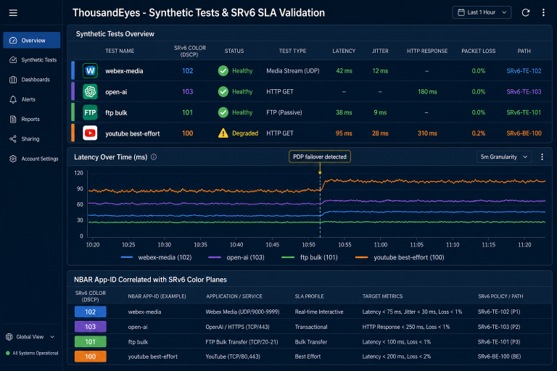
| PDP failover on liveness-down |
Synthetic test detects path change; TE timeline |
Table 1. Illustrative ThousandEyes view: synthetic probes validate SRv6 color-plane SLAs for Webex-media (102), open-ai (103), bulk (101), and best-effort (100) traffic classes.
Deployment models on secure routers
The Cisco ThousandEyes Virtual Appliance (TEVA) is a software-based Enterprise Agent that you deploy as a virtual machine at a hub site or data center. TEVA aggregates NetFlow and IP Flow Information Export (IPFIX) records from multiple Cisco 8000 Series Secure Routers at branch sites, and it forwards the enriched flow data to the Cisco ThousandEyes cloud.
TEVA supports a higher flow scale than embedded branch agents. A 32-GB, 16-core appliance supports up to 200,000 flows per second. This scale makes TEVA well suited for regional aggregation, while branch routers retain embedded agents for local synthetic testing.
| Model |
Description |
Best for |
| Embedded (CAF) |
Enterprise Agent on each Secure Router |
Branch SRv6 head-end |
| Centralized (TEVA) |
Flows to hub TEVA (200k flows/sec) |
Regional aggregation |
Operational use cases
● Validate NBAR + SRv6 steering — confirm open-ai flows use the intended color plane
● Troubleshoot SLA breach — Path Visualization isolates underlay vs. ISP vs. overlay
● QoS and policy audit — compare NBAR app mix against queue and FC distribution
● SD-WAN + SRv6 correlation — WAN Insights validates overlay and underlay together
Integration summary
The Cisco ThousandEyes Virtual Appliance (TEVA) is a software-based Enterprise Agent that you deploy as a virtual machine at a hub site or data center. TEVA aggregates NetFlow and IP Flow Information Export (IPFIX) records from multiple Cisco 8000 Series Secure Routers at branch sites, and it forwards the enriched flow data to the Cisco ThousandEyes cloud.
TEVA supports a higher flow scale than embedded branch agents. A 32-GB, 16-core appliance supports up to 200,000 flows per second. This scale makes TEVA well suited for regional aggregation, while branch routers retain embedded agents for local synthetic testing.
Design recommendations
● Classify at the trust boundary — apply NBAR + ePBR on LAN-facing interfaces.
● Separate overlay AAR from underlay SRv6 steering.
● Keep Protocol Packs current for AI application signatures.
● Use PDP performance measurement on latency-sensitive planes.
● Use NBAR and DSCP complementarily — NBAR for SRv6 steering; DSCP for downstream QoS queuing.
● Plan scale: ~200 PFP, ~1000 PDP per Secure Router platform.
● Deploy ThousandEyes Traffic Insights on SRv6 head-ends — export NBAR-enriched NetFlow and correlate with synthetic SLA tests.
Conclusion
DSCP-based routing answers one question: How should the network queue this packet?
Application-aware routing answers two questions: What application is this, and which network path meets its service-level agreement (SLA)?
On the Cisco 8000 Series Secure Routers, Network-Based Application Recognition (NBAR2) chains to Enhanced Policy-Based Routing (ePBR) Forward Classes, Segment Routing over IPv6 (SRv6) Per-Flow Policies (PFPs), and Per-Destination Policies (PDPs) that use delay and affinity constraints. NBAR2 supports AI protocols through Protocol Packs 75 through 78. Cisco ThousandEyes validates that the steering delivers the intended application experience. As a result, you can engineer an intent-based WAN without depending on endpoint markings.
References
● Cisco QoS Configuration Guide — Classifying Network Traffic Using NBAR (IOS XE 17.x)
● Cisco QoS Configuration Guide — Configuring NBAR Using MQC
● NBAR2 Protocol Pack Library — https://www.cisco.com/c/en/us/td/docs/ios-xml/ios/qos_nbar/prot_lib/config_library/nbar-prot-pack-library.html
● Protocol Pack 75.0.0 / 76.0.0 / 77.0.0 / 78.0.0 Release Notes
● Segment Routing over IPv6 — IOS XE 17.x Configuration Guide
● Cisco 8000 Series Secure Routers — ThousandEyes Traffic Insights White Paper
● Cisco Live BRKENT-2520 — Segment Routing Innovations
● Cisco Live BRKXAR-2027 — Cisco 8000 Series Secure Router
This document is intended for network architects and engineers planning application-aware SRv6 deployments on Cisco 8000 Series Secure Routers. Configuration examples are illustrative; validate against your IOS XE release notes and platform scale limits.