Cisco Identity At a Glance
Available Languages
Bias-Free Language
The documentation set for this product strives to use bias-free language. For the purposes of this documentation set, bias-free is defined as language that does not imply discrimination based on age, disability, gender, racial identity, ethnic identity, sexual orientation, socioeconomic status, and intersectionality. Exceptions may be present in the documentation due to language that is hardcoded in the user interfaces of the product software, language used based on RFP documentation, or language that is used by a referenced third-party product. Learn more about how Cisco is using Inclusive Language.
Cisco Cloud Control
Bring identity context to the network through Cisco Cloud Control
AI has turned identity ambiguity into network risk. Every unmanaged actor, credential, and privilege expands the attack surface, while AI-powered attackers can find weak credentials, stale access, exposed keys, and unprotected paths at machine speed.
For the network, the problem is direct: it often sees the connection before it understands the actor. It may see an IP address, VLAN, device, session, or flow, but not enough context to know who or what is behind it, whether it should be trusted, or what it should be allowed to reach. Cisco Identity closes that gap by making actor, posture, and risk context part of how the network understands and protects access.
The Power of Identity in the Network
The network sees activity
It connects users, devices, apps, workloads, services, and agents to the resources they need.
Identity explains the actor
Actor context shows who or what is behind access, whether posture changed, and where risk is concentrated.
Enforcement turns context into protection
Network teams can use identity context to guide policy, segmentation, and access.
From signal to action
Turn Identity Context Into Action
Overview
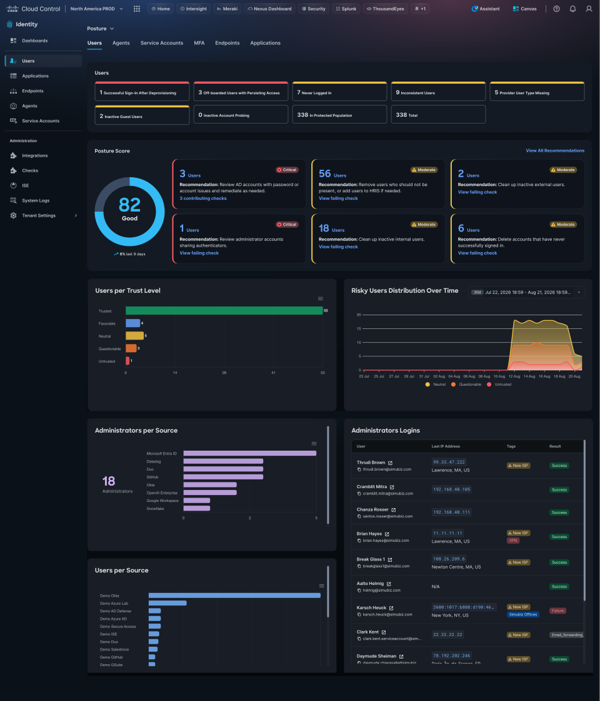
Identity in Cloud Control brings identity, device, network, application, and agentic activity into one operational view. This unified view brings together context from sources such as identity providers, endpoint security tools, developer platforms, SaaS applications, and AI-agent sources.
Capabilities
See the actors behind access
Identify humans, devices, applications, workloads, service accounts, and AI agents across Cisco and supported vendor sources.
Evaluate posture and change
User Trust Level, anomaly signals, timelines, and access context to understand which actors need attention.
Investigate and resolve with context
AI Canvas can bring identity, device, network, and application context into a guided investigation path.
Identity-aware networking
Visibility Is the Starting Point. Network Enforcement Is the Outcome.
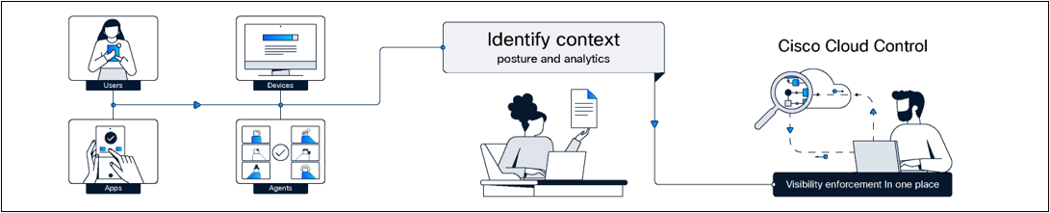
Cisco Identity is not about adding another isolated identity view. It brings actor context into Cisco infrastructure so access decisions can be informed by identity, posture, risk, and network context.
Troubleshoot access with the full story
See identity state, device posture, network access, recent activity, and application context together.
Reduce blind spots across human and non-human identities
Bring service accounts, agents, endpoints, and application activity into the same operating conversation.
Prepare the network to make identity-aware decisions
Use actor context in Cisco Cloud Control to guide protection, segmentation, and exposure reduction.