Cisco 8000 Secure Routers (MX OS): Unified Security and Flexible Connectivity for the Modern Branch Solution Overview
Available Languages
Bias-Free Language
The documentation set for this product strives to use bias-free language. For the purposes of this documentation set, bias-free is defined as language that does not imply discrimination based on age, disability, gender, racial identity, ethnic identity, sexual orientation, socioeconomic status, and intersectionality. Exceptions may be present in the documentation due to language that is hardcoded in the user interfaces of the product software, language used based on RFP documentation, or language that is used by a referenced third-party product. Learn more about how Cisco is using Inclusive Language.
Branch environments and distributed sites face the same threats as centralized enterprise locations, but often operate without dedicated security teams, automation engineers, or the budget to maintain complex multivendor stacks. Each additional point solution increases operational overhead, expands the attack surface, and makes it harder to maintain consistent policy and audit trails. At the same time, customer-facing and business-critical applications— payments, electronic medical records (EMR), point of sale, collaboration, and operational technology—depend on continuous, secure connectivity, with performance issues or outages immediately impacting revenue and safety.
These realities demand a modern, security-first architecture that unifies connectivity and security, provides end-to-end observability, and uses automation and AI to keep pace with evolving threats.
The Cisco Secure Networking Architecture
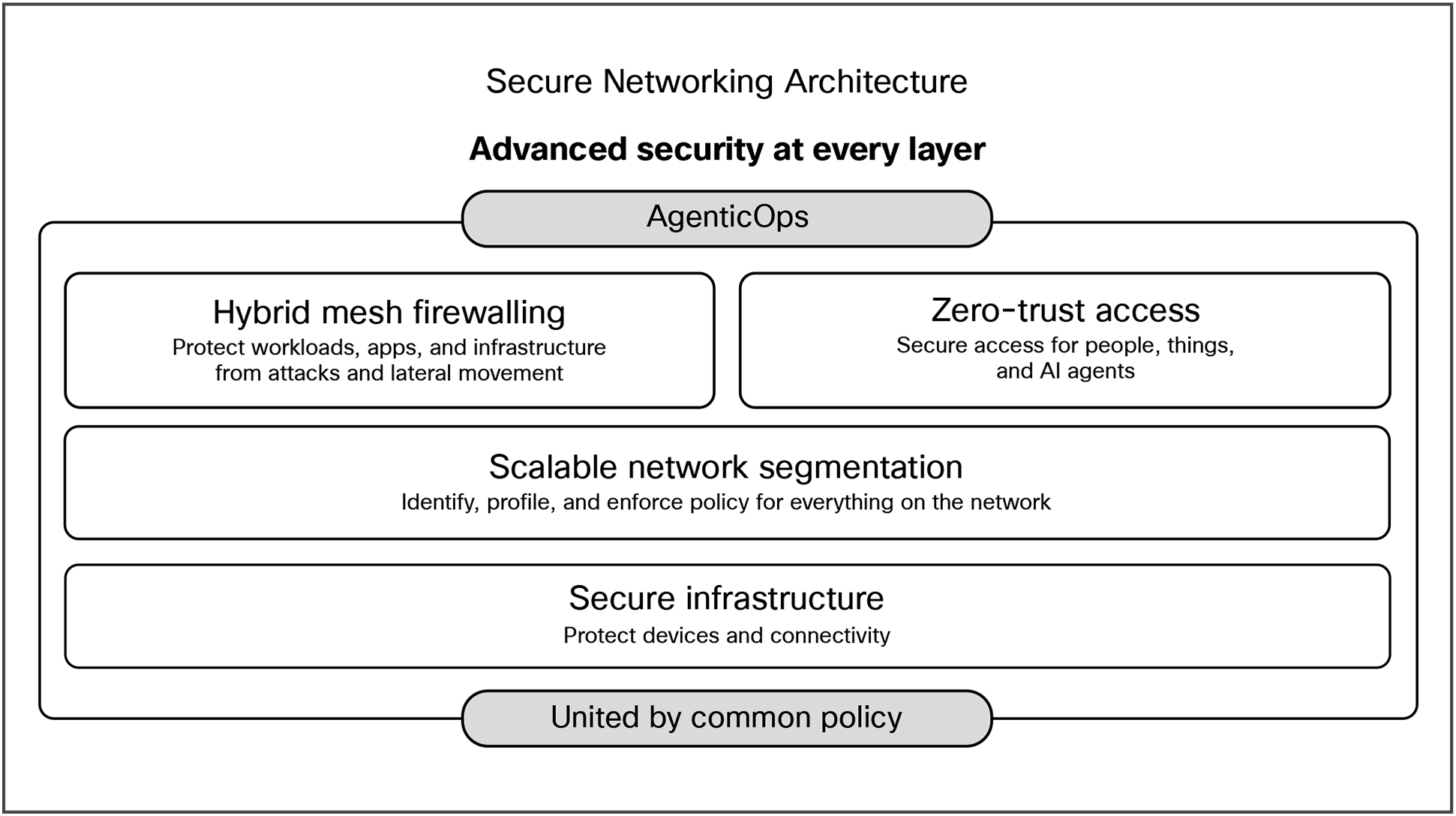
Cisco Secure Networking Architecture
The Cisco® Secure Router platform is built on a layered architecture that separates physical transport from logical services while enforcing security at every layer.
Secure edge with Cisco Secure Routers
Cisco 8000 Series Secure Routers (MX OS) act as secure edge devices at branches, campuses, and small data centers, combining Next-Generation Firewall (NGFW), unified threat management, and SD WAN in a single platform. Advanced security services (intrusion detection and prevention [IDS/IPS], Advanced Malware Protection [AMP], content filtering) are enabled directly on the router, helping ensure that traffic is inspected and enforced at the edge before it enters the SD WAN fabric.
Policy driven SD WAN fabric
Cisco Secure Routers use Auto VPN, dynamic path selection, and application aware Quality of Service (QoS) to build an overlay across diverse underlays such as broadband, Multiprotocol Label Switching (MPLS), LTE/5G, and cloud connections. Traffic is classified by application on the first packet and steered according to business defined Service-Level Agreements (SLAs) for latency, loss, and jitter. Virtual MX (vMX) instances extend this fabric into public and private cloud environments, enabling consistent connectivity and security for infrastructure-as-a-service workloads.
Cloud security with Cisco Secure Access
Cisco Secure Access converges secure web gateway, Zero-Trust Network Access (ZTNA), DNS security, Cloud Access Security Broker (CASB), and data protection into a cloud native Security Service Edge (SSE), tightly integrated with the router. Branch and remote user traffic can be directed to Secure Access for internet and Software-as-a-Service (SaaS) inspection, enabling direct to cloud, remote-to-branch, branch-to-branch and branch-to-data center access with policy enforcement close to the user.
Operations, analytics, and AI
The Cisco Meraki™ dashboard provides a single, cloud native control plane for configuration, monitoring, and APIs across all sites. Cisco XDR, ThousandEyes®, and Splunk® integrations extend analytics and observability, while Cisco AI Assistant, AI Canvas, and agentic workflows bring natural language operations and automation to the platform.
This architecture mirrors modern design principles—zero trust overlays, diverse underlays, and centralized orchestration—but is delivered in a form factor and operational model accessible to lean IT teams.
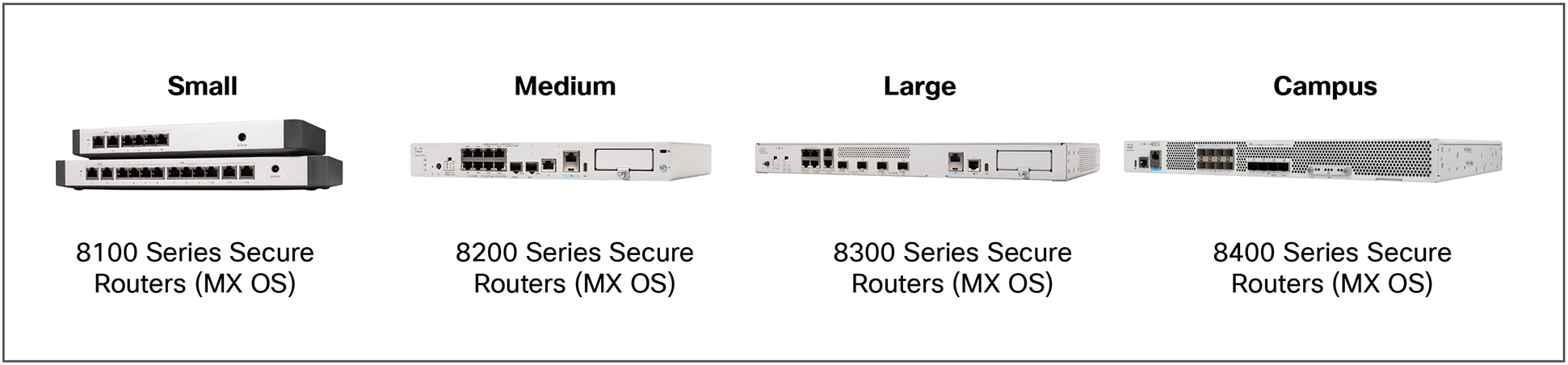
Platforms in the 8000 Series Secure Routers (MX OS)
Securing distributed branches and remote sites: Protect every branch, remote site, and user with enterprise-grade security—regardless of location or deployment model.
Capabilities
● Advanced firewall at the edge: Unified Threat Management (UTM), Layer 3/Layer 4 and application firewall, powered by Cisco Network Based Application Recognition.
● IDS/IPS: Continuous threat signature updates via Cisco Talos®, powered by Snort®.
● Hitless Snort engine and security signature updates (content filtering, AMP, IPS signatures).
● AMP: Real-time detection, sandbox-based analysis, retrospective alerts.
● Content and web filtering: Blocks malicious domains and torrents and enforces safe search policies.
Business value
● Consistent, up-to-date protection for all sites.
● Centralized policy management via Meraki Dashboard—reduces complexity and risk.
● Lower total cost of ownership: Consolidates security capabilities and reduces operational overhead.
Rapid and resilient branch connectivity: Enable fast, reliable, and scalable connectivity for new and existing branch sites, supporting business expansion and hybrid work.
Capabilities
● Intelligent path selection: Real-time link monitoring, traffic optimization, and application prioritization.
● Auto VPN: Three-click setup, subsecond failover, and automatic key management; policies applied automatically.
● Multi WAN and cellular failover: Redundancy with integrated 5G, bandwidth bonding, cellular fallback.
● Virtual MX for cloud: Extends routing fabric to AWS, Azure, Google Cloud, and more.
Business value
● Deployment time for new locations reduced from weeks to minutes.
● Optimized application delivery lowers connectivity spend.
● Seamless hybrid cloud networking without added complexity.
Secure access service edge (SASE) for hybrid workforces: Deliver secure, seamless access for all users—branch employees, remote workers, contractors—via a unified, cloud-native SASE platform.
Capabilities
● Cisco Secure Access integration: Cloud-delivered SSE with ZTNA, Secure Web Gateway (SWG), CASB, firewall as a service, VPN as a service, data loss prevention, AI Assistant, DNS Security, and more.
● Identity-based policy: Consistent access policies across branches, remote users, and contractors.
● Direct, distributed access: Users connect to the nearest Secure Access point—no backhauling, reduced latency.
● Third-party SSE interoperability: The Cisco Secure Router MX OS integrates with all major SASE vendors, including Zscaler and Palo Alto Prisma with redundant or active-active IPsec tunnels.
Business value
● Reduces point-solution complexity and while preserving architectural choice.
● Enhances user experience and performance.
● Provides consistent security posture with reduced operational burden.
Automated threat detection and response: Accelerate detection and containment of threats through integrated network and endpoint security, reducing the impact of a breach.
Capabilities
● Native Cisco XDR integration: Automated, risk-based threat response, and real-time enforcement.
● Correlates endpoint and network activity for unified defense.
Business value
● Eliminates manual firewall updates and device isolation.
● Accelerates threat containment and helps limit breach impact.
End-to-end network and application visibility: Gain actionable visibility into network and application performance across all branches and cloud environments, enabling proactive resolution of issues.
Capabilities
● Embedded ThousandEyes agents: Synthetic, application-centric monitoring from every branch.
● Active probes for SaaS and cloud app performance (Microsoft 365, Salesforce, Webex®).
● Automated remediation workflows for performance thresholds.
Business value
● Proactive optimization, reduced Mean Time To Resolution (MTTR).
● Simplified operations: Single dashboard for all monitoring.
● Maintains service quality without manual intervention.
Advanced analytics and compliance reporting: Integrate network data into enterprise Security Information and Event Management (SIEM) for deeper threat analytics, anomaly detection, and compliance reporting.
Capabilities
● Splunk integration: API-driven log ingestion, correlation, compliance reporting, anomaly detection, incident forensics, and user behavior analytics.
Business value
● Accelerated investigations and reduced MTTR.
● Supports audit, logging, and reporting needs associated with HIPAA, PCI DSS, and SOC 2.
Unified management and AI-driven operations: Simplify global network and security operations by centralizing visibility, automating tasks, and empowering teams with AI.
Capabilities
● Cisco Cloud Control Dashboard: Real-time monitoring, customizable alerts, reporting, granular access control, API-first management.
● Cisco AI Assistant: Conversational monitoring, troubleshooting, workflow automation.
● AI Canvas: Real-time, cross-team collaboration, unified data context, agentic automation.
● Workflows: AI-powered no-code/low-code automation for routine and complex tasks.
Business value
● Single pane of glass for distributed networks eliminates operational blind spots.
● Reduces time to resolution and dependency on specialized talent.
● Improves operational consistency, decision making, and scalability.
Notes and considerations
● All features are managed via Cisco’s cloud-native dashboard.
● Native integrations with Cisco XDR, ThousandEyes, and Splunk eliminate operational complexity.
● AI-powered capabilities simplify network operations, enabling nonexperts to automate and resolve issues.
Cisco 8000 Series Secure Routers (MX OS), with Cisco security and integrated AI-powered operations, move organizations from reactive troubleshooting to proactive network defense—anticipating threats, automating responses, and continuously optimizing connectivity before issues impact the business. Whether securing branches, enabling hybrid workforces, or streamlining operations, Cisco 8000 Series Secure Routers deliver the intelligence and simplicity needed to stay ahead of an evolving threat landscape.