Cisco UCS Virtual Interface Card 1385 Data Sheet
Available Languages
Bias-Free Language
The documentation set for this product strives to use bias-free language. For the purposes of this documentation set, bias-free is defined as language that does not imply discrimination based on age, disability, gender, racial identity, ethnic identity, sexual orientation, socioeconomic status, and intersectionality. Exceptions may be present in the documentation due to language that is hardcoded in the user interfaces of the product software, language used based on RFP documentation, or language that is used by a referenced third-party product. Learn more about how Cisco is using Inclusive Language.
Cisco Unified Computing System overview
The Cisco Unified Computing System™ (Cisco UCS®) is a next-generation data center platform that unites computing, networking, storage access, and virtualization resources in a cohesive system designed to reduce Total Cost of Ownership (TCO) and increase business agility. The system integrates a low-latency, lossless 10 or 40 Gigabit Ethernet unified network fabric with enterprise-class blade and rack x86-architecture servers. The system is an integrated, scalable, multichassis platform in which all resources participate in a unified management domain.
The Cisco UCS Virtual Interface Card (VIC) 1385 is a Cisco® innovation. It provides a policy-based, stateless, agile server infrastructure for your data center. This dual-port Enhanced Quad Small Form-Factor Pluggable (QSFP) half-height PCI Express (PCIe) card is designed exclusively for Cisco UCS C-Series Rack Servers. The card supports 40 Gigabit Ethernet and Fibre Channel over Ethernet (FCoE). It incorporates Cisco’s next-generation Converged Network Adapter (CNA) technology and offers a comprehensive feature set, providing investment protection for future feature software releases. The card can present more than 256 PCIe standards-compliant interfaces to the host, and these can be dynamically configured as either Network Interface Cards (NICs) or Host Bus Adapters (HBAs). In addition, the VIC supports Cisco Data Center Virtual Machine Fabric Extender (VM-FEX) technology. This technology extends the Cisco UCS Fabric Interconnect ports to virtual machines, simplifying server virtualization deployment.
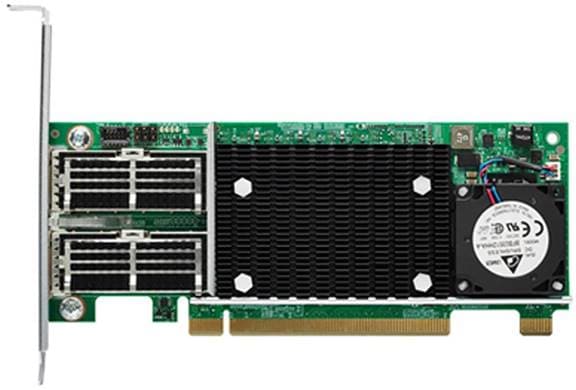
Cisco UCS VIC 1385
The Cisco UCS VIC 1385 provides the following features and benefits:
● Stateless and agile platform: The personality of the card is determined dynamically at boot time using the service profile associated with the server. The number, type (NIC or HBA), identity (MAC address and World Wide Name [WWN]), failover policy, bandwidth, and Quality-of-Service (QoS) policies of the PCIe interfaces are all determined using the service profile. The capability to define, create, and use interfaces on demand provides a stateless and agile server infrastructure (Figure 2).
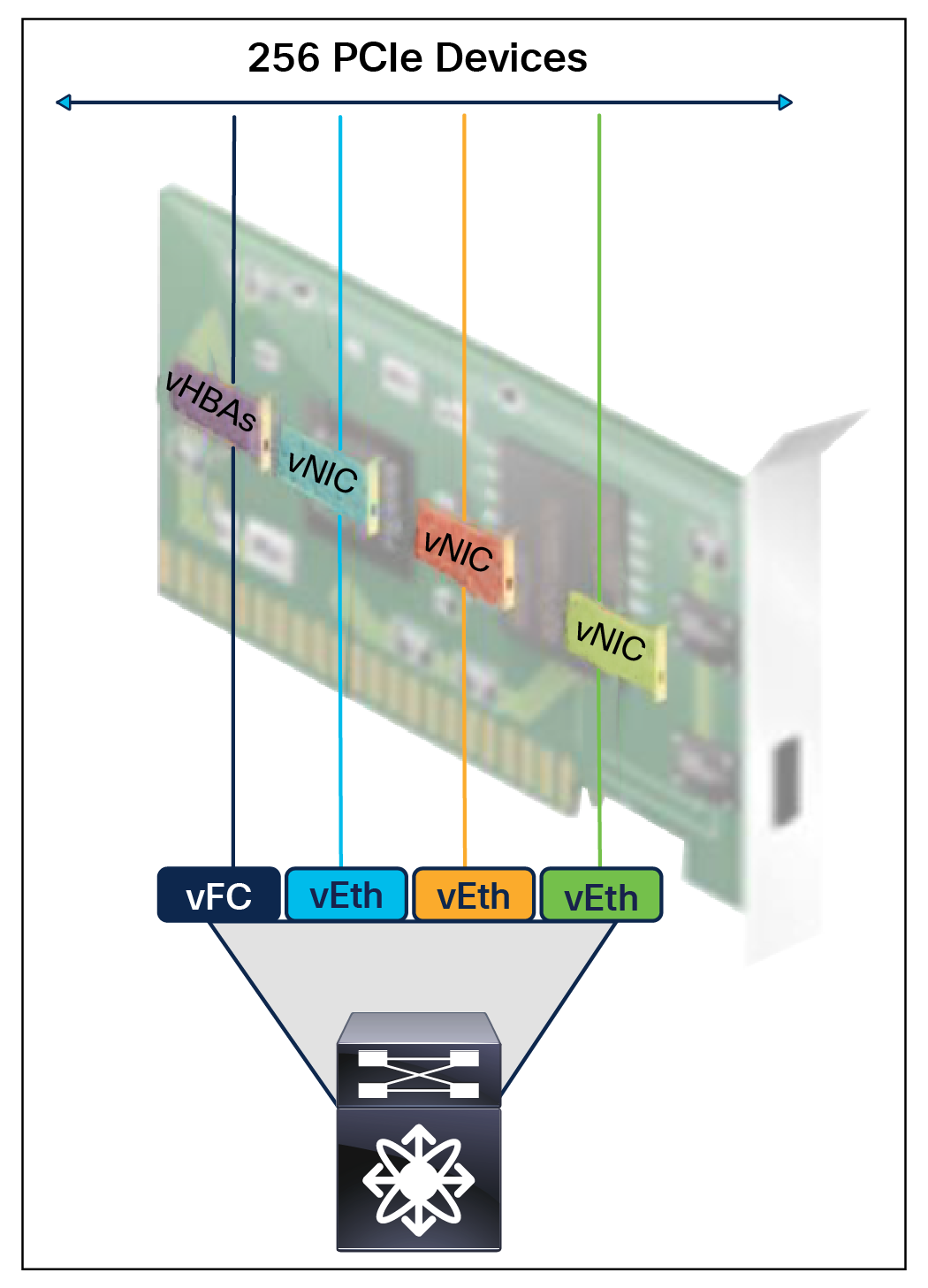
Virtual Device Support on the Cisco UCS VIC 1385
● Network interface virtualization: Each PCIe interface created on the VIC is associated with an interface on the Cisco UCS Fabric Interconnect, providing complete network separation for each virtual cable between a PCIe device on the VIC and the interface on the Fabric Interconnect (Figure 3).
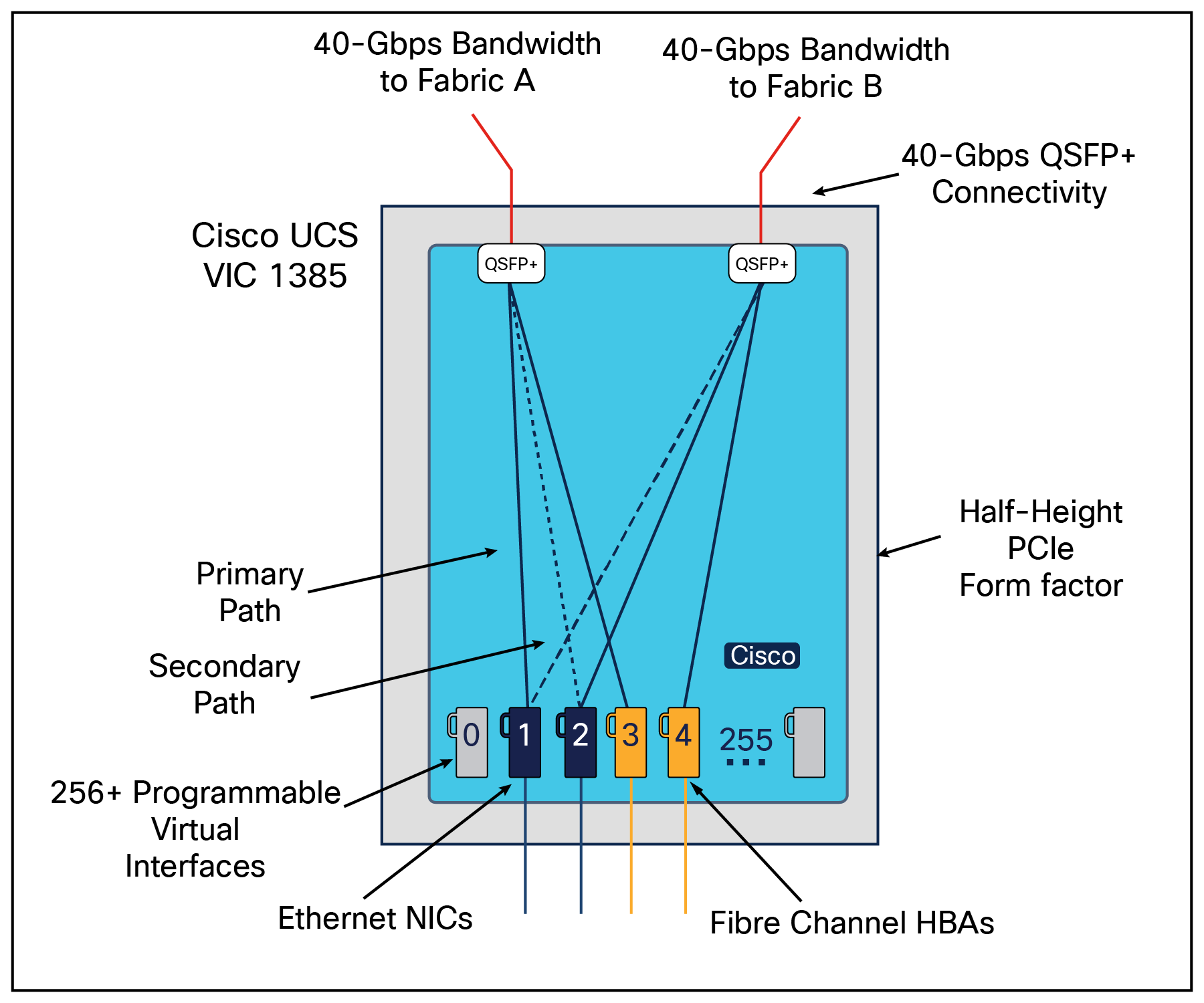
Cisco UCS VIC 1385 Architecture
Next-Generation Data Center features
A hardware classification engine provides support for advanced data center requirements including stateless network offloads for NVGRE and VXLAN (VMware only), low-latency features for us NIC and RDMA, and performance optimization applications such as VMQ, DPDK, and Cisco NetFlow. The Cisco UCS VIC 1385 provides high network performance and low latency for the most demanding applications:
● Big data, High-Performance Computing (HPC), and High-Performance Trading (HPT)
● Large-scale virtual machine deployments
● High-bandwidth storage targets and archives
When the VIC 1385 is used in combination with Cisco Nexus® 3000 Series Switches, big data and financial trading applications benefit from high bandwidth and low latency. When the VIC is connected to Cisco Nexus 5000 Series Switches, pools of virtual hosts scale with greater speed and agility. The Cisco Nexus 6004 Switch provides native 40-Gbps FCoE connectivity from the VIC to both Ethernet and Fibre Channel targets.
The VIC provides industry-leading performance and features:
● Cisco NetFlow: NetFlow is supported at the adapter level, providing network traffic accounting and monitoring down to the virtual machine level for network billing, security, traffic characterization, and Denial-of-Service (DoS) attack monitoring. NetFlow provides valuable information about network users and applications, peak use times, and traffic routing.
● Cisco usNIC: usNIC is an ultra-low-latency solution for HPC and HPT applications over Ethernet. The solution includes firmware, kernel driver, user-space driver, and Open Message Passing Interface (MPI) support for Cisco VICs and provides OS bypass services directly to the application layer.
● Cisco Data Center VM-FEX: VM-FEX technology extends Fabric Interconnect ports directly to virtual machines, eliminating software-based switching in the hypervisor. VM-FEX collapses virtual and physical networking infrastructure into a single infrastructure that is fully aware of the virtual machines’ locations and networking policies (Figure 3). VM-FEX is implemented by Cisco VICs with a prestandard implementation of IEEE 802.1BR Port Extender.
Cisco Nexus Switch Supporting VM-FEX Virtual Machine Migration with VM-FEX.
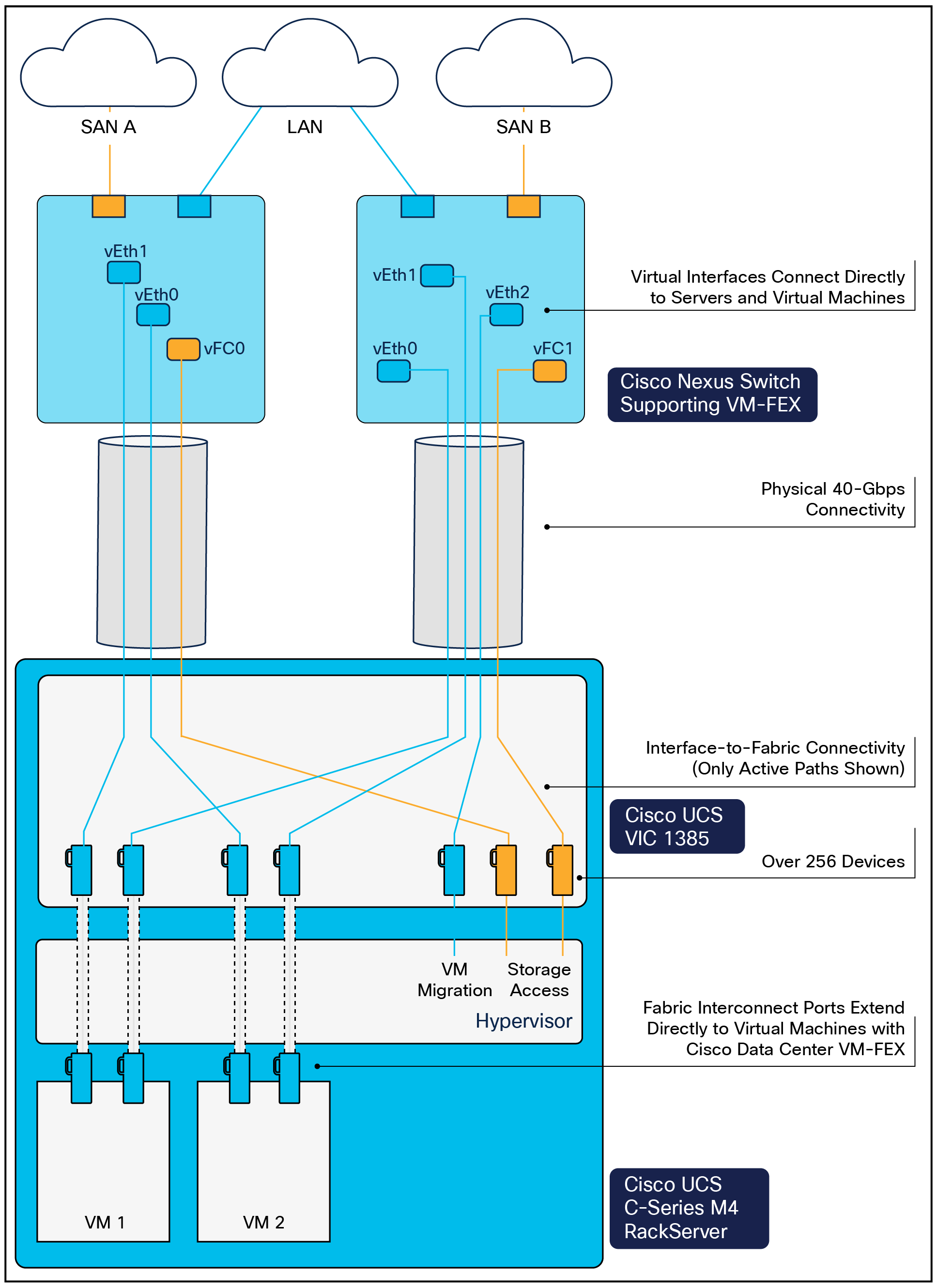
Cisco Data Center VM-FEX with Cisco UCS VIC 1385
Table 1 summarizes the main features and benefits of the Cisco UCS VIC 1385.
Table 1. Features and benefits
| Feature |
Benefit |
| x16 PCIe Gen3 interfaces |
Delivers greater throughput |
| 2 x 40-Gbps unified I/O |
● Delivers 80 Gbps to the server
● Delivers over 100 Gbps In a dual VIC configuration with the Cisco UCS M4/M5 C-Series Rack Server
● Helps reduce TCO by consolidating the overall number of NICs, HBAs, cables, and switches because LAN and SAN traffic run over the same adapter card and fabric
|
| Over 256 dynamic virtual adapters and interfaces |
● Creates fully functional unique and independent PCIe adapters and interfaces (NICs or HBAs) without requiring Single-Root I/O Virtualization (SR-IOV) support from OSs or hypervisors
● Allows these virtual interfaces and adapters to be configured and operated independently, just like physical interfaces and adapters
● Creates a highly flexible I/O environment needing only one card for all I/O configurations
Note: Cisco UCS VIC 1385 hardware is SR-IOV capable, and you can enable SR-IOV after SR-IOV is broadly supported by the popular operating systems. Please refer to Cisco UCS Manager configuration limits for your specific OS and environment in the configuration guide. |
| Low-latency connectivity |
Supports usNIC technology, delivering latency as low as 1.2 microseconds in back-to-back VIC connections; standard latency using the Cisco Nexus 3000 Series Switch is approximately 2 microseconds |
| Cisco SingleConnect technology |
A single unified network: the same network brings LAN, SAN, and management connectivity to each server |
| Cisco Data Center VM-FEX technology |
● Unifies virtual and physical networking in a single infrastructure
● Provides virtual machine visibility from the physical network and a consistent network operating model for physical and virtual servers
● Enables configurations and policies to follow the virtual machine during virtual machine migration
|
| Centralized management |
Enables the PCIe card to be centrally managed and configured by Cisco UCS Manager. |
| Support for advanced features |
● usNIC
● Small Computer System Interface over IP (iSCSI) and iSCSI boot
● Ethernet NIC (eNIC) and Fibre Channel NIC (fNIC)
● VM-FEX
● VMware VMDirectPath
● SR-IOV
● VMQ
● Microsoft System Center Virtual Machine Manager (SCVMM)
● DPDK
● NetFlow
● Cisco Adapter FEX
● N-Port ID Virtualization (NPIV)
● Receive Flow Steering
● Extended Receive (Rx) Ring
● Receive Segment Coalescing (RSC)
● VMware NetQueue
● Multi-RQ
● Receive-Side Scaling
● VXLAN and NVGRE
|
| Fibre Channel |
Supports Fibre Channel over the UCS unified fabric with Cisco UCS Fabric Interconnect 6300 Series, 6400 Series and 6536 Supports FCoE Fibre Channel with 10-15 Bit Error Rate (BER) connected to the Cisco Nexus 6004 Switch |
| Network architecture |
Provides a redundant path to the Fabric Interconnect using hardware-based fabric failover |
| More than 600,000 I/O Operations Per Second (IOPS) |
Provides high I/O performance for demanding applications |
| Support for lossless Ethernet |
Uses Priority Flow Control (PFC) to enable FCoE as part of the Cisco Unified Fabric |
| Broad OS and hypervisor support |
Supports customer requirements for Microsoft Windows, Red Hat Enterprise Linux, CentOS and Ubuntu, VMware vSphere, and Citrix XenServer |
Table 2 lists the specifications for the Cisco UCS VIC 1385.
Table 2. Product specifications
| Item |
Specifications |
| Standards |
● 40 Gigabit Ethernet
● IEEE 802.3ae
● IEEE 802.3x
● IEEE 802.1q VLAN
● IEEE 802.1p
● IEEE 802.1Qaz
● IEEE 802.1Qbb
● Pre-standard IEEE 802.1BR
● Jumbo frames up to 9 KB
● Fibre Channel Protocol (FCP)
● SCSI-FCP
● T11 FCoE
|
| Components |
Cisco UCS custom Application-Specific Integrated Circuit (ASIC) |
| Ports |
2 x 40-Gbps FCoE QSFP ports |
| Connectivity |
PCIe 3.0 x 16 form factor |
| Performance |
40-Gbps line rate per port, limited by PCIe 3.0 to 64 Gbps per PCIe port |
| Management |
Cisco UCS Manager Release 2.2 (4) and later (standalone server mode) |
| Number of interfaces |
Over 256 virtual interfaces (approximately 8 are reserved for internal use; other factors such as the OS and hypervisor may limit this number further) |
| Supported switches |
Cisco Nexus switches supporting SFP+ and QSFP+ host interfaces including:
● Cisco UCS FI-6536
● Cisco UCS-FI-64108
● Cisco UCS-FI-6454
● Cisco UCS-FI-6332-16UP
● Cisco UCS-FI-6332
● Cisco UCS-FI-6248
● Cisco UCS-FI-6296
● Cisco Nexus 3016Q Switch
● Cisco Nexus 3064-X Switch
● Cisco Nexus 3064-T Switch
● Cisco Nexus 3132Q Switch
● Cisco Nexus 3172 Switch
● Cisco Nexus 3172TQ Switch
● Cisco Nexus 6001 Switch
● Cisco Nexus 6004 Switch
● Cisco Nexus 9332PQ Switch
● Cisco Nexus 9508 Switch
● Cisco Nexus 93180YC-FX3 in FEX mode only
|
| Physical dimensions |
● Length = 6.6 in. (16.76 cm)
● Width = 2.5 in. (6.35 cm)
|
| Supported media |
● QSFP-40G-SR4, 40GBASE-SR4 QSFP+ transceiver module for MMF, 4 lanes, 850-nm wavelength, 12-fiber MPO/MTP connector
● QSFP-40G-SR4-S, 40GBASE-SR4 QSFP+ transceiver module for MMF, 4 lanes, 850-nm wavelength,12-fiber MPO/MTP connector, S-Class
● QSFP-40G-CSR4, 40GBASE-CSR4 QSFP+ transceiver module for MMF, 4 lanes, 850-nm wavelength,12-fiber MPO/MTP connector
● QSFP-40G-SR-BD, 40-Gbps QSFP BiDi optical transceiver
● QSFP-40G-LR4 40GBASE-LR4 QSFP+ transceiver module for SMF, duplex LC, 10-km reach
● QSFP-40G-LR4-S 40GBASE-LR4 QSFP+ transceiver module for SMF, duplex LC, 10-km reach, S-Class
● QSFP-40/100-SRBD, 40-Gbps QSFP BiDi optical transceiver
● QSFP-4SFP10G-CU1M, 40GBASE-CR4 QSFP+ to 4 x 10GBASE-CU SFP+ direct-attach breakout cable assembly, 1m passive
(1)
●
*QSFP-4SFP10G-CU3M, 40GBASE-CR4 QSFP+ to 4 x 10GBASE-CU SFP+ direct-attach breakout cable assembly, 3m passive
(1)
● QSFP-H40G-CU1M, direct-attach copper, 1m
● QSFP-H40G-CU3M, direct-attach copper, 3m
● QSFP-H40G-CU5M, direct-attach copper, 5m
● QSFP-H40G-ACU7M, 40GBASE-CR4 QSFP+ direct-attach copper cable, 7m active
● QSFP-H40G-ACU10M, 40GBASE-CR4 QSFP+ direct-attach copper cable, 10m active
●
*QSFP-4x10G-AC7M, 40GBASE-CR4 QSFP+ to 4 x 10GBASE-CU SFP+ direct-attach breakout cable assembly, 7m active
(1)
●
*QSFP-4x10G-AC10M, 40GBASE-CR4 QSFP+ to 4 x 10GBASE-CU SFP+ direct-attach breakout cable assembly, 10m active
(1)
● QSFP-H40G-AOC1M, 40-Gbps QSFP active optical cable, 1m
● QSFP-H40G-AOC2M, 40-Gbps QSFP active optical cable, 2m
● QSFP-H40G-AOC3M, 40-Gbps QSFP active optical cable, 3m
● QSFP-H40G-AOC5M, 40-Gbps QSFP active optical cable, 5m
● QSFP-H40G-AOC7M, 40-Gbps QSFP active optical cable, 7m
● QSFP-H40G-AOC10M, 40-Gbps QSFP active optical cable, 10m
●
*QSFP-4X10G-AOC1M, QSFP to 4 x SFP 10-Gbps active optical cable. 1m
(1)
●
*QSFP-4X10G-AOC2M, QSFP to 4 x SFP 10-Gbps active optical cable, 2m
(1)
●
*QSFP-4X10G-AOC3M, QSFP to 4 x SFP 10-Gbps active optical cable, 3m
(1)
●
*QSFP-4X10G-AOC5M, QSFP to 4 x SFP 10-Gbps active optical cable, 5m
(1)
●
*QSFP-4X10G-AOC7M, QSFP to 4 x SFP 10-Gbps active optical cable, 7m
(1)
●
*QSFP-4X10G-AOC10M, QSFP to 4 x SFP 10-Gbps active optical cable, 10m
(1)
● CVR-QSFP-SFP10G, QSFP to SFP+ adapter (QSA)
|
| SFP Cables support with QSA |
● SFP-10G-SR (short range, MMF)
● SFP-10G-LR (long range, SMF)
● 10GBase-CU SFP+ cable, 1m
● 10GBase-CU SFP+ cable, 3m
● 10GBase-CU SFP+ cable, 5m
●
SFP-10GB-ACU cable, 7m
|
| Typical power |
17 watts (W) |
Third party cables and transceivers are not supported by the Cisco UCS C-series VICs and the link would not come up if they are used to connect UCS C-Series VIC to a Fabric Interconnect or to a ToR switch like Nexus 9K. Hence when connecting UCS C-series VIC to Fabric Interconnect or a ToR switch only the supported transceivers and cables listed above should be used.
The Cisco UCS VIC 1385 is designed for use only on Cisco UCS C-Series Rack Servers. A single VIC 1385 is supported on Cisco UCS C220 M4/M5, C240 M4/M5, C460 M4, and C480 M5 Rack Servers. The C-series rack servers can support up to two VIC 1385 cards.
Find warranty information at Cisco.com on the Product Warranties page.
Cisco environmental sustainability
Information about Cisco’s environmental sustainability policies and initiatives for our products, solutions, operations, and extended operations or supply chain is provided in the “Environment Sustainability” section of Cisco’s Corporate Social Responsibility (CSR) Report.
Reference links to information about key environmental sustainability topics (mentioned in the “Environment Sustainability” section of the CSR Report) are provided in the following table:
| Sustainability topic |
Reference |
| Information on product material content laws and regulations |
|
| Information on electronic waste laws and regulations, including products, batteries, and packaging |
Cisco makes the packaging data available for informational purposes only. It may not reflect the most current legal developments, and Cisco does not represent, warrant, or guarantee that it is complete, accurate, or up to date. This information is subject to change without notice.
Cisco Unified Computing Services
Using a unified view of data center resources, Cisco and our industry-leading partners deliver services that accelerate your transition to a unified computing architecture. Cisco Unified Computing Services help you quickly deploy your data center resources, simplify ongoing operations, and optimize your infrastructure to better meet your business needs. For more information about these and other Cisco Data Center Services, visit https://www.cisco.com/go/unifiedcomputingservices.
The Cisco Unified Computing System continues Cisco’s long history of innovation in delivering integrated systems for improved business results based on industry standards and using the network as the platform. Recent examples include IP telephony, LAN switching, unified communications, and unified I/O. Cisco began the unified computing phase of our unified data center strategy several years ago by assembling an experienced team from the computing and virtualization industries to augment our own networking and storage access expertise. As a result, Cisco delivered foundational technologies, including the Cisco Nexus Family, supporting unified fabric and server virtualization. Cisco UCS completes this phase, delivering innovation in architecture, technology, partnerships, and services. Cisco is well positioned to deliver this innovation by taking a systems approach to computing that unifies network intelligence and scalability with innovative ASICs, integrated management, and standard computing components.
Flexible payment solutions to help you achieve your objectives
Cisco Capital makes it easier to get the right technology to achieve your objectives, enable business transformation and help you stay competitive. We can help you reduce the total cost of ownership, conserve capital, and accelerate growth. In more than 100 countries, our flexible payment solutions can help you acquire hardware, software, services and complementary third-party equipment in easy, predictable payments. Learn more.
For more information about Cisco UCS, visit https://www.cisco.com/en/US/products/ps10265/index.html