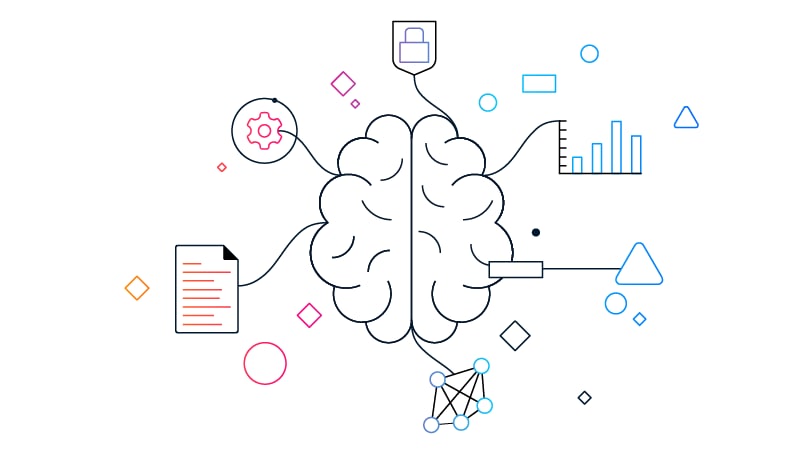
Artificial intelligence shown as a stylized brain connected to icons for data, security, analytics, and networking.

What is agentic AI?

Agentic AI refers to autonomous systems that can perceive information, plan complex tasks, and execute decisions independently to achieve high-level goals.

Infrastructure for agentic AI

Defining agentic AI

Agentic AI goes beyond passive response to human interactions — it can actively solve complex problems in a dynamic and evolving environment. It represents AI agent(s) and the automation pipeline in order to understand, plan, execute and adapt a decision-making process without constant human oversight.

The evolution from LLMs to agentic systems

Recent advancements in large language models (LLMs) have demonstrated agency and capability for active problem solving while accounting for uncertain and unspecified constraints, task objectives, and pathways to reach a desired future state.

This led to the development of systems that can reduce human intervention in using intelligent AI agents to handle end-to-end processes on their own, instead of solving complex but isolated tasks with human intervention. Agentic AI therefore combines the multiple engineering domains including software, infrastructure, design and user-experience, safety, and security to deliver a dependable AI system. 

Agentic AI vs. traditional AI: Key differences

Agentic AI is different from a traditional AI system that responds to explicit user prompts and requires humans to orchestrate the multi-step task execution workflow.

  • In traditional AI systems, including generative AI, humans are responsible for the decision-making and planning process, and the AI agent is expected to understand user requirements and deliver a single output.
  • In contrast, agentic AI relies on longer time horizons and executes the necessary steps on its own without human intervention. While a standalone AI agent is responsible for prediction and generation, the agentic AI system is responsible for decision planning and task execution to achieve an objective.

How agentic AI works: Planning, reasoning, and execution

Unlike traditional AI, which simply follows a prompt to produce a single output, agentic AI operates through a continuous loop of thinking and acting. It treats every objective as a journey from a "present state" to a "desired future state," navigating the steps in between autonomously.

Goal-directed planning and reasoning: The “think” phase

The process begins when the system receives a high-level objective. Rather than attempting to solve the entire problem at once, the agentic system uses reasoning techniques, such as chain-of-thought, to break the goal into smaller, actionable sub-tasks.

This allows the AI to consider multiple pathways to success. It evaluates the trade-offs of different approaches and identifies patterns that help it decide which step to take first. If the user’s requirements or the environment change mid-process, the system can dynamically re-plan its route to stay on track.

Dynamic execution and tool use: The “act” phase

Once a plan is in place, the system moves into execution. Agentic AI is rarely a closed system; it often relies on multiple specialized agents and interfaces with external tools and services to get the job done.

To interact with the world securely and efficiently, these agents use standardized interfaces like the Model Context Protocol (MCP). Through these "bridges," agents can independently retrieve information from databases, execute code, or trigger functions in third-party software. Each action provides the system with new data, which it processes to update its understanding of the task's current status.

Feedback and autonomous adaptation: The “learn” phase

What truly distinguishes agentic AI is its ability to monitor its own progress. As it executes tasks, it receives "feedback signals" from the environment. For example, if a specific tool fails or a piece of data is missing, the system doesn't just stop and wait for a human to fix it.

Instead, it uses that feedback to adjust its strategy in real-time. This self-correcting nature allows agentic AI to sustain "long-horizon" tasks—complex projects that take place over hours or days—without requiring constant human oversight to manage every transition.
8 common types and architectures of agentic AI

Agentic AI is a fast-evolving technology and is typically designed as a specialized solution for unique use cases. Some of the categories, applications, and types of Agentic AI include:

Architectural types

  • Task-specific: Systems designed to solve unique and specialized use cases, such as coding.
  • Hierarchical system: A system involving manager or teacher agents supervising multiple worker or student agents. The results from the lower hierarchical level are distilled and synthesized to make decisions at the higher level, suitable for privacy-preserving AI pipelines.
  • Peer-to-peer networks or multi-agent: Several AI agents collaborating on tasks as equals, especially on isolated tasks based on domain-specific expertise.
  • General purpose: Flexible systems that can solve complex problems across most domains.
  • Self-healing and autonomous workflows: A property or capability of AI agents where they can correct errors and adapt their decision pathways.

Functional types

  • Workflow automation: Systems that specialize in solving multi-step operational workflows for business, connecting disparate systems and data sources.
  • Research and analysis: Systems that can ingest data from multiple sources, synthesize findings and generate facts, autonomously verifying and cross-referencing them for validity.
  • Personal assistant: Systems that learn user preferences and adapt recommendations such as managing schedule and routine interactions on behalf of the user.

Agentic AI use cases: Real-world examples and research

While agentic AI is an evolving field, these examples demonstrate how systems are moving from simple "chat" to autonomous "work."

  • Autonomous software engineering: Modern agents can now move beyond basic coding help to autonomously plan, debug, and deploy entire software projects from start to finish.
  • Stanford’s "Smallville" research: Academic studies have proven that dozens of AI agents can autonomously plan their days, socialize, and coordinate complex group events without human scripts.
  • Enterprise logistics orchestration: In global supply chains, agentic systems can monitor shipping delays and independently source alternative vendors, calculating costs, and legal terms to present a finalized solution to human managers.

The benefits of agentic AI: Efficiency and scalability

Agentic AI transforms how organizations approach complex work—and the shift toward autonomous agency is already well underway. According to Gartner, 60% of brands will use agentic AI to deliver streamlined, one-to-one customer interactions by 2028.

Moving from simple automation to autonomous agency offers several key advantages:

End-to-end task completion

The system takes over the "thinking" required to map out a project. This reduces the cognitive burden on users, who only need to provide high-level goals and constraints rather than identifying every individual step.

Unlocking human innovation

By handling multi-step operational workflows, agentic AI frees up the workforce to focus on critical business problems and high-level innovation rather than routine task orchestration.

Scalable, adaptive problem solving

Unlike static software, agentic AI continuously learns and adapts. This makes problem-solving highly scalable, as the system becomes more efficient the more it interacts with its environment.

Persistence across long-horizon tasks

Agentic systems can maintain context over long periods, even if a workflow is interrupted. This allows agents to operate "asynchronously"—working in the background to complete complex projects without requiring a human to stay logged in and monitor the progress.

Challenges and limitations of agentic AI

While powerful, agentic AI is still an evolving technology with specific hurdles that organizations must navigate:

  • Reliability and "hallucinations": Because these systems are autonomous, a single error can snowball (known as error propagation) and lead to incorrect results. Addressing this requires specialized safety tools, expert prompting, and robust error-handling mechanisms.
  • High resource intensity: Running agentic workflows requires significant "compute" power and energy. Because these models are often large and perform multiple reasoning steps for a single goal, they can be more expensive to operate than traditional AI.

Managing AI risks: The shift to "human-on-the-loop"

To address these limitations, enterprises are moving toward unified agentic control planes. These systems are designed to monitor and govern the behavior of AI agents in real-time.

This has led to a new oversight model: human-on-the-loop. In this setup, humans no longer need to actively assist the AI in every decisions (that’s known as human-in-the-loop). Instead, they maintain high-level oversight, stepping in only for audits, compliance checks, or to course-correct the system if it deviates from its goal.


Related topics

What is AgenticOps?

Agentic operations involve autonomous AI agents that can plan, reason, and execute tasks to improve efficiency. 

What is an AI data center?

See the architecture and networking required to support the intensive compute needs of AI models. 

What is AI in networking?

AI in networking leverages machine learning to automate, optimize, and secure network operations for better performance and reliability.

What is neocloud?

Neocloud providers offer specialized, high-performance infrastructure designed to power AI workloads. 

Guide: Agentic AI Infrastructure

Understand the requirements for supporting autonomous AI agents and intelligent workflows in the enterprise.

Cisco AI Blog

Get the latest news, research, and expert insights on AI-native infrastructure and networking. 

Explore the portfolio of Cisco-developed AI infrastructure technologies, from silicon to full-stack systems, designed to help all AI ecosystem participants thrive in the agentic AI era.