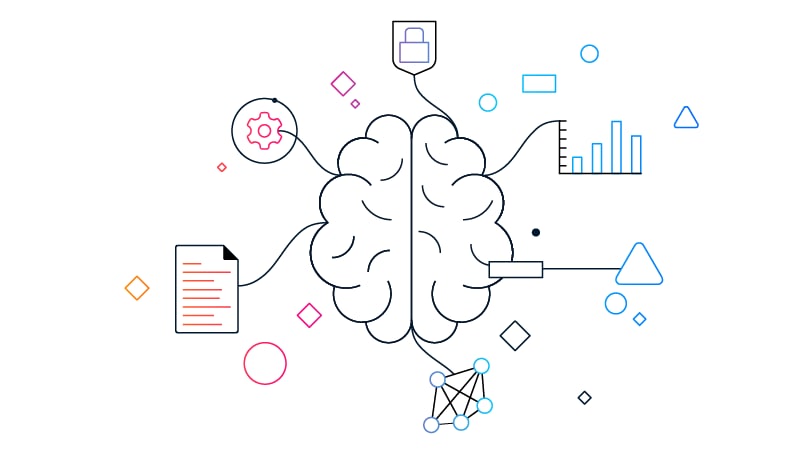
Artificial intelligence shown as a stylized brain connected to icons for data, security, analytics, and networking.

What is Model Context Protocol (MCP)?

Model Context Protocol (MCP) is an open standard that enables seamless, secure integration between AI models and the applications, data, and tools they need to function.

Defining Model Context Protocol

Model Context Protocol (MCP) is an open-source, standardized interface designed to provide AI models with a consistent way to access external data and perform actions.
Historically, providing context to an AI required embedding vast amounts of information directly into prompts as unstructured text. MCP replaces this inefficient method with a formal, machine-readable interface, allowing models to query and interact with external systems dynamically.
Building a dependable MCP ecosystem is a multidisciplinary effort, requiring the integration of multiple engineering domains—including software development, infrastructure management, UX design, and robust security protocols. By shifting from a prompt-centric to a protocol-centric architecture, MCP ensures that the model focuses on reasoning while the protocol handles the secure execution of tasks.

Model Context Protocol vs. prompt-based integration: Key differences

Understanding the difference between MCP and traditional prompt engineering highlights why a standardized protocol is necessary for scaling AI in the enterprise.

Traditional prompt-based approach

In a prompt-based setup, developers must manually describe tools and data schemas within the prompt text for the model to follow. This approach is often brittle, as small changes in wording can cause tool failures, and it consumes a significant portion of the model's context window with repetitive instructions.

The MCP approach

With MCP, tools and resources are declared once at the protocol level rather than being redefined in every prompt. The model relies on structured metadata provided at runtime, which improves reliability and allows the integration to evolve without requiring constant updates to the underlying application code.

How Model Context Protocol works

The architecture of MCP is built on a clear separation of responsibilities between the model, the host application, and the external data sources. The MCP framework operates through three primary components:

  • The MCP client
  • The MCP server
  • The MCP host

The MCP client

The client represents the model’s side of the interaction, typically existing within an AI runtime or agent framework. When a client connects to a server, it performs a "discovery" handshake—a List Tools/Resources call—that allows the model to dynamically learn its available capabilities. This enables the model to understand what it can do without the developer needing to hard-code every possible interaction into the application.

The MCP server

The MCP server acts as the gateway to external capabilities, such as databases, APIs, or local files. Because these servers operate independently of the model, they can enforce strict security protocols, including authentication, authorization, and granular logging. Each server explicitly declares the tools and resources it offers, ensuring that the model interacts with data in a controlled, predictable manner.

The MCP host

The host is the parent application (such as an IDE or AI runtime) that initiates the connection and provides the environment for the MCP client to interact with servers. MCP utilizes JSON-RPC 2.0 as its standard messaging format to ensure compatibility across different programming languages. To accommodate various environments, the protocol supports two primary transport methods:

  • stdio for local process communication
  • HTTP with Server-Sent Events (SSE) for remote, cloud-based servers

Types of AI agent architectures using MCP

When building AI agents using the Model Context Protocol, several architectural patterns can be employed to manage how the model processes information and interacts with its environment.

Reflexive agents 

Reflexive agents operate on "if-then" logic or maintain a simple internal model to track the state of their environment. They are best suited for predictable, repetitive tasks where the operating conditions remain relatively stable.

Goal and utility-based agents

Goal-based or utility-based agents use reasoning to determine the best sequence of actions to reach a specific future state. They often use a "utility function" to make autonomous trade-offs, choosing the most efficient or cost-effective path to success.

Learning agents

Designed to operate in unfamiliar environments, learning agents use a "learning element" to improve performance over time. This allows them to refine their decision-making processes (inference) without needing to be manually reprogrammed.

Hierarchical and multi-agent systems

Hierarchical and multi-agent systems involve a collective of agents working together. In a hierarchical structure, a "manager" agent oversees "worker" agents, which is particularly effective for privacy-preserving AI pipelines; the manager can delegate tasks without giving workers access to sensitive, high-level data.


Model Context Protocol use cases

By providing a standardized way for agents to "reach out" to the world via API calls or software commands, MCP enables a wide range of enterprise applications.

  • Workflow automation: MCP allows agents to solve multi-step operational workflows by connecting disparate systems and data sources. This eliminates the need for manual data entry and "swivel chair" operations between platforms.
  • Research and data synthesis: Agentic systems can use MCP to ingest data from multiple sources to generate market intelligence. These agents can autonomously verify and cross-reference facts for validity, significantly reducing the risk of AI hallucinations.
  • Intelligent personal assistants: By learning user preferences through MCP-connected data stores, these agents can manage schedules and routine interactions. They act as digital proxies, executing tasks on behalf of the user across various applications.

Key benefits of Model Context Protocol

Implementing a standardized protocol for context management provides several strategic advantages for AI development.

  • Reduced integration complexity: Developers can build a single MCP server that works across multiple different AI agents and models. This eliminates the need to create unique, one-to-one connections for every new tool added to the ecosystem.
  • Improved context window efficiency: MCP allows the client to pull in specific resource definitions only when the model's reasoning determines they are needed. By not crowding the prompt with every possible tool definition, the system preserves more of the context window for actual problem-solving.
  • Enhanced reusability: Functional tools and data connectors can be built once and deployed across various applications. This modularity allows organizations to scale their AI capabilities rapidly without duplicating engineering efforts.
  • Increased operational velocity: Reusable protocol components significantly shorten the time required to deploy new AI agents. Teams can quickly assemble complex workflows by connecting existing MCP servers to new model runtimes.

Challenges and considerations for MCP

As an emerging standard, the adoption of Model Context Protocol involves certain technical and security trade-offs.

  • Security and prompt injection: While MCP provides a structured interface, the underlying model is still susceptible to malicious instructions hidden within data. Organizations must implement rigorous guardrails to ensure that autonomous actions triggered via MCP do not lead to unauthorized system access.
  • Implementation and resource complexity: Building and maintaining effective MCP servers requires a dedicated team of experts and access to significant compute resources. Organizations must balance these requirements against the expected operational gains to ensure a positive return on investment.
  • Technology maturity: As a relatively new protocol, MCP may lack the extensive ecosystem of libraries and community support found in more established frameworks. Early adopters must be prepared for evolving standards and the potential need for custom development to meet production-level requirements.

The future of Model Context Protocol

As artificial intelligence moves toward more autonomous, agentic workflows, the management of context will become more important than the raw intelligence of the model itself. The future of AI system design is shifting toward a tool-centric model where standardized protocols like MCP provide the foundation for interoperability. By decoupling the "brain" of the AI from the "tools" it uses, organizations can create more secure, scalable, and maintainable AI ecosystems that can adapt to the rapid pace of technological change.


Related topics

What is AI in networking?

AI in networking leverages machine learning to automate, optimize, and secure network operations for better performance and reliability.

What is an AI server?

AI servers process complex AI workloads, including large-scale model training and real-time inference.

What is neocloud?

Neocloud providers offer specialized, high-performance infrastructure designed to power AI workloads. 

Guide: Agentic AI Infrastructure

Understand the requirements for supporting autonomous AI agents and intelligent workflows in the enterprise.

What is an AI agent?

AI agents achieve specific goals through their ability to perceive an environment, reason through tasks, and take action. 

What is agentic AI?

Agentic AI can perceive information, plan complex tasks, and act independently to achieve high-level goals.

Explore the portfolio of Cisco-developed AI infrastructure technologies, from silicon to full-stack systems, designed to help all AI ecosystem participants thrive in the agentic AI era.