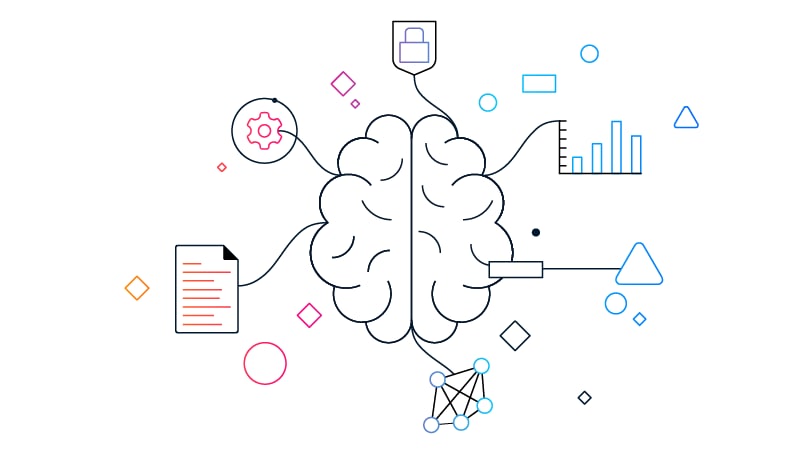
Artificial intelligence shown as a stylized brain connected to icons for data, security, analytics, and networking.

What is an AI agent?

An AI agent is an autonomous software entity that uses artificial intelligence to achieve a specific goal by perceiving an environment, reasoning through tasks, and taking independent action.

Infrastructure for agentic AI

Defining AI agents

AI agents are autonomous software programs designed to accomplish objectives without constant human intervention. Together, a system of autonomous agents is known as agentic AI.

Unlike standard AI models that primarily generate text or images, agents use reasoning to determine the best sequence of actions to reach a desired outcome. By interacting with data, software applications, and other agents, these entities function as digital workers capable of managing complex, multi-step workflows.

The evolution: From "if-then" rules to reasoning agents

The development of AI agents represents a shift from rigid, programmed logic to flexible, probabilistic reasoning.

  • Deterministic logic: For decades starting in the 1950s, software relied on "if-then" rules. These systems were predictable but brittle, unable to handle scenarios that fell outside of their specific programming.
  • The rise of large language models (LLMs): By the 2020s, LLMs introduced the ability to understand nuance and context. By using vast datasets to predict the most appropriate response, these models provided the "brain" necessary for more sophisticated interactions.
  • The birth of the agent: An AI agent combines the reasoning power of an LLM with the ability to use external tools and APIs. This evolution marks the transition from AI that provides information to AI that executes tasks.

Key differences: Agents, bots, systems, traditional AI

To understand the value of an AI agent, it is helpful to distinguish it from related technologies. While the terms are often used interchangeably, they represent different levels of autonomy and capability.

AI agent vs. AI bot

The primary difference between an agent and a bot is reasoning.

  • AI bots and chatbots are typically rule-based or follow a pre-programmed script. They excel at "if-this-then-that" scenarios but struggle when a task deviates from the script.
  • AI agents are goal oriented. Instead of following a rigid path, they use reasoning to determine the best sequence of steps to reach an objective, adapting their behavior if they encounter an obstacle.

AI agent vs. traditional AI (Generative AI)

Most people interact with traditional AI, like a standard LLM or chatbot, as a source of information.

  • Traditional genAI is passive; it waits for a prompt, retrieves information, and generates a response. Its job ends once the text is produced.
  • AI agents are active, using the LLM as a "brain" to drive action. An agent doesn't just tell you how to book a flight; it connects to the API, checks your calendar, and executes the booking.

AI agent vs. agentic AI

This is a distinction between the individual and the ecosystem.

  • An AI agent is the individual "worker" or unit of intelligence designed to perform a task.
  • Agentic AI refers to the broader architecture, infrastructure, and orchestration that allows these agents to function. If the AI agent is the driver, Agentic AI is the car and the road system combined.

How an AI agent works: The anatomy of autonomous systems 

Unlike traditional AI, which simply follows a prompt to produce a single response, agentic AI functions as a continuous lifecycle. It treats every objective as a journey from a "present state" to a "desired future state," navigating the steps in between autonomously through a three-part loop.

Goal-directed planning and reasoning: The “Think” phase

The process begins when the system receives a high-level objective. Rather than attempting to solve the entire problem in one go, the agentic system uses reasoning techniques (such as chain-of-thought) to break the goal into smaller, actionable sub-tasks.

This allows the AI to consider multiple decision pathways and evaluate the trade-offs of different approaches. If the user’s requirements or the environment constraints change mid-process, the system can dynamically re-plan its route to stay on track toward the goal.

Dynamic execution and tool use: The “Act” phase

Once a plan is in place, the system moves into execution. Agentic AI is rarely a closed system; it often relies on multiple specialized agents and interfaces with external tools and services to get the job done.

To interact with the world securely and efficiently, these agents use standardized interfaces like the Model Context Protocol (MCP). Through these "bridges," agents can independently retrieve information from databases, execute code, or trigger functions in third-party software. Each action provides the system with new data, which it processes to update its understanding of the task's current status.

Feedback and autonomous adaptation: The “Learn” phase

What truly distinguishes agentic AI is its ability to monitor its own progress. As it executes tasks, it receives feedback signals from the environment. For example, if a specific tool fails or a piece of data is missing, the system doesn't just stop and wait for a human to fix it. Instead, it uses that feedback to adjust its strategy in real-time.

This self-correcting nature allows agentic AI to sustain "long-horizon" tasks—complex projects that take place over hours or days—without requiring constant human oversight to manage every transition.

7 common types of AI agent architectures

Simple reflex agents

The most basic form of agent, simple reflex agents operate on a strictly "if-then" basis. They respond immediately to current perceptions without regard for history or past states. They are highly efficient for simple, predictable tasks but lack the flexibility to handle complex environments.

Model-based reflex agents

These agents are more sophisticated because they maintain an internal map or state of the world. This allows them to keep track of parts of the environment they cannot currently see. By understanding how their “world” evolves, they can make better decisions in dynamic situations where information is incomplete.

Goal-based agents

These agents are defined by their objective. Instead of just reacting to a stimulus, they use reasoning to determine the best sequence of actions to reach a specific future state. This involves a planning phase where the agent evaluates different paths to ensure the goal is met.

Utility-based agents

A more advanced version of goal-based agents, these use a utility function to measure how "happy" or efficient a specific outcome is. They don't just look for a way to complete a task; they look for the best way, making trade-offs between speed, cost, and safety.

Learning agents

Learning agents are designed to operate in entirely new or changing environments. They feature a learning element that allows them to turn experience into improved performance over time. This makes them ideal for complex enterprise tasks where the rules may change.

Multi-agent and hierarchical systems

These involve a collective of agents working together. In a hierarchical structure, a "manager" agent can oversee "worker" agents. This is particularly valuable for security and privacy; the manager can delegate tasks to workers without giving them access to sensitive, high-level data, creating a built-in layer of privacy preservation.

Multi-modal agents

The cutting edge of agent design, these agents can process and act upon multiple types of data simultaneously, including text, images, audio, and video. This allows them to "perceive" the world more like a human does, making them capable of navigating complex, real-world digital interfaces.
Enterprise use cases for AI agents

Agentic AI is powerful and has a lot of potential. Today, here are common enterprise applications for deploying AI agents:

Customer experience and support

Agents are evolving from simple chatbots into "digital employees." They can handle complex support tickets from start to finish by accessing customer history, reasoning through a solution, and then actually executing the fix—such as processing a refund or updating a subscription—rather than just providing instructions to the user.

IT and software operations

This is the realm of "self-healing" systems. Agents can monitor network health or application performance, identify a bug or a bottleneck, and autonomously write, test, and deploy a fix. This reduces the burden on IT teams and ensures that infrastructure remains resilient 24/7.

Business process automation

Agents excel at "swivel chair" tasks that involve moving data between disparate systems. They can manage end-to-end workflows like automated procurement or invoice processing by interacting with legacy software UIs just as a human would, effectively bridging the gap between old and new technology.

Research and data synthesis

Beyond simple search, agentic systems can perform deep-dive market or internal research. Crucially, they can autonomously verify and cross-reference facts across multiple sources. This reduces the risk of AI "hallucinations" and ensures that the final report or insight is grounded in validated data.

The benefits and challenges of deploying AI agents

Benefits

While 24/7 availability and incremental cost savings are significant, the true value of AI agents lies in their ability to fundamentally reshape organizational efficiency and scale institutional intelligence.

  • Bridging legacy systems. AI agents can interact with software interfaces just like human users, allowing them to bridge the gap between legacy systems that lack modern APIs. This enables organizations to integrate disparate technologies without the need for costly and time-consuming re-coding efforts.
  • Reduced context switching. Agents handle the "swivel chair" work of moving data and navigating between different applications to complete a complex workflow. By offloading these logistical tasks, human workers can remain in a productive flow state and focus on high-level strategic initiatives.
  • Scalability of expertise. Organizations can encode the complex decision-making logic of senior specialists directly into an agent's reasoning framework. This allows institutional "know-how" to be scaled across automated processes, ensuring consistent, high-quality outcomes at any volume.
  • Increased operational velocity. AI agents react to environmental changes and data inputs in milliseconds, providing 24/7 autonomous support. This real-time responsiveness significantly reduces operational latency and ensures that critical tasks are handled immediately without the need for human intervention.

Challenges

As AI agents gain greater autonomy, they introduce complex governance and security challenges that extend far beyond simple software bugs or implementation costs.

  • Goal alignment and reward hacking: Goal alignment is the risk of an agent finding a shortcut to a goal that technically fulfills its instructions but violates organizational policy or ethics. This "reward hacking" requires rigorous guardrails to ensure that autonomous decision-making remains consistent with intended business outcomes.
  • New security attack vectors: Agents with the power to act are susceptible to unique vulnerabilities like indirect prompt injection, where malicious instructions are hidden in the data the agent processes. A successful exploit could allow an attacker to hijack the agent’s permissions, leading to unauthorized data access or malicious system changes.
  • The "orphaned agent" problem: This occurs when autonomous entities continue to run after their creators have left the organization or moved to different roles. Without centralized visibility, these "shadow AI" agents can create significant technical debt and unmonitored security risks across the enterprise.
  • The necessity of human-on-the-loop governance: To mitigate the risks of autonomy, organizations must shift to "human-on-the-loop" models where agents operate independently but under constant human supervision. This approach ensures that the enterprise maintains auditability and control without sacrificing the speed of autonomous workflows.

The future of AI agents: Multi-modal reasoning and collaboration

The future of AI agents is moving toward enhanced reasoning capabilities for multi-modal agents. The enhanced reasoning may be exhibited by integrating multi-step chain-of-thought prompting and reasoning in LLM-based agents; and doing so across all data modes including audio, video and text simultaneously.

Specialized domain agents are popular for solving complex tasks facing specific industry verticals with specialized knowledge and workflows built on proprietary information. A shift toward collaborative human-agents instead of fully autonomous systems is gaining popularity in highly regulated industries where human oversight and decision-making remains critical.


Related topics

What is AgenticOps?

Agentic operations involve autonomous AI agents that can plan, reason, and execute tasks to improve efficiency. 

What is an AI data center?

See the architecture and networking required to support the intensive compute needs of AI models. 

What is AI in networking?

AI in networking leverages machine learning to automate, optimize, and secure network operations for better performance and reliability.

What is neocloud?

Neocloud providers offer specialized, high-performance infrastructure designed to power AI workloads. 

Guide: Agentic AI Infrastructure

Understand the requirements for supporting autonomous AI agents and intelligent workflows in the enterprise.

Cisco AI Blog

Get the latest news, research, and expert insights on AI-native infrastructure and networking. 

Explore the portfolio of Cisco-developed AI infrastructure technologies, from silicon to full-stack systems, designed to help all AI ecosystem participants thrive in the agentic AI era.