Handling the Network Provided Location Information Requests

Feature Summary and Revision History

Summary Data

Table 1. Summary Data

Applicable Products or Functional Area

5G-PCF

Applicable Platform(s)

SMI

Feature Default Setting

Enabled

Related Changes in this Release

Not Applicable

Related Documentation

Not Applicable

Revision History

Table 2. Revision History
Revision Details Release

First introduced.

2020.05.0

Feature Description

The Network Provided Location Information (NPLI) service is responsible for retrieving the access network information in the IMS network architecture. Depending on the service operator's policy configuration and subscription, the NPLI service fetches the UE time zone information and the user location information from the access network.

The PCF provides the NPLI information over the Rx interface to the Application Function (AF) based on the response that it receives from SMF over the N7 interface.

How it Works

The AF initiates a request toward the PCF to provide the network information. The request is sent over an Rx interface through the Required-Access-Info AVP. When the Access Network Information is available the SMF provides the required Access Network Information to the PCF within the 3GPP-User-Location-Info AVP or 3GPP-MS-TimeZone AVP or both as requested. Upon receiving the request, PCF triggers an N7 Update Notify request with ‘Access Network Info’ event trigger (if not already subscribed for) towards SMF. The SMF responds to PCF with the required information, which PCF further forwards to the AF.

When the SMF responds with ServingNetwork attribute instead of UserLocationInfo, then to set the Mobile Country Codes (MCC) and Mobile Network Code (MNC) ensure that the NetLoc features is enabled. For information on how to enable the NetLoc, see Enabling the NetLoc Feature .

The PCF provides the following information during an ACCESS_NETWORK_INFO_REPORT event trigger within the Event-Trigger AVP:

  • 3GPP-User-Location-Info AVP (If available)

  • User-Location-Info-Time AVP (If available)

  • 3GPP-SGSN-MCC-MNC AVP (If the location information is not available) or 3GPP-MS-TimeZone AVP or both.

Considerations

This section defines the considerations that apply for successful handling of the NPLI requests:

  • In Policy Builder > Diameter Clients > Rx Client, set the STA Hold Time Ms parameter to maximum duration of 3000 milliseconds. The parameter indicates the duration by which the STA is held back. A lower timer value minimizes the performance impact that occurs when AF and PCF continue to wait for a response from each other and eventually timeout.

Call Flows

This section describes the following call flows.

NPLI in Rx RAR Call Flow

This section describes the following call flow.

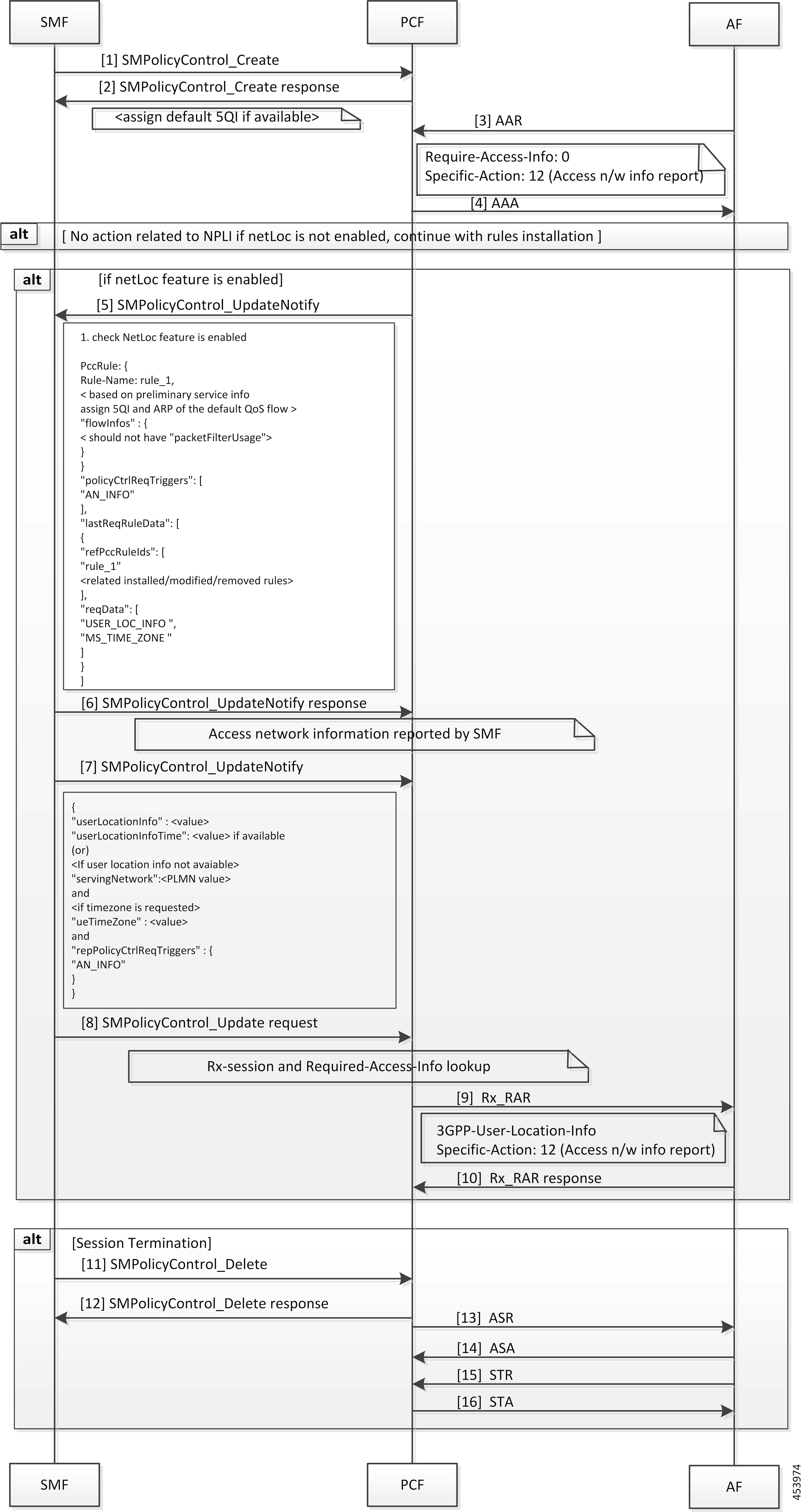
Figure 1. NPLI in Rx RAR Call Flow

This image is not available in preview/cisco.com

Table 3. NPLI in Rx RAR Call Flow Description

Step

Description

1

The SMF sends a SMPolicyControl_Ceate request to the PCF.

2

The PCF responds to the SMPolicyControl_Create request.

3

The AF sends an Authenticate-Authorize-Request (AAR) message to the PCF. The message contains Required-Access-Info AVP requesting the access network information required for the AF session.

4

If the NetLoc feature is enabled, then the PCF sends an SMPolicyControl_UpdateNotify request toward the SMF.

5

In response to the SMPolicyControl_UpdateNotify request, the SMF sends the access network information to the PCF.

6

The PCF sends the SMPolicyControl_Update request to the SMF.

7

The SMF sends the SMPolicyControl_Update request to the PCF.

8

After the establishing the Rx-session and the Required-Access-Info lookup, the PCF sends the Rx Re-Authorization Request message to the AF.

9

The AF sends the Rx Re-Authorization Request response containing the 3GPP-User-Location-Info AVP and access network information report to the PCF.

10

If the session terminates, the SMF sends a SMPolicyControl_Delete request to the PCF.

11

The PCF responds to SMF for the SMPolicyControl_Delete request.

12

The PCF sends the Abort-Session-Request message to the AF.

13

The AF responds with the Abort-Session-Answer to the PCF.

14

The AF sends the Session-Termination-Request to the PCF.

15

The PCF responds with the Session-Termination-Answer message to the AF.

NPLI in Rx STA Call Flow

This section describes the following call flow.

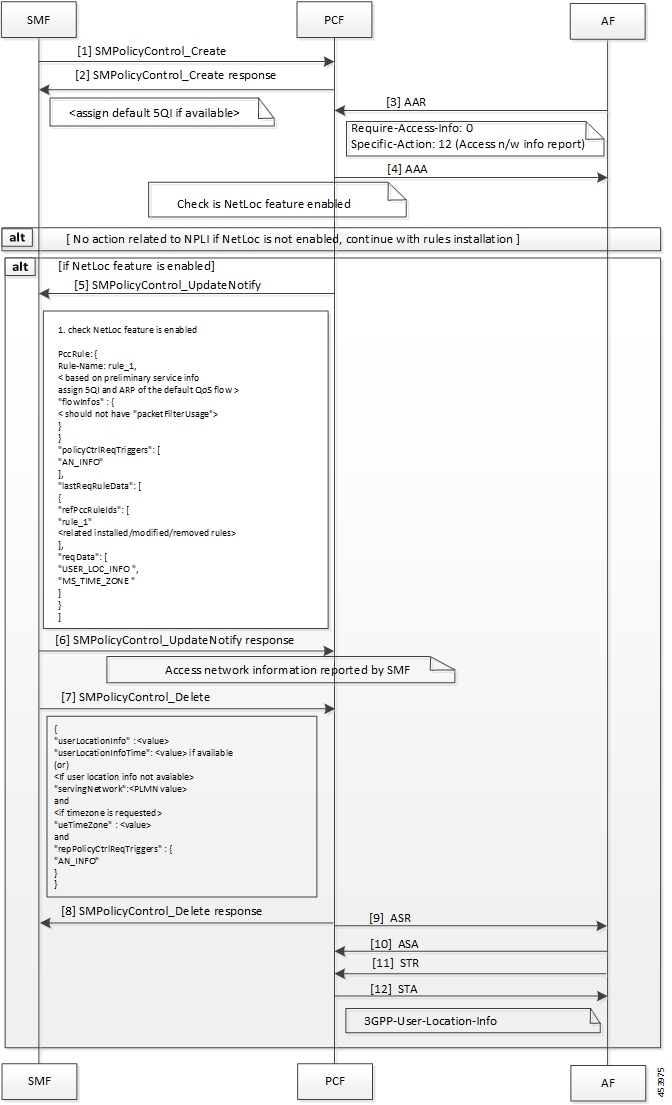
Figure 2. NPLI in Rx STA Call Flow

This image is not available in preview/cisco.com

Table 4. NPLI in Rx STA Call Flow Description

Step

Description

1

The SMF sends a SMPolicyControl_Ceate request to the PCF.

2

The PCF responds with the SMPolicyControl_Create response to the SMF.

3

The AF sends an Authenticate-Authorize-Request message to the PCF.

The message contains Required-Access-Info AVP requesting the access network information required for the AF session.

4

The PCF responds with an AA-Answer message to the AF.

5

If the NetLoc feature is enabled, the PCF sends the SMPolicyControl_UpdateNotify request to the SMF.

6

The SMF responds with the SMPolicyControl_UpdateNotify message to the PCF. This message contains the access network information.

7

The SMF sends the SMPolicyControl_Delete request to the PCF.

8

The PCF responds to the SMF with the SMPolicyControl_Delete message.

9

The PCF sends the Abort-Session-Request message to the AF.

10

The AF responds with the Abort-Session-Answer to the PCF.

11

The AF sends the Session-Termination-Request to the PCF.

12

The PCF responds with the Session-Termination-Answer message to the AF. This message contains the user location information.

Required Access Information in STR Call Flow

This section describes the following call flow.

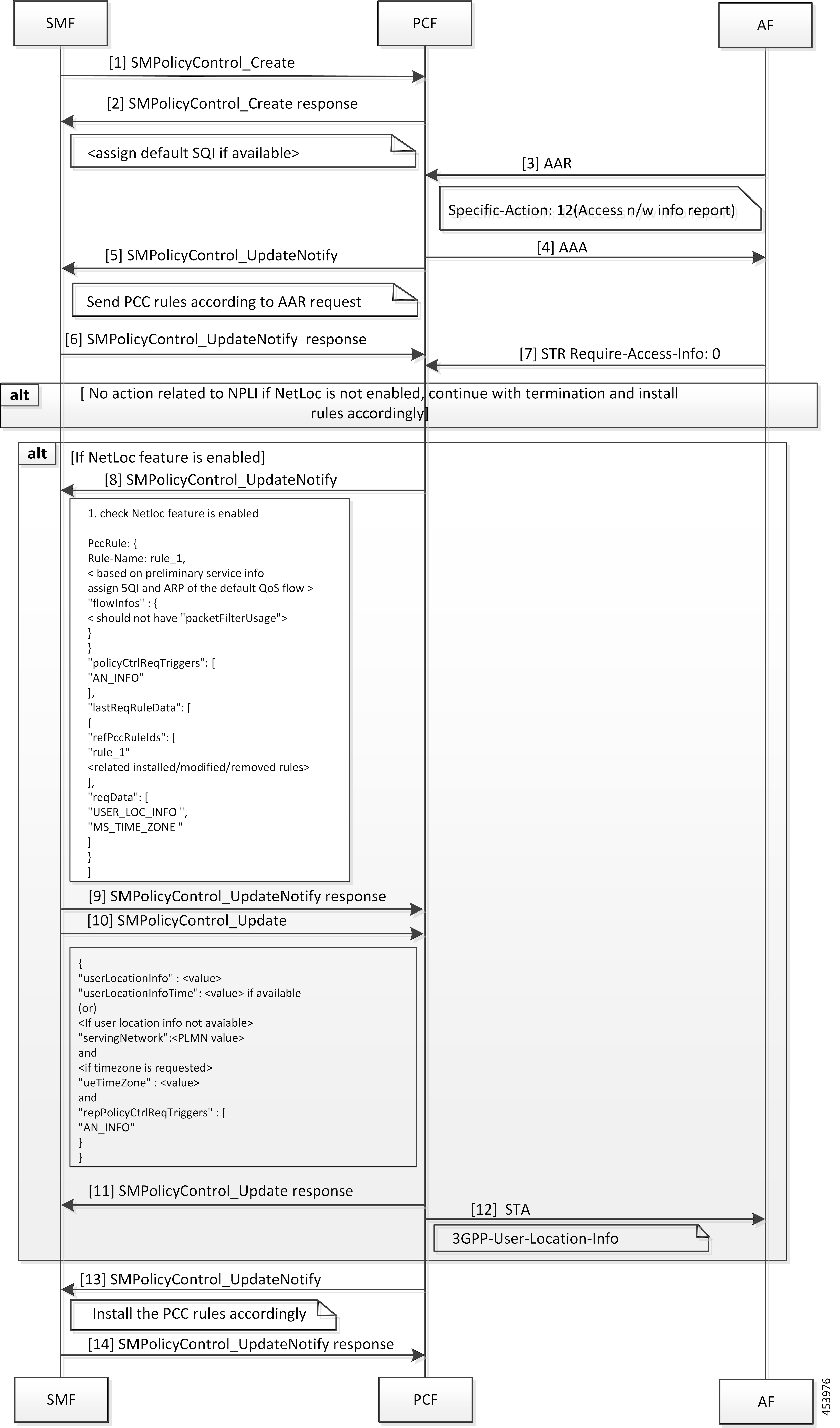
Figure 3. Required Access Information in STR Call Flow

This image is not available in preview/cisco.com

Table 5. Required Access Information in STR Call Flow Description

Step

Description

1

The SMF sends an SMPolicyControl_Create request to the PCF.

2

The PCF responds to the SMF with the SMPolicyControl_Create response.

3

The AF sends an Authenticate-Authorize-Request message to the PCF.

4

The PCF sends an AA-Answer message to the AF.

5

The PCF sends an SMPolicyControl_UpdateNotify request to the SMF.

6

The SMF sends PCC rules as requested in the Authenticate-Authorize-Request in the SMPolicyControl_UpdateNotify response to the PCF.

7

The AF sends a Session-Termination-Request to PCF to retrieve the Required-Access-Info AVP.

8

If the NetLoc feature is enabled, the PCF sends as SMPOlicyControl_UpdateNotify request to the SMF.

9

The SMF sends an SMPOlicyControl_UpdateNotify response to the PCF.

10

The SMF sends an SMPOlicyControl_Update request to the PCF.

11

The PCF sends a response for the SMPOlicyControl_Update request to the SMF.

12

The PCF sends the Session-Termination-Answer message to the AF with the user location information.

13

The PCF sends the SMPolicyControl_UpdateNotify request to the SMF.

14

On installing the PCC rules, the SMF sends SMPolicyControl_UpdateNotify response to the PCF.

Enabling the NetLoc Feature

This section describes how to enable the NetLoc feature that supports the Access Network Information Reporting in 5G.

To enable the NetLoc feature, in the initial N7 request set the "suppFeat" value's 6th binary digit to 1.