- About this Guide
- Mobility Management Entity Overview
- Mobility Management Entity Configuration
- 128K eNodeB Connections
- A-MSISDN Functionality
- Access Restriction based on Regional Zone Code
- APN Override
- Backup and Recovery of Key KPI Statistics
- Cause Code #66
- Cell Broadcast Center - SBc Interface
- Cell Traffic Trace
- Closed Subscriber Groups
- CSFB and SMS over SGs Interface
- CSFB for 1xRTT
- DDN Throttling
- Default APN for DNS Failure
- eDRX Support on the MME
- Emergency Bearer Services
- Enhanced Congestion Control and Overload Control
- Enhanced Multimedia Priority Service (eMPS)
- Enhanced Event Logging
- Foreign PLMN GUTI Management
- GTP-C Load and Overload Control on MME
- GUTI Re-allocation
- Heuristic and Intelligent Paging
- HSS-based P-CSCF Restoration
- Idle-mode Signaling Reduction
- IMSI Manager Overload Control
- IMSI Manager Scaling on the MME
- Integrity and Confidentiality Algorithms for UE
- IPNE Service
- Limiting the Number of SGWs Tried
- Load Balancing and Rebalancing and VoLTE Offloading
- Local Emergency Numbers List
- Location Services
- MBMS for MME (eMBMS)
- Operator Policy
- Operator Specific QCI
- Operator Policy Selection Based on IMEI-TAC
- Overcharging Protection
- Paging Priority IE Support
- Power Saving Mode (PSM) in UEs
- QoS Profile Support
- S13 Additional IMEI Check
- Selective Authentication
- Session Tracing
- SGW Blacklisting on the MME
- SGSN-MME Combo Optimization
- Single Radio Voice Call Continuity
- SRVCC for 1xRTT
- State-Location Information Retrieval Flag
- TAI-based Routing for 20-bit and 28-bit eNB ID
- Timer-based GBR Bearer Deactivation
- UDPC2 Support for MME/SGSN
- UE Relocation
- VLR Management
- Troubleshooting the MME Service
- Monitor the MME Service
- Engineering Rules
Default APN for DNS
Failure
With Release 18.2, it is possible for the operator to configure the MME to use a default APN in some situations where the DNS resolution fails due to a problem with the subscriber-requested APN. As a result, the Attach could proceed or the PDP context activation could complete.
Feature Description
The Default APN for DNS Failure feature makes it possible for the operator to ensure that calls and PDP context activation are not rejected because of possible UE errors, such as, the UE requested a misspelled APN name. This feature allows the operator to promote activation success if
when
and if
This functionality is configured with the use of the require-dns-fail-wildcard keyword. This keyword is currently supported only on MME.
By default, this new functionality is not enabled. If not enabled, then the MME sends a PDN connectivity reject to the eNodeB if the DNS resolution fails for the reasons indicated above.
Relationships to Other Features
Operator Policy - Default APN for DNS Failure is configured with the commands in the APN Remap Table configuration mode which is a key component of the Operator Policy feature. For information about this feature, see the chapter on Operator Policy.
How It Works
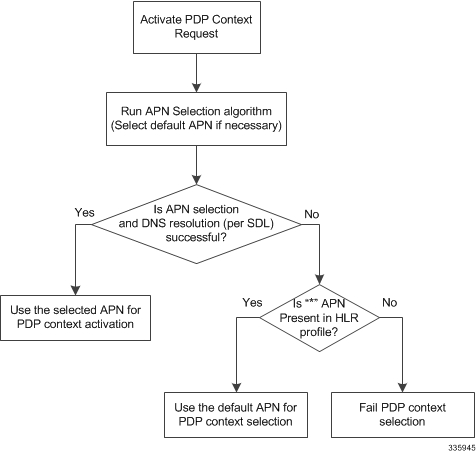
With the Default APN for DNS Failure enabled by configuring the 'required-dns-fail-wildcard', if DNS resolution fails because the UE-requested APN name is not present in the subscription record but the wildcard subscription is present, then MME overrides the requested APN with a configured default APN. The MME proceeds with the DNS resolution of the configured default APN and then proceeds with the Attach or PDP context activation.
The MME checks the subscription record with the configured default APN. If subscription record of the configured default APN is available, then the MME takes the QoS profile and the ARP values from that record. If the subscription record is not available, then the MME checks the QoS profile and ARP values included in the wildcard subscription record.
Note that DNS query will be retried with default APN only once. If DNS resolution fails again, even after applying the configured default APN, then the Activation Request will be rejected.
Architecture
Standards Compliance
The Default APN for DNS Failure feature complies with the following standards:
- 3GPP TS 23.060
- 3GPP TS 36.413
- 3GPP TS 24.301
- 3GPP TS 29.274
- 3GPP TS 23.401
Configuring Default APN for DNS Failure
Enabling Default APN for DNS Failure is configured in the APN Remap Table configuration mode. This mode generates a remap table that is a key component of the Operator Policy feature. The operator policy must be assigned subscribers in the LTE Policy, the LTE policy's subscriber map must be associated with the MME service.
Check the MME's current configuration for names of already created APN remap tables, operator policies, subscriber maps and mme-service instances. If desired, these names can be used to create associations with pre-configured tables, policies and services.
We recommend that all table, policy, and service names be unique - not only within a context but across the MME's configuration. Do not use preconfigured names unless the association is desired.
- creating an APN remap table and enabling 'require-dns-fail-wildcard',
- creating an operator policy and associating the remap table with the operator policy,
- associating the remap table with the operator policy,
- assigning subscribers to the operator policy in the LTE policy,
- associating the LTE policy's subscriber map to the MME service configuration.
All commands, keywords, and variables are defined in the Command Line Interface Reference for this release.
All components must be completed for the feature to be enabled. Begin this procedure in the Local context in the Exec mode.
- Enabling 'require-dns-fail-wildcard'
- Associating the APN Remap Table with the Operator Policy
- Assigning Subscribers to the Operator Policy
- Associating the Subscriber's Map with the MME Service
- Verifying the Feature's Configuration
Enabling 'require-dns-fail-wildcard'
The following configuration components deals with creating an APN Remap Table and configuring the special keyword specific to enabling the Default APN for DNS Failure feature.
config
   apn-remap-table <table_name> -noconfirm
      apn-selection-default network-identifier   net_id  require-dns-fail-wildcard
      end
Notes:
- net_id - Specifies the network identifier to be used as the default APN name. Must be a string of 1 to 62 characters, including digits, letters, dots (.) and dashes (-).
- require-dns-fail-wildcard - The keyword that enables the use of the default APN when DNS resolution fails. This keyword is currently supported only on MME.
- no prefixed to the command will remove the require-dns-fail-wildcard configuration from the remap table.
Associating the APN Remap Table with the Operator Policy
The following configuration components deals with creating an operator policy or accessing the operator policy configuration to associate the APN remap table identified in the configuration procedure above.
config
   operator-policy name <policy_name> -noconfirm
      associate apn-remap-table <table_name>
      end
Assigning Subscribers to the Operator Policy
The following configuration components deals with assigning subscribers to the operator policy in the LTE policy.
config
   lte-policy
      subscriber-map <map_name> -noconfirm
         precedence precedence match-criteria all operator-policy-name <policy_name>
         end
Associating the Subscriber's Map with the MME Service
The following configuration components deals with associating the LTE policy's subscriber map to the MME service configuration
config
   context context_name -noconfirm
      mme-service <srvc_name> -noconfirm
         associate subscriber-map <map_name>
         end
Verifying the Feature's Configuration
The show apn-remap-table full all command generates a display that indicates the configuration for the APN Remap Table. The Use Default APN when DNS Query fails field indicates if the Default APN for DNS Failure feature has been enabled.
The following is a sample display is only a portion of the output and this sample shows star.com configured as the default APN name.
[local]asr5000 show apn-remap-table full all
APN Remap Table Name = test-table
Default APN                        : star.com
    Require Subscription APN                                 : Not Configured
        Use Default APN when no APN is requested             : Yes
        Use Default APN when DNS Query fails                 : Yes
        Fallback APN to use when Default APN not present
        in subscription                                      : Not Configured
        . . . .
 Feedback