- About this Guide
- Mobility Management Entity Overview
- Mobility Management Entity Configuration
- 128K eNodeB Connections
- A-MSISDN Functionality
- Access Restriction based on Regional Zone Code
- APN Override
- Backup and Recovery of Key KPI Statistics
- Cause Code #66
- Cell Broadcast Center - SBc Interface
- Cell Traffic Trace
- Closed Subscriber Groups
- CSFB and SMS over SGs Interface
- CSFB for 1xRTT
- DDN Throttling
- Default APN for DNS Failure
- eDRX Support on the MME
- Emergency Bearer Services
- Enhanced Congestion Control and Overload Control
- Enhanced Multimedia Priority Service (eMPS)
- Enhanced Event Logging
- Foreign PLMN GUTI Management
- GTP-C Load and Overload Control on MME
- GUTI Re-allocation
- Heuristic and Intelligent Paging
- HSS-based P-CSCF Restoration
- Idle-mode Signaling Reduction
- IMSI Manager Overload Control
- IMSI Manager Scaling on the MME
- Integrity and Confidentiality Algorithms for UE
- IPNE Service
- Limiting the Number of SGWs Tried
- Load Balancing and Rebalancing and VoLTE Offloading
- Local Emergency Numbers List
- Location Services
- MBMS for MME (eMBMS)
- Operator Policy
- Operator Specific QCI
- Operator Policy Selection Based on IMEI-TAC
- Overcharging Protection
- Paging Priority IE Support
- Power Saving Mode (PSM) in UEs
- QoS Profile Support
- S13 Additional IMEI Check
- Selective Authentication
- Session Tracing
- SGW Blacklisting on the MME
- SGSN-MME Combo Optimization
- Single Radio Voice Call Continuity
- SRVCC for 1xRTT
- State-Location Information Retrieval Flag
- TAI-based Routing for 20-bit and 28-bit eNB ID
- Timer-based GBR Bearer Deactivation
- UDPC2 Support for MME/SGSN
- UE Relocation
- VLR Management
- Troubleshooting the MME Service
- Monitor the MME Service
- Engineering Rules
Overcharging
Protection
Overcharging Protection helps to avoid charging subscribers for dropped downlink packets while the UE is in idle-mode.
Feature Description
For Non-GBR (Guaranteed Bit Rate) 4G bearers, the P-GW is not aware when the UE loses radio coverage, and will continue to forward and charge downlink packets, which can result in overcharging of subscribers. 3GPP does not specify a standard solution to deal with such scenarios.
A typical example is when a subscriber drives into a tunnel while having an active download session. Downlink packets will be counted in P-GW before discarded later in S-GW due to the UE not responding to paging.
The subscriber may lose coverage while connected to a particular MME/S-GW and later regain coverage in the same or diiferent MME/S-GW.
The subscriber may lose coverage in 4G and regain coverage in 2G/3G, or vice versa.
Gn and S3/S4 based network architecture may be used in the case of Loss of Radio Coverage.
A valid license key is required to enable Overcharge Protection on the MME. Contact your Cisco Account or Support representative for information on how to obtain a license.
Relationships to Other Features
Overcharging protection on the MME requires separate overcharging protection licenses on the S-GW and P-GW.
How It Works
Call Flows
The following diagram depicts the call flow when a UE loses radio access, and then later regains access, as it relates to overcharging protection.
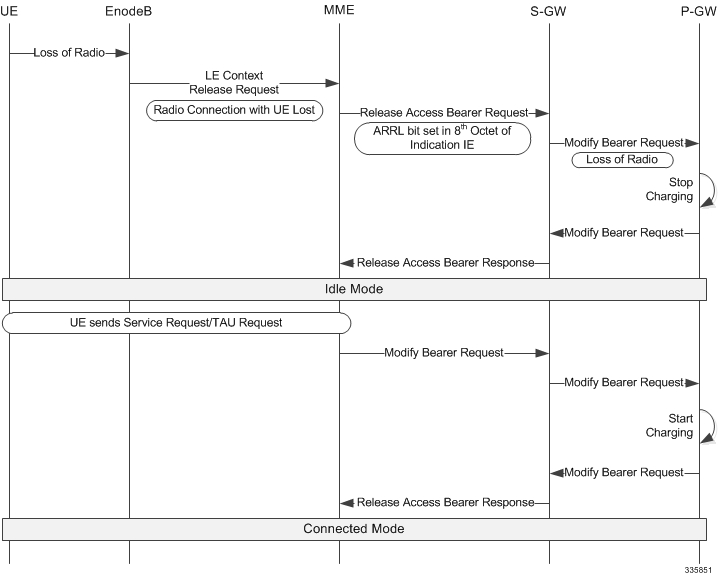
Overcharging protection in MME is triggered by a UE Context Release Request from the eNodeB. This request can come to MME when UE is in EMM connected/connecting mode.
On receiving the UE Context Release Request, the MME checks the radio cause in the received message against the configured overcharging protection cause code.
If the configured cause code matches the received cause code, the MME sends Loss of Radio Contact using ARRL (Abnormal Release of Radio Link) bit in the Release Access Bearer Request (GTPv2 message) to the S-GW. The ARRL (Abnormal Release of Radio Link) is bit 7 in the 8th Octet of Indication IE of Release Access Bearer Req message.
On Receiving ARRL indication in Release Access Bearer Request , the S-GW will inform the P-GW to stop charging.
When the radio contact is resumed in the 4G network, the Modify Bearer Req will enable the P-GW to start charging again.
The ARRL bit is supported only in Release Access Bearer Request message by MME.
Configuring Overcharge Protection
- Enabling Overcharging Protection
- Configuring S1AP Cause Code Group and Cause Code
- Verifying the Overcharge Protection Configuration
Enabling Overcharging Protection
To enable overcharging protection for a specific MME service, issue the following commands:
configure
   context context_name
      mme-service svc_name
         policy overcharge-protection s1ap-cause-code-group group_name
         end
To disable overcharging protection:
no policy overcharge-protection
Configuring S1AP Cause Code Group and Cause Code
To configure the S1AP Cause Code Group and S1AP cause code "Radio Connection With UE Lost (21)":
configure
   lte-policy
      cause-code-group group_name protocol s1ap
         class radio cause radio_cause_code
         end
Notes:
Verifying the Overcharge Protection Configuration
The Overcharge Protection field has been added to the output of show mme-service name service_name to display the configuration of this feature, either "Not configured" or showing the configured S1-AP cause code group name:
Policy Inter-RAT Indirect Fwd Tunnels    : Never
Policy Inter-RAT Ignore SGSN ContextID   : Disabled
Policy S1-Reset                          : Idle-Mode-Entry
Overcharge Protection                    : Cause Code Group grp1
 Feedback