Cisco IP Phone Hardware

Overview of the Cisco IP Phone 6800 Series Multiplatform Phones

The Cisco IP Phone 6800 Series Multiplatform Phones comprises a set of full-featured VoIP (Voice-over-Internet Protocol) phones that provide voice communication over an IP network. The phones provide all the features of traditional business phones, such as call forwarding, redialing, speed dialing, transferring calls, and conference calling. The Cisco IP Phone 6800 Series Multiplatform Phones is targeted for solutions that are centered on third-party SIP-based IP PBX.


Note

This document doesn't include the DECT phones.


The Cisco IP Phone 6800 Series Multiplatform Phones deliver easy-to-use, highly-secure voice communications. In the following figure, you see (Clockwise from the top left):

  • Cisco IP Phone 6841 Multiplatform Phone

  • Cisco IP Phone 6851 Multiplatform Phone with Key Expansion Module

  • Cisco IP Phone 6851 Multiplatform Phone

  • Cisco IP Phone 6861 Multiplatform Phone

  • Cisco IP Phone 6871 Multiplatform Phone

  • Cisco IP Phone 6821 Multiplatform Phone
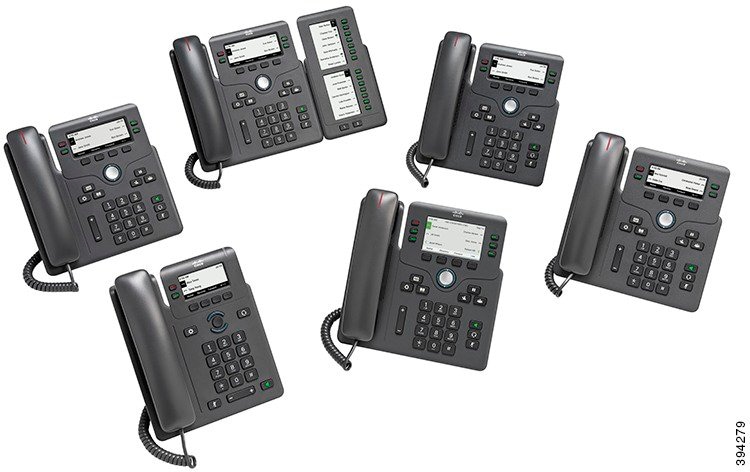
Figure 1. Cisco IP Phone 6800 Series Multiplatform Phones
Cisco IP Phone 6821, 6841, 6851, 6861, and 6871

Note

In this document, the terms Cisco IP Phone, phone, or device mean Cisco IP Phone 6800 Series Multiplatform Phones.


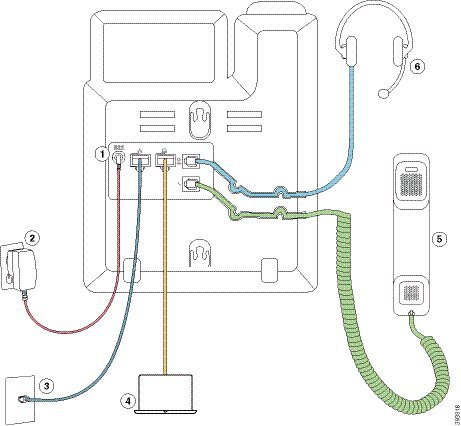
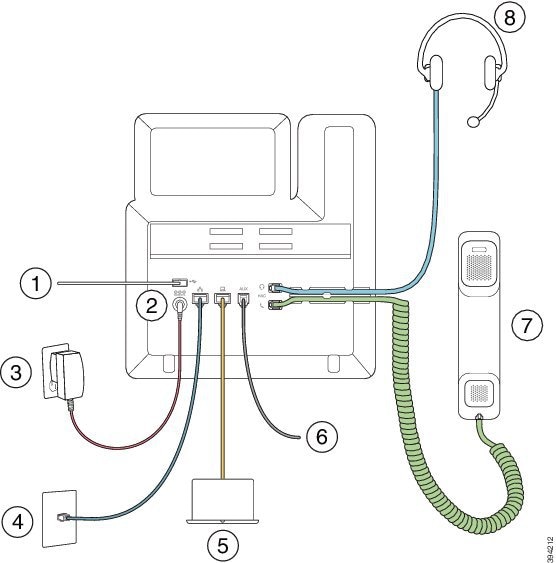
Cisco IP Phone 6821 Multiplatform Phones Connections

Connect your phone to your LAN with an Ethernet cable to enable full functionality of your phone. If your Ethernet port is equipped with Power over Ethernet (PoE), you can power the phone through the LAN port. If you don't have PoE available, then you need to use a power adapter to power the phone. Do not extend the Ethernet cable outside the building. For your phone to work, it must be connected to the IP telephony network.

Figure 2. Cisco IP Phone 6821 Multiplatform Phones Connections

1

DC adapter port (optional)

4

Access port (10/100 PC) connection (optional)

2

Power adapter (optional)

5

Handset connection

3

Network port (10/100 SW) connection; IEEE 802.3af power enabled

6

Analog headset connection (optional)

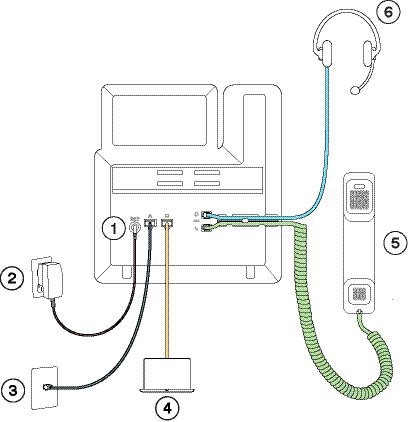
Cisco IP Phone 6841 Multiplatform Phones Connections

Connect your phone to your LAN with an Ethernet cable to enable full functionality of your phone. You need to use a power adapter to power the phone. Do not extend the LAN Ethernet cable outside the building. For your phone to work, it must be connected to the IP telephony network.

1

DC adapter port

4

Access port (10/100/1000 PC) connection (optional)

2

Power adapter

5

Handset connection

3

Network port (10/100/1000 SW) connection

6

Analog headset connection (optional)

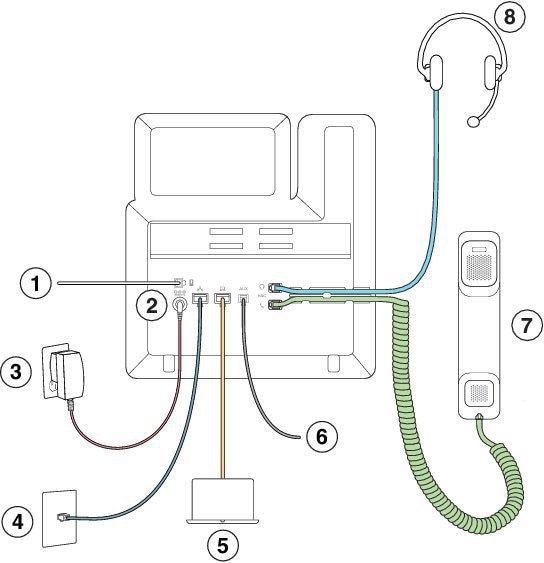
Cisco IP Phone 6851 Multiplatform Phones Connections

Connect your phone to your LAN with an Ethernet cable to enable full functionality of your phone. If your Ethernet port is equipped with Power over Ethernet (PoE), you can power the phone through the LAN port. If you don't have PoE available, then you need to use a power adapter to power the phone. Do not extend the LAN Ethernet cable outside the building. For your phone to work, it must be connected to the IP telephony network.

1

Key Expansion Module port

5

Access port (10/100/1000 PC) connection (optional)

2

DC adapter port (optional)

6

Auxiliary port (optional)

3

Power adapter (optional)

7

Handset connection

4

Network port (10/100/1000 SW) connection; IEEE 802.3af power enabled

8

Analog headset connection (optional)

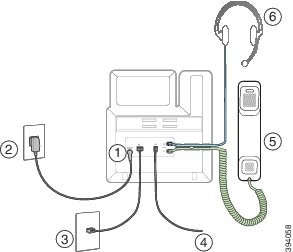
Cisco IP Phone 6861 Multiplatform Phones Connections

Connect your phone to your LAN with an Ethernet cable or with Wi-Fi to enable full functionality of your phone. You need to use a power adapter to power the phone. If you connect your phone to a wired network, do not extend the LAN Ethernet cable outside the building. For your phone to work, it must be connected to the IP telephony network.

1

DC adapter port

4

Auxiliary port (optional)

2

Power adapter

5

Handset connection

3

Network port (10/100 SW) connection

6

Analog headset connection (optional)

Cisco IP Phone 6871 Multiplatform Phones Connections

Connect your phone to your LAN with an Ethernet cable to enable full functionality of your phone. If your Ethernet port is equipped with Power over Ethernet (PoE), you can power the phone through the LAN port. If you don't have PoE available, then you need to use a power adapter to power the phone. Do not extend the LAN Ethernet cable outside the building. For your phone to work, it must be connected to the IP telephony network.

1

USB Headsets

5

Access port (10/100/1000 PC) connection (optional)

2

DC adapter port (optional)

6

Auxiliary port (optional)

3

Power adapter (optional)

7

Handset connection

4

Network port (10/100/1000 SW) connection; IEEE 802.3af power enabled

8

Analog headset connection (optional)

Cisco IP Phone 6821 Multiplatform Phones Buttons and Hardware

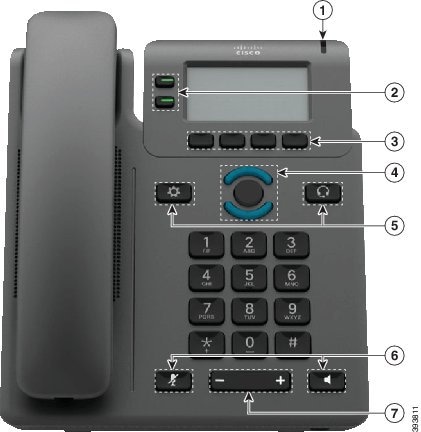
The following figure shows the Cisco IP Phone 6821 Multiplatform Phones.

Figure 3. Cisco IP Phone 6821 Multiplatform Phones

1

Light strip

Indicates whether you have an incoming call (flashing red) or a new voice message (steady red).

2

Programmable feature buttons and line buttons

Access your phone lines, features, and call sessions.

For more information, see Softkey, Line, and Feature Buttons.

3

Softkey buttons

Access functions and services such as Conference and Transfer.

For more information, see Softkey, Line, and Feature Buttons.

4

Navigation cluster

Navigation ring and Select button. Scroll through menus, highlight items, and select the highlighted item.

5

Applications and Headset

Applications Access call history, user preferences, phone settings, and phone model information.

Headset Toggle the headset on or off. When a headset is active, a headset icon is displayed in the header.

6

Mute and Speakerphone

Mute Toggle the microphone on or off. When the microphone is muted, a mute icon flashes on the screen.

Speakerphone Toggle the speakerphone on or off.

7

Volume button

Adjust the handset, headset, and speakerphone volume (off hook) and the ringer volume (on hook).

Cisco IP Phone 6841, 6851, and 6861 Multiplatform Phones Buttons and Hardware

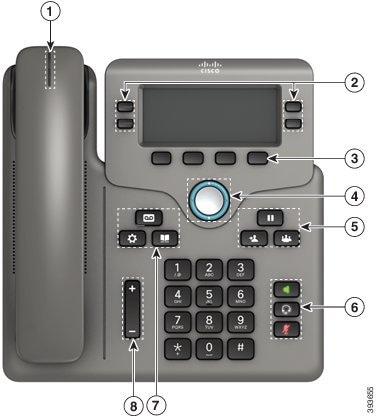
The following figure shows the Cisco IP Phone 6841.

Figure 4. Cisco IP Phone 6841, 6851, and 6861 Multiplatform Phones Buttons and Features

1

Handset and Handset light strip

Indicates whether you have an incoming call (flashing red) or a new voice message (steady red).

2

Programmable feature buttons and line buttons

Access your phone lines, features, and call sessions.

For more information, see Softkey, Line, and Feature Buttons.

3

Softkey buttons

Access functions and services.

For more information, see Softkey, Line, and Feature Buttons.

4

Navigation cluster

Navigation ring and Select button. Scroll through menus, highlight items, and select the highlighted item.
5

Hold/Resume, Conference, and Transfer

Hold/Resume Place an active call on hold and resume the held call.

Conference Create a conference call.

Transfer Transfer a call.

6

Speakerphone, Mute, and Headset

Speakerphone Toggle the speakerphone on or off. When the speakerphone is on, the button is lit.

Mute Toggle the microphone on or off. When the microphone is muted, the button is lit.

Headset Toggle the headset on or off. When the headset is on, the button islit.

7

Contacts, Applications, and Messages

Contacts Access personal and corporate directories.

Applications Access call history, user preferences, phone settings, and phone model information.

Messages Autodial your voice messaging system.

8

Volume button

Adjust the handset, headset, and speakerphone volume (off hook) and the ringer volume (on hook).

Cisco IP Phone 6871 Multiplatform Phones Buttons and Hardware

The following figure shows the Cisco IP Phone 6871.

Figure 5. Cisco IP Phone 6871 Multiplatform Phones Buttons and Features
Cisco IP Phone 6871 Buttons

1

Handset and Handset light strip

Indicates whether you have an incoming call (flashing red) or a new voice message (steady red).

2

Programmable feature buttons and line buttons

Access your phone lines, features, and call sessions.

For more information, see Softkey, Line, and Feature Buttons.

3

Softkey buttons

Access functions and services.

For more information, see Softkey, Line, and Feature Buttons.

4

Navigation cluster

Navigation ring and Select button. Scroll through menus, highlight items, and select the highlighted item.
5

Hold/Resume, Conference, and Transfer

Hold/Resume Place an active call on hold and resume the held call.

Conference Create a conference call.

Transfer Transfer a call.

6

Speakerphone, Mute, and Headset

Speakerphone Toggle the speakerphone on or off. When the speakerphone is on, the button is lit.

Mute Toggle the microphone on or off. When the microphone is muted, the button is lit.

Headset Toggle the headset on or off. When the headset is on, the button islit.

7

Contacts, Applications, and Messages

Contacts Access personal and corporate directories.

Applications Access call history, user preferences, phone settings, and phone model information.

Messages Autodial your voice messaging system.

8

Volume button

Adjust the handset, headset, and speakerphone volume (off hook) and the ringer volume (on hook).

Softkey, Line, and Feature Buttons

You can interact with the features on your phone in several ways:

  • Softkeys, located below the screen, give you access to the function displayed on the screen above the softkey. The softkeys change depending on what you are doing at the time. The More ... softkey shows you that more functions are available.

  • Feature and line buttons give you access to phone features and phone lines. On the Cisco IP Phone 6821, these are the buttons on the left side of the screen. On the Cisco IP Phone 6841, 6851, 6861, and 6871, these are the buttons on either side of the screen.

    • Feature buttons—Used for features such as Speed dial or Call pickup, and to view your status on another line.

    • Line buttons—Used to initiate or answer a call. You can also use a line key to open and close the call session window, and to navigate through the call session window. Open the call session window to see the calls on the line.

Feature and line buttons illuminate to indicate status:

  • or Green—Line is idle.

  • or Red, steady—Line is active or in use.

  • or Red, flashing—Line is on hold or there is an inbound call.

  • or Amber, steady—Line is unregistered (cannot be used).

Some functions can be set up as softkeys or as feature buttons. You can also access some functions with softkeys or the associated hard button.

The Cisco IP Phone 6821 has a limited number of hard buttons. You use the softkeys to access most call features.

Terminology Differences

The following table highlights some of the terminology differences in the Cisco IP Phone 6800 Series Multiplatform Phones User Guide and the Cisco IP Phone 6800 Series Multiplatform Phones Administration Guide

Table 1. Terminology Differences

User Guide

Administration Guide

Message Indicators

Message Waiting Indicator (MWI) or Message Waiting Lamp

Voicemail System

Voice Messaging System

Phone Web Page

Configuration Utility