- Read Me First
- Introduction to Segment Routing
- Segment Routing With IS-IS v4 Node SID
- IS-IS Link-protection Topology Independent Loop Free Alternate Fast Reroute
- Segment Routing Traffic Engineering With IS-IS
- Segment Routing With OSPFv2 Node SID
- OSPFv2 Link-protection Topology Independent Loop Free Alternate Fast Reroute
- Segment Routing Traffic Engineering With OSPF
- BGP Dynamic Segment Routing Traffic Engineering
- Segment Routing On Demand Next Hop for L3/L3VPN
- Routing Information Base Support
- SR-TE On Demand LSP
- Segment Routing MPLS OAM Support
- Using Seamless BFD and SSPF with Segment Routing
- Dynamic PCC
- ISIS - SR: uLoop Avoidance
- BGP - SR: BGP Prefix SID Redistribution
- Restrictions for Segment Routing –Traffic-Engineering Dynamic BGP
- Information About Segment Routing –Traffic-Engineering Dynamic BGP
- How to Configure TE Label Switched Path Attribute-Set
- Additional References for BGP Dynamic Segment Routing Traffic Engineering
- Feature Information for BGP Dynamic Segment Routing Traffic Engineering
BGP Dynamic Segment
Routing Traffic Engineering
Border Gateway Protocol (BGP) has become a popular choice as a routing protocol in Data Center (DC) network. The ability to setup Segment Routing-Traffic Engineering (SR-TE) path initiated by BGP simplifies DC network operation.
- Restrictions for Segment Routing –Traffic-Engineering Dynamic BGP
- Information About Segment Routing –Traffic-Engineering Dynamic BGP
- How to Configure TE Label Switched Path Attribute-Set
- Additional References for BGP Dynamic Segment Routing Traffic Engineering
- Feature Information for BGP Dynamic Segment Routing Traffic Engineering
Restrictions for Segment Routing –Traffic-Engineering Dynamic BGP
Information About Segment Routing –Traffic-Engineering Dynamic BGP
In BGP dynamic SR-TE, the label Switched Path (LSP) is enabled on demand when defined criteria and policies are met and that is the key difference between manually enabled SR-TE and BGP dynamic SR-TE. Policies, for example, low latency path, minimum cost path, and so on are carried via BGP and matches on a given customer prefix. SR-TE tunnel used for L3VPN or Virtual Private LAN Services (VPLS) using BGP for auto-discovery and signaling is referred to as BGP-TE Dynamic.
BGP SR-TE dynamic assumes the on-demand auto-tunnel resides in single IGP domain. In this case path computation is done via IGP. SR-TE auto-tunnel created based on the request from BGP is a dynamic SR-TE tunnel. In other words, tunnel path information, or label stack, is computed based on the BGP next-hop and TE attribute configuration. BGP dynamic SR-TE functions to trigger an On-demand LSP (auto-tunnel). The functions include:
-
Tag customer prefixes (IPv4 or L3VPN VRF) using communities (community list) via route map configuration.
-
Associate each community with a TE attribute-set or profile.
SR-TE profile is locally configured in attribute-set to define certain SR-TE parameters, for example, latency, disjoint path and so on. Once the BGP customer prefixes are mapped to an SR-TE-profile, a tunnel is dynamically created (auto-tunnel or On demand Label Switched Path (LSP)) using the parameters defined in the attribute-set, for each specified BGP next-hop and attribute-set pair associated with the prefixes. A binding SID is associated with each SR-TE auto-tunnel and passed to BGP. The binding SID or binding label is installed into Routing Information Base (RIB) and Forwarding Information Base (FIB). FIB resolves BGP path via the binding SID or binding label, which forwards over the On demand SR-TE auto-tunnel. The binding-SID is also used to steer the customer traffic over the SR-TE LSP.
It must be noted that BGP only carries the SR-TE policy in this case, while path computation is done via IGP in a single IGP domain. In a single IGP domain the headend node has full visibility of the end to end path and the topology engineering database (Traffic Engineering Database or TED). Also it is assumed with BGP Dynamic SR-TE that all the nodes reside within single AS and single IGP domain.
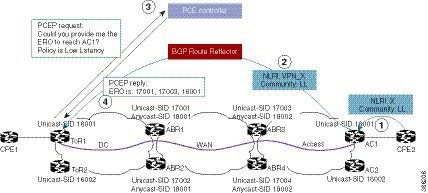
-
Customer premise equipment 2 (CPE) sends BGP update for Prefix-X and adds LL community, for example, 100:333.
-
AC1 announces a VPN route for prefix X with LL community.
-
After receiving BGP update of the VPN route matching community LL, ToR1 sends a request to PCE controller for LSP path towards AC1 with low latency TE policy.
-
Path calculation element (PCE) controller replies with a label stack, for example, 17003, 1600.
-
ToR1 creates SR-TE auto-tunnel and installs the route for Prefix-X in VRF of this VPN.
TE Label Switched Path Attribute-Set
TE-LSP attribute-set is used to configure the properties of a LSP. It describes TE profile or policy such as bandwidth, affinities inclusion and exclusion, links/nodes/SRLG inclusion and exclusion, metrics, path disjoint degree and group, and so on that are used to create an auto-tunnel.
How to Configure TE Label Switched Path Attribute-Set
Configuring TE Label Switched Path Attribute-Set
You can use the command mpls traffic-eng lsp attribute <name> to configure TE-LSP attribute. The following options are available:
Mpls traffic-eng lsp attribute name
   affinity      Specify attribute flags for links comprising LSP
   lockdown      Lockdown the LSP--disable reoptimization
   priority      Specify LSP priority
TE-LSP attribute command can be extended to support configuration for the two options pce and path-selection. It can be configured as following:
mpls traffic-eng lsp attribute name <test>
    path-selection
       metric <te/igp>
       invalidation <time-out> <drop/tear>
       segment-routing adjacency <protected/unprotected>
-
If pce option is set in the TE attribute the dynamic path is calculated by PCE. Otherwise, the path is calculated locally by TE PCALC (path-calculation) entity. In the later case, IGP has to be configured and the BGP next-hop has to be both advertised by IGP and reachable from the local node over an IGP route.
-
The option path-selection metric indicates whether the path calculation is based on TE metrics or IGP metrics. If this option is not configured the global value configured under mpls traffic-eng path-selection metric is used.
-
The option path-selection invalidation configures the behavior of how an LSP reacts to soft failure from network. When an LSP path has a protected path from IGP against a link or node failure, the failure to the link or node is considered as soft failure.
-
The option path-selection segment-routing adjacency indicates whether to choose an adjacency-SID with or without IGP protection when calculating LSP label stack.
-
The option pce disjoint-path indicates the tunnel LSP is a member of disjoint-path group. Any LSPs within the same disjoint-path group do not traverse the same resources, such as links, nodes, or SRLG, in its path. This is used to create two or more tunnel LSPs with disjoint paths.
For BGP-TE Dynamic, a TE attribute name is associated with a BGP route-map set extension as following:
route-map <name>
	   match community <name>
	        set attribute-set  <name>
BGP uses the attribute-set <name> string together with its BGP next-hop to request a SR-TE auto-tunnel.
Additional References for BGP Dynamic Segment Routing Traffic Engineering
Related Documents
|
Related Topic |
Document Title |
|---|---|
|
Cisco IOS Commands |
Feature Information for BGP Dynamic Segment Routing Traffic Engineering
The following table provides release information about the feature or features described in this module. This table lists only the software release that introduced support for a given feature in a given software release train. Unless noted otherwise, subsequent releases of that software release train also support that feature.
Use Cisco Feature Navigator to find information about platform support and Cisco software image support. To access Cisco Feature Navigator, go to www.cisco.com/go/cfn. An account on Cisco.com is not required.|
Feature Name |
Releases |
Feature Information |
|---|---|---|
|
BGP Dynamic Segment Routing Traffic Engineering |
Cisco IOS XE Everest 16.5.1b |
In BGP dynamic SR-TE, the label Switched Path (LSP) is enabled on demand when defined criteria and policies are met. The following commands were introduced or modified: mpls traffic-eng lsp attribute name |
 Feedback