Introduction
This document describes the improper subscriber detachment that occurs as a result of the defect outlined in Bug ID CSCwr06145.
Background Information
After a user (UE) completes an emergency call, the network incorrectly implicitly detaches the UE immediately when it returns to idle state.
The root cause is a software defect in Cisco’s MME logic, incorrectly triggering an implicit detach when the T3412 extended timeout is set to zero.
Prerequisites
Components Used
The information in this document is based on these software and hardware versions:
- Software Version:21.28.m28 (see BST for additional affected software versions).
- Hardware Platform: ASR-5500.
The information in this document was created from the devices in a specific lab environment. All devices used in this document started with a cleared (default) configuration. If your network is live, ensure that you understand the potential impact of any command.
Affected Devices/Versions:
- Cisco ASR5500 System Software Version 21.28.m28 and prior releases where the previously mentioned logic is implemented.
- All ASR5000/ASR5500 platforms, including legacy and virtual MME.
- All software images/configurations where `emm t3412-extended-timeout` can be set to zero.
Problem
The Cisco MME implementation references emergency session logic and uses `emm t3412-extended-timeout configuration to determine when to trigger implicit detach for UEs after emergency service.
According to affected configuration:
`emm t3412-extended-timeout` is set to 0.
Cisco MME code (incorrectly) triggers implicit detach "immediately" because its logic interprets the extended timer value of 0 as expiration, rather than ignoring it.
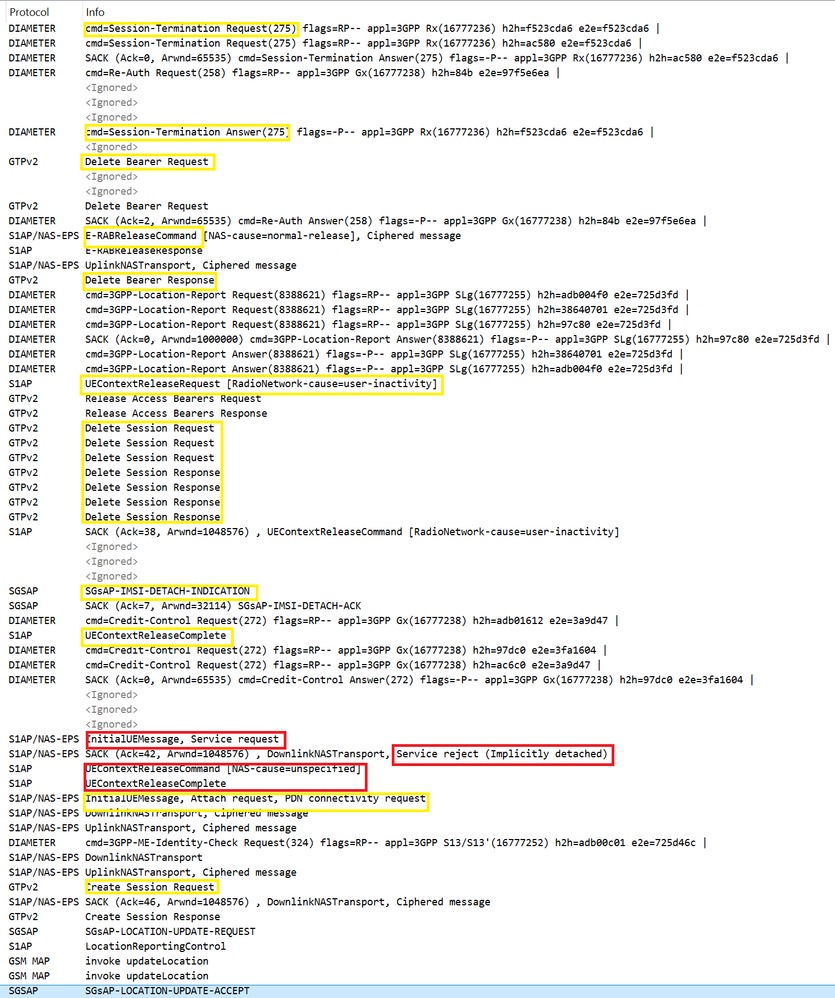
As a result, upon transition to idle after emergency bearer release, the MME deletes all PDN sessions, implicitly detaches the UE, and the subsequent service request from UE is rejected with “implicitly detached” cause.
Network logs confirm Delete Session Requests for all PDNs and SGs-IMSI-Detach (when SGs interface present).
This is not standard-compliant because, by spec, when T3412 extended is not advertised, normal periodic TAU timers must be used.
Technical Indicators:
- Immediate detach observed in S1AP, GTPv2 logs at idle transition.
- No extended timer advertised in NAS Accept messages.
- Attach Accept/TAU Accept from network to UE lacks T3412 extended timer IE.
- All nodes (legacy/virtual) exhibit same behavior.
Example Configuration where the emm t3412-extended-timeout` configuration is set to 0.
emm t3412-timeout 6480
emm t3412-extended-timeout 0
emm implicit-detach-timeout 3600
In the sample trace, after the emergency call is released and the device went to IDLE, the implicit detach incorrectly happened, followed by a Service Reject.
Solution
Old behavior: For emergency sessions with MS network feature support enabled, while moving to idle, T3412 extended timer (emmt3412-extended-timeout) was considered as mobile reachability timer.
This occurs because the MME logic incorrectly interprets the emmt3412-extended-timeout` value of "0" as expiration, rather than ignoring it.
New behavior: For emergency sessions with MS network feature support enabled, while moving to idle, if T3412 extended timer (emmt3412-timeout) is configured as 0, then T3412 timer will be considered as mobile reachability timer.
The Fix for this defect CSCwr06145 is available in Cisco ASR5000/ASR5500 System Software R21.28.m38 and later.
References:
- Bugs: CSCwr06145 : Emergency Call Incorrect Implicit Detach

 Feedback