Troubleshoot Multicast Packet Drop Through Bridge Group Members Without BVI nameif
Available Languages
Contents
Issue
Multicast packets through bridge group member interfaces are dropped on the firewall with these symptoms:
1. The multicast packets do not leave the intended egress interface:
firewall# show bridge-group
Static mac-address entries:  0 (in use), 16384 (max)
Dynamic mac-address entries: 2 (in use), 16384 (max)

 Bridge Group: 100
 Interfaces:
 GigabitEthernet0/2
 GigabitEthernet0/3

firewall# show nameif
Interface                Name                     Security
..
GigabitEthernet0/2       inside                   100
GigabitEthernet0/3       outside                  0

firewall# show capture
capture capi type raw-data trace interface inside[Capturing - 15642 bytes]
  match udp any host 239.1.1.1
capture capo type raw-data interface outside [Capturing - 0 bytes]
  match udp any host 239.1.1.1
2. The bytes in the output of the relevant show conn command output is 0:
firewall# show conn address 239.1.1.1
16 in use, 17 most used

UDP inside  192.0.2.1:50609 outside  239.1.1.1:5555, idle 0:01:03, bytes 0, flags –
3. The S,G mroute incoming interface is Null:
firewall# show mroute

Multicast Routing Table
Flags: D - Dense, S - Sparse, B - Bidir Group, s - SSM Group,
       C - Connected, L - Local, I - Received Source Specific Host Report,
       P - Pruned, R - RP-bit set, F - Register flag, T - SPT-bit set,
       J - Join SPT
Timers: Uptime/Expires
Interface state: Interface, State

(*, 239.1.1.1), 3d01h/never, RP 198.51.100.100, flags: SCJ
  Incoming interface: rp
  RPF nbr: 198.51.100.100
  Immediate Outgoing interface list:
    outside, Forward, 3d01h/never

(192.0.2.1, 239.1.1.1), 00:02:48/00:00:41, flags: SJ
  Incoming interface: Null
  RPF nbr: 0.0.0.0
  Inherited Outgoing interface list:
    outside, Forward, 3d01h/never
Environment
Topology
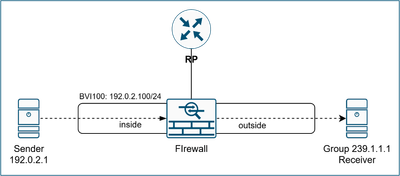
Firepower 4115 running Secure Firewall Threat Defense. Other hardware platforms and Security ASA can also be affected.
FTD version 7.6.4. Other software versions can also be affected.
Multicast routing with the Protocol Independent Multicast (PIM) Sparse Mode (SM) is enabled.
Multicast traffic path is through bridge group members.
The bridge virtual interface (BVI) does not have nameif:
firewall# show bridge-group
Static mac-address entries:  0 (in use), 16384 (max)
Dynamic mac-address entries: 2 (in use), 16384 (max)

 Bridge Group: 100
 Interfaces:
 GigabitEthernet0/2
 GigabitEthernet0/3

firewall# show nameif
Interface                Name                     Security
..
GigabitEthernet0/2       inside                     100
GigabitEthernet0/3       outside                   0

firewall# show run int bvi100
interface BVI100
no nameif
security-level 0
ip address 192.0.2.100 255.255.255.0
Resolution
Analysis
1. The multicast forwarding information base (MFIB) Other drops counter increase:
firewall# show mfib 239.1.1.1
Entry Flags: C - Directly Connected, S - Signal, IA - Inherit A flag,
             AR - Activity Required, K - Keepalive
Forwarding Counts: Pkt Count/Pkts per second/Avg Pkt Size/Kbits per second
Other counts: Total/RPF failed/Other drops
Interface Flags: A - Accept, F - Forward, NS - Negate Signalling
             IC - Internal Copy, NP - Not platform switched
             SP - Signal Present
Interface Counts: FS Pkt Count/PS Pkt Count

(*,239.1.1.1) Flags: C K
   Forwarding: 0/0/0/0, Other: 0/0/0
   rp Flags: A NS
   outside Flags: F NS
     Pkts: 0/0
(192.0.2.1,239.1.1.1) Flags: K
   Forwarding: 0/0/0/0, Other: 2620/0/2620
   OBNS-FWinside Flags: A
   outside Flags: F NS
     Pkts: 0/0

firewall# show mfib 239.1.1.1
…
(192.0.2.1,239.1.1.1) Flags: K
   Forwarding: 0/0/0/0, Other: 2629/0/2629
   rp Flags: A
   outside Flags: F NS
     Pkts: 0/0
2. The MFIB packet debugs indicate multicast packet drops:
firewall# debug mfib pak 239.1.1.1
MFIB IPv4 pak debugging enabled
  all MFIB debugging is for 239.1.1.1
MFIB: Pkt (192.0.2.1,239.1.1.1) from inside (PS) dropping
MFIB: Pkt (192.0.2.1,239.1.1.1) from inside (PS) dropping
3. The debug pim command output shows RPF lookup failed for root 192.0.2.1 messages:
firewall# debug pim

IPv4 PIM:    RPF lookup failed for root 192.0.2.1
IPv4 PIM:    RPF lookup failed for root 192.0.2.1
4. PIM is enabled on bridge group members:
firewall# show pim interface

Address          Interface          PIM  Nbr   Hello  DR         DR
                                         Count Intvl  Prior

239.1.1.1      inside             on   0     30     1          this system
239.1.1.1      outside            on   0     30     1          this system
Bridge group members must not participate in multicast routing protocols. This issue is tracked in Cisco bug ID CSCwv23349.
The workaround is to add the nameif to the BVI, then remove/re-add bridge member interface nameif. Removal of nameifs is impactful. User discretion is advised and this change is recommended only during controlled maintenance window.
Cause
Due to Cisco bug ID CSCwv23349 if the BVI does not have a nameif, the bridge group members participate in multicast routing protocols, that is PIM and the Internet Group Messaging Protocol (IGMP) are enabled on these interfaces. Activation of multicast routing protocol results in enforcement of all protocol level checks, one of which is the reverse path forwarding (RPF) check.
RPF check compares the multicast ingress interface (A) to the interface toward the multicast sender according to the unicast table (B). If the interfaces do not match, multicast packets are dropped due to RPF failure.
In this case, inside is the ingress interface. In the routing table there’s no unicast route toward the multicast sender with the IP address 192.0.2.1.
firewall# show route 192.0.2.1

% Network not in table

firewall# show asp table routing address 192.0.2.1
route table timestamp: 46
Considering that bridge group members do not participate in routing, the routing table does not have routes over bridge group members. This results in RPF-check failures if bridge group members participate in routing protocols. The versions with the fix of Cisco bug ID CSCwv23349 exempt these interfaces from multicast routing protocols.

Warning: This defect is specifically about the bridge group members participation in multicast routing protocols. It does not apply to the through-the-box multicast through the bridge group members, that is multicast connectivity between upstream/downstream devices.
Related Content
Cisco bug ID CSCwv23349
Revision History
| Revision | Publish Date | Comments |
|---|---|---|
1.0 |
06-Jul-2026
|
Initial Release |

 Feedback
Contact Cisco
- Open a Support Case

- (Requires a Cisco Service Contract)