Troubleshoot Access Point Certificate-Based Authentication Failure Through FTD
Available Languages
Contents
Issue
These symptoms are reported after the migration of Cisco Adaptive Security Appliance 5508 to Cisco Secure Firewall (CSF) Threat Defense (FTD) 1230 in the main branch (HQ):
1. The access points (AP) located in the branch offices fail to authenticate to the RADIUS server in HQ using certificate authentication.
2. Authentication with username and password is successful.
The symptoms are observed for access points in all branches.
Environment
FMC-managed CSF 1230 in high availability configuration running version 7.7.10.1 in HQ and multiple standalone Firepower 1010 running version 7.4.2.4 in branches, other software version can also be affected. The symptoms in this case are hardware agnostic.
Topology
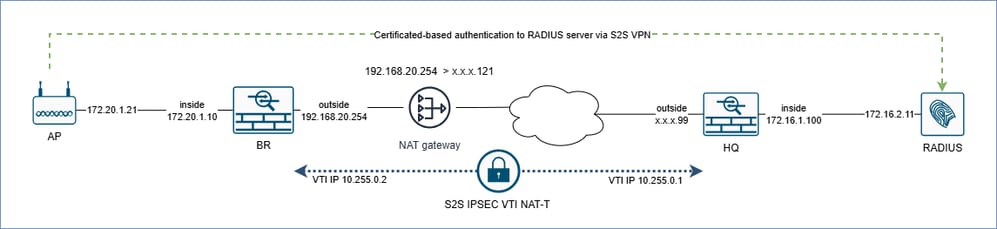 inline_image_0.png
Key points about the topology:
At network layer, the access point is in the subnet of the BR (branch) firewall inside interface.
The router as a NAT gateway translates the BR firewall outside interface IP address to a public address x.x.x.121. This means the BR firewall is at least 1 hop away from the HQ firewall.
HQ and BR firewalls are connected using Site-to-Site Virtual Private Networks (S2S VPN) using Internet Protocol Security (IPsec) with Encapsulating Security Payload (ESP) and the Virtual Tunnel Interface (VTI) over NAT.
At the network level, the RADIUS server is in the subnet of the HQ firewall inside interface.
Resolution
For technical analysis the packet captures were collected from the HQ and BR firewalls.
On HQ and BR firewall data plane ingress/egress captures on physical interfaces, capture on VTI interfaces, ASP drop captures for inner and outer traffic based on the peer IP address:
BR firewall:
cap br_inside interface inside packet-length 9000 buffer 33554400 match ip host 172.20.1.21 host 172.16.2.11
cap br_vti interface vti-hq packet-length 9000 buffer 33554400 match ip host 172.20.1.21 host 172.16.2.11
cap br_asp match ip host x.x.x.99 any
cap br_asp match ip host 172.20.1.21 host 172.16.2.11
cap br_outside interface outside packet-length 9000 buffer 33554400 match ip host x.x.x.99 any
Note that x.x.x.99 is substituted with an actual IP address.
HQ firewall:
cap hq_inside interface inside packet-length 9000 buffer 33554400 match ip host 172.20.1.21 host 172.16.2.11
cap hq_vti interface vti-br packet-length 9000 buffer 33554400 match ip host 172.20.1.21 host 172.16.2.11
cap hq_asp match ip host x.x.x.121 any
cap hq_asp match ip host 172.20.1.21 host 172.16.2.11
cap hq_outside interface outside packet-length 9000 buffer 33554400 match ip host x.x.x.121 any
Note that x.x.x.121 is substituted with an actual IP address.
Additionally, on HQ firewall collect bidirectional internal switch captures in chassis interfaces based on the outside nameif and all uplink interfaces:
cap hqfxos switch interface outside direction both packet-length 2048 match ip x.x.177.121
cap hqfxos switch interface in_data_uplink1 direction both packet-length 2048 match ip x.x.x.121
cap hqfxos switch interface in_data_uplink2 direction both packet-length 2048 match ip x.x.x.121
cap hqfxos switch interface in_data_uplink3 direction both packet-length 2048 match ip x.x.x.121
no cap hqfxos switch stop.
Technical Analysis
HQ Firewall
The Accelerated Security Path (ASP) drop captures in HQ firewall indicate that fragments are dropped with the reason fragment-reassembly-failed:
> show capture hq_asp
Target:     OTHER
Hardware:   CSF-1230
Cisco Adaptive Security Appliance Software Version 99.23(37)127
ASLR enabled, text region aaaae5d50000-aaaae902d504
172.20.1.21.38676 > 172.16.2.11.1812:  udp 1913 Drop-reason: (fragment-reassembly-failed) Fragment reassembly failed, Drop-location: frame snp_fh_destroy:1055
Drop-reason: (fragment-reassembly-failed) Fragment reassembly failed, Drop-location: frame snp_fh_destroy:1055 flow (NA)/NA
172.20.1.21.38676 > 172.16.2.11.1812:  udp 1913 Drop-reason: (fragment-reassembly-failed) Fragment reassembly failed, Drop-location: frame snp_fh_destroy:1055
Drop-reason: (fragment-reassembly-failed) Fragment reassembly failed, Drop-location: frame snp_fh_destroy:1055 flow (NA)/NA
172.20.1.21.56952 > 172.16.2.11.1812:  udp 1913 Drop-reason: (fragment-reassembly-failed) Fragment reassembly failed, Drop-location: frame snp_fh_destroy:1055
Drop-reason: (fragment-reassembly-failed) Fragment reassembly failed, Drop-location: frame snp_fh_destroy:1055 flow (NA)/NA
The Timeout counter for the VTI interface in the output of the show fragment command in HQ firewall increases:
> show fragment
Interface: vti-br
    Configuration: Size: 200, Chain: 24, Timeout: 5, Reassembly: virtual
    Run-time stats: Queue: 0, Full assembly: 0
    Drops: Size overflow: 0, Timeout: 1217,
           Chain overflow: 0, Fragment queue threshold exceeded: 0,
           Small fragments: 0, Invalid IP len: 0,
           Reassembly overlap: 0, Fraghead alloc failed: 0,
           SGT mismatch: 0, Block alloc failed: 0,
           Invalid IPV6 header: 0, Passenger flow assembly failed: 0
           Cluster reinsert collision: 0
According to the command reference (https://www.cisco.com/c/en/us/td/docs/security/asa/asa-cli-reference/S/asa-command-ref-S/show-f-to-show-ipu-commands.html#wp4144096608), the Timeout is "The maximum number of seconds to wait for an entire fragmented packet to arrive". The default value is 5 seconds. This means if the entire fragment chain does not arrive at the firewall within 5 seconds, the received fragments are dropped, and fragment reassembly fails.
Based on the previous point, the HQ firewall does not receive the complete chain of fragment that results in fragment reassembly failure.
BR Firewall
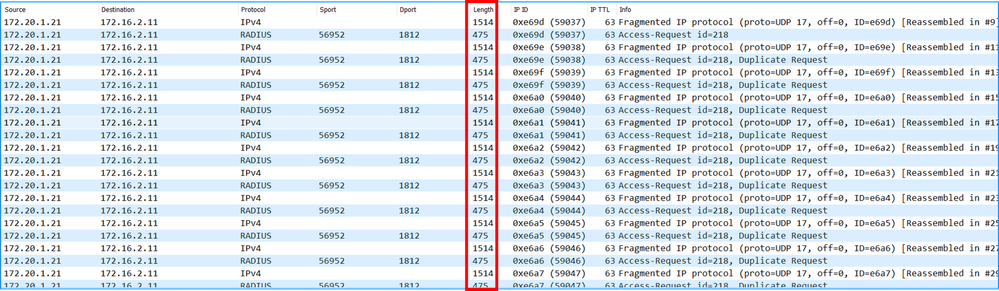
Based on the captures, the AP sends RADIUS certificate-based authentication request in 2 separate fragments to the BR firewall. The br_inside capture shows 2 ingress fragments of 1514 bytes and 475 bytes respectively. The same packets are seen in the BR VTI interface captures that show packet before encryption:
 inline_image_0.png
The BR outside interface Maximum Transmission Unit (MTU) is 1500 bytes. Due to this reason, the 1514-byte fragment must be fragmented into 2 packets before encryption.
ASP drop captures br_asp for inner RADIUS traffic on BR firewall do not show dropped packets. Meanwhile, for outer traffic, there are drops of 226-byte packets with the reason unexpected-packet:
firepower# show capture br_asp
Target:     OTHER
Hardware:   FPR-1010
Cisco Adaptive Security Appliance Software Version 9.20(2)121
ASLR enabled, text region 560817d6b000-56081d1ae26d
103 packets captured
   1: 10:13:22.160239       192.168.20.254.4500 > x.x.x.99.4500:  udp 184 Drop-reason: (unexpected-packet) Unexpected packet, Drop-location: frame 0x000056081b03fd35 flow (NA)/NA
   2: 10:13:23.160727       192.168.20.254.4500 > x.x.x.99.4500:  udp 184 Drop-reason: (unexpected-packet) Unexpected packet, Drop-location: frame 0x000056081b03fd35 flow (NA)/NA
   3: 10:13:24.161200       192.168.20.254.4500 > x.x.x.99.4500:  udp 184 Drop-reason: (unexpected-packet) Unexpected packet, Drop-location: frame 0x000056081b03fd35 flow (NA)/NA
 inline_image_1.png
Note that the output of the show capture br_asp command shows 184 bytes of payload length, while the total length of each packet is 226 bytes.
To verify if 226-byte dropped ESP packets are relevant to the affected traffic between AP and the RADIUS server, the br_inside capture was replayed in the internal lab using same security policy configurations from HQ and BR firewalls. The br_vti capture from the lab device shows 1514-byte and 475-byte fragments, that is before encryption:
 inline_image_2.png
The br_outside captures show the lack of 226-byte packets and the gap in ESP sequence numbers between the 562-byte and 1506-byte packets:
 inline_image_3.png
Key Points
226-byte is missing in the br_outside capture, because it is dropped in the BR firewall ASP with the unexpected-packet ASP drop reason.
The packet drop explains the gap in the ESP sequence numbers.
Additionally, the missing sequence number in the range means that the 226-byte ESP packet was generated by the BR firewall but not transmitted out the outside interface.
Since the 226-byte packet was not sent out the BR firewall outside interface, the HQ firewall never received it.
The lack of the 226-byte packet in the HQ firewall resulted in the fragment reassembly failure as show in the “HQ firewall section”.
Explanation
The findings from the technical analysis section match the symptoms of the Cisco bug ID CSCwp10123.
High lever overview of the firewall actions to generate ESP packets and transmitted them out the egress interface:
The firewall receives fragmented packets that are supposed to be sent via the VTI tunnel.
If the length of the inner packet is greater than the interface MTU size minus the IPSEC overhead, then the packet is fragmented.
Based on the routing table lookup the next hop is found. In the case of the VTI, the next hop is the peer VTI IP address.
Based on the tunnel destination address the egress interface and the next hop are identified (for example, outside interface).
The original packets are encapsulated inside ESP packets.
Adjacency lookup for the next hop from step 3 is performed and packets are sent out the egress interface.
Due to Cisco bug ID CSCwp10123, for subsequent ESP-encapsulated fragments (non-initial) packets at step 4 new route-lookup is performed. If the firewall has more specific routes to the peer IP address (or subnet), then the new route are used instead of the route for the initial packet. In this example, the HQ firewall interface IP address is x.x.x.99. The HQ firewall advertises its outside subnet to the BR firewall via the Border Gateway Protocol (BGP) running over the VTI:
> show route bgp
Codes: L - local, C - connected, S - static, R - RIP, M - mobile, B - BGP
       D - EIGRP, EX - EIGRP external, O - OSPF, IA - OSPF inter area
       N1 - OSPF NSSA external type 1, N2 - OSPF NSSA external type 2
       E1 - OSPF external type 1, E2 - OSPF external type 2, V - VPN
       i - IS-IS, su - IS-IS summary, L1 - IS-IS level-1, L2 - IS-IS level-2
       ia - IS-IS inter area, * - candidate default, U - per-user static route
       o - ODR, P - periodic downloaded static route, + - replicated route
       SI - Static InterVRF, BI - BGP InterVRFGateway of last resort is 192.168.20.1 to network 0.0.0.0
B        x.x.x.96 255.255.255.224 [20/0] via 10.255.0.1, 13:57:43 <--BR firewall learns /27 route via BGP over VTI
> show bgp summary
BGP router identifier 192.168.179.10, local AS number 65001
BGP table version is 25, main routing table version 25
23 network entries using 4600 bytes of memory
24 path entries using 1920 bytes of memory
2/2 BGP path/bestpath attribute entries using 416 bytes of memory
1 BGP AS-PATH entries using 24 bytes of memory
0 BGP route-map cache entries using 0 bytes of memory
0 BGP filter-list cache entries using 0 bytes of memory
BGP using 6960 total bytes of memory
BGP activity 23/0 prefixes, 24/0 paths, scan interval 60 secs
Neighbor        V           AS MsgRcvd MsgSent   TblVer  InQ OutQ Up/Down  State/PfxRcd
10.255.0.1      4        65000 762     761           25    0    0 13:59:01  18
> show ip
…
Tunnel1                  vti-hq                 10.255.0.2      255.255.255.252 CONFIG <-- 10.255.0.1 is the peer VTI IP
…
> show ip
…
Tunnel1                  vti-hq                 10.255.0.2      255.255.255.252 CONFIG <-- 10.255.0.1 is the peer VTI IP in the same subnet
…
The 1514-byte ESP packet is sent out the outside interface. But for the 226-byte the firewall at step 3 performs a route-lookup and finds specific route toward the peer IP address via the VTI. In other words, instead of sending the packets out the VPN-terminating interface, the firewall uses VTI interface and tries to resolve the adjacency on the VTI interface. Since the VTI interfaces do not have a concept of adjacency, the packets are eventually be dropped with the unexpected-packet drop reason.
As a workaround, on CSF1230 the user included the access-list (ACL) in the route-map. After policy deployment, the ACL denied HQ outside subnet, effectively removing the propagation of HQ outside subnet from BGP routing. Due to this change, the BR firewalls do not receive HQ outside subnet prefix over the tunnel interface.
Q: Why are 266-byte packets dropped after the migration from ASA to Secure Firewall?
A: The ASA firewall configuration explicitly blocked the propagation of the HQ outside interface subnet to the branches.
ASA5508
router bgp 65000
...
  redistribute connected route-map BGP_RM
route-map BGP_RM permit 10
 match ip address bgp-connected-routes
access-list bgp-connected-routes standard deny x.x.x.96 255.255.255.224 <-- deny = do not redistribute HQ outside subnet
CSF1230
router bgp 65000
...
  redistribute connected route-map BGP_RM
route-map BGP_RM permit 40 <-- No match, means redistribute all connected routes
Cause
The issue was triggered by a configuration difference in BGP route redistribution between the original ASA 5508 and the new FTD 1230. The ASA 5508 had an access control list that denied redistribution of the x.x.x.96/27 subnet, while the FTD 1230 was configured to redistribute all connected routes. This configuration difference triggered Cisco bug ID CSCwp10123.
Related Content
Cisco bug ID CSCwp10123
Revision History
| Revision | Publish Date | Comments |
|---|---|---|
2.0 |
23-Apr-2026
|
Initial Release, added alt text |
1.0 |
21-Apr-2026
|
Initial Release |

 Feedback
Contact Cisco
- Open a Support Case

- (Requires a Cisco Service Contract)