Configure and Operate FTD Prefilter Policies

Available Languages
Contents
Introduction
This document describes the configuration and operation of Firepower Threat Defense (FTD) Prefilter Policies.
Prerequisites
Requirements
There are no specific requirements for this document.
Components Used
The information in this document is based on these software and hardware versions:
- ASA5506X that runs FTD code 6.1.0-195
- Two 3925 Cisco IOS® routers that run 15.2 images
- FireSIGHT Management Center (FMC) that runs 6.1.0-195
The information in this document was created from the devices in a specific lab environment. All of the devices used in this document started with a cleared (default) configuration. If your network is live, ensure that you understand the potential impact of any command.
Background Information
A Prefilter Policy is a feature introduced in Version 6.1 and serves three main purposes:
- Match traffic based on both inner and outer headers.
- Provide early Access Control which allows a flow to bypass Snort engine completely.
- Work as a placeholder for Access Control Entries (ACEs) that are migrated from the Adaptive Security Appliance (ASA) migration tool.
Configure
Prefilter Policy Use Case 1
A Prefilter Policy can use a Tunnel Rule Type which allows FTD to filter based on both inside and/or outside IP header tunneled traffic. At the time this article was written, tunneled traffic refers to:
- IP-in-IP
- IPv6-in-IP
- Teredo Port 3544
- Generic Routing Encapsulation (GRE)
Consider a GRE tunnel as shown in the image:

When you ping from R1 to R2 with the use of a GRE tunnel, the traffic goes through the Firewall:

If the firewall is an ASA device, it checks the outer IP header:
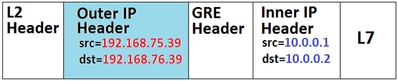
ASA# show conn
GRE OUTSIDE 192.168.76.39:0 INSIDE  192.168.75.39:0, idle 0:00:17, bytes 520, flags
If the firewall is a FirePOWER device, it checks the inner IP header:
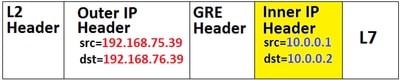
With prefilter policy, an FTD device can match traffic based on both inner and outer headers.
Main Point
| Device |
Checks |
| ASA |
Outer IP |
| Snort |
Inner IP |
| FTD |
Outer (Prefilter) + Inner IP (Access Control Policy (ACP)) |
Prefilter Policy Use Case 2
A Prefilter Policy can use a Prefilter Rule Type which can provide early Access Control and allow a flow to bypass Snort engine completely:
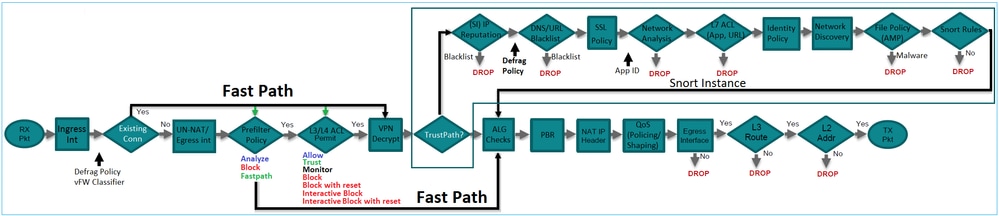
Task 1: Verify Default Prefilter Policy
Task Requirement
Verify the default Prefilter Policy.
Solution
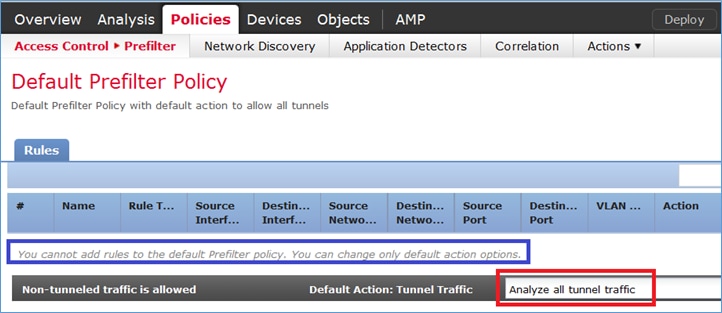
1. Navigate to Policies > Access Control > Prefilter. In this example, a default Prefilter Policy already exists:
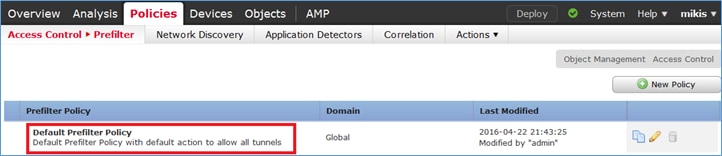
2. Select Edit to view the policy settings:
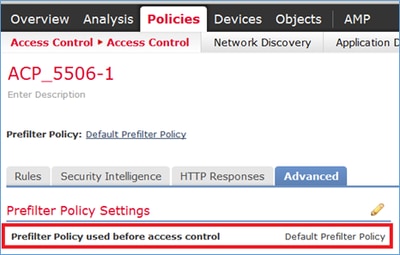
3. The Prefilter Policy is already attached to the Access Control Policy:
CLI (LINA) Verification
Prefilter rules are added on top of ACLs:
firepower# show access-list
access-list cached ACL log flows: total 0, denied 0 (deny-flow-max 4096)
            alert-interval 300
access-list CSM_FW_ACL_; 5 elements; name hash: 0x4a69e3f3
access-list CSM_FW_ACL_ line 1 remark rule-id 9998: PREFILTER POLICY: Default Tunnel and Priority Policy
access-list CSM_FW_ACL_ line 2 remark rule-id 9998: RULE: DEFAULT TUNNEL ACTION RULE
access-list CSM_FW_ACL_ line 3 advanced permit ipinip any any rule-id 9998 (hitcnt=0) 0xf5b597d6
access-list CSM_FW_ACL_ line 4 advanced permit 41 any any rule-id 9998 (hitcnt=0) 0x06095aba
access-list CSM_FW_ACL_ line 5 advanced permit gre any any rule-id 9998 (hitcnt=5) 0x52c7a066
access-list CSM_FW_ACL_ line 6 advanced permit udp any any eq 3544 rule-id 9998 (hitcnt=0) 0xcf6309bc
Task 2: Block Tunneled Traffic with Tag
Task Requirement
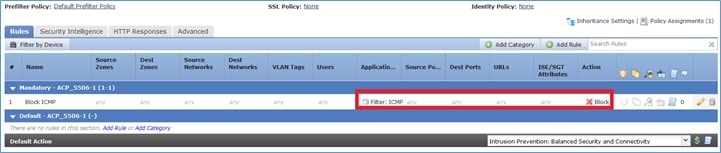
Block ICMP traffic that is tunneled inside GRE tunnel.
Solution
1. If you apply these ACPs, you can see the Internet Control Message Protocol (ICMP) traffic is blocked, even if it goes through the GRE tunnel or not:
R1# ping 192.168.76.39
Type escape sequence to abort.
Sending 5, 100-byte ICMP Echos to 192.168.76.39, timeout is 2 seconds:
.....
Success rate is 0 percent (0/5)
R1# ping 10.0.0.2
Type escape sequence to abort.
Sending 5, 100-byte ICMP Echos to 10.0.0.2, timeout is 2 seconds:
.....
Success rate is 0 percent (0/5)
In this example, you can use a Prefilter Policy to meet the task requirement. The logic is as follows:
- Tag all packets that are encapsulated inside GRE.
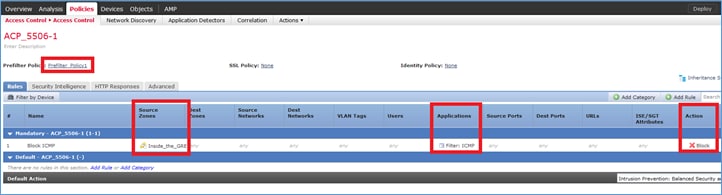
- Create an Access Control Policy that matches the tagged packets and blocks ICMP.
From architecture point of view, the packets are checked against the LInux Natively (LINA) pre-filter rules, then Snort pre-filter rules and ACP, and finally Snort instructs LINA to drop. The first packet makes it through the FTD device.
1. Define a Tag for tunneled traffic.
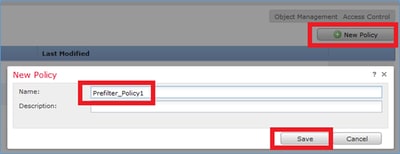
2. Navigate to Policies > Access Control > Prefilter and create a new Prefilter Policy. Remember the default Prefilter Policy cannot be edited:
Inside the Prefilter Policy, define two types of rules:
- Tunnel Rule
- Prefilter Rule
You can think of these two as totally different features that can be configured in a Prefilter Policy. For this task, it is necessary to define a Tunnel Rule:.
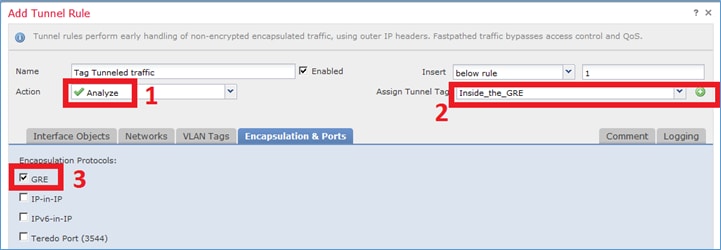
This table defines the Actions with a short description of each:
| Action |
Description |
| Analyze |
After LINA, the flow is checked by Snort Engine. Optionally, a Tunnel Tag can be assigned to the tunneled traffic. |
| Block |
The flow is blocked by LINA. The outer header is to be checked. |
| Fastpath |
The flow is handled only by LINA without the need to engage the Snort engine. |
2. Define the Access Control Policy for the tagged traffic
- Although it is not very intuitive at first, the Tunnel Tag can be used by an Access Control Policy Rule as a Source Zone. Navigate to Policies > Access Control and create a Rule that blocks ICMP for the tagged traffic:
Verification
Enable capture on LINA and on CLISH:
firepower# show capture
capture CAPI type raw-data trace interface inside [Capturing - 152 bytes]
capture CAPO type raw-data trace interface outside [Capturing - 152 bytes]
> capture-traffic
Please choose domain to capture traffic from:
  0 - br1
  1 - Router

Selection? 1

Please specify tcpdump options desired.
(or enter '?' for a list of supported options)
Options: -n
From R1, try to ping the remote GRE tunnel endpoint; the ping fails:
R1# ping 10.0.0.2
Type escape sequence to abort.
Sending 5, 100-byte ICMP Echos to 10.0.0.2, timeout is 2 seconds:
.....
Success rate is 0 percent (0/5)
The CLISH capture shows the first echo-request went through FTD and the reply was blocked:
Options: -n
18:21:07.759939 IP 192.168.75.39 > 192.168.76.39: GREv0, length 104: IP 10.0.0.1 > 10.0.0.2: ICMP echo request, id 65, seq 0, length 80
18:21:07.759939 IP 192.168.76.39 > 192.168.75.39: GREv0, length 104: IP 10.0.0.2 > 10.0.0.1: ICMP echo reply, id 65, seq 0, length 80
18:21:09.759939 IP 192.168.75.39 > 192.168.76.39: GREv0, length 104: IP 10.0.0.1 > 10.0.0.2: ICMP echo request, id 65, seq 1, length 80
18:21:11.759939 IP 192.168.75.39 > 192.168.76.39: GREv0, length 104: IP 10.0.0.1 > 10.0.0.2: ICMP echo request, id 65, seq 2, length 80
18:21:13.759939 IP 192.168.75.39 > 192.168.76.39: GREv0, length 104: IP 10.0.0.1 > 10.0.0.2: ICMP echo request, id 65, seq 3, length 80
18:21:15.759939 IP 192.168.75.39 > 192.168.76.39: GREv0, length 104: IP 10.0.0.1 > 10.0.0.2: ICMP echo request, id 65, seq 4, length 80
The LINA capture confirms this:
> show capture CAPI | include ip-proto-47
 102: 18:21:07.767523  192.168.75.39 > 192.168.76.39:  ip-proto-47, length 104
 107: 18:21:09.763739  192.168.75.39 > 192.168.76.39:  ip-proto-47, length 104
 111: 18:21:11.763769  192.168.75.39 > 192.168.76.39:  ip-proto-47, length 104
 115: 18:21:13.763784  192.168.75.39 > 192.168.76.39:  ip-proto-47, length 104
 120: 18:21:15.763830  192.168.75.39 > 192.168.76.39:  ip-proto-47, length 104
>
> show capture CAPO | include ip-proto-47
  93: 18:21:07.768133  192.168.75.39 > 192.168.76.39:  ip-proto-47, length 104
  94: 18:21:07.768438  192.168.76.39 > 192.168.75.39:  ip-proto-47, length 104
Enable CLISH firewall-engine-debug, clear LINA ASP drop counters and complete the same test. The CLISH debug shows that for the Echo-Request you matched the prefilter rule and for the Echo-Reply the ACP rule:
10.0.0.1-8 > 10.0.0.2-0 1 AS 1 I 0 New session
10.0.0.1-8 > 10.0.0.2-0 1 AS 1 I 0 uses prefilter rule 268434441 with tunnel zone 1
10.0.0.1-8 > 10.0.0.2-0 1 AS 1 I 0 Starting with minimum 0, id 0 and SrcZone first with zones 1 -> -1, geo 0 -> 0, vlan 0, sgt tag: 65535, svc 0, payload 0, client 0, misc 0, user 9999997, icmpType 8, icmpCode 0
10.0.0.1-8 > 10.0.0.2-0 1 AS 1 I 0 pending rule order 3, 'Block ICMP', AppId
10.0.0.1-8 > 10.0.0.2-0 1 AS 1 I 0 uses prefilter rule 268434441 with tunnel zone 1
10.0.0.1-8 > 10.0.0.2-0 1 AS 1 I 0 Starting with minimum 0, id 0 and SrcZone first with zones 1 -> -1, geo 0 -> 0, vlan 0, sgt tag: 65535, svc 3501, payload 0, client 2000003501, misc 0, user 9999997, icmpType 0, icmpCode 0
10.0.0.1-8 > 10.0.0.2-0 1 AS 1 I 0 match rule order 3, 'Block ICMP', action Block
10.0.0.1-8 > 10.0.0.2-0 1 AS 1 I 0 deny action
The ASP drop shows Snort dropped the packets:
> show asp drop

Frame drop:
  No route to host (no-route)                                     366
  Reverse-path verify failed (rpf-violated)                         2
  Flow is denied by configured rule (acl-drop)                      2
  Snort requested to drop the frame (snort-drop)                    5
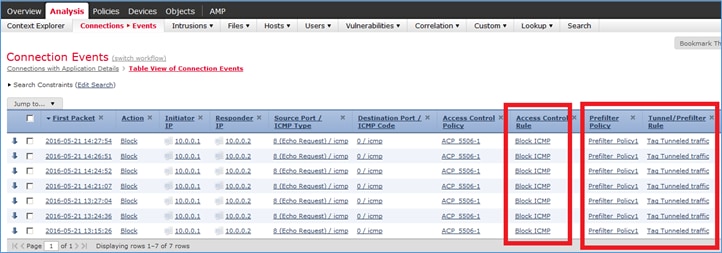
In the Connection Events, you can see the Prefilter Policy and Rule that you matched:
Task 3: Bypass Snort Engine with Fastpath Prefilter Rules
Network Diagram

Task Requirement
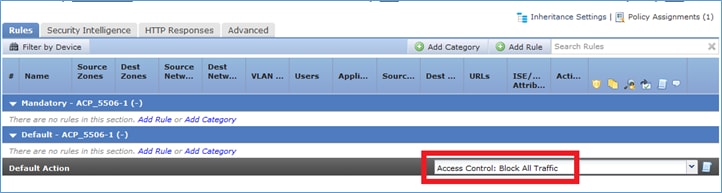
- Remove the current Access Control Policy rules and add an Access Control Policy rule that blocks all traffic.
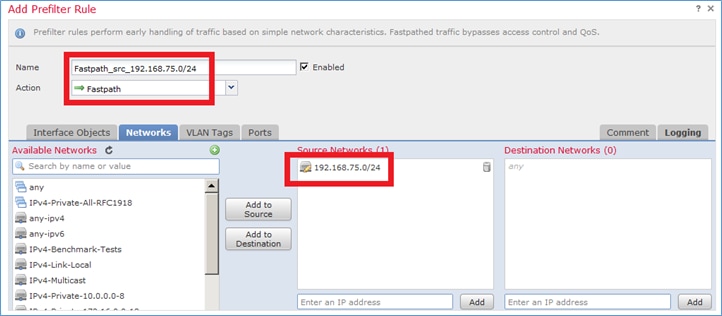
- Configure a Prefilter Policy rule that bypasses the Snort Engine for traffic sourced from the 192.168.75.0/24 network.
Solution
1. Access Control Policy that Blocks all traffic:
2. Add a Prefilter Rule with Fastpath as an action for source network 192.168.75.0/24:
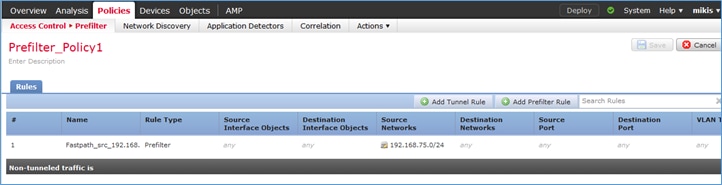
3. The result is displayed in the next image:
4. Save and Deploy.
Enable capture with trace on both FTD interfaces:
firepower# capture CAPI int inside trace match icmp any any
firepower# capture CAPO int outsid trace match icmp any any
Try to ping from R1 (192.168.75.39) to R2 (192.168.76.39) through the FTD; ping fails:
R1# ping 192.168.76.39
Type escape sequence to abort.
Sending 5, 100-byte ICMP Echos to 192.168.76.39, timeout is 2 seconds:
.....
Success rate is 0 percent (0/5)
The capture on the inside interface shows:
firepower# show capture CAPI

5 packets captured

   1: 23:35:07.281738   192.168.75.39 > 192.168.76.39: icmp: echo request
   2: 23:35:09.278641   192.168.75.39 > 192.168.76.39: icmp: echo request
   3: 23:35:11.279251   192.168.75.39 > 192.168.76.39: icmp: echo request
   4: 23:35:13.278778   192.168.75.39 > 192.168.76.39: icmp: echo request
   5: 23:35:15.279282   192.168.75.39 > 192.168.76.39: icmp: echo request
5 packets shown
Trace of first packet (echo-request) shows (important points highlighted):
firepower# show capture CAPI packet-number 1 trace
5 packets captured
1: 23:35:07.281738 192.168.75.39 > 192.168.76.39: icmp: echo request
Phase: 1
Type: CAPTURE
Subtype:
Result: ALLOW
Config:
Additional Information:
MAC Access list
Phase: 2
Type: ACCESS-LIST
Subtype:
Result: ALLOW
Config:
Implicit Rule
Additional Information:
MAC Access list
Phase: 3
Type: ROUTE-LOOKUP
Subtype: Resolve Egress Interface
Result: ALLOW
Config:
Additional Information:
found next-hop 192.168.76.39 uses egress ifc outside
Phase: 4
Type: ACCESS-LIST
Subtype: log
Result: ALLOW
Config:
access-group CSM_FW_ACL_ global
access-list CSM_FW_ACL_ advanced trust ip 192.168.75.0 255.255.255.0 any rule-id 268434448 event-log both
access-list CSM_FW_ACL_ remark rule-id 268434448: PREFILTER POLICY: Prefilter_Policy1
access-list CSM_FW_ACL_ remark rule-id 268434448: RULE: Fastpath_src_192.168.75.0/24
Additional Information:
Phase: 5
Type: CONN-SETTINGS
Subtype:
Result: ALLOW
Config:
class-map class-default
match any
policy-map global_policy
class class-default
set connection advanced-options UM_STATIC_TCP_MAP
service-policy global_policy global
Additional Information:
Phase: 6
Type: NAT
Subtype: per-session
Result: ALLOW
Config:
Additional Information:
Phase: 7
Type: IP-OPTIONS
Subtype:
Result: ALLOW
Config:
Additional Information:
Phase: 8
Type: INSPECT
Subtype: np-inspect
Result: ALLOW
Config:
class-map inspection_default
match default-inspection-traffic
policy-map global_policy
class inspection_default
inspect icmp
service-policy global_policy global
Additional Information:
Phase: 9
Type: INSPECT
Subtype: np-inspect
Result: ALLOW
Config:
Additional Information:
Phase: 10
Type: NAT
Subtype: per-session
Result: ALLOW
Config:
Additional Information:
Phase: 11
Type: IP-OPTIONS
Subtype:
Result: ALLOW
Config:
Additional Information:
Phase: 12
Type: FLOW-CREATION
Subtype:
Result: ALLOW
Config:
Additional Information:
New flow created with id 52, packet dispatched to next module
Phase: 13
Type: ACCESS-LIST
Subtype: log
Result: ALLOW
Config:
access-group CSM_FW_ACL_ global
access-list CSM_FW_ACL_ advanced trust ip 192.168.75.0 255.255.255.0 any rule-id 268434448 event-log both
access-list CSM_FW_ACL_ remark rule-id 268434448: PREFILTER POLICY: Prefilter_Policy1
access-list CSM_FW_ACL_ remark rule-id 268434448: RULE: Fastpath_src_192.168.75.0/24
Additional Information:
Phase: 14
Type: CONN-SETTINGS
Subtype:
Result: ALLOW
Config:
class-map class-default
match any
policy-map global_policy
class class-default
set connection advanced-options UM_STATIC_TCP_MAP
service-policy global_policy global
Additional Information:
Phase: 15
Type: NAT
Subtype: per-session
Result: ALLOW
Config:
Additional Information:
Phase: 16
Type: IP-OPTIONS
Subtype:
Result: ALLOW
Config:
Additional Information:
Phase: 17
Type: ROUTE-LOOKUP
Subtype: Resolve Egress Interface
Result: ALLOW
Config:
Additional Information:
found next-hop 192.168.76.39 uses egress ifc outside
Phase: 18
Type: ADJACENCY-LOOKUP
Subtype: next-hop and adjacency
Result: ALLOW
Config:
Additional Information:
adjacency Active
next-hop mac address 0004.deab.681b hits 140372416161507
Phase: 19
Type: CAPTURE
Subtype:
Result: ALLOW
Config:
Additional Information:
MAC Access list
Result:
input-interface: outside
input-status: up
input-line-status: up
output-interface: outside
output-status: up
output-line-status: up
Action: allow
1 packet shown
firepower#
Capture on the outside interface shows:
firepower# show capture CAPO

10 packets captured

   1: 23:35:07.282044   192.168.75.39 > 192.168.76.39: icmp: echo request
   2: 23:35:07.282227   192.168.76.39 > 192.168.75.39: icmp: echo reply
   3: 23:35:09.278717   192.168.75.39 > 192.168.76.39: icmp: echo request
   4: 23:35:09.278962   192.168.76.39 > 192.168.75.39: icmp: echo reply
   5: 23:35:11.279343   192.168.75.39 > 192.168.76.39: icmp: echo request
   6: 23:35:11.279541   192.168.76.39 > 192.168.75.39: icmp: echo reply
   7: 23:35:13.278870   192.168.75.39 > 192.168.76.39: icmp: echo request
   8: 23:35:13.279023   192.168.76.39 > 192.168.75.39: icmp: echo reply
   9: 23:35:15.279373   192.168.75.39 > 192.168.76.39: icmp: echo request
  10: 23:35:15.279541   192.168.76.39 > 192.168.75.39: icmp: echo reply
10 packets shown
Trace of the return packet shows it matches the current flow (52), but is blocked by the ACL:
firepower# show capture CAPO packet-number 2 trace

10 packets captured

   2: 23:35:07.282227       192.168.76.39 > 192.168.75.39: icmp: echo reply
Phase: 1
Type: CAPTURE
Subtype:
Result: ALLOW
Config:
Additional Information:
MAC Access list

Phase: 2
Type: ACCESS-LIST
Subtype:
Result: ALLOW
Config:
Implicit Rule
Additional Information:
MAC Access list

Phase: 3
Type: FLOW-LOOKUP
Subtype:
Result: ALLOW
Config:
Additional Information:
Found flow with id 52, uses current flow

Phase: 4
Type: ACCESS-LIST
Subtype: log
Result: DROP
Config:
access-group CSM_FW_ACL_ global
access-list CSM_FW_ACL_ advanced deny ip any any rule-id 268434432 event-log flow-start
access-list CSM_FW_ACL_ remark rule-id 268434432: ACCESS POLICY: ACP_5506-1 - Default/1
access-list CSM_FW_ACL_ remark rule-id 268434432: L4 RULE: DEFAULT ACTION RULE
Additional Information:

Result:
input-interface: outside
input-status: up
input-line-status: up
Action: drop
Drop-reason: (acl-drop) Flow is denied by configured rule
5. Add one more prefilter rule for the return traffic, the next image displays the result
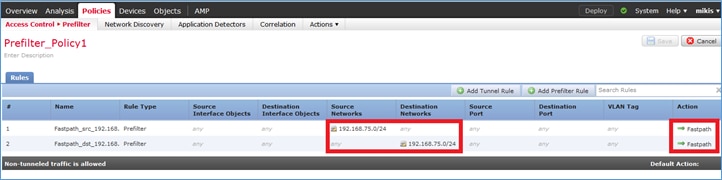
Now trace the return packet you see (important points highlighted):
firepower# show capture CAPO packet-number 2 trace
10 packets captured
2: 00:01:38.873123 192.168.76.39 > 192.168.75.39: icmp: echo reply
Phase: 1
Type: CAPTURE
Subtype:
Result: ALLOW
Config:
Additional Information:
MAC Access list
Phase: 2
Type: ACCESS-LIST
Subtype:
Result: ALLOW
Config:
Implicit Rule
Additional Information:
MAC Access list
Phase: 3
Type: FLOW-LOOKUP
Subtype:
Result: ALLOW
Config:
Additional Information:
Found flow with id 62, uses current flow
Phase: 4
Type: ACCESS-LIST
Subtype: log
Result: ALLOW
Config:
access-group CSM_FW_ACL_ global
access-list CSM_FW_ACL_ advanced trust ip any 192.168.75.0 255.255.255.0 rule-id 268434450 event-log both
access-list CSM_FW_ACL_ remark rule-id 268434450: PREFILTER POLICY: Prefilter_Policy1
access-list CSM_FW_ACL_ remark rule-id 268434450: RULE: Fastpath_dst_192.168.75.0/24
Additional Information:
Phase: 5
Type: CONN-SETTINGS
Subtype:
Result: ALLOW
Config:
class-map class-default
match any
policy-map global_policy
class class-default
set connection advanced-options UM_STATIC_TCP_MAP
service-policy global_policy global
Additional Information:
Phase: 6
Type: NAT
Subtype: per-session
Result: ALLOW
Config:
Additional Information:
Phase: 7
Type: IP-OPTIONS
Subtype:
Result: ALLOW
Config:
Additional Information:
Phase: 8
Type: ROUTE-LOOKUP
Subtype: Resolve Egress Interface
Result: ALLOW
Config:
Additional Information:
found next-hop 192.168.75.39 uses egress ifc inside
Phase: 9
Type: ADJACENCY-LOOKUP
Subtype: next-hop and adjacency
Result: ALLOW
Config:
Additional Information:
adjacency Active
next-hop mac address c84c.758d.4981 hits 140376711128802
Phase: 10
Type: CAPTURE
Subtype:
Result: ALLOW
Config:
Additional Information:
MAC Access list
Result:
input-interface: inside
input-status: up
input-line-status: up
output-interface: inside
output-status: up
output-line-status: up
Action: allow
Verify
Use this section to confirm your configuration works properly. The verification has been explained in the respective tasks sections.
Troubleshoot
There is currently no specific information available to troubleshoot this configuration.
Related Information
- All versions of the Cisco Firepower Management Center configuration guide can be found in the Navigating the Cisco Secure Firewall Threat Defense Documentation
- Cisco Global Technical Assistance Center (TAC) strongly recommends this visual guide for in-depth practical knowledge on Cisco Firepower Next Generation Security Technologies, that includes the ones mentioned in this article under Cisco Firepower Threat Defense (FTD)
- For all Configuration and Troubleshooting TechNotes, refer to Cisco Secure Firewall Management Center
Revision History
| Revision | Publish Date | Comments |
|---|---|---|
6.0 |
18-Aug-2026
|
Updated spelling, grammar, inserted horizontal lines to separate sections for readability. |
5.0 |
25-Jul-2024
|
Formatting issues and checked spelling. |
4.0 |
12-May-2023
|
Removed PII.
Added Alt Text.
Updated Title, Introduction, SEO, Machine Translation, Gerunds and Formatting. |
1.0 |
29-Jan-2018
|
Initial Release |
 Feedback